





By Geoffrey S. Turner
- The new side-by-side arrangement for Pillar Two – a global minimum tax regime for large multinationals – leaves Canadian multinationals at a potential competitive disadvantage relative to their US counterparts. US multinationals are largely exempt from key elements of Pillar Two and remain subject to US international tax rules that can offer advantages, including a lower effective rate on certain foreign income and global averaging. Canadian multinationals, meanwhile, must navigate both Pillar Two and Canada’s already complex foreign affiliate rules.
- Canada could seek its own side-by-side exemption, but doing so would require replacing its largely territorial approach with a worldwide system that taxes foreign business income as it is earned. Instead, this Commentary argues that Canada should build on the competitiveness advantages of its existing foreign affiliate regime by simplifying rules that already operate largely as a de facto exemption system but retain costly and unnecessary surplus-tracking requirements for various types of income.
- Canada should adopt a full exemption system for foreign affiliate income, as recommended by the Advisory Panel on Canada’s System of International Taxation in 2008. Doing so would eliminate costly surplus tracking and reduce compliance burdens, while the revenue impact is likely to be modest. Recent Pillar Two and interest-deductibility rules also reduce concerns about erosion of the Canadian tax base, strengthening the case for reform as part of a broader effort to improve Canada’s tax competitiveness.
The author extends gratitude to Cheryl Bailey, Nicholas Dahir, Brian Ernewein, Alexandre Laurin, John Lester, Michael Lubetsky, Peter MacKenzie, Nick Pantaleo, Shawn Porter, Harpreet Roopra, Jeffrey Trossman, and several anonymous referees for valuablecomments and suggestions. The author retains responsibility for any errors and the views expressed.
Introduction: The Degraded International Tax Policy Landscape for Canadian Outbound Investment
From the current foreign affiliate system’s inception in the 1970s, Canada’s international tax policy for outbound investment of Canadian corporations has by design promoted the competitiveness of Canadian businesses operating abroad, with robust safeguards to protect the Canadian tax base.
The foreign affiliate rules in Canada’s Income Tax Act (ITA) accomplish this through complex exemption and credit mechanisms that apply to income earned indirectly by a Canadian parent corporation through a foreign subsidiary. For active business income sourced in a country with which Canada has a tax treaty, an exemption system cedes taxing jurisdiction to the foreign source country in a territorial approach similar to nearly all other countries except the United States.
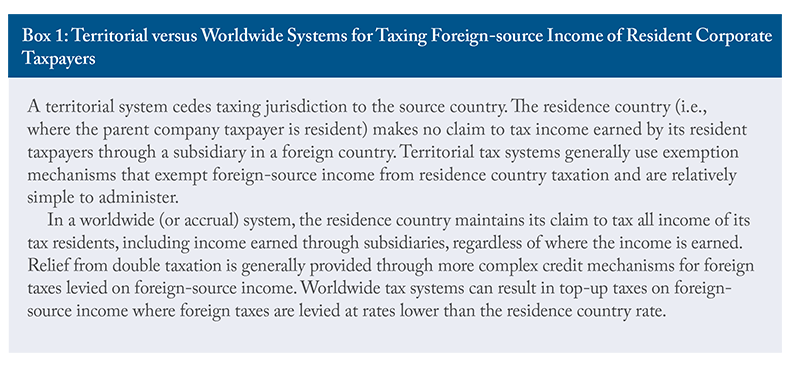
This qualified exemption system avoids potential double taxation of foreign-source business income and enables Canadian taxpayers to compete globally on a level playing field. Although Canadian corporations face heavy compliance burdens tracking their foreign sources of income in multiple surplus accounts, in most cases the exemption system applies and they pay only source country tax, with no additional Canadian tax, including when the Canadian parent receives the after-tax profits as dividends.
Now layered on top of this foreign affiliate system is a new and separate global minimum tax regime (Pillar Two), part of a two-pronged multilateral agreement announced on October 8, 2021, by the Organisation for Economic Co-operation and Development (OECD) inclusive framework, then including over 135 countries (OECD 2021). Canada has now implemented Pillar Two through the Global Minimum Tax Act (GMTA), which applies from 2024 to multinational enterprises (MNEs) with annual revenues exceeding 750 million euros.
Under these exceedingly complex GMTA rules, in-scope Canadian MNEs (i.e., those with a Canadian parent company) are subject to an income inclusion rule (IIR) that imposes top-up tax on the Canadian parent to the extent its foreign subsidiaries have not paid foreign corporate taxes at a minimum 15 percent effective tax rate (ETR). Thus, unlike under Canada’s pre-existing international tax policy, foreign-source business income earned in foreign affiliates of Canadian MNEs is now potentially subject to immediate taxation in Canada, a departure from the longstanding territorial system in the ITA designed to promote the competitiveness of Canadian taxpayers operating abroad.
As contemplated in the 2021 Pillar Two agreement, all countries were expected to adopt these harmonized global minimum tax rules and apply them in an equivalent way to their MNEs. Had that played out, Canadian multinationals would be in no worse competitive position from being subject to the Canadian version of the IIR than multinationals based in other countries and subject to comparable IIRs.
However, on its first day in office, the new US administration declared the Pillar Two global minimum tax deal to have no force or effect in the United States (The White House 2025a). This foreshadowed geopolitical turmoil triggered by new US economic measures, including “Liberation Day” tariffs and threats of retaliatory “revenge” withholding taxes on non-residents. At their June 2025 meetings in Kananaskis, AB, the G7 countries capitulated to the US administration’s demands and agreed to exempt US MNEs from the Pillar Two global minimum tax regime (Canada 2025). This G7 deal was reluctantly accepted by the full OECD inclusive framework as a means of ensuring the ongoing viability of the Pillar Two global minimum tax project without US participation.
The inclusive framework released the technical details for the US exclusion from Pillar Two on January 5, 2026 (OECD 2026a). US MNEs will now be subject to pre-existing (and arguably more favourable) US international tax rules, while MNEs elsewhere remain subject to the OECD global minimum tax rules, with the two systems operating “side-by-side” (SbS).
This paper grapples with these confounding international tax policy developments in two main parts. The first part explores the context and significance of the SbS compromise, why it raises competitiveness concerns for Canadian MNEs, and possible Canadian policy responses.
This leads to a broader critique of Canada’s international tax policy for outbound investment addressed in the second part of the paper. It explains the foreign affiliate rules and why they now operate as a de facto exemption system, but with unnecessary surplus tracking requirements on various types of income that have become far more onerous than originally conceived in the 1970s.
Canada should respond to the competitive threat posed by the SbS compromise by simplifying the foreign affiliate rules through a full exemption system, as recommended by the Advisory Panel on Canada’s System of International Taxation (2008). This would reduce needless reporting and compliance burdens for Canadian MNEs and help offset the impacts of the new Pillar Two global minimum tax regime, with minimal revenue loss.
Part 1: Side-by-Side Global Minimum Tax – Pillar Two in Canada but Not the US
To explain why the US objected to the Pillar Two global minimum tax rules and why the SbS compromise potentially disadvantages Canadian MNEs, it is useful first to examine the basic mechanics of the Pillar Two model rules as adopted in Canada’s GMTA (OECD 2023).
Overview of the Pillar Two Regime
The overriding objective of the global minimum tax regime is to ensure that multinationals pay tax at a minimum 15 percent effective tax rate (ETR) on income arising in each jurisdiction where they operate. Determining an MNE’s jurisdictional ETRs requires calculating its consolidated annual income in each jurisdiction and the aggregate income taxes payable on that income in each jurisdiction. The MNE’s ETR for each jurisdiction is then calculated by dividing jurisdictional taxes by jurisdictional income.
If the ETR for any jurisdiction as so determined is less than 15 percent, the difference is the MNE’s top-up percentage for the jurisdiction, potentially resulting in top-up tax in respect of the jurisdiction. However, two safe harbour features could reduce or eliminate a Pillar Two top-up tax in respect of a source country, even where the jurisdictional ETR is below 15 percent.
First, a substance-based income exclusion (SBIE) may apply, computed as 5 percent of the MNE’s payroll costs in the jurisdiction, plus 5 percent of the MNE’s tangible assets in the jurisdiction. This SBIE amount is excluded from the MNE’s jurisdictional income in the source country that is potentially subject to top-up tax. The SBIE safe harbour effectively permits limited source country tax competition by allowing low or nil taxes on profits (up to a 5 percent return) generated from labour and capital situated in the jurisdiction as a proxy for real, substance-based activity.
Second, the Pillar Two rules grant the source country a first right to impose top-up taxes on the MNE’s excess profits (income exceeding the SBIE) in the jurisdiction if the jurisdiction levies a qualified domestic minimum top-up tax (QDMTT) that complies with the OECD model rules. To so qualify, a QDMTT must follow the same Pillar Two methodology and apply top-up tax to the excess profits in the jurisdiction of all in-scope MNEs at no less than the top-up percentage to bring each MNE’s jurisdictional ETR on such excess profits up to at least the minimum 15 percent rate. This gives low-tax countries an incentive to adopt QDMTTs and capture the top-up tax revenue that otherwise may be taxed elsewhere under the Pillar Two rules.
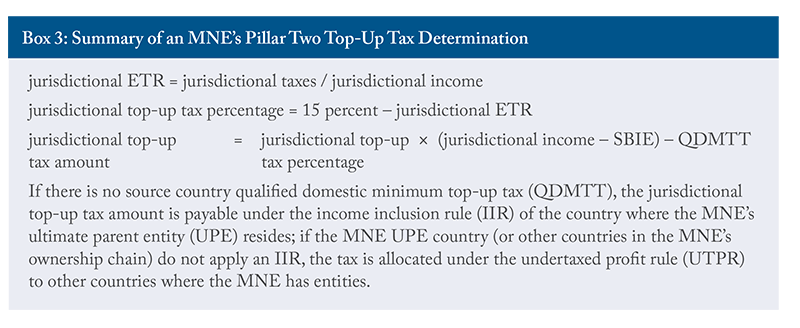
This, of course, is one of the fundamental objectives of the Pillar Two project: curtailing so-called harmful tax competition and limiting the “race to the bottom” by inducing low-tax countries to raise their ETRs on in-scope MNEs to the 15 percent minimum rate. An OECD-sponsored peer review process determines if the domestic minimum tax regime of a country sufficiently conforms to the OECD model rules to qualify as a QDMTT, and if so, the country is listed on the OECD central record.11 The central record is regularly updated at: OECD. 2026. “Central Record for Purposes of the Global Minimum Tax.” https://www.oecd.org/en/topics/sub-issues/global-minimum-tax/central-record-of-legislation-with-transitional-qualified-status.html. At the time of writing, 50 countries were listed as having QDMTT regimes. Canada is on the list, reflecting implementation of the Canadian QDMTT under Part 3 of the GMTA. The central record is currently based on a transitional self-certification by implementing countries and is intended to be followed up with full peer reviews of the relevant legislation commencing before the end of 2026 (Tax Notes 2026c; OECD 2026b).
Thus, even if an MNE’s ETR in a jurisdiction is less than 15 percent, resulting in a jurisdictional top-up percentage, a jurisdictional top-up tax amount will arise only to the extent the jurisdictional top-up percentage multiplied by the jurisdictional excess profits (the MNE’s income in the jurisdiction exceeding the SBIE) is positive and the amount is not already taxed within the source jurisdiction pursuant to its QDMTT.
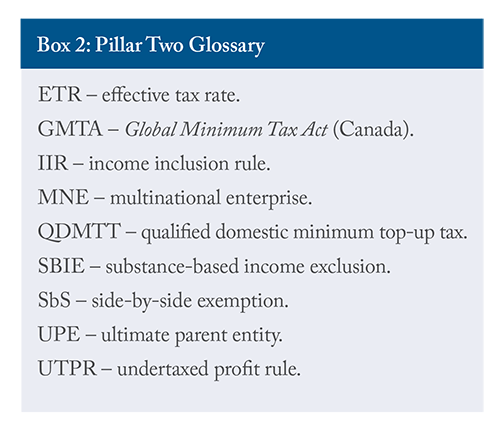
If an MNE has a jurisdictional top-up tax amount in respect of a jurisdiction (i.e., the source country does not itself collect the top-up tax under a QDMTT), the Pillar Two rules require the jurisdiction of the ultimate parent entity (UPE) to levy the top-up tax under the IIR in proportion to the UPE’s ownership interests in the entities in the low-tax jurisdiction. If the UPE jurisdiction has not adopted Pillar Two and does not apply the IIR, the taxing right may then be exercised under the IIRs applicable to any relevant intermediate holding entities in the ownership chain.
If none of the jurisdictions in the ownership chain levies an IIR top-up tax, the undertaxed profit rule (UTPR) provides a backstop.22 When the OECD inclusive framework released the Pillar Two agreement in October 2021, it included an undertaxed payment rule described as operating through denials of deductions or equivalent adjustments, which was understood to be targeted at intragroup payments made to low-tax entities. However, when the Pillar Two model rules were released in December 2021, the UTPR was recast (without explanation) as the undertaxed profit rule with a broader scope, functioning as a backstop to encourage low-tax countries to implement QDMTTs. This substantive variation heightened concerns about the legitimacy of the Pillar Two project, the delegation of sovereignty to unelected OECD tax experts, and excessive complexity. This new version of the UTPR also severs the nexus between the income source and the taxing jurisdiction, and raises potential conflicts with longstanding income tax treaty principles constraining residence countries from taxing business income generated in a source country unless the taxpayer has a permanent establishment in the source country. It allocates the top-up taxing right to any other relevant jurisdictions (1) that have adopted a Pillar Two UTPR and (2) in which the MNE group has entities, including entities with no direct or indirect ownership interest in any entity located in the jurisdiction where the profits arose. In such a case, the top-up tax is allocated among those UTPR jurisdictions in proportion to the MNE’s employees and tangible assets situated in each UTPR jurisdiction.33 Canada’s GMTA was enacted without a UTPR, but draft legislation released August 12, 2024, proposed the addition of a UTPR rule. At the time of writing, the UTPR is included in Bill C-31, which received first reading on May 6, 2026, and would add the UTPR to the GMTA as new Part 2.1, applicable to taxation years that begin on or after December 31, 2025. The UTPR is a novel and controversial feature of the Pillar Two rules, primarily because it allocates taxing rights over low-taxed income in a source country (in the absence of a source country QDMTT and a parent country IIR) to other countries with no nexus to the source country income.
Why Did the US Object to Pillar Two?
The US initially supported the OECD’s two-pillar base erosion and profit shifting (BEPS) project, and indeed the previous US administration’s participation in the OECD inclusive framework was key to the compromise reached in October 2021. Essentially, the US preferred a coordinated global approach to international tax reform, both to prevent the proliferation of unilateral digital services taxes (DSTs) as addressed in Pillar One, and to reduce incentives for large MNEs to shift profits to low-tax jurisdictions and thereby curtail harmful tax competition, as addressed in Pillar Two.
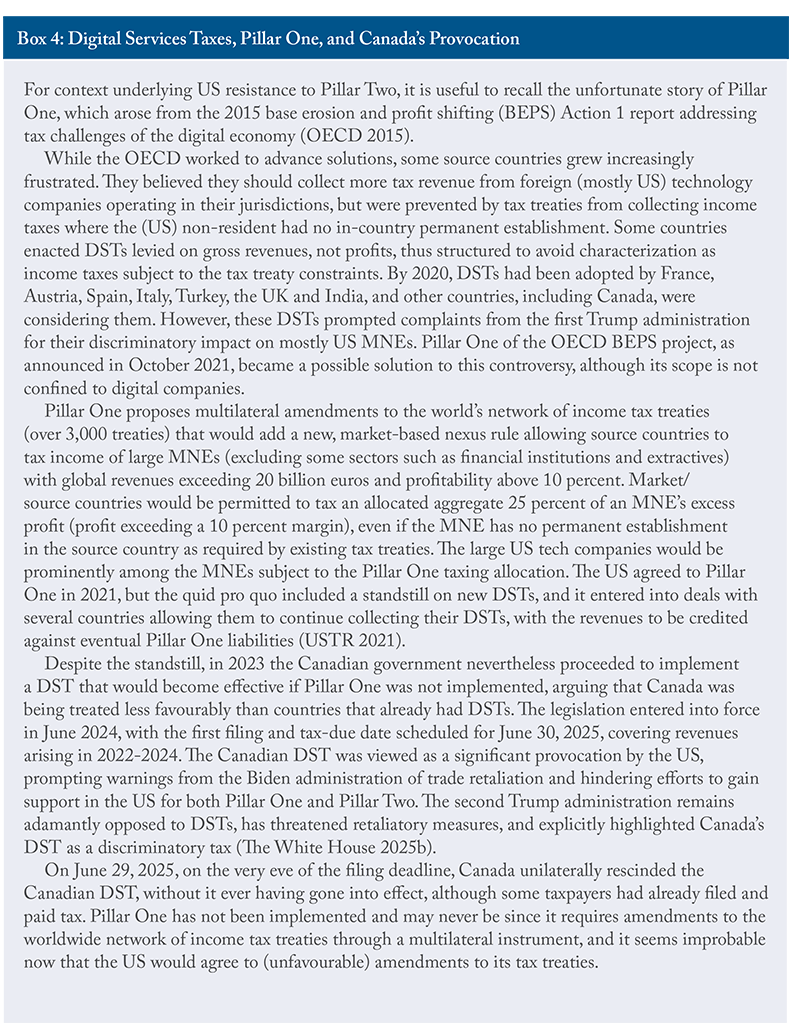
The US already had international tax rules that were in some respects similar to the Pillar Two mechanisms. These include its longstanding controlled foreign corporation (CFC) rules under subpart F (applicable generally to passive income) and the global intangible low-taxed income (GILTI) rules introduced in 2017, as further amended and renamed net CFC tested income (NCTI) in 2025. These NCTI rules apply a form of worldwide tax system that operates similarly to the Pillar Two IIR (and is said to have inspired it), but (1) not using the country-by-country approach of the IIR, (2) at a lower effective rate of 12.6 percent as of 2026, and (3) generally using US tax principles rather than financial accounting principles to calculate relevant amounts.44 The US federal corporate tax rate is 21 percent, but for NCTI purposes, only 60 percent of the foreign-source income earned in a subsidiary of a US MNE is subject to tax at that rate because of the section 250 deduction (Bloomberg Tax 2025). In addition, the US introduced its 15 percent corporate alternative minimum tax (CAMT) in 2022, which, with some significant differences, applies similarly to the Pillar Two QDMTT, but only to corporations with financial statement income exceeding US$1 billion. Making these US domestic tax systems fully compliant with the OECD’s Pillar Two model rules would have required legislative amendments, but over time it became increasingly apparent that the necessary Congressional support for US adoption of Pillar Two (or Pillar One) was unlikely to materialize.
The probable non-adoption by the US of an OECD-compliant income inclusion rule (IIR) added fuel to the fire of US opponents of Pillar Two, who argued that Pillar Two gives insufficient recognition to the equivalency of the US system. In this view, the UTPR is an extraterritorial tax that, in the absence of a US IIR, would inappropriately apply to US MNEs, even though they are subject to the similar GILTI (and now NCTI) regime, which is arguably functionally equivalent to an IIR (albeit at a 12.6 percent rate lower than 15 percent, and not using the country-by-country approach required for a qualified IIR).
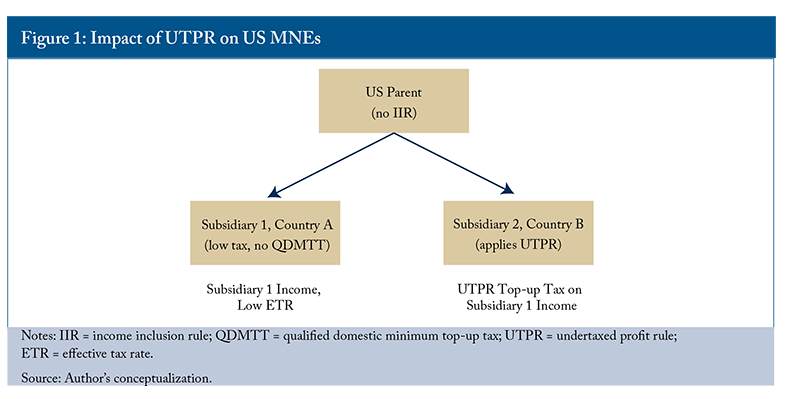
Figure 1 shows that the low-taxed income of US Parent’s Subsidiary 1 would give rise to Pillar Two top-up tax that, in the absence of a Country A QDMTT and a US IIR, would be paid by Subsidiary 2 under Country B’s UTPR. Country B would impose UTPR tax on income to which it has no nexus, in addition to any US tax imposed on the US Parent under US domestic rules, including NCTI, thus eroding the US Parent group’s competitiveness compared to MNEs from countries that have adopted Pillar Two.
Side-by-Side Exemption for the US
The current US administration objected to this extraterritoriality of the UTPR and refused to give effect to Pillar Two (The White House 2025a). This led to the June 2025 G7 agreement to develop a system that would exempt US MNEs from Pillar Two and to the resulting January 2026 SbS package, which established the new SbS safe harbour that effectively disapplies both the IIR and undertaxed profit rule (UTPR) to US multinationals (OECD 2026a).
Curiously, the SbS package does not explicitly mention the US as the sole relevant country exempted from the effect of the IIR and UTPR. The package instead purports to frame the exemption in principled terms by defining a Qualified SbS Regime as one that has both an eligible domestic tax system and an eligible worldwide tax system enacted before January 1, 2026 (although it also contemplates that a country may adopt such a tax system in 2027 or 2028), and that provides foreign tax credits for the qualified domestic minimum top-up taxes of other countries.55 The SbS package maintains the pretense that before the end of 2028, any other country may request an assessment of its tax system for eligibility as a Qualified SbS Regime. However, it also discourages other countries from doing so by saying that the adoption of a coordinated global minimum tax based on a common QDMTT approach is critically important and should be the primary system.
For this purpose, an eligible domestic tax system is one with:
- at least a 20 percent statutory corporate tax rate;
- a QDMTT or corporate alternative minimum tax at a minimum 15 percent rate (presumably satisfied by the US corporate alternative minimum tax [CAMT]); and
- no material risk that MNE groups headquartered in the jurisdiction will have an ETR less than 15 percent.
- An eligible worldwide tax system is one that:
- comprehensively taxes all resident corporations on foreign income including active and passive income of controlled foreign companies regardless of whether the income is distributed (presumably satisfied by the US NCTI and subpart F rules);
- incorporates mechanisms to address profit shifting risks; and
- has no material risk that MNE groups headquartered in the jurisdiction will have an ETR on foreign profits less than 15 percent.
These definitions, of course, have been drafted to include the US; the territorial tax systems of virtually every other country, including Canada, would not qualify.66 Brazil has a worldwide tax system and is listed in the OECD central record as having adopted a QDMTT, so it is possible Brazil could become a Qualified SbS Regime (Tax Notes 2026e). As such, the US is the sole country listed in the OECD central record as having a Qualified SbS Regime exempting its MNEs from the IIR and UTPR.77 The US is listed as a Qualified SbS Regime for fiscal years commencing on or after January 1, 2026. https://www.oecd.org/en/topics/sub-issues/global-minimum-tax/central-record-of-legislation-with-transitional-qualified-status.html#qualified-sbs-regimes. This means that US MNEs were subject to the regular Pillar Two rules for 2024 and 2025, which is why US MNEs with calendar fiscal years faced the same June 30, 2026, first filing deadline as MNEs headquartered everywhere in the world, and why the IIRs of jurisdictions where intermediate holding entities of a US MNE are located could have applied in 2024 and 2025.
Thus, by virtue of the SbS package, US MNEs (i.e., any multinational group with a US parent) may elect into the SbS safe harbour. The effect is to deem the top-up tax to be nil for purposes of the IIR and UTPR for all entities in the electing US MNE group, wherever situated. However, the SbS safe harbour does not affect the QDMTT. Thus, where a US MNE has subsidiaries in countries that have adopted QDMTTs, those countries must still apply their QDMTTs and are permitted to do so under the SbS package.
The deal reached at the June 2025 G7 meetings in Canada was presumably put to the larger OECD inclusive framework countries as the only realistic way to salvage Pillar Two. The comparable US systems under NCTI and CAMT must have been considered “close enough” in effect to their Pillar Two equivalents to justify acquiescence to US demands.
The SbS exemption is not necessarily permanent. It provides for a review (or “stock take”) to be concluded by 2029. However, OECD officials have stated the review is not intended to terminate the SbS package or remove its benefits for the US (Tax Notes 2026d). Moreover, it is difficult to expect that any future US administration would be easily persuaded to give up the SbS exemption or be willing to pursue US legislative amendments to the NCTI and CAMT to make them compliant with the OECD’s model rules, in either case exposing US MNEs to arguably worse outcomes under the Pillar Two global minimum tax regime.
Nevertheless, the review description does signal the continued importance to the inclusive framework of widespread QDMTT adoption. The OECD intends to keep a watchful eye on jurisdictions that might be tempted to backtrack from QDMTTs so as to attract foreign investment from US MNEs not subject to Pillar Two (Tax Notes 2026a).
Adverse Competitive Impacts on Canadian MNEs
US Treasury officials assert the SbS safe harbour does not privilege the US, properly recognizes the US international tax system, and creates a level playing field (Tax Notes 2026e). The OECD’s international tax coordination unit head acknowledges the subtleties:
US rules are not necessarily that advantageous when you compare the overall picture. That said, there will inevitably be companies that could benefit from a more favorable system if they were established in the United States rather than being subject to the global minimum tax (Tax Notes 2026b).
There are two sources of apparent competitive advantage for US MNEs under the SbS exemption. The first relates to the high complexity and compliance burden of the Pillar Two regime. In-scope MNEs from all other countries adopting Pillar Two are now subject to the full brunt of the global minimum tax rules.88 The first Pillar Two filing season recently concluded. The global minimum tax rules came into effect for 2024, with the first returns due 18 months after the filing MNEs’ year-end; so calendar-year taxpayers were required to file by June 30, 2026. Reports confirm it was a mammoth effort, but extensive taxpayer and advisor preparation made it “not as catastrophic as everyone thought it would be” and “a huge burden for very few euros” collected (Tax Notes 2026f). These are independent of and layered on top of the respective domestic international tax systems. For Canadian MNEs, this means complying with both the existing foreign affiliate rules in the ITA and regulations (whose excessive complexity is discussed in the second part of this paper), and the new web of rules under the GMTA, together with thousands of pages of OECD commentary and guidance.99 The concern is not merely the resources devoted by MNEs to filing required returns and reporting. In the planning stage for any transaction, MNEs need to assess the tax consequences of all possible proposed steps in all relevant jurisdictions. Adding Pillar Two rules into the mix makes this task doubly difficult, time consuming, and costly. Where the uncertainty and analysis costs become elevated, and possibly disproportionate to the expected benefits, commercial initiatives can be inhibited altogether.
US MNEs, on the other hand, from 2026 are largely spared the supplemental compliance burden arising from the global minimum tax rules. It is true that their non-US subsidiaries must still comply with QDMTTs and the US parent must still navigate the domestic US rules, including subpart F, NCTI, and the CAMT. The US international tax system is notoriously complex, and the resulting compliance burden on US MNEs should not be downplayed or diminished.1010 In the author’s 35 years of tax practice, working extensively on cross-border matters and collaborating with tax advisors from other countries, it was widely understood that the US international tax system is highly complex and challenging to navigate, arguably more so than any other country. However, some relative cost savings for US MNEs are sure to result, compared to MNEs from other countries.
The second source of US MNE advantage stems from the relative leniency of the US net CFC tested income (NCTI) rules compared to the more stringent Pillar Two IIR, and the opportunities potentially available to US MNEs to exploit that by engaging in tax planning not available to MNEs headquartered elsewhere.
One difference is the previously noted effective US tax rate under NCTI of only 12.6 percent, compared to the 15 percent top-up tax applicable to non-US MNEs under the IIR.
Another key difference is the use of global averaging under US rules, rather than the country-by-country calculations mandated by Pillar Two. In particular, foreign tax credits under NCTI operate on a global averaging basis, with all foreign taxes in the relevant jurisdictions aggregated and credited (although only as to 90 percent, due to a 10 percent haircut) against the US tax on NCTI at the effective 12.6 percent rate (Bloomberg Tax 2025). In contrast, Pillar Two takes a strict country-by-country approach that does not permit high foreign taxes in one jurisdiction to be blended with and offset low taxes in a jurisdiction with an ETR below 15 percent.
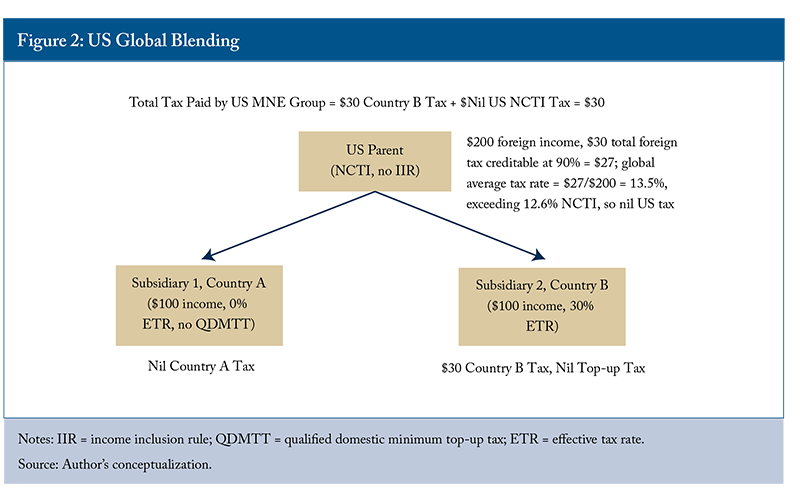
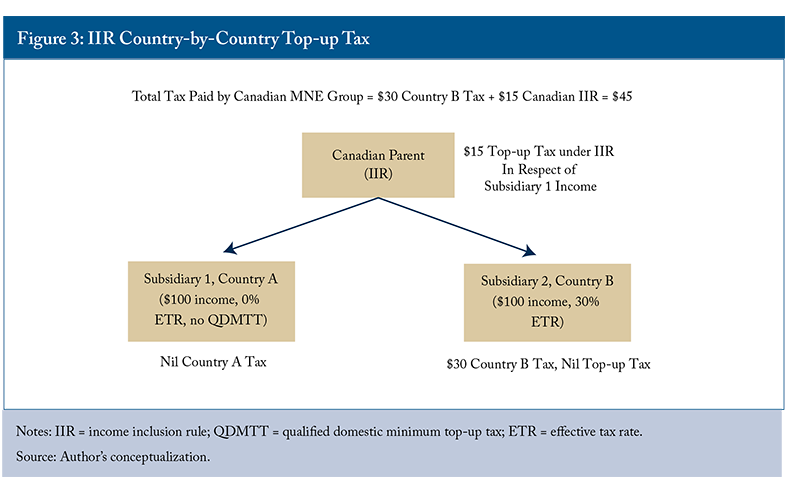
Figures 2 and 3 illustrate the structural disadvantage for Canadian MNEs arising from the country-by-country approach of the Pillar Two IIR.1111 These figures are based on slides presented at the C.D. Howe Institute’s Fiscal and Tax Competitiveness Council on May 6, 2026, featuring a panel discussion by Patrick Marley, Geoffrey Turner, and Brian Ernewein. Each MNE group has subsidiaries in low-tax Country A and high-tax Country B that earn $100 of income. The US MNE group in Figure 2 bears only $30 of total tax because the nil tax paid to Country A is averaged with the $30 of tax paid to Country B so that no additional US tax is applied under the NCTI rules.
In contrast, the Canadian MNE group in Figure 3 bears $45 in total tax. Although the foreign affiliate rules (using territorial principles) do not result in Canadian top-up tax on the $200 foreign-source income, the Canadian Pillar Two IIR (using worldwide principles) results in a $15 top-up tax because of the nil tax paid to Country A. Even though tax is paid to Country B at greater than the minimum 15 percent ETR, this additional tax does not offset or reduce the Country A top-up tax computed on the jurisdiction-by-jurisdiction basis under Pillar Two.
Note that this tax burden disparity in Figures 2 and 3 arises in part because of the assumption that low-tax Country A has not adopted a qualified domestic minimum top-up tax. If Country A had a QDMTT, both groups would bear the same total $45 tax. This highlights the potential strategic opportunity for low-tax countries to continue competing for investment from US MNEs by maintaining low tax rates or other incentives and not adopting a QDMTT.
This is precisely the concern expressed in the SbS package, and one of the main reasons for the review before 2029 to discourage backsliding on QDMTT adoption. As stated by a former US international tax affairs official,
QDMTTs are going to be the linchpin of whether there is a level playing field. Three of the top jurisdictions where US multinationals have their profits booked are Ireland, Switzerland, and Singapore, and all of them have QDMTTs, at least at this stage. (Tax Notes 2026a.)
Will these jurisdictions, or any others with significant US investment, relinquish or not adopt QDMTTs? If so, this risks undermining the Pillar Two project’s objective of establishing a common floor on harmful tax competition. To the extent this occurs, Canadian MNEs may potentially suffer higher tax burdens on foreign-source business income than their US MNE competitors.
Furthermore, the competitive disadvantage of having an ultimate parent resident in Canada, as opposed to the US, may create a structural incentive for Canadian MNEs to be acquired by US-based buyers. This risks exacerbating the extent to which Canada is a nation of foreign-controlled subsidiaries, to the potential detriment of the Canadian economy, tax base, and global influence.
Policy Options for Canada
It remains to be seen how severely the new SbS exemption will impact Canadian MNEs, and whether it will prompt migration of economic activity from Canada to the US or acquisitions of Canadian MNEs by US buyers. As noted, this depends on the extent to which low-tax countries adopt and retain QDMTTs, or instead choose to facilitate inbound profit shifting from US MNEs.1212 At the time of writing, the 50 countries listed on the OECD central record as having qualified domestic minimum top-up taxes include some tax competitive countries such as Bahamas, Bahrain, Barbados, Guernsey, Hong Kong, Ireland, Isle of Man, Luxembourg, Netherlands, Singapore, Switzerland, Qatar, and the United Arab Emirates, for example. The list does not yet include some of the traditional tax havens such as Anguilla, Bermuda, British Virgin Islands, Cayman Islands, Curacao, Cyprus, Jersey, Malta, and Turks and Caicos, for example. What tax strategies will these countries adopt, in light of the SbS exemption for US MNEs? For current updates, see https://www.oecd.org/en/topics/sub-issues/global-minimum-tax/central-record-of-legislation-with-transitional-qualified-status.html#qdmtt-rules-safe-harbours. It also depends on the extent of any net compliance savings from avoiding Pillar Two rules as a US MNE (but being subject to the complex US international tax rules and foreign QDMTTs), and on the magnitude of possible top-up tax savings from the lower 12.6 percent rate applicable to foreign income under NCTI, compared to the 15 percent rate under the IIR, which is relevant only in respect of income earned by the MNE in low-tax, non-QDMTT countries.1313 For perspective, the Department of Finance estimates in the May 2026 Spring Economic Update that aggregate Pillar Two tax revenues will be approximately $2.7 billion in 2026/27 (reflecting revenue from the January 2024 implementation date), and then approximately $2 billion annually thereafter. See Table A1.8 in: Department of Finance Canada. 2026. “Annex 1: Details of Economic and Fiscal Projections.” Spring Economic Update 2026. April 28. https://budget.canada.ca/update-miseajour/2026/report-rapport/anx1-en.html#wb-cont. However, this aggregate estimate does not break down anticipated collections from Canada’s QDMTT, IIR, and UTPR (when enacted).
In any event, the SbS exemption clearly worsens the competitive position of Canadian MNEs relative to US MNEs and gives at least some added incentive for Canadian MNE groups to escape the burdens of the Pillar Two rules by migrating to the US or being acquired by a US parent, for example. It is yet another competitive disadvantage faced by businesses in Canada relative to the US, added to higher tax rates, regulatory burden, productivity challenges, and the recent disruption of tariff-free access to the US market. What can Canada do about this?
a) Abandon Pillar Two
Canada could repeal the GMTA and unilaterally exit from Pillar Two. This would be heavily criticized as inconsistent with Canada’s enthusiastic participation in the OECD BEPS project and as an unprincipled repudiation of Canada’s international commitment to Pillar Two. It might be countered that Canada and other countries agreed in 2021 to a fully harmonized global minimum tax with a common 15 percent ETR floor, and under the SbS exemption, Pillar Two is no longer the harmonized global minimum tax system originally agreed to. Yet Canada was one of the G7 countries that agreed to the SbS exemption in June 2025 and worked with the remaining countries of the OECD inclusive framework to develop the final SbS package.
Even if Canada left Pillar Two, the competitive position of Canadian MNEs would not necessarily be materially improved since the UTPRs of other remaining countries would still apply as the backstop to collect top-up taxes from entities in Canadian MNE groups. Canada’s exit might encourage other countries to abandon Pillar Two for similar reasons, leading to collapse of the entire project and a return of uncontrolled tax competition.
Regardless, this alternative is unrealistic because Canada has already agreed to the SbS exemption and withdrawing now would be incompatible with and would undermine the re-invigorated middle-power multilateralism being pursued by the Canadian government on defence, trade, and other domains.
b) Persuade the US to Adopt Pillar Two
It seems unlikely Canada (either alone, or through the G7, G20, OECD, or the inclusive framework for that matter) could convince the US to recommit to the original version of Pillar Two harmonization. The OECD inclusive framework has left open this possibility by programming a review to take stock of the SbS system by 2029. But US adoption of Pillar Two would require the US to relinquish the perceived benefits of the SbS exemption and expose US MNEs to the full burdens of the Pillar Two system. It seems improbable that a future US administration could muster the Congressional support needed for legislative changes to adopt Pillar Two.
c) Persuade Inclusive Framework to Change Pillar Two
Another possibility is for Canada to push for changes to the Pillar Two rules to conform them more closely to the US system by abandoning the country-by-country approach and instead adopting global averaging for the computation of ETRs. However, this would undermine the foundational concept of Pillar Two that there should be a common floor to tax competition applicable everywhere. This option to change the Pillar Two regime was of course available to the inclusive framework, but it chose to preserve the Pillar Two rules for everyone other than the US under the SbS compromise. It seems unlikely now that the inclusive framework would be inclined to backtrack from the SbS solution.
d) Apply for Canadian Side-by-Side Exemption
Some commentators have boldly proposed that Canada could seek its own SbS exemption to level the playing field with the US (Marley and Chayka 2026; Marley and Gray 2026; Porter 2026). Although it is tacitly discouraged, the SbS package does contemplate that any country may apply in 2027 or 2028 for assessment as a Qualified SbS Regime, so it remains theoretically possible for Canada to amend the foreign affiliate rules on a very short timetable to meet the conditions for a Canadian SbS exemption.
But what would this entail? Canada would need to establish an eligible worldwide tax system that comprehensively taxes both active and passive income of foreign subsidiaries, whether or not distributed. This means abandoning the territorial system embodied in the ITA’s foreign affiliate rules. A comprehensive worldwide tax system as required for SbS treatment would presumably require extending current taxation not only to in-scope MNEs as under Pillar Two, but even to smaller Canadian parent groups that do not meet the Pillar Two revenue threshold. This would likely be far more complex than the current foreign affiliate system and would make Canada an outlier as one of the handful of countries (including the US) employing a worldwide tax system.
e) Streamline Foreign Affiliate Rules
As explained in the next part of this paper, Canada’s foreign affiliate regime operates as a de facto exemption system with imperfectly realized competitiveness benefits. The pragmatic approach for Canada is to accept the unfortunate reality of the US SbS exemption and not seek to replicate it (Arnold 2026b; Porter 2026). Instead, Canada should respond to the SbS exemption’s exacerbation of the tax competitiveness deficit by urgently improving Canadian tax competitiveness, including by making reforms to the foreign affiliate rules.
An obvious competitiveness-enhancing tax policy reform within Canada’s control is to reduce the general corporate tax rate, as argued in a C.D. Howe Institute “big bang” tax reform report and elsewhere (Laurin, Dahir and Mintz 2026; CPA Ontario 2025). But those studies did not include within their scope Canada’s international tax policy and the foreign affiliate rules applicable to outbound investment of Canadian MNEs. The next part of this paper fills this gap by arguing that Canada should double down on the existing territorial tax system and simplify the foreign affiliate rules to reap maximum competitiveness benefits from a full exemption system for foreign-source active business income.
Part 2: Full Exemption System for Canada
Tax Policy Underpinnings of Foreign Affiliate and FAPI Rules
When fully implemented in 1976, Canada’s system for taxing Canadian-resident corporations on foreign-source income earned indirectly through foreign subsidiaries adopted multiple approaches to balance competing tax policy objectives.1414 All Canadian resident taxpayers (individuals, corporations, trusts) are taxed on a worldwide basis on their directly earned income from sources anywhere in the world (ITA s. 2(1)) and may be eligible for foreign tax credits to the extent the taxpayer pays income tax to the source country (ITA s. 126). This discussion focuses on the rules for outbound foreign direct investment (FDI) made by Canadian-resident corporations and consequently considers indirect sources of income earned by Canadian corporations through foreign subsidiaries (ITA ss. 91, 95). Separate rules apply to indirect sources of income earned through foreign trusts (ITA s. 94) or investment funds (ITA s. 94.1). With some modifications (most notably the 2009 extension of exemption treatment to income sourced in certain tax haven countries and the 2011 hybrid surplus and upstream loan rules), these three conceptual approaches from the 1970s remain operative today.
- Worldwide (or accrual with credit) method: This applies to passive income (FAPI) earned in a controlled foreign affiliate (CFA) of the taxpayer. The taxpayer’s proportionate share of the FAPI is included in the taxpayer’s income in the year it is earned (i.e., on an accrual basis), with offsetting deductions for foreign taxes paid in respect of the FAPI that operate analogous to a foreign tax credit. Accrual taxation of FAPI is limited to CFAs to ensure the Canadian taxpayer has the ability (through its control) to collect the relevant information from the foreign subsidiary.1515 While FAPI attribution is confined to controlled foreign affiliates (CFAs), the broad definition of a CFA can cause FAPI attribution to apply to a taxpayer having a relatively small, non-controlling interest in a foreign affiliate if it is among up to five Canadian residents that collectively control the foreign affiliate. This is relevant to the subsequent discussion about lowering the FAPI attribution threshold to non-controlling interests since the current system can already have that effect in some circumstances. This worldwide method for FAPI is intended to protect the Canadian tax base by neutralizing any tax incentive to shift relatively mobile sources of passive investment income outside Canada to controlled subsidiaries in lower-tax jurisdictions. The FAPI rules are thus said to promote capital export neutrality.
- Deferral with credit method: This variant of worldwide taxation applies primarily to active business income (ABI) or taxable capital gains earned in a foreign affiliate of the taxpayer from sources in a country with which Canada does not have an income tax treaty or a tax information exchange agreement (TIEA). It also applies to FAPI earned in a foreign affiliate that is not a CFA (such that the FAPI is not immediately taxed under the accrual system) and, with the 2011 introduction of hybrid surplus, to capital gains from dispositions of excluded property FA shares. These income sources of a foreign affiliate are not attributed to the Canadian corporation and immediately taxed (hence the deferral), but Canada nevertheless retains a claim to tax this income when it is ultimately distributed to the Canadian parent corporation as a dividend (out of hybrid surplus or taxable surplus), subject to a crediting mechanism for applicable foreign taxes.
- Territorial (or exemption) method: This applies primarily to active business income earned in a foreign affiliate of the taxpayer resident in a country with which Canada has an income tax treaty or a TIEA (a designated treaty country, or DTC). It also applies to capital gains from dispositions of excluded property (other than shares of other foreign affiliates that are excluded property, the gains from which are taxed using the deferral with credit method under the hybrid surplus rules). Canada cedes taxing jurisdiction for these types of income to the source country and makes no claim to tax such income in Canada, either as earned in the foreign affiliate or when ultimately distributed to the Canadian parent corporation as a dividend (out of exempt surplus). The exemption from Canadian tax avoids double taxation of the foreign-source income in both the source country and Canada. Since exempt surplus dividends paid to the Canadian parent are not taxed, there is no Canadian tax disincentive for the taxpayer to repatriate the profits back to Canada. Thus, the territorial or exemption system is said to promote capital import neutrality.
The key goals of Canada’s foreign affiliate system include promoting the competitiveness of Canadian corporations operating abroad through foreign affiliates and preventing erosion of the Canadian tax base from shifting passive income outside Canada. David Dodge, then deputy minister of finance, emphasized this in 1992:
Canada’s approach to taxing foreign source income...falls squarely within the international norms. What it seeks to do is to ensure that Canadian-based multinationals remain viable and competitive with those based in other countries...At the same time, the specific anti-avoidance rules…seek to ensure the system is not open to abuse. (Advisory Panel 2008.)
The FAPI rules employing the worldwide (or accrual) method for taxing passive income are very complex, but generally coherent, robust, consistent with practices in most other countries, and supported by the Advisory Panel (2008). Similarly, the exemption system applied to ABI of subsidiaries resident in a DTC is also complex, but conceptually coherent and consistent with practices of most other countries. Canada justifiably surrenders any claim to tax such income and yields to the universally accepted claim of source countries to tax it.
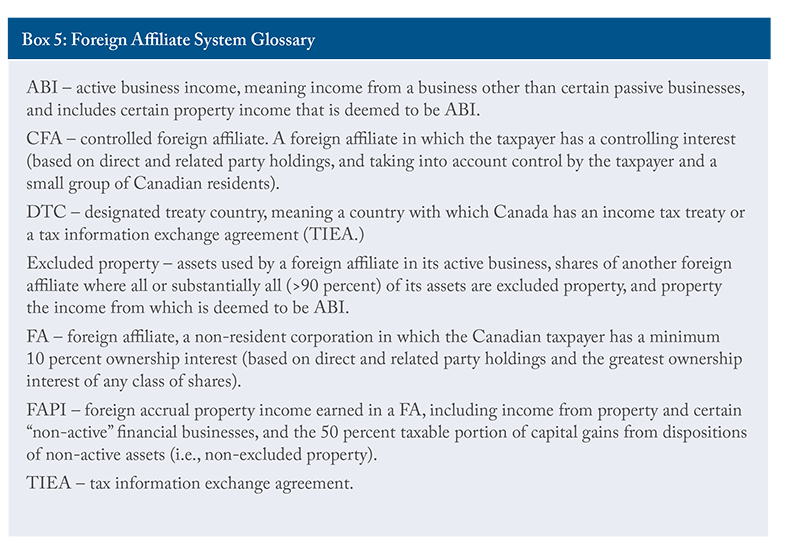
The problems with Canada’s current system arise from the continued application of the deferral with credit method, and Canada’s residual claim to apply worldwide taxation (albeit on a deferred basis) to sources of income in non-DTCs and capital gains from excluded property FA share dispositions. Retaining these taxing rights renders it necessary to enforce a complex FA surplus tracking system so that any Canadian top-up tax can be determined when an FA distributes profits to the Canadian parent corporation. The FA’s surplus account from which the distribution is paid determines whether the distribution is subject to the deferral with credit system or is exempt.
This mandatory surplus tracking makes Canada’s foreign affiliate system unduly complex and costly to navigate, yet as the Advisory Panel noted, it generates little tax revenue because taxpayers generally defer repatriating profits if such repatriation would result in additional Canadian tax. Consequently, the Advisory Panel recommended that Canada abandon the deferral with credit method and instead broaden the territorial method in a full exemption system (2008).
Since this critique of Canada’s foreign affiliate regime is based primarily on its excessive and unnecessary compliance burden, it is useful to survey the mechanics of the foreign affiliate rules, why they have become so much more onerous than envisioned in the 1970s, and how they could be improved and simplified in a full exemption system.1616 Nick Pantaleo and Scott Wilkie (2007) developed the theoretical basis for a full exemption system in their IFA travelling lectureship series. Following the Advisory Panel recommendation for a full exemption system, several commentaries have suggested various specific ways in which it might be implemented (Mustard, Pantaleo, and Wilkie 2009; Nikolakakis 2009; Mustard 2013; Turner 2020). Recent endorsements of a full exemption system have emphasized the practical benefits of simplification and strategic advantages for Canada as a preferred head office jurisdiction (Porter 2025; Suarez 2025).
Foreign Affiliate Surplus Tracking and Distributions
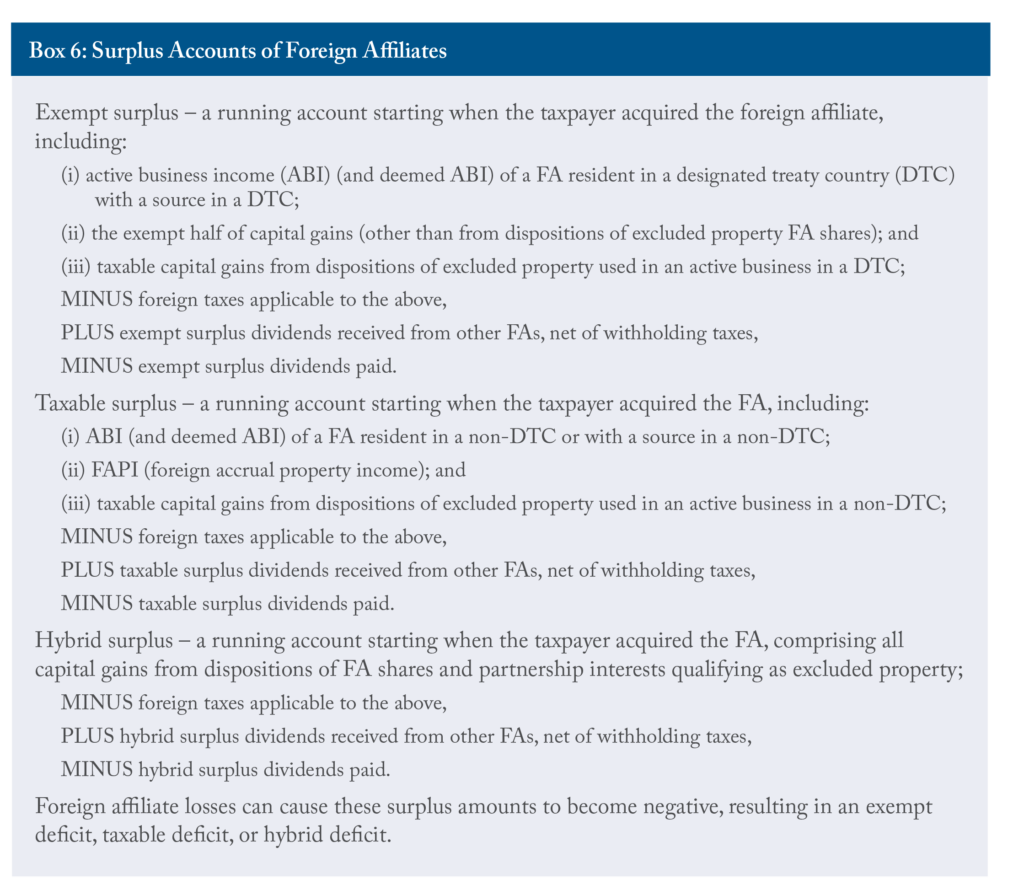
Canada’s foreign affiliate system employs a transaction-based approach that requires taxpayers to categorize each income source of each FA and allocate it to one of the three surplus accounts maintained for each foreign affiliate. This, in turn, determines the applicable method of Canadian taxation – worldwide (for FAPI), territorial (for exempt surplus), or deferral with credit (for taxable surplus and hybrid surplus).
Except for FAPI earned by a CFA, foreign-source income of foreign affiliates is not taxed in Canada on an accrual basis, as it is earned. Instead, Canadian taxation (if any) is deferred until such time as the FA distributes its after-tax income up to the Canadian parent corporation as a dividend. All such FA dividends are fully included in income. If the dividend is paid out of exempt surplus, it may then be fully deducted in computing the taxable income of the Canadian corporation, effectively exempting all such exempt surplus amounts from Canadian taxation.
If instead the dividend is paid out of taxable surplus or hybrid surplus, an indirect tax credit is allowed for the amount of underlying foreign tax applicable to the dividend amount, effected as a deduction from income of a grossed-up amount of the underlying foreign tax (which must therefore also be tracked in separate running accounts). If foreign taxes have been paid on the taxable surplus or hybrid surplus amounts at a sufficiently high rate (equivalent to the Canadian corporate tax rate), then the deduction would fully offset the dividend inclusion amount, and no further Canadian tax would be imposed. On the other hand, if foreign taxes have been paid at a lower rate, the indirect foreign tax credit deduction would be less than the dividend inclusion amount, resulting in a net income inclusion for the Canadian parent corporation, and possible Canadian top-up tax.1717 Dividends from non-resident corporations are included in income by ITA s. 90. In computing taxable income, Canadian corporations may claim potentially offsetting deductions under ITA s. 113, analogous to the domestic intercorporate dividend deduction available under ITA s. 112, reflecting the assumption that corporate level tax is already paid on dividend amounts distributed from after-tax profits. Paragraph 113(1)(a) permits deduction of the portion of the dividend paid out of exempt surplus. Paragraph 113(1)(a.1) permits deduction of half the portion of the dividend paid out of hybrid surplus (reflecting the tax-exempt portion of the FA’s capital gain from disposing of excluded property FA shares), plus a grossed-up amount of foreign taxes applicable to the FA’s taxable capital gain included in the hybrid surplus dividend (the taxable half of the capital gain). Paragraph 113(1)(b) permits deduction of a grossed-up amount of foreign taxes applicable to the portion of the dividend paid out of taxable surplus.
A surplus ordering rule requires FA dividends to be treated as paid first out of exempt surplus (to the extent of the FA’s exempt surplus amount), then out of hybrid surplus (to the extent of the hybrid surplus balance), then out of taxable surplus (to the extent of the taxable surplus balance). If the dividend amount exceeds the available surplus balances, it is treated as a pre-acquisition surplus dividend, which is deductible from income and reduces the adjusted cost base of the FA shares, analogous to a return of capital. It is also possible for a taxpayer to elect to reverse this surplus ordering and treat a FA dividend as a pre-acquisition surplus dividend, thus accessing the taxpayer’s adjusted cost base attribute before reducing surplus balances.1818 ITA Regulation 5901 contains the surplus ordering rule, which also takes into account deficits. Pre-acquisition surplus represents surplus amounts already in an FA when the taxpayer acquired its interest in the FA, and are thus analogized to capital amounts that, when distributed, are deductible in computing taxable income by paragraph 113(1)(d) and reduce the taxpayer’s adjusted cost base of the FA shares under ITA s. 92(2). This can result in a capital gain under ITA s. 40(3) if the adjusted cost base of the FA shares is reduced to a negative amount. Regulation 5901(2)(b) allows the FA dividend to be electively treated as a pre-acquisition surplus dividend that would reduce the adjusted cost base in this manner.
Contemporary Reality of Surplus Tracking for Canadian MNEs
Requiring Canadian corporations with FAs to track surpluses using the transaction-by-transaction approach may not have been especially onerous for Canadian corporations in the 1970s when the system was conceived. However, several factors have increased the complexity and compliance costs as now experienced by Canadian MNEs, prompting reconsideration of whether mandatory surplus tracking still serves a useful purpose in today’s context.
- Scale of globalization: Encouraged by Canada’s trade and tax policies, many Canadian businesses have successfully expanded into foreign markets, such that the number of foreign affiliates of Canadian corporations requiring surplus computations has increased significantly. The largest Canadian MNEs have hundreds of FAs in their corporate groups, in numerous countries, and even smaller Canadian businesses increasingly go global through FAs. This has brought many more FAs into the Canadian tax net, for many more Canadian corporate taxpayers, and exposes more small business entrepreneurs to the challenges of surplus tracking.
- Extended tracking period: Surplus accounts require a cumulative calculation of income items starting from when the Canadian taxpayer first acquired its interest in the foreign affiliate. For the oldest FAs, this requires tracking the earnings history over 50 years. Each passing year adds more transactions impacting an FA’s surplus balances.
- Foreign tax complexity: Active business income of a foreign affiliate is determined using foreign tax rules, starting with income as reported in the FA’s home jurisdiction, then adjusted to conform with Canadian income principles. This requires an understanding of all such foreign tax systems, which have also become more sophisticated, complex, and ever-changing. In jurisdictions with consolidated tax reporting or fiscally transparent entities, separate calculations must be made solely for Canadian surplus tracking on a separate entity basis.
- Dependence on excluded property determinations: Several of the detailed rules for classifying FA income hinge on the status of underlying assets as excluded property at particular times and assume that taxpayers are capable of making these determinations readily and with confidence.1919 Under ITA s. 95(2)(a)(ii)(D), deemed ABI treatment for interest depends on the continued excluded property status of FA shares purchased with the borrowed funds. Hybrid surplus requires a definitive excluded property determination for the FA shares disposed of. Deemed dispositions of FA shares can also occur if an FA distribution is treated as paid out of preacquisition surplus, reducing the adjusted cost base of the shares to a negative amount and triggering capital gain under ITA s. 40(3), requiring determination of the excluded property status of the deemed disposed FA shares. Excluded property status may also be required for a liquidating FA under ITA s. 95(2)(e)(iv). In reality, excluded property status can be challenging to ascertain because it requires assessment of the relative values of all assets of an FA and whether they are used in an active business. This can exacerbate surplus uncertainty and may necessitate significant due diligence and information gathering to support positions taken.
- Surplus elevation rules: Common FA transactions can trigger automatic elevation of the surplus balances of lower-tier FAs, even where no actual dividends are paid, including sales of FA shares, upstream loans to the Canadian parent, or internal FA share transfers invoking the “out-from-under” surplus adjustments.2020 On a sale of FA shares, ITA s. 93 requires a capital gain to be reduced by the net surplus of the FA, determined under Regulation 5902 as though all underlying FAs had paid dividends up the chain equal to their respective net surplus amounts. Similarly, the surplus available to shelter an upstream loan income inclusion under ITA s. 90(11) includes all such downstream surplus in lower-tier FAs. Under Regulation 5905(7.2), where an FA with positive surplus balances is transferred out from under a higher-tier FA with a blocking deficit, notional dividends are assumed to be paid sufficient to “fill-the-hole,” using the same Regulation 5902 surplus elevation mechanism. Each time this necessitates surplus estimates for all relevant FAs and adjustments to reflect the notional distributions.
- Continuity of surplus balances on change of control: When a taxpayer acquires control of a Canadian corporation with FAs, the historical surplus balances of those FAs are preserved, not reset to nil. It may be challenging for the acquiror to thereafter make reliable surplus estimates for those FAs in respect of the historical earnings prior to the acquiror’s control, especially when there is turnover in key personnel.
There is a fundamental disconnect between the tax policy underlying the foreign affiliate rules and the practical realities for Canadian taxpayers making outbound foreign direct investment (FDI) through FAs. The system’s design implicitly assumes that Canadian MNEs continually update the surplus balances of their foreign affiliates on a real-time basis and can expeditiously make excluded property determinations with certainty.
Yet in practice, Canadian multinationals find it costly and burdensome to maintain up-to-date surplus balances for all their FAs and ongoing assessments of the excluded property status of their worldwide assets. These determinations are generally deferred until they are actually relevant, that is, when an FA disposes of property or makes a distribution, prompting a more focused, urgent effort to update the amounts for the relevant FAs on an “as-needed” basis. Similarly, the Canada Revenue Agency (CRA) typically does not annually audit the surplus balances of a Canadian MNE’s FAs, generally deferring this time-consuming work until surplus is actually relevant to a Canadian tax liability. This compounds the difficulty, as estimating surplus typically requires revisiting the earnings history of the relevant FAs reaching back over a longer period, for which the required information and institutional knowledge may not be readily available.
Moreover, Canadian MNEs respond as expected to the incentives they face under the foreign affiliate rules. For income amounts taxed under the deferral with credit system, the potential additional Canadian tax discourages FA distributions out of taxable surplus or hybrid surplus unless there is sufficient underlying foreign tax applicable to offset the dividend income inclusion. Consequently, MNEs generally prefer to reinvest such amounts outside of Canada, rather than repatriating them as would readily be done for exempt surplus amounts taxed under the exemption system promoting capital import neutrality, as found by the Advisory Panel.2121 Research undertaken for the Advisory Panel found that 92 percent of FA dividends paid to Canadian companies from 2000-2005 were from exempt surplus, and it was not possible, from the information available, to determine whether any Canadian tax was collected on the 8 percent of such dividends paid from taxable surplus. It would be useful for this to be updated by the Department of Finance, taking into account the 2011 addition of hybrid surplus and the 2009 expansion of the de facto exemption system to include TIEA countries. It is therefore expected that very little tax revenue is collected in Canada in respect of foreign-source ABI and capital gains residually captured in the Canadian tax base by the deferral with credit system, although current empirical evidence for this claim is not available.2222 The 2026 report on federal tax expenditures does contain a category for tax expenditure associated with the tax treatment of active business income of foreign affiliates of Canadian corporations and deductibility of expenses incurred to invest in foreign affiliates (Canada 2026). However, no dollar amounts are provided; see https://www.canada.ca/en/department-finance/services/publications/federal-tax-expenditures/2026/part-7.html#tax-treatment-active-business-income.
Why does Canada use this deferral with credit mechanism that necessitates costly surplus tracking, yet likely generates little to no tax revenue? Like many OECD countries, in the 1970s Canada had a high combined corporate tax rate (roughly 45-50 percent depending on the province). There was an understandable base erosion concern if exemption treatment had been extended to all foreign-source ABI, since corporations might have had significant incentive to shift income to FAs in lower-tax jurisdictions. Canada then had a small but growing number of income tax treaties, primarily with other developed nations imposing similarly high corporate tax rates. Consequently, when implemented in 1976, the exemption system was restricted to countries with which Canada had a tax treaty as a proxy for comparably high-tax countries to which it was less likely income would be shifted for tax reasons, alleviating these base erosion concerns. For ABI sourced in non-treaty countries, the deferral with credit system applied, promoting capital export neutrality and ostensibly protecting the Canadian tax base. In effect, the foreign affiliate system was arguably conceived primarily as a deferral with credit system, with exemption treatment allowed as a simplifying exception for income earned in a small (but important) subset of comparably high-tax countries.
Since then, Canada’s network of income tax treaties has expanded to now include 94 countries.2323 The full list of Canada’s income tax treaties is posted by the Department of Finance at https://www.canada.ca/en/department-finance/programs/tax-policy/tax-treaties.html#status. The tax treaty with Russia is currently suspended. In 2009, the exemption system was further extended to ABI sourced in countries that have entered into a TIEA with Canada. This was a successful effort to induce tax haven countries to exchange tax information with Canada, as there are now 24 such low-tax TIEA countries.2424 The full list of TIEA countries is posted by the Department of Finance at https://www.canada.ca/en/department-finance/programs/tax-policy/tax-information-exchange-agreements.html Consequently, exemption treatment now applies to ABI sourced in 118 DTCs, which include most of the common jurisdictions where Canadian MNEs operate through foreign affiliates. Since this includes the 24 TIEA countries that are mostly tax havens, and since some of the 94 countries with which Canada has tax treaties levy corporate taxes at much lower rates than Canada, it is no longer the case that exemption treatment applies only to income sourced in jurisdictions with corporate tax systems comparable to Canada. As observed by the Advisory Panel (2008) and as is even more the case 18 years later, in practice Canada’s tax regime for outbound investment operates as a de facto exemption system, despite maintaining the complexity of its deferral with credit features and required surplus tracking stemming from its 1970s origins.
Over time, Canada’s combined corporate tax rate has decreased to roughly 26.5 percent (depending on the province), while the average statutory corporate tax rate among OECD countries is 24.1 percent as of 2025 (among 145 inclusive framework countries it is 21.2 percent), putting Canada closer to the middle of the pack globally compared to the 1970s.2525 The OECD maintains a dataset comparing statutory corporate tax rates at: OECD. 2025. Corporate Tax Statistics 2025. November 25. https://www.oecd.org/en/publications/corporate-tax-statistics-2025_6a915941-en/full-report/statutory-corporate-income-tax-rates_c95f6f62.html#boxsection-d1e2383-89f829de7f. In addition, Pillar Two as adopted in Canada through the GMTA is explicitly intended to mitigate incentives for in-scope Canadian MNEs to engage in profit shifting. These factors substantially alleviate the base erosion concerns that prevailed in the 1970s, such that the original rationale for retaining the deferral with credit method is now undermined and would be especially so if Canada were to meaningfully reduce the corporate tax rate further.
Canada did not implement the Advisory Panel’s recommendation for a full exemption system in 2008 and in fact moved in the opposite direction with subsequent measures to tighten the integrity of the surplus tracking system, including the addition of hybrid surplus, upstream loan rules, and out-from-under surplus adjustments, for example. This may reflect policymakers’ persistence in the original conceptual understanding of Canada’s foreign affiliate system as primarily a deferral with credit regime and a continued focus on protecting the Canadian tax base. Base erosion concerns may also have been influenced by longstanding controversy over Canada’s interest deductibility rules and the restoration of open-ended deductibility of interest on funds borrowed to invest in FA shares, following implementation of the Advisory Panel’s other recommendation to repeal s. 18.2 of the ITA.2626 Canada’s longstanding general rule for interest deductibility in ITA s. 20(1)(c) uses a tracing/linking approach that permits the interest deduction if the borrowed funds are used for the purpose of earning income, and in the context of borrowings to acquire FA shares, the deduction is not conditioned on whether the dividend income is exempt or taxable. This unrestricted deduction helped promote the competitiveness of Canadian corporations, but it also incentivized the shifting of debt into Canada to fund offshore investments. This raised base erosion concerns addressed by the Technical Committee on Business Taxation, which recommended that such interest on funds borrowed to invest in FAs should be denied (Canada 1998). This recommendation was not implemented, but in the March 2007 federal budget, a new rule (ITA s. 18.2) was proposed to curb interest deductibility on funds traced to FA investments. This provoked opposition from the business community on the grounds that it would compromise Canadian competitiveness. The Advisory Panel was constituted in part to address this, and it recommended removal of the s. 18.2 interest deductibility restriction (which by then had been enacted in a modified form, targeting double-dip interest deductibility structures). In March 2009, s. 18.2 was repealed without ever having come into effect, leaving in place the unrestricted s. 20(1)(c) deduction which remains applicable today. As discussed below, the recent enactment of supplementary interest deductibility limitations (the EIFEL rules) should substantially address this policy impediment to a full exemption system.2727 In addition, Canada responded to the Advisory Panel recommendations by enacting the foreign affiliate dumping rules in ITA s. 212.3. These are complex, controversial, and now arguably redundant given the enactment of the EIFEL interest limitations, at least with respect to their debt dumping purpose (Porter 2025).
The Advisory Panel’s recommendation for Canada to broaden the exemption system to cover all active business income earned through FAs, and all capital gains from excluded property FA share dispositions, also took into account benchmarking to the systems of other countries. Participation exemption regimes providing tax-exempt treatment for dividends from foreign subsidiaries are common in EU countries, generally with minimum ownership thresholds and in some cases with holding period requirements (KPMG Ireland 2023). Notably, Australia and the UK employ broad exemption systems for dividends from foreign subsidiaries. Canada would not be out of sync with its OECD peers in adopting a full exemption system similar to these participation exemption regimes.
Full Exemption System for Canada
Elaborating upon the recommendations made by the Advisory Panel, a full exemption system adapted to the Canadian context could have the following features.
- Exempt foreign affiliate dividends: All FA dividends received by a Canadian corporation would benefit from territorial/exemption treatment, regardless of their source.2828 Exemption treatment could employ the same inclusion/deduction mechanism currently used for exempt surplus dividends by extending the scope of ITA s. 113(1)(a) to cover all FA dividends. The exemption of all FA dividends would eliminate the need to track the surplus pool out of which the dividend is paid.
- Tightened foreign affiliate threshold to qualify for exempt dividend treatment: FA status is obtained with a relatively low 10 percent ownership in any class or series of shares of the non-resident corporation, even if that constitutes a nominal economic interest. This could be made more robust, possibly at a higher ownership level and conditioning access to the broader exemption system on a “votes and value” ownership standard (or a minimum stipulated ownership percentage of common equity) and perhaps requiring a minimum holding period as in other participation exemption regimes.
- Retained worldwide/accrual taxation for FAPI: The current regime for attributing foreign accrual property income would be continued, protecting the Canadian tax base and promoting capital export neutrality for passive, mobile income. It may be necessary to lower the FAPI attribution threshold from CFA to the newly tightened foreign affiliate threshold, so that a single harmonized FA threshold applies both for exemption of FA dividends and for attribution of FAPI.2929 Currently, foreign accrual property income (FAPI) earned in a non-controlled foreign affiliate is not attributed to the Canadian taxpayer, but is added to the FAs taxable surplus and is thus eventually taxed when distributed under the deferral with credit method. Eliminating deferral with credit could enable FAPI earned in non-CFAs to escape Canadian taxation, impairing the intended capital export neutrality for FAPI. However, if protecting the tax base requires FAPI attribution to be extended to non-controlled FAs, the taxpayer may encounter difficulties obtaining the required information from the FA to comply. The Advisory Panel addressed this issue but did not make a recommendation. For example, a 25 percent ownership threshold could be considered.3030 It may be objected that a Canadian taxpayer could be subject to current taxation of FAPI earned in an FA in which it has a mere 25 percent, non-controlling interest, such that it is unable to dictate the nature of the FA’s income sources, force distribution of any FAPI, or obtain the tax information required from the FA for the Canadian taxpayer’s FAPI compliance. In some circumstances, this result can already arise for minority interests under the broad definition of CFA, which includes an FA controlled by a group of up to five Canadian residents who need not be related. Moreover, the current 10 percent FA threshold already requires Canadian taxpayers to obtain tax information from non-controlled subsidiaries in order to comply with surplus tracking. Taxpayers might be expected to adapt to a new harmonized FA/FAPI attribution threshold by negotiating for contractual rights to ensure their FAPI compliance when making significant (at least 25 percent) but non-controlling investments in FAs. There could also be transitional relieving rules and possibly alternative elective attribution mechanisms for minority FA interests such as those used in ITA s. 94.1 for offshore investment fund properties based on the prescribed rate applied to the taxpayer’s cost of the investment.
- Exempt all capital gains from excluded property foreign affiliate share dispositions: The Advisory Panel recommended full exemption for capital gains from dispositions of FA shares, provided they qualify as excluded property (i.e., substantially all value is attributable to active business assets). Consistent with the participation exemption regimes in other countries, the exemption would apply to dispositions by FAs and also by the Canadian parent itself or any Canadian subsidiary. This approach effectively treats gains from dispositions of excluded property FA shares as a proxy for foreign-source ABI since the gain on the shares is effectively a substitute for the FA disposing of all its active business assets (gains from which are exempt) and distributing the proceeds as a dividend (also exempt). Viewed another way, this approach would effectively treat the proceeds of disposition of the FA shares as representing the aggregate present value of (1) historical retained ABI earnings and (2) future expected ABI earnings of the FA, all of which are exempt.31 31 Exempting a Canadian corporation from tax on gains on FA shares while taxing it on gains from domestic shares could give MNEs an incentive to invest outside Canada. This is perhaps the primary policy objection to a full exemption system. However, in the pragmatic view of a recent commentator endorsing extension of exemption treatment to directly held FA shares, the enormous simplification benefits would likely outweigh any resulting tax leakage (Porter 2025). It is also relevant that under the current system in which Canadian corporations are taxed on gains from dispositions of directly held FA shares, it is common to avoid this result with advance planning by making the FA investment through an intermediate holding FA in a low-tax jurisdiction. The eventual exit is then structured as a sale by the holding affiliate of its excluded property FA shares, giving rise to hybrid surplus that could be reinvested outside Canada, thus perpetually deferring Canadian tax on the gain. Extending the exemption to the Canadian parent would obviate this planning and allow the Canadian parent to hold its FA investments directly and receive sale proceeds directly with greater flexibility in redeploying them.
- Tightened excluded property qualification: With exemption extended to capital gains from excluded property FA shares realized by the Canadian parent corporation, the excluded property threshold would become even more significant. The Advisory Panel raised several possible reforms, including a downstream consolidation look-through approach for determining the relative value of active and non-active assets, a look-back period to prevent short-term “asset stuffing” that temporarily exceeds the 90 percent active asset threshold, and possible relief for temporary cash balances resulting from sales of active assets.
- Interest deductibility: Controversially, the deduction of interest on funds borrowed to invest in foreign affiliate shares generating exempt dividend income has long been permitted. However, in response to the OECD base erosion and profit shifting (BEPS) project recommendations, Canada implemented additional restrictions (the EIFEL rules) effective for 2024 that can override the general rule to limit interest deductions to a cap of 30 percent of a taxpayer’s adjusted taxable income.3232 The BEPS recommendations are targeted at multinational groups and are intended to limit interest deductions to 30 percent of a taxpayer’s earnings before interest, taxes, depreciation and amortization (EBITDA). Canada’s version is enacted in new ITA s. 18.2 and 18.21 (replacing the aborted interest restriction that was repealed following the Advisory Panel’s recommendation) as the excessive interest and financing expense limitation (EIFEL). The EIFEL rules apply to taxation years beginning after September 2023 to all taxpayers other than “excluded entities.” These include Canadian-controlled private corporations (CCPC) with taxable capital less than $50 million, taxpayers with annual interest and financing expenses under $1 million, and taxpayers with de minimis foreign affiliate holdings valued under $5 million. With respect to funds borrowed to invest in FA shares, the excessive interest and finance expense limitation rules can effectively deny the interest deduction because FA dividends taxed under the exemption system are not included in taxable income, and thus do not generate capacity for interest deductions under the 30 percent EIFEL ratio. For Canadian MNEs that are subject to these EIFEL rules (generally most MNEs with FA holdings exceeding de minimis limits) and that incur interest on funds borrowed to invest in FAs, there should no longer be policy objections to a continued interest deduction subject to the EIFEL limitations.3333 For “excluded entity” taxpayers excluded from the EIFEL restrictions, base erosion concerns in a full exemption system might perhaps be assuaged by denying deductibility of interest on funds borrowed to invest in FA shares, but permitting the taxpayer to instead elect into the EIFEL rules and deduct such interest as thereby allowed under the 30 percent of adjusted taxable income test.
- Elective surplus tracking: The full exemption system would confer exemption treatment for capital gains on dispositions of excluded property foreign affiliate shares, but gains from FA shares not meeting the 90 percent active business asset threshold for excluded property status would still be taxed (regardless of whether the vendor is the Canadian parent or its FA). Currently there is a mechanism (ITA s. 93) to reduce capital gains from FA share dispositions to the extent of the underlying net surplus balances of the FA disposed of, and it would be appropriate to retain this relief. For this purpose, surplus tracking could be made electively available, confining the compliance costs to taxpayers choosing to reduce their gain amounts by net underlying surplus amounts.3434 This approach would be expected to be utilized by a relatively small subset of Canadian MNEs whose FA shares may not qualify as excluded property. Another alternative is to fully eliminate surplus tracking and the ITA s. 93 mechanism and replace it with relief based on ITA s. 55(2.1) “safe income” principles.
- Transition approaches: The Advisory Panel addressed possible treatments of historical untaxed FA earnings under the deferral with credit method (taxable surplus, and now also hybrid surplus) and recommended amnesty treatment. This would be simple to administer but would reward taxpayers that deferred distribution of such legacy surplus with low underlying tax, compared to taxpayers who previously distributed such amounts and paid Canadian top-up taxes. An alternative (but problematic) approach would require taxpayers to undertake a final taxable and hybrid surplus calculation for all FAs as at the transition to a full exemption system, with a deemed repatriation of those final balances and a deemed disposition of top-tier FA shares for fair market value, triggering a one-off tax liability under the old FA system and a fresh start reset under the new full exemption system.3535 This approach is not recommended as it would impose a large administrative burden due to the required transition date valuations and surplus computations, and it could result in taxpayers having tax payable without cash available to fund it. However, if it is adopted, relief could be modelled on the US transition to the GILTI regime which involved a deemed repatriation component but applied tax at a rate lower than the prevailing statutory rate and permitted the resulting tax to be paid over time. A better, less draconian alternative would (1) avoid immediate taxation from a deemed disposition and surplus repatriation, instead deferring the legacy tax liability until the top-tier FA shares are disposed of and proceeds are available, and (2) preserve historic net surplus attributes by converting them to adjusted cost base attributes. This could be achieved by allowing taxpayers to electively determine their FA surplus balances under the old system and add the net surplus to the adjusted cost base of their top-tier FA shares. When those top-tier FA shares are eventually disposed of, a transition mechanism would separate the pre-transition (taxable) capital gain from the post-transition (exempt) capital gain (Turner 2020).3636 The Canadian taxpayer’s post-transition proceeds of disposition would be deemed to be the lesser of (i) actual proceeds and (ii) the value of the top-tier FA shares at the time of transition to the full exemption system. The adjusted cost base of the top-tier FA shares would be the sum of (i) actual historic cost and (ii) an elective step-up for the transition day tax-free surplus balance. The effect would be to tax only the capital gain accrued up to the transition day, with elective relief for accrued surplus balances up to the transition day that could have been distributed without additional tax.
Conclusion
The side-by-side exemption from Pillar Two for US MNEs impairs the competitive position of Canadian MNEs relative to their US counterparts. Canadian MNEs face heightened complexity from overlapping rules in the Global Minimum Tax Act and the ITA’s foreign affiliate system, and their US competitors are subject to net CFC tested income (NCTI) at a lower rate than the income inclusion rule, enjoy protection from the controversial undertaxed profit rule, and may use global averaging to benefit from low rates in tax havens not adopting minimum top-up taxes.
The optimal Canadian policy response should urgently prioritize the competitiveness of Canada’s tax system, including reductions in the general corporate tax rate and simplifications to ease compliance burdens. While this cannot directly offset the potential advantages for US MNEs relative to Canadian MNEs under the SbS system, competitiveness improvements can at least narrow the gap. Simplifications to the foreign affiliate rules would be a natural focus to reduce duplicative compliance burdens for Canadian MNEs and should be pursued in any event. The SbS deal makes these reforms even more salient.
In 2008, the Advisory Panel recommended a full exemption system for foreign-source active business income, similar to the participation exemption regimes of many other countries. This would eliminate costly, unnecessary surplus-tracking requirements that are now far more onerous than those contemplated in the 1970s. Moreover, since taxpayers are already able to structure sales of FA shares so as to defer Canadian tax on capital gains and generally avoid distributions of taxable surplus and hybrid surplus with insufficient underlying tax, the revenue impacts of exempting those FA dispositions and distributions are likely to be modest.
The government did not implement a full exemption system after 2008, and in fact went the opposite direction by adding complex base protection features to the foreign affiliate rules, including hybrid surplus, which tracks capital gains from selling the shares of a foreign affiliate. But the competitive threat to Canada is now worse, and the new side-by-side system exacerbates it. Recent implementation of Pillar Two and EIFEL rules on interest deductibility significantly mitigate residual base erosion concerns.
Canada should now implement a full exemption system as part of its effort to improve tax competitiveness and simplification, which is even more pressing given the advantages now available to US multinationals under the side-by-side regime.
References
Advisory Panel on Canada’s System of International Taxation. 2008. Enhancing Canada’s International Tax Advantage, Final Report. Ottawa: Department of Finance Canada. https://publications.gc.ca/collections/collection_2009/fin/F2-184-3-2008E.pdf.
Arnold, Brian. 2026a. “A New World Order? What Are the Implications for the Canadian Income Tax System?” The Arnold Report. Posting 319. Canadian Tax Foundation. January 21. https://www.ctf.ca/EN/Newsletters/The_Arnold_Report/2026/BArnold_319.aspx.
___________. 2026b. “Side-by-Side – With the US in the Lead: The Inclusive Framework’s Side-by-Side Package.” The Arnold Report. Posting 320. Canadian Tax Foundation. January 27. https://www.ctf.ca/EN/Newsletters/The_Arnold_Report/2026/BArnold_320.aspx.
Bloomberg Tax. 2025. “How to Calculate GILTI Tax (Now NCTI) on Foreign Earnings.” Bloomberg. November 3. https://pro.bloombergtax.com/insights/international-tax/how-to-calculate-gilti-tax-on-foreign-earnings/#tax-planning-implications.
Boidman, Nathan. 2026. “The Side-by-Side Agreement Reshapes US Canadian Subsidiaries’ Tax.” Tax Management International Journal. February 24.
Canada. 1998. Report of the Technical Committee on Business Taxation. Ottawa: Department of Finance. https://publications.gc.ca/collections/Collection/F32-5-1998E.pdf.
______. 2025. “G7 Statement on Global Minimum Taxes.” Ottawa: Department of Finance. June 28. https://www.canada.ca/en/department-finance/news/2025/06/g7-statement-on-global-minimum-taxes.html.
______. 2026. Report on Federal Tax Expenditures – Concepts, Estimates and Evaluations 2026. Ottawa: Department of Finance. https://www.canada.ca/en/department-finance/services/publications/federal-tax-expenditures/2026.html.
CPA Ontario. 2025. Tax Reform for Growth in Canada. https://assets.cpaontario.ca/insights/thought-leadership/pdfs/tax-reform-for-growth-in-canada-final.pdf.
KPMG Ireland. 2023. “Roadmap for the Introduction of a Participation Exemption to Irish Corporation Tax.” December. https://assets.gov.ie/static/documents/kpmg-response-to-the-public-consultation-on-the-introduction-of-a-participation-exempt.pdf.
Laurin, Alexandre, Nicholas Dahir, and Jack Mintz. 2026. “Big Bang” Tax Reform: Unleashing Growth in the Canadian Economy. Commentary 707. Toronto: C.D. Howe Institute. https://cdhowe.org/publication/big-bang-tax-reform-unleashing-growth-in-the-canadian-economy/.
Marley, Patrick, and Kaitlin Gray. 2026. “Canada Should Follow in US’ Footsteps on Pillar Two Carve-Out.” Bloomberg Tax. January 23. https://news.bloombergtax.com/tax-insights-and-commentary/canada-should-follow-in-us-footsteps-on-pillar-two-carve-out.
Marley, Patrick, and Oleg Chayka. 2025. “G7 Pillar 2 Announcement and its Implications for Canada.” International Tax Highlights 4(3). Canadian Tax Foundation and International Fiscal Association. September. https://www.ctf.ca/EN/Newsletters/International_Tax_Highlights/2025/3/250302.aspx.
______________. 2026. “The Side-by-Side Package and its Implications for Canada.” International Tax Highlights 5(1). Canadian Tax Foundation and International Fiscal Association. February. https://www.ctf.ca/EN/Newsletters/International_Tax_Highlights/2026/1/260102.aspx.
Mustard, Brian. 2013. “Canada’s System of International Taxation: A Look Back and a Look Forward.” Canadian Tax Journal 61, Special Supplement: 257–270. https://www.ctf.ca/EN/Secured_Content/2013/CTJ_Content/2013CTJSPS.
Mustard, Brian, Nick Pantaleo, and Scott Wilkie. 2009. “Why Not Kenora? Reflections on What Canada’s Approach to Taxing Foreign Business Income Is and Could Be.” Canadian Tax Foundation 2009 Conference Report. Toronto. https://www.ctf.ca/EN/Publications/Conference_Reports/2009CR_TOC_2.aspx.
Nikolakakis, Angelo. 2009. “Yes, Virginia . . . Reconciling a Broader Exemption System with Continued Taxation of FAPI and Domestic Gains.” International Tax 45: 12–15. Toronto: CCH Canadian. April.
Organisation for Economic Co-operation and Development. 2015. OECD/G20 Base Erosion and Profit Shifting Project – Addressing the Tax Challenges of the Digital Economy – Action 1: 2015 Final Report. Paris: OECD. https://www.oecd.org/content/dam/oecd/en/publications/reports/2015/10/addressing-the-tax-challenges-of-the-digital-economy-action-1-2015-final-report_g1g58cdd/9789264241046-en.pdf.
______________. 2021. Tax Challenges Arising from Digitalisation of the Economy – Global Anti-Base Erosion Model Rules (Pillar Two): Inclusive Framework on BEPS. Paris: OECD. https://www.oecd.org/en/publications/2021/12/tax-challenges-arising-from-digitalisation-of-the-economy-global-anti-base-erosion-model-rules-pillar-two_eed81a23.html.
______________. 2023. The Pillar Two Rules in a Nutshell. Paris: OECD. Updated May 2025. https://www.oecd.org/content/dam/oecd/en/topics/policy-sub-issues/global-minimum-tax/pillar-two-model-rules-in-a-nutshell.pdf.
______________. 2026a. Tax Challenges Arising from the Digitalisation of the Economy – Global Anti-Base Erosion Model Rules (Pillar Two), Side-by-Side Package: Inclusive Framework on BEPS. Paris: OECD. https://www.oecd.org/content/dam/oecd/en/topics/policy-sub-issues/global-minimum-tax/side-by-side-package.pdf.
______________. 2026b. Global Minimum Tax: Terms of Reference and Assessment Methodology for the Full Legislative Review. Paris: OECD. https://www.oecd.org/content/dam/oecd/en/topics/policy-sub-issues/global-minimum-tax/terms-of-reference-and-assessment-methodology-for-the-full-legislative-review.pdf.
Pantaleo, Nick, and Scott Wilkie. 2007. “Are the Surplus Rules Surplus?” Course materials presented at the 2007 International Fiscal Association (Canadian branch) Travelling Lectureship. February and March.
Porter, Shawn. 2025. “Simplifying International Tax Rules.” International Tax Highlights 4(2). Canadian Tax Foundation and International Fiscal Association. May. https://www.ctf.ca/EN/Newsletters/International_Tax_Highlights/2025/2/250203.aspx.
__________. 2026. “The Geopolitics of the Global Minimum Tax: Consequences for Canada.” International Tax Highlights 5(1). Canadian Tax Foundation and International Fiscal Association. February. https://www.ctf.ca/EN/Newsletters/International_Tax_Highlights/2026/1/260103.aspx.
Suarez, Steve. 2025. “Elbows Up: Canada’s Tax Policy Opportunity in 2025.” Perspectives on Tax Law and Policy 6(2). Toronto: Canadian Tax Foundation. June. https://www.ctf.ca/EN/Newsletters/Perspectives/2025/2/250201.aspx.
Tax Notes Today International. 2026a. “OECD in Side-by-Side Package: Don’t Mess With Your QDMTT Regime.” March 20. https://www.taxnotes.com/tax-notes-today-international/oecd-pillar-2-global-minimum-tax/oecd-side-side-package-dont-mess-your-qdmtt-regime/2026/03/20/7vhcp?highlight=%22side-by-side%22.
______________. 2026b. “OECD Defends Pillar 2 Side-by-Side Package Before French MPs.” March 30. https://www.taxnotes.com/tax-notes-today-international/base-erosion-and-profit-shifting-beps/oecd-defends-pillar-2-side-side-tax-package-french-mps/2026/03/30/7vjm5?highlight=%22side-by-side%22.
______________. 2026c. “OECD Peer Review of Pillar 2 Tax Laws to Start Before Year-End.” April 17. https://www.taxnotes.com/tax-notes-today-international/oecd-pillar-2-global-minimum-tax/oecd-peer-review-pillar-2-tax-laws-start-year-end/2026/04/17/7vp9c?highlight=%22side-by-side%22.
______________. 2026d. “Side-by-Side Deal is Likely Here to Stay, OECD Official Says.” April 20. https://www.taxnotes.com/tax-notes-today-international/conference-coverage/side-side-deal-likely-here-stay-oecd-official-says/2026/04/20/7vpdp?highlight=%22side-by-side%22.
______________. 2026e. “US Isn’t Privileged With Side-by-Side Safe Harbor, Burch Says.” July 13. https://www.taxnotes.com/tax-notes-today-international/conference-coverage/u.s-isnt-privileged-side-side-safe-harbor-burch-says/2026/07/10/7wd5x?highlight=%22side-by-side%22.
______________. 2026f. “First-Ever Global Minimum Tax Filing Season Gets a Chaotic Start.” July 21. https://www.taxnotes.com/tax-notes-today-international/oecd-pillar-2-global-minimum-tax/first-ever-global-minimum-tax-filing-season-gets-chaotic-start/2026/07/21/7wdr9.
Turner, Geoffrey. 2008. “A Possible Framework for an Expanded Exemption System: A Submission to the Advisory Panel on Canada’s System of International Taxation.” July 15.
______________. 2020. “Easing Foreign Affiliate Compliance Burdens in a Full Exemption System for Foreign-Source Active Business Income.” Canadian Tax Foundation 2020 Conference Report. Toronto. https://www.ctf.ca/EN/Publications/Conference_Reports/2020_Conference_Report.aspx.
United States Trade Representative. 2021. “USTR Welcomes Agreement with Austria, France, Italy, Spain and the United Kingdom on Digital Services Taxes.” October 21. https://ustr.gov/about-us/policy-offices/press-office/press-releases/2021/october/ustr-welcomes-agreement-austria-france-italy-spain-and-united-kingdom-digital-services-taxes.
The White House. 2025a. “The Organization for Economic Co-operation and Development (OECD) Global Tax Deal (Global Tax Deal).” January 20. https://www.whitehouse.gov/presidential-actions/2025/01/the-organization-for-economic-co-operation-and-development-oecd-global-tax-deal-global-tax-deal/.
______________. 2025b. “Defending American Companies and Innovators from Overseas Extortion and Unfair Fines and Penalties.” February 21. https://www.whitehouse.gov/presidential-actions/2025/02/defending-american-companies-and-innovators-from-overseas-extortion-and-unfair-fines-and-penalties/.