




The Study In Brief
Over the past several years, the federal government has consulted widely in formulating new rules for the regulation of brand-name drug prices through the Patented Medicine Prices Review Board (PMPRB) and a long-delayed set of rules that are expected to result in large price reductions, now slated to come into force in January 2022.
But in designing policies and institutions to reduce drug prices, one must keep in mind the obligations that Canada has as a member of the international community that shares in the financing of pharmaceutical R&D under the current global patent system.
In this Commentary, we first review the way drug prices have been negotiated and regulated under current policies and discuss how reforms that are in our national interest must reflect both our desire for controlling healthcare costs and the expectation that we should carry our fair share of the global pharmaceutical R&D burden.
We briefly consider the proposed reforms of rules governing the PMPRB’s regulation of brand-name drug prices. While we think these reforms reflect reasonable principles, we question whether direct price regulation is the best way of resolving the tension between these two objectives.
In the concluding section, we outline an alternative arrangement under which prices of patented drugs sold in Canada would instead be established through negotiations between manufacturers and the new Canadian Drug Agency that is currently being established, with a diminished role for direct price regulation.
In framing a new drug-pricing policy, we believe Canada should pursue a two-track strategy. On one hand, Canada should participate actively in strengthening the international agreements and institutions that deal with new drug and vaccine development and other aspects of the global commons. On a parallel track, the federal government should, in collaboration with the provinces, pursue policies that try to reduce the cost of drugs subject to the constraint that we pay our fair share of global R&D costs. Specifically, Canada should seek to:
Improve the international burden-sharing system. In the area of patent legislation that relates to pharmaceuticals, the federal government should do what it can to support efforts by multilateral institutions such as the World Health Organization, the World Trade Organization (WTO) and the UN to promote such negotiations.
Strengthen the federal role through the Canadian Drug Agency. A natural way to strengthen the federal role in pharmaceutical pricing would be for the CDA to take over the pCPA’s (Pan-Canadian Pharmaceutical Alliance’s) current role. The plans for the CDA were first announced in the 2019 federal budget, where it was stated that it would “negotiate drug prices on behalf of Canada’s drug plans.”
Redefine the role of the PMPRB. The need for expertise in comparing Canadian and foreign drug prices, and our other contributions to global R&D financing, will continue to be important in informing the CDA’s negotiating strategy. As part of its past regulatory mandate, the PMPRB developed a great deal of expertise in this area, and even if it no longer had a price regulatory mandate, it could continue to collect and report data on Canada’s contribution to global R&D financing.
The Canadian system for pricing patented drugs is currently in a state of flux. Since 2010, provincial and federal governments have collaborated, through the pan-Canadian Pharmaceutical Alliance, in negotiating lower prices of brand-name drugs whose costs for seniors and other groups are reimbursed by public plans.
Meanwhile, private drug insurers have also begun to independently negotiate confidential price discounts in listing agreements with drug manufacturers. Over the past several years, the federal government has consulted widely in formulating new rules for the regulation of brand-name drug prices through the Patented Medicine Prices Review Board (PMPRB) and a long-delayed set of rules that are expected to result in large price reductions is currently slated to come into force in January 2022. The federal government has also stated its intention to work toward some form of universal pharmacare,1 In this Commentary, we use the term “pharmacare” to mean any form of universal prescription drug insurance coverage, whether in the form of a public plan that covers everyone or a mixed model of compulsory public and private insurance similar to the one used in Quebec. and proponents of a public plan that covers all Canadians believe that a single public payer would be able to obtain substantial price discounts (Morgan 2015a, Parliamentary Budget Officer 2017).
But in designing policies and institutions to reduce drug prices, one must keep in mind the obligations that Canada has as a member of the international community that shares in the financing of pharmaceutical R&D under the current global patent system. If we are to create a new drug-pricing model in Canada, this issue should receive more attention than it has been given recently.
In this Commentary, we first review the way drug prices have been negotiated and regulated under current policies and discuss how reforms that are in our national interest must reflect both our desire for controlling healthcare costs and the expectation that we should carry our fair share of the global pharmaceutical R&D burden. We cite data which support the claim that drug prices in Canada are higher than in many peer countries and briefly consider the proposed reforms of rules governing the PMPRB’s regulation of brand-name drug prices. While we think these reforms reflect reasonable principles, we question whether direct price regulation is the best way of resolving the tension between these two objectives.
In the concluding section, we outline an alternative arrangement under which prices of patented drugs sold in Canada would instead be established through negotiations between manufacturers and the new Canadian Drug Agency that is currently being established, with a diminished role for direct price regulation. We think such an arrangement would be better suited to reach an acceptable compromise between the conflicting objectives and less likely to invite challenges from Canada’s trading partners.
The International Patent System and Canada’s National Interest
The prices at which newly introduced drugs are sold in Canada and elsewhere depend heavily on the fact that they typically are protected by patents. The goal of the patent system is to reward the creation of valuable new knowledge or technology. It does this by making the patent holder, or someone who has the patent holder’s permission, the only agent who can legally produce and sell products that incorporate the knowledge or technology that the patent covers. Because unauthorized firms cannot legally sell the same product, patent owners and their licensees can earn higher revenues than they otherwise would. These revenues will cover not only production costs but can also recoup, in whole or in part, the costs of the R&D that has gone into developing the patented technology. Although economic theory suggests that rewarding R&D and innovation directly out of public funds could, under ideal conditions, be more efficient, that funding method also has problems. On the whole, our mixed system of public and private R&D funding seems to have worked well, and many kinds of patented technology have helped save lives and raise the standard of living throughout the world.
Technology is global: the benefits of new technology are potentially available everywhere in the world, regardless of where it was developed. In recognition of this, almost all countries have patent laws that make patent protection available to both domestic and foreign patentees. Therefore, under the international patent system buyers of patented products all over the world contribute at least a portion of the monopoly profits that help recoup the R&D expenditures in whatever country (or countries) the product was developed.
This form of international R&D finance sharing may seem a fair and reasonable approach. However, it doesn’t always work smoothly. Patent law is complex and differs from country to country in various dimensions. For example, it varies with respect to the rules that determine whether competing products infringe on an existing patent or which inventions are patentable. More importantly, in certain sectors such as pharmaceuticals, patent owners’ pricing power may also be restricted through price controls, or by policies that create countervailing market power on the buyers’ side. These differences affect the expected profits from sales of patented products, and patent-related policy must therefore balance the interests of buyers who favour weak patent laws and lower prices, against those of patent holders and the desire to preserve the system’s incentives to develop new knowledge.
The temptation to be a free rider
In striking a balance between the interests of buyers and sellers, policymakers in small countries with limited R&D activity may tend to favour weak patent laws since most of those on the producer side who benefit from stronger laws are foreign residents. Since Canada is a small country, accounting for between 2 and 3 percent of global pharmaceutical spending, Canadian drug prices have only a small impact on global pharmaceutical industry profits and, hence, on worldwide pharmaceutical R&D. Therefore, a narrow definition of our national interest might suggest that our policy should favour weak patent laws and follow strict regulatory policies that would enable us to reach the lowest possible prices – namely, prices at which sellers are indifferent to the choice between selling and not selling in Canada.
However, countries with weak patent laws are sometimes referred to as “free riders” who benefit from the fruits of the R&D that is undertaken in other countries but do not contribute their fair share to financing it.2As one of our referees put it, free riders are trying to have their cake and eat it too. In pharmaceuticals, critics have suggested that Canada and other countries have sometimes been acting as free riders relative to the US where patent rules and pharmaceutical pricing policies have led to much higher drug prices than elsewhere in the world. The United States Trade Representative in the 2020 Special Report 301 placed Canada on a list of countries with alleged sub-standard levels of intellectual property protection (which includes patents). More specifically in the pharmaceutical sector, he writes (p. 79): “The United States urges Canada to appropriately recognize the value of innovative medicines in both the private and public markets, to ensure its decisions are made transparently, and to contribute fairly to research and development for innovative treatments and cures.” Not surprisingly, the rules for pharmaceutical patent protection have figured prominently in US-Canada trade negotiations, most recently with the US putting pressure on Canada to provide additional patent protection for biologics (drugs produced from living organisms).
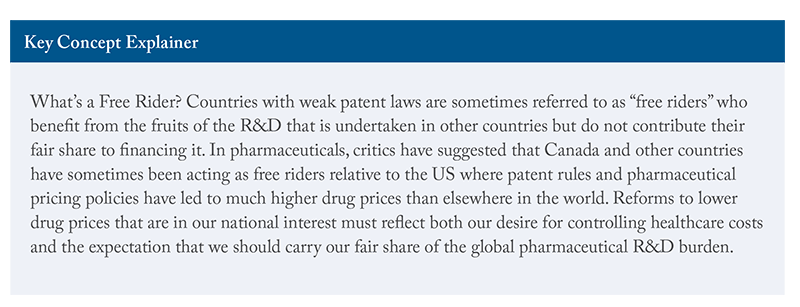
Because Canada is a high-income industrialized country, foreigners expect us to contribute proportionately to global R&D financing. Policies that could be construed as making us a free rider would be damaging to our relations with other countries and our standing in the international community. To avoid this, Canadian policy must produce a pricing structure that would make other countries agree that Canada is abiding by the spirit of the international patent system and that its consumers are contributing their fair share to the global revenues that incentivize most of the sector’s R&D. In the introduction, we referred to the tension between the conflicting objectives of lower drug prices as a tool for controlling overall healthcare costs and that of more R&D to discover and develop new and more effective drug therapies. For a small country like Canada, a hypothetical strategy of trying to sidestep this conflict through more aggressive price controls and weak patent laws may seem tempting, but it will backfire if it makes other countries see us as free riders and they become less willing to make concessions as we negotiate with them about other global issues.3It is sometimes suggested that another consequence of low drug prices is that they lead to delays in the introduction of new drugs. We believe that the empirical evidence to this effect partly reflects drugs that are sold by small companies that don’t have the resources to launch drugs simultaneously in many markets, although the literature also suggests that international referencing pricing schemes can cause companies to delay launches into markets with relatively low prices. We refer to this possibility below.
Is Canada a free rider? The data
Data published by Canada’s Patented Medicine Prices Review Board (PMPRB), the quasi-judicial body that establishes maximum prices for patented drugs, throw some light on how Canadian patented drug prices compare with those elsewhere. Figure 24 and Table 9 from the PMPRB’s 2019 Annual Report contain the most current estimates (Table 1).
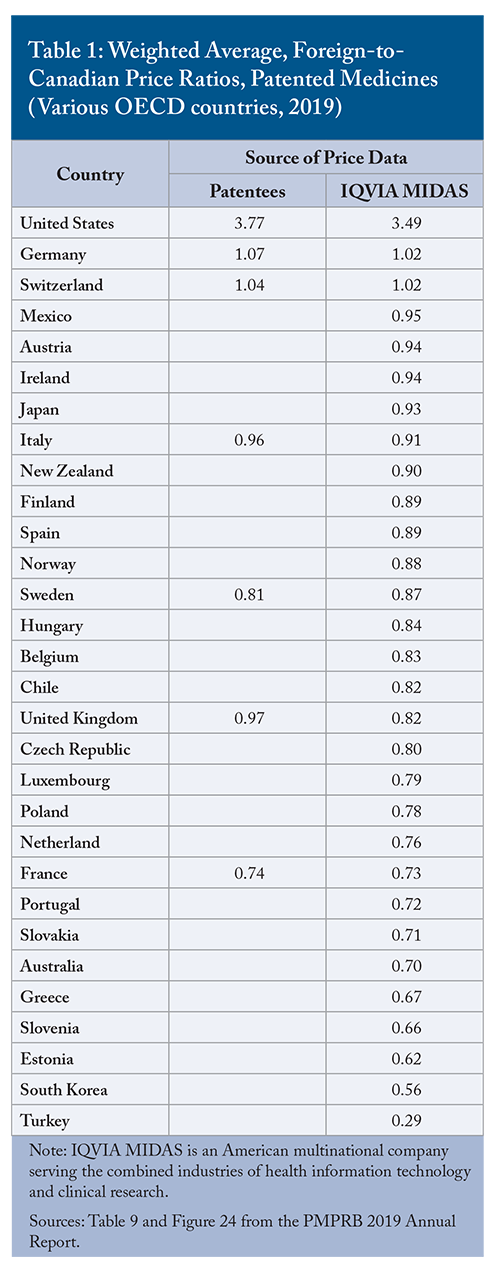
The seven entries in the first column compare the ex-factory list prices that sellers have posted for patented drugs in Canada vis-a-vis those in seven OECD countries: the US, the UK, Switzerland, Germany, France, Sweden and Italy. In the past, the PMPRB has used these countries – known as the PMPRB7 – to determine price ceilings for some patented drugs.4Patentees are required to report on list prices in each of the PMPRB7 countries. The PMPRB defines which price lists are acceptable in PMPRB (2018a). Each entry is a weighted average of foreign-to-Canadian price ratios for medicines sold in both countries. The weights in this average reflect Canadian dollar sales for these drugs. Because some patented drugs sold in Canada are not sold in other markets, the set of comparator drugs will vary by country. It is also possible that drugs that are patented in Canada are not patented in the comparator country. Foreign currency units are converted to Canadian dollars using market exchange rates.
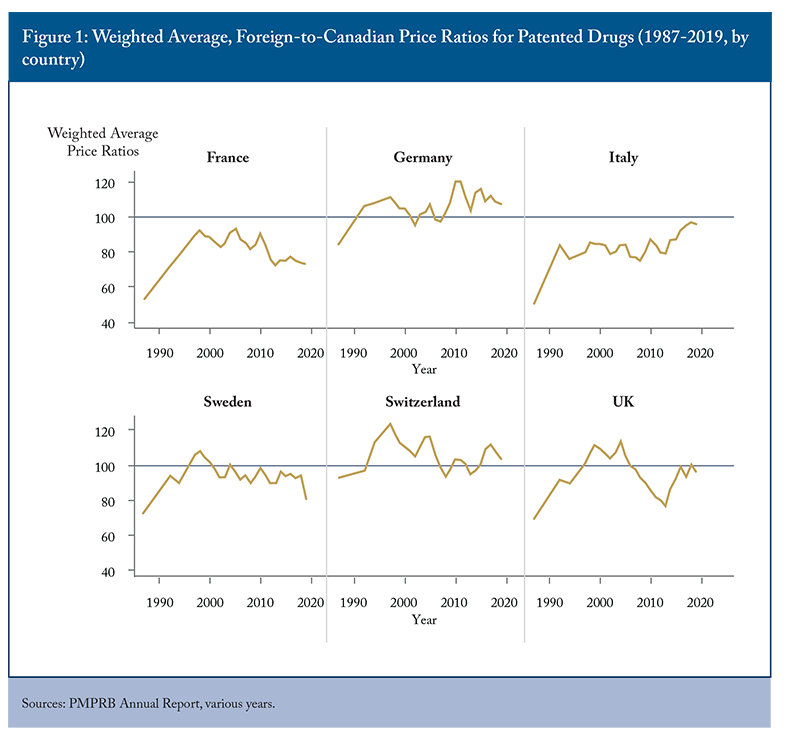
The average France to Canada price ratio at 74 percent is considerably lower than 100 percent or parity. The ratios for the remaining European countries are somewhat higher: prices paid in Sweden, Italy and the UK are, respectively, 81 percent, 96 percent and 97 percent of Canadian prices. Prices paid in Switzerland and Germany are 4 percent and 7 percent higher than those paid in Canada. US list prices are much higher than elsewhere, over three times higher than Canadian prices.
In the Figure 1 panels below, we show that the ratios of non-US PMPRB7 pricing to Canadian prices have varied considerably over time but that the relative position of the countries to Canada remains reasonably stable. The US-Canada ratio (not shown in the figure) has been at the high end throughout this period, but most of the growth that has resulted in its current outlier value has taken place in the past five years.
The estimates in the first column of Table 1 are based on the list prices reported to the PMPRB directly by the patentees themselves. These country-specific prices will in general be higher than the prices actually paid by the pharmacies that buy the drugs for resale to patients, because they do not reflect any discounts or rebates granted by the sellers, either on or off invoice.
Figure 24 in the PMPRB 2019 Annual Report displays relative price estimates calculated the same way as those displayed in the first column of Table 1, but the source of the pricing data is different and the set of comparison countries includes most OECD countries, not just those in the PMPRB7. Specifically, the estimates in Figure 24 of that report are derived from the 2019 Medical Information Data Analysis System (MIDAS) database produced by IQVIA, a leading provider of international pharmaceutical sales data. The price data that IQVIA collects are derived from a survey of pharmacies and reflect invoice prices paid by pharmacies in each country, net of an estimate of the wholesalers’ delivery fees.5Because they reflect pharmacy acquisition prices, they will exclude any pharmacy distribution markups or dispensing fees allowed by the drug plans. (Some Canadian private drug plans allow for a 10-percent pharmacy upcharge.) The IQVIA data reflect actual transaction prices more accurately than the list prices reported to the PMPRB because they account for any discounts that appear on the seller’s invoice. However, they may still overstate the true net cost to some extent because they do not account for any confidential off-invoice rebates or discounts paid to a drug plan or pharmacy. As we note below, these discounts may be substantial and may differ across plans.
The bilateral price comparisons based on the IQVIA data are reported in the second column of Table 1. The median OECD to Canadian price ratio is 81 percent, although some OECD countries pay prices that result in a markedly lower price ratio. As an example, among the set of drugs that are sold in both Canada and Turkey, the weighted average Turkish to Canadian price ratio is 29 percent. Prices paid in France and Australia are, respectively, 73 percent and 70 percent of Canadian prices. Prices paid in Sweden, Italy and the UK are respectively 87 percent, 91 percent and 82 percent of Canadian prices. The Italy and UK price ratios based on the IQVIA data are somewhat lower than the ratios of list prices in Column 1; the Swedish IQVIA price ratios are somewhat larger. Canadian prices are comparable to those paid in Switzerland and Germany but still are less than one-third the US prices.
The data in Table 1 suggest that, on average, Canadian drug prices are much lower than those in the US but clearly higher than in many other peer countries. Because they do not take account of any confidential price rebates, comparisons based on these data may be somewhat misleading. There is, however, some limited public information on the size of the confidential discounts. In Canada, members of the pan-Canadian Pharmaceutical Alliance (pCPA) – provincial, territorial and federal governments – obtain rebates that have been reported to be in the neighbourhood of 25 percent of list prices.6Green Shield, Sun Life, Manulife and other private insurers are also beginning to engage in confidential price negotiations, but it is unclear how large the resulting rebates are. These insurers administer group drug plans and also offer traditional insurance. Most of these group drug plans are provided by employers to employees. Given that some of the clients these insurers represent have drug benefit plans with few restrictions on what drugs are covered, the rebates are likely not as large as those obtained by the public drug plans (Auditor General of Ontario 2017). In Australia, there is evidence that rebates also are around 25 percent.7The Australian Department of Health reports the receipt of $3.27 billion in pharmaceutical rebates in 2016/17. The total pharmaceuticals budget for that year was $12 billion, representing a rebate of approximately 25 percent of total prescription drug costs (including distribution markups and pharmacy fees) but excluding patient co-payments. Pharmacy fees in that year were about $2.7 billion. For more, visit: https://www.aph.gov.au/About_Parliament/Parliamentary_Departments/Parliamentary_Library/pubs/rp/BudgetReview201819/Medicines and https://www.health.gov.au/sites/default/files/2016-17_department_of_health_annual_report.pdf. A brief to the Commonwealth Fund (Rodwin 2019) cites a study (Paris 2009) that estimates rebates paid in France were in the order of 10 percent to 30 percent. A 2012 study by Vogler et al. indicates that confidential rebates are provided to the public drug plans in 21 of the European Union’s 27 member states.
We can produce rough estimates of the ratios of foreign to Canadian actual transaction prices for patented drugs if we are willing to place bounds on the relative sizes of the proportional rebates. First, pre-rebate patented drug prices in Canada are much less than those in the US but are about one-third higher than prices in France and Australia. These price differences likely remain after accounting for confidential rebates. It seems unlikely that US rebates are sufficient to account for the three-fold price difference. Moreover, it is unlikely that rebates paid in Canada are sufficiently large relative to those paid in France and Australia to overcome the difference in public prices. The prices actually paid in Sweden, Italy and the UK, relative to those actually paid in Canada, are hard to estimate with precision, but it seems plausible that these countries pay prices that are 90 percent or less than Canadian prices, assuming that the rebates (expressed in percentage discounts off list prices) in these countries are at least as large as those paid in Canada on drugs sold by government plans that are part of the pCPA.
Based on these data and assumptions, most observers would answer the question whether Canada is a free rider on other countries’ pharmaceutical R&D funding in the negative. True, the much higher prices paid for brand-name drugs in the US suggest that Canadians, on average, contribute a considerably smaller amount than Americans. But Canadians, on average, make a larger contribution than residents in most other high-income countries, including the UK, France and Australia, which reasonably could be classified as our peers.8Data on aggregate spending on prescription drugs indicate that higher patented drug prices tend to translate into higher per-capita spending on prescription drugs generally. OECD data for 2015 and 2017 show that per-capita spending on prescription drugs in France and Australia, expressed in US purchasing-power-parity dollars, were only 82 percent and 70 percent of Canadian spending; the ratio for the UK was only 43 percent. The values for Germany and Switzerland were somewhat higher than in Canada. The US data showed per-capita spending some 50 percent higher than in Canada. This is much less than one would have expected by looking at the price data in the text, likely reflecting both more use of generic drugs in the US than in Canada and extensive confidential discounts that lowered payers’ actual drug costs.
The relatively high list prices of US patented drugs reflects the very considerable market power that sellers of pharmaceuticals and other healthcare-related products can exercise in a somewhat unregulated market environment, as we discuss next. While other countries have tried to counteract this market power through regulation and in other ways, the US has done so to a lesser extent, resulting in the pattern just described.
The patent system and the special characteristics of pharmaceuticals
For most goods and services, the idea that the patent holder should be the only legal seller of a new product may seem reasonable. Even if the lack of competition allows the seller to charge a high price and earn some monopoly rents, no one is forced to buy the product. The relatively high price of patented products often means that most of the monopoly rents are earned from relatively affluent buyers who are willing to purchase newly developed products even when they are expensive.
But new patented drugs (or other health-related products such as medical and diagnostic devices) are not bought and used by regular buyers. Many of those who use them are people who are experiencing cases of serious illness. Those who want access to them may be desperately looking for a drug that can save their lives or alleviate terrible suffering. In such situations, giving the patent holder the right to charge the highest price they can get from the buyers is harder to justify.
The case for putting limits on patent holders’ rights to exploit their pricing power may seem less strong when the cost of the drugs or medical devices are paid, in whole or in part, by public and private drug plans. However, drug plans get their funding from either premiums or tax revenue and have countervailing market power only insofar as they can refuse to cover the drugs or devices if they consider their prices too high. Some public drug plans that have done so have come under extreme pressure from desperate patients, especially in cases where there is no alternative to the patented products. Unless restrictions are placed upon patent holders, sellers of products that are needed by seriously ill people have a great deal of pricing power for both insured and uninsured buyers.9Hollis (2002) argues for re-introduction of a limited version of compulsory licensing, a restrictive feature in earlier Canadian patent law that we discuss below. He also draws attention to the fact that when provincial governments are subject to language under which they are legally obliged to provide patients with any drug that is “medically necessary,” it is not clear that there is any limit on the price that a seller may ask.
In recognition of this issue, most countries either have some form of regulation that limits the ability of patent holders in the pharmaceutical sector to fully exploit their pricing power or have moved toward centralized purchasing in which drug prices are negotiated between the patent holders and agencies that represent large groups of insured buyers (sometimes the entire population) and, therefore, have substantial countervailing market power. As we discuss below, the current Canadian system has elements of both approaches: drug prices are regulated by the PMPRB and the pCPA negotiates with patent holders (and suppliers of generic medicines) on behalf of federal and provincial government drug plans.10While the outcomes of the negotiations regarding patented drugs are confidential, the negotiated prices of generic drugs are public and are posted on the agency’s website. Moreover, governments have mandated that pharmacies charge these negotiated prices to private payers as well.
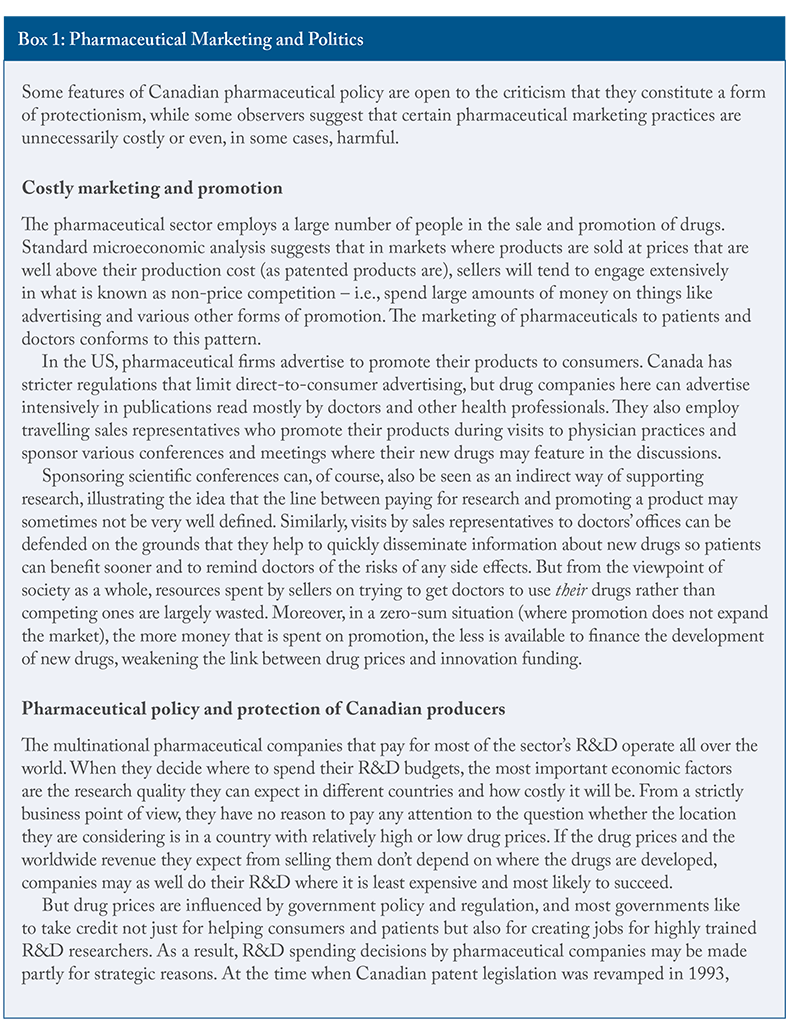
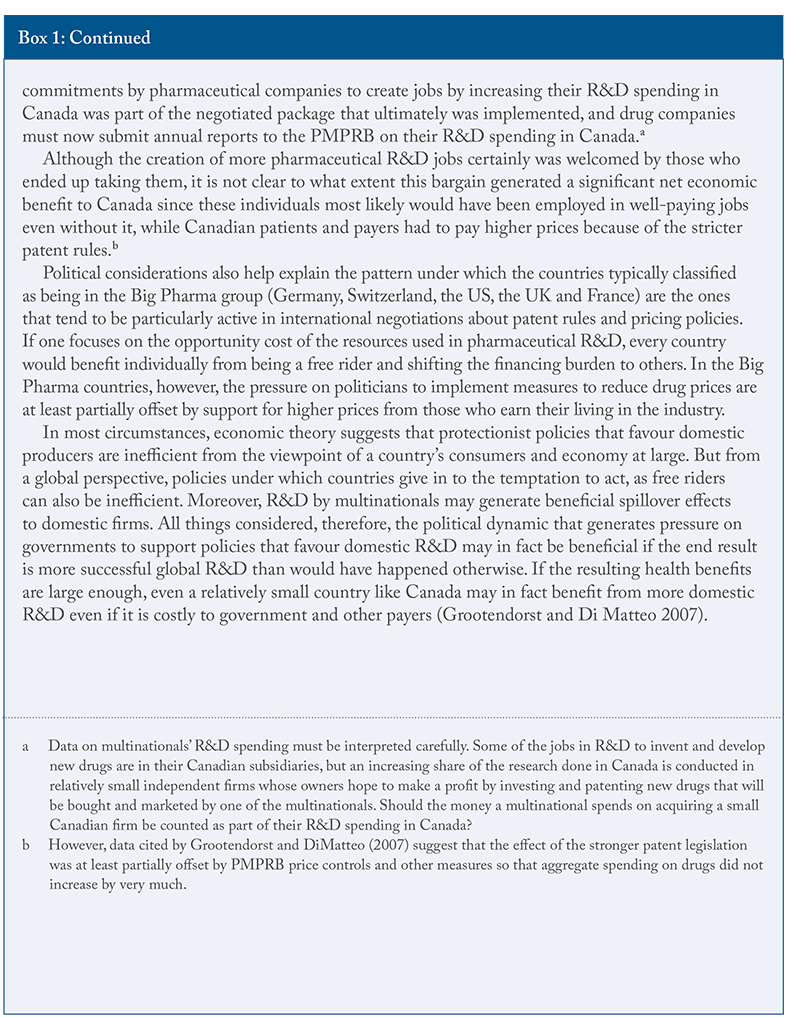
The international patent system and the way it has been applied to pharmaceuticals have been criticized, sometimes sharply (Lexchin 2016). We agree that it has sometimes given rise to questionable practices and policy measures (Box 1). It has, however, scored many remarkable successes and is a globally accepted system that will be with us for the foreseeable future. As a member of the international community, Canada must pursue policies that recognize that reality but should also improve on the approaches we have used in the past.
Pharmaceutical Pricing in Canada: Past and Present
In this section, we briefly review how the pricing of brand-name pharmaceuticals in Canada has been influenced by changes in the underlying patent legislation, by the regulatory activities of the PMPRB and by the creation of the pCPA, which has had a major impact on the relative market power of buyers and sellers and, hence, on net prices.
Patent law and pharmaceuticals in Canada
For much of the 20th century, Canadian patent law had a special provision that limited the pricing power of pharmaceutical patent holders and laid us open to the charge that we were to some extent acting as free riders on other countries’ R&D. Specifically, if a Canadian firm wanted to produce and sell a generic version of a patented drug, the patent holder was obliged to grant it a licence to do so in exchange for royalty payments that were fixed at 4 percent of the seller’s revenue. Although this provision – known as “compulsory licensing” – had existed since the 1920s, it was rarely used before 1969 because the law stated that compulsory licences would be granted only if the generic drug in question was to be manufactured using Canadian-produced active ingredients, which often were unavailable. In 1969, however, the Patent Act was changed to allow granting compulsory licences for generic drugs produced with imported ingredients, a change that led to rapid growth in Canada’s generic drug industry.11For a review of the history of compulsory licensing, see Government of Canada (1985). That report is often referred to as the Eastman report, after the name of the head of the commission that produced it.
Needless to say, the compulsory licensing system was controversial as it tended to diminish the Canadian revenues from sales of the patented originator (i.e., brand-name) versions of the drugs. Canada came under considerable pressure to modify the system during the initial free trade negotiations with the US in the 1980s and, later, as the agreement was re-negotiated and expanded to include Mexico in the NAFTA. In response, Canada changed its rules so as to reduce or delay the competition from generics, initially by guaranteeing brand drugs a minimum of seven years of market exclusivity (in 1987) and later by abolishing the compulsory licensing system entirely (in 1993).
Canada has also enhanced the protection of the patent holders’ market power in other, indirect, ways. It has made it more costly for generic drugs to be approved for sale by not allowing generic firms to rely on data from clinical trials of the brand drug until several years after it had been introduced (the “data protection” period). It has also introduced so-called “linkage” regulations that delay generic entry until the courts rule on disputes with respect to intellectual property that the seller claims are relevant. Most recently, in the negotiations about the Comprehensive Economic and Trade Agreement between Canada and the European Union and when NAFTA was replaced by the Canada-US-Mexico Agreement, attention has shifted to the rules that apply to patents on biologic drugs – drugs produced from living organisms – and the market entry of competing “bio-similar” versions.
The specific issues that were debated in these negotiations may seem arcane, but in general the underlying rationale remains the same: other countries don’t want us to have patent laws and regulations that significantly reduce drug prices here in comparison to those in other countries and, therefore, reduce Canada’s contribution to the funding of pharmaceutical R&D through the patent system.
Drug-price regulation by the PMPRB
Canada’s Patented Medicine Prices Review Board was established in 1987 as part of the same reform package that modified the compulsory licensing system that year. As noted in the introduction, new rules that govern the PMPRB’s regulation of patented drug prices are slated for coming into force in January 2022. In the following paragraphs, we briefly describe the agency’s regulatory function and the most important of these coming changes.
The PMPRB’s mandate is to ensure that the prices patentees charge are not “excessive.” The law itself has never precisely defined what excessive might mean beyond a general description of what “factors” the PMPRB is required to take into account (mostly prices of similar drugs or prices that are charged for the drug in other countries). In practice, the PMPRB sets the maximum price for a patent-protected drug partly on the basis of its assessment of the drug’s therapeutic novelty, as decided by the agency’s Human Drug Advisory Panel. Each drug is assigned to one of four categories that range from “breakthrough” to “slight or no improvement.” Depending on the category, the allowable price has in the past been calculated on the basis of domestic prices of other drugs in the same therapeutic class or on the median price at which the drug is sold in the PMPRB’s seven comparator countries – the PMPRB7. Also, all patented drugs, regardless of therapeutic novelty, had to be priced lower than the highest price charged internationally.
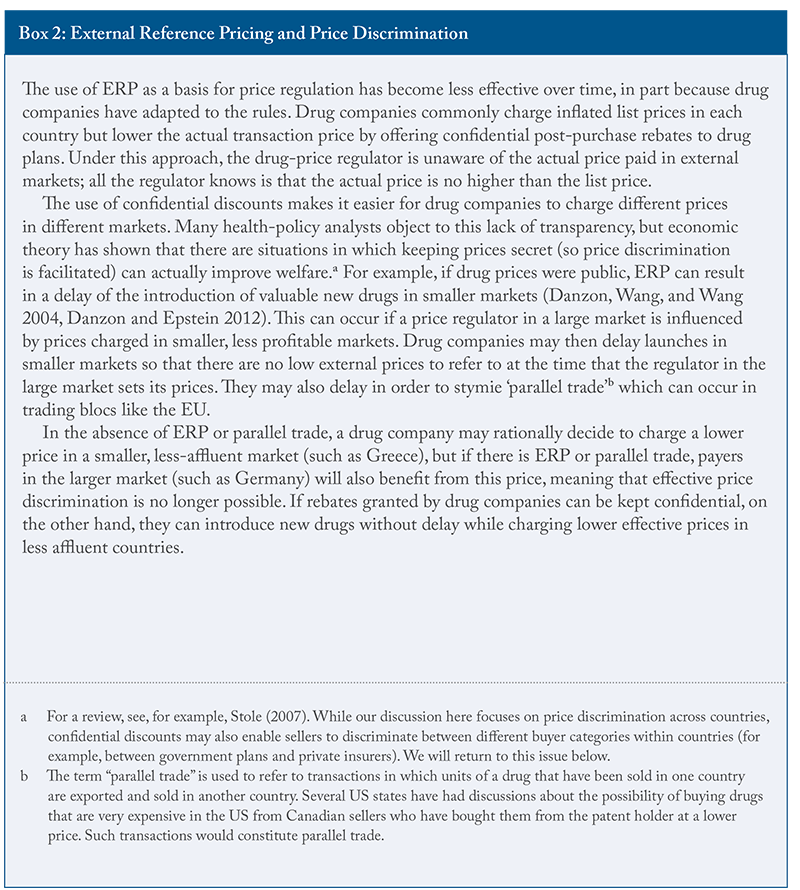
Not surprisingly, comparisons with prices in other countries – often referred to by the acronym ERP, for external reference pricing – have played a major role in regulating and negotiating drug prices in many countries. Pricing agencies can use international comparisons to support the argument that their home country is contributing its fair share to R&D financing. In Canada, the framers of the legislation that created the PMPRB and its ERP mechanism explicitly tied Canadian prices to those charged in other high-income countries rather than to the lower prices often observed in lower-income ones. In recent years, however, ERP has become criticized because it has unintended side effects on the patent system (Box 2).
The new legislation regarding drug-price regulation will give the PMPRB new tools to regulate prices (Government of Canada 2017). In setting the maximum price for a new drug, it will still refer to prices of the same or similar drugs charged domestically or internationally, but there will be changes to the set of comparator countries. The US and Switzerland, two relatively high-price countries, will be replaced by six countries whose list prices tend to be lower than Canada’s. The new rules also require the PMPRB to use certain new “economics-based price regulatory factors” in setting prices. These new factors include pharmacoeconomic evaluation (an estimate of the new drug’s cost-effectiveness) and estimates of the total expected spending on the drug.
Preliminary indications are that the new rules will result in very substantial price reductions if they are implemented in the way the agency has proposed. Needless to say, the pharmaceutical industry has sharply criticized the new regime and has challenged it in court, even though the rules have not yet come into force. Early court decisions have already led to modifications in the way the PMPRB will be allowed to apply the rules (in particular, with respect to the role of information about confidential discounts in the regulatory process).12For discussions of the challenges, see Smith (2020) and Gagné and Jospé (2021). Even if the outcome may ultimately be a somewhat weaker form or regulation than originally envisaged, a question that remains is to what extent a country that aggressively regulates drug prices can still be said to respect the spirit of the international patent system.
Drug prices and the pan-Canadian Pharmaceutical Alliance
As noted earlier, the pan-Canadian Pharmaceutical Alliance negotiates with the pharmaceutical companies about the prices of new patent-protected drugs that are supplied through federal, provincial and territorial drug plans, such as those that cover seniors and social assistance recipients. The pCPA originated as a consortium of provincial and territorial governments in 2010; in 2016, the federal government joined them, meaning that the negotiated prices now apply to its drug plans as well.13Updates on the activities of the pCPA are available on the website of the Council of the Federation, an organization that coordinates joint efforts by the provinces and the federal government. Historical background and discussion of its mandate is provided in Council of the Federation (2014), and a recent critical account of its activities is in Salek et al. (2019). One area in which the pCPA has been particularly effective has been the pricing of generic drugs that have become considerably less expensive in Canada in recent years (Grant 2018).
While the pCPA does not reach the status of a nationwide, centralized buying agency of the type that can be found in Europe and the antipodes (Blomqvist and Wyonch 2019), the fact that it negotiates on behalf of buyers that jointly pay for about half of all prescription drugs in Canada means that it has considerable bargaining power. This power ultimately derives from the fact that a seller’s expected revenue from a given drug depends critically on insurance plan decisions whether or not to include the drug in their formularies (lists of drugs that they cover).
Drug companies have strong incentives to ensure that their drugs are listed in public and private plan formularies. In Canada, prescribing doctors have no direct incentive to pay attention to drug prices; since they pay no part of the cost, their prescribing choices do not affect their own net income. However, if a drug is expensive, patients may not actually buy it even if it has been prescribed, unless most of the cost is picked up by the drug plan. This is particularly the case for individuals who use many prescription drugs or are less affluent – both of whom tend to be covered by public drug plans. Moreover, prescribing physicians tend to become familiar with the drugs listed on the provincial government drug plans, and this may make these drugs top-of-mind when they make prescribing choices, including for those with private coverage. To ensure that their drugs are included in public drug plan formularies, pharmaceutical companies must offer prices that are acceptable to the plans. The fact that the plans can refuse to include a new drug in their formularies is what gives them a great deal of bargaining power when they negotiate prices with patent holders.
In making formulary decisions, plan managers must take into account the collective interest of the taxpayers, employers and other premium payers who want to restrain aggregate costs, but they are also subject to pressure from insured clients to cover new drugs that show promise in generating better health outcomes. In performing the delicate balancing act between these objectives, public plan administrators are increasingly appealing to some form of pharmaco-economic evaluation when justifying a decision to not cover a drug. The approach most commonly used today is cost-utility analysis (CUA), a methodology that uses data from randomized controlled clinical trials and other sources to measure the health gains and costs of a new drug vis-a-vis that of the drugs (or other health interventions) currently used. In Canada, most CUA expertise resides in the Canadian Agency for Drugs and Technologies in Health (CADTH), a non-profit agency that is jointly funded by provincial and federal governments, and its sister organization in Quebec, the Institut national d’excellence en santé et en services sociaux. Since 2003, these two agencies have provided cost-effectiveness estimates and listing recommendations for new drugs that the provincial and federal government drug plans consider for formulary inclusion.14A succinct description of this process, know as the Common Drug Review, is provided on the CADTH website. Since 2007, there is a separate review process, the pan-Canadian Oncology Drug Review, for cancer drugs.
The pricing negotiations between the pharmaceutical companies and the pCPA are confidential, not just with respect to the size of the discounts that have been negotiated but also with respect to what factors have featured in them. We, therefore, cannot determine the impact of the CADTH’s value-for-money assessments on the discounted prices government plans have actually paid for patented drugs, but it seems very likely that they have been influential. These assessments also have played a role in provincial decisions about formulary inclusion.
CUA remains controversial, especially with respect to how the PMPRB should use it in price regulation. As well, it has many methodological issues that are far from settled. Nevertheless, we believe that CUA’s logical basis is compelling, and that it should have a prominent role in Canada’s future drug-pricing system.15While CUA-related decisions about formularies most likely have had a major role in Canadian public plans’ efforts to control costs, that method does not appear to have been extensively used in private insurance. Until recently, private plans have tended to cover most drugs approved by Health Canada on equal terms (Canadian Life and Health Insurance Association 2018). In the US, differentiated formularies that cover different drugs on different terms have been prominent tools for pharmaceutical benefit managers, firms that help private employers manage their health insurance plans and negotiate price reductions with pharmaceutical companies (Morton and Kyle 2012).
While the pCPA may have reduced the net cost of drugs to public plans, it has been criticized for causing long delays before many new medicines are listed in plan formularies and, hence, are eligible for reimbursement (Salek et al. 2019). These delays have been due in part to the process of negotiating the confidential discounts and, in part, to the time that the plans have subsequently taken to decide whether to list a drug, given the discount. Private plans, which pay prices that are closer to list prices, have been able to give their clients faster access to many of these medicines. As a result, it is not surprising that the Canadian Life and Health Insurance Association (CLHIA), which represents private insurers, has been vocal in supporting the PMPRB reforms16See, for example, the quote from the Canadian Life and Health Insurance Association in the e-newsletter Life Health Professional available at: https://www.lifehealthpro.ca/news/pmprb-finalizes-new-drugpricing-guidelines-334557.aspx. since lower regulated list prices would reduce their costs but allow them to continue giving their clients access to new drugs without long delays.
The future: Regulation vs. centralized purchasing
The growing role of the pCPA in negotiating confidential discounts means that the Canadian model for establishing drug prices has been undergoing major changes for some time. With the federal government announcing its commitment to implementing some form of universal pharmacare in the 2019 budget it was reasonable to expect that further changes were coming, even before the legislation that provided the PMPRB with new tools.
The pCPA experience confirms that a negotiated approach based on the joint purchasing power of large insurance plans working together can be quite successful in obtaining lower drug prices while respecting the spirit of the international patent system. This has also been the experience in many of Canada’s peer countries such as, for example, Australia where a pricing or purchasing agency negotiates on behalf of a universal drug-insurance plan. (In the Appendix, we discuss a feature of the Australian system that Canada might want to emulate in the future.)
In negotiating with companies about drug prices, countries such as the UK and Australia draw heavily on pharmacoeconomic evaluations such as CUA. A drug’s estimated cost-effectiveness according to CUA is also among the new “economics-based price regulatory factors” that the PMPRB will consider when determining the maximum prices for new drugs after its new rules come into effect. We believe CUA can have a useful role to play when buyers negotiate with sellers about prices, but it is less clear whether it is an appropriate tool for regulation. In one sense, price regulation may be considered just as an alternative to increased bargaining power on the buyers’ side in obtaining lower drug prices. From a legal viewpoint, however, there is obviously a distinction between regulation and negotiation. While CUA is widely used, many aspects of it are still controversial, and a regulatory regime in Canada that led to substantially lower drug prices than we have had in the past could well be considered by some as being inconsistent with the spirit of Canada’s international obligations under the patent system and various trade agreements. We will return to this question in the concluding section.
Policy Recommendations
In framing a new drug-pricing policy, we believe Canada should pursue a two-track strategy. On one hand, Canada should participate actively in negotiations about the way countries collaborate in strengthening the international agreements and institutions that deal with new drug and vaccine development and other aspects of the global commons. On a parallel track, the federal government should, in collaboration with the provinces, pursue policies that try to reduce the cost of drugs subject to the constraint that we pay our fair share of global R&D costs.
Improving the international burden-sharing system
Historically, the patent system has produced a large amount of highly beneficial innovations. In recent years, however, its shortcomings as a mechanism for financing the development of new knowledge and technology have become increasingly evident, with disputes about enforcement of intellectual property law and forced technology transfer, as well as about drug-pricing policies.17Comprehensive surveys and discussion of how the patent system works in the US and internationally can be found in Danzon (2011) and Goldman and Lakadawalla (2012). Hollis (2016) reviews some of the patent system’s problems and discusses alternatives to it. Technology and knowledge have global benefits, and the question how large a portion of the world’s economic resources should be devoted to R&D, and who should pay for it, can be settled in an efficient and equitable manner only through negotiations among the major countries that are part of the international economic system. In the area of patent legislation that relates to pharmaceuticals, the federal government should do what it can to support efforts by multilateral institutions such as the World Health Organization, the World Trade Organization (WTO) and the UN to promote such negotiations, which ideally should include agreements on the basic parameters of each country’s patent legislation and on the relative weights given to direct government financing of R&D in comparison to revenues generated through the patent system.
To the extent that such a burden-sharing model would continue to be based on the patent system, it most likely would produce a structure in which the relative prices of drugs in different countries would reflect the highest amounts that health-system managers would be willing to pay for the expected health benefits of new drugs (perhaps based on estimates by an international agency). In CUA, health benefits are quantified as quality-adjusted life years (QALY). Since one would expect the maximum willingness to pay for an incremental QALY would vary with the country’s average income, countries with the highest per-capita income would pay the highest prices. As well, one might expect a narrowing of the current gap between prices in the US and other countries, if pricing based on CUA were to come into wider use in the US.
Ideally, international negotiations on burden sharing could also continue the process of making patent legislation simpler and more uniform. For example, patent holders in many countries have, in the past, been able to effectively extend the duration of a drug’s patent protection by repeated filings of new patent applications that cover variations of what is essentially the same breakthrough drug. Provisions that extend patent protection to what may be seen as relatively minor variations can be justified to some extent on the grounds that they imply an incentive for developing further improvements on breakthrough drugs, but they may also raise payer costs if they delay entry of competition from generics. Such delays may happen as a result of “evergreening” – new patents that can be used in claims that a generic entrant is guilty of infringement. In recent years, revised rules have reduced the scope of such practices, but further simplification and international coordination of patent law may be possible. An additional benefit of simplified rules for generic entry may also be that they would reduce the extent and costs of litigation activity in the pharmaceutical sector, which have been large in recent years.
While a negotiated multilateral system should be the ultimate goal, it is one that won’t be reached until many years from now, if ever. In the meantime, Canada should take unilateral action to reform and streamline its current drug-pricing model in various ways. As our earlier discussion has suggested, it should do so in a manner that promotes better control over the aggregate cost of pharmaceuticals and more cost-effective use of drugs but also makes it possible for us to truthfully claim that Canada is not a free rider: that we are carrying our fair share of global pharmaceutical R&D financing. The new Canadian Drug Agency – that the federal government is establishing as part of its plans to implement universal pharmacare – could be helpful here, whether or not pharmacare fully materializes.
Strengthen the federal role through the Canadian Drug Agency
A natural way to strengthen the federal role in pharmaceutical pricing would be for the CDA to take over the pCPA’s current role. The plans for the CDA were first announced in the 2019 federal budget, where it was stated that it would “negotiate drug prices on behalf of Canada’s drug plans.” Although the announcement did not specify whether “Canada’s drug plans” was meant to include private as well as public plans, it seems reasonable to assume that the intention was to at least leave that possibility open.
Through the pCPA, Canada’s provincial governments have already embarked on a course that has led to lower drug prices. The federal government should negotiate an agreement with the provinces under which the CDA would take over the pCPA’s role, and the CDA should negotiate confidential discounts on behalf of all plans, private or public.18In taking on this role, the CDA should be given enough resources to be able to undertake its evaluations and negotiations quickly to avoid the delays in access to new medicines that have plagued public plans in recent years. Currently, the confidential discounts are not applied to drugs that are privately paid for, meaning that privately insured Canadians, and those without comprehensive insurance, implicitly are asked to pay a larger share of Canada’s contribution to global R&D financing than those insured under government plans. This obviously adds to the financial burden for those who are not covered by public plans, and the higher cost also is likely to reduce the willingness of employers to offer health insurance as a fringe benefit for individuals in low-paying and short-term jobs.19Extending the benefit of lower prices to private plans would also make it easier for provinces to attain universal pharmacare coverage through a mixed private-public model like the one that currently is used in Quebec (Blomqvist and Busby 2015). In making the recommendation that private insurers should enjoy the same price reductions as government plans, we are assuming that the reduced cost gets passed on to those who pay the premiums.
Provincial governments may object to this suggestion on the grounds that the pharmaceutical companies may be less willing to grant substantial discounts if these must be applied to all sales, not just to participating government plans. Such objections could be overcome through the federal government offering the provinces increased transfers as part of a deal to establish some form of universal pharmacare, whether in the form of a single public plan or a mixed public-private model of the form already used in Quebec.
With universal pharmacare, every Canadian would be covered by a public or private plan. A CDA with a mandate to negotiate drug prices on behalf of all drug plans would then become the de facto national agency negotiating the prices of brand-name drugs sold in Canada, similar to agencies that exist in Australia and some European countries.
The pCPA ultimately derives its bargaining power with brandname drug manufacturers from the fact that the government plans on whose behalf it negotiates can threaten to not include a new drug in their formularies. In making their listing decisions, provincial plans draw on the recommendations by the CADTH. Since the work that the CADTH does is of benefit to all Canadian plans, we think it also should become part of the CDA. Again, this seems to have been the federal government’s intention when the plans for the CDA were initially announced: the 2019 budget presentation stated that the new agency would “assess the effectiveness of new prescription drugs” and “recommend which drugs represent the best value-for-money for Canadians.”
Using its expertise in pharmacoeconomic analysis, the CDA would also be charged with the task of developing a model formulary, which provincial and private plans could adopt or modify as they saw fit. Assuming a CDA formulary would become the guide for government and private plans across Canada, the threat of not including a drug in it could give the CDA considerable bargaining power when negotiating prices of new brand-name drugs.20Morgan et al. (2015) emphasize the importance of properly constructed formularies in steering prescription behaviour in more cost-effective directions, as well as their use in negotiations about reduced prices. The pharmacoeconomic evaluation method it should use should be some form of CUA, as in Australia and the UK. In CUA, the basic metric is the cost per incremental QALY that is expected from a new drug or healthcare intervention (relative to the standard of care). In countries where CUA is widely used, there typically is public discussion of the critical value that should be used as the maximum amount that society is willing to pay for an additional QALY. Estimates of the incremental QALYs that could be expected from a new drug (measured relative to an existing therapy) can then be combined with this critical value as a helpful element in discussions about the maximum price that payers could be expected to pay for a new drug.
Redefining the role of the PMPRB
Under a pharmacare model in which every Canadian is insured and the CDA negotiates prices on behalf of all payers, every buyer would pay the negotiated net prices. In these circumstances, the need for a separate agency with responsibility for regulating patented drug prices would weaken or disappear. However, the need for expertise in comparing Canadian and foreign drug prices, and our other contributions to global R&D financing, will continue to be important in informing the CDA’s negotiating strategy. As part of its past regulatory mandate, the PMPRB developed a great deal of expertise in this area, and even if it no longer had a price regulatory mandate, it could continue to collect and report data on Canada’s contribution to global R&D financing. The agency’s reporting mandate would generate important evidence to refute assertions that we are free riders. Administratively, therefore, it seems reasonable that the functions and personnel of what at present are the pCPA and PMPRB would be combined in a CDA branch responsible for negotiating drug prices. A beneficial side effect of such a consolidation could be a streamlined and shortened process of satisfying the various regulatory and reporting steps that must be completed before a new drug’s price is determined and approved for sale.
Although stricter regulation along the lines contemplated under the new PMPRB rules certainly could be used to bring about lower drug prices, it may also invite complaints against Canada under the WTO or other international agreements. A process of negotiating prices could be less controversial, even if it were done by a centralized buying agency and be less likely to draw complaints. Although regulation would become largely irrelevant, there would be no harm in keeping the language of the Patent Act and regulatory rules on the books but with new guidelines to reflect the changes to the system. Paradoxically, in a new model along these lines, it might be in Canada’s interest to continue the practice of negotiating for effective net prices that are reduced through confidential discounts while allowing sellers to continue posting higher list prices. From the viewpoint of private and public insurance plans, these list prices would be irrelevant since all of them would be eligible for the discounts. From the sellers’ point of view, keeping the negotiated net prices confidential might be an advantage because that might reduce the risk that buyers in countries with higher prices would try to obtain their drugs through “parallel imports” from the Canadian market or use regulation to explicitly tie their prices to those paid in Canada.
Appendix: Specifying the CDA’s Mandate
Normally, the mandate of a purchasing agency that negotiates on a collective’s behalf is to buy at the lowest possible price. A national buying agency that procures pharmaceuticals on behalf of a country’s insurance plans, however, should not be given this mandate. If it did, the country it represented would be a free rider that shirked its responsibility to contribute a fair share to global pharmaceutical R&D, as discussed in the text. For this reason, the CDA’s mandate should instead be to negotiate prices that the international community would accept as consistent with Canada’s implicit R&D obligations.
In order to direct Canada’s contribution to pharmaceutical R&D toward those drugs that are most valuable to patients, the CDA could aim to negotiate prices that reflected the various drugs’ expected health benefits. That is, the relative prices that CDA should try to negotiate should be based on exactly the kind of pharmacoeconomic evaluations that it would take over from the CADTH.
As discussed in the text, CUA health benefits are measured in QALYs, and if a maximum value that provincial insurance plans are prepared to pay for an incremental QALY is reasonably well established, it could also be the basis for the maximum price that the CDA should accept for a brand-name drug. If Canada were to accept drug prices consistent with our maximum willingness to spend money on other inputs in the healthcare system (such as hospital facilities or physician services), this could certainly be taken as a sign that we were contributing at least our fair share of global R&D financing. Indeed, one might even argue that by doing so, we would contribute more than our fair share in comparison to other countries where regulation and aggressive bargaining by monopsony buying agencies succeed in getting prices that are low enough to lay them open to the charge of free riding.
Centralized bargaining about drug prices on behalf of all Canadian payers can be conducted in a way that is not only consistent with Canada’s obligations under the international patent system but also implies incentives for more efficient utilization of new technology than under the current model. Standard economic theory suggests that when a good or service is priced above the cost of producing it, buyers have an inefficient incentive to restrict the quantities they use. In the context of patented drugs, the buyers are the insurance plans and individuals who pay for the drugs. Under the conventional approach, the prices that buyers pay the sellers must be above the cost of production if the patent holders are to recoup any part of their R&D costs. In response, cost-conscious individuals and insurers may try to reduce drug utilization, for example, by measures such as restrictive prescription rules or patient co-payments that serve to promote cheaper alternatives, even if they are less effective.
When a centralized buying agency undertakes purchasing and price negotiations, however, government can intervene in the process to overcome this problem and encourage more use of patented drugs that cost less to produce than the prices at which they are sold. One approach that has been used in Australia is for the buying agency to negotiate agreements under which sellers supply consumers with drugs at prices that approximate the cost of production, but the government pays the sellers a per-unit subsidy high enough to earn the sellers the same amount of profit as they would have under conventional patent-protected pricing (Johnston and Zeckhauser 1991). An alternative approach that would accomplish the same result would be for the buying agency to negotiate a two-tiered, price-volume agreement under which it negotiates a high per-unit, first-tier price up to a specified quantity and a lower second-tier price that approximates the production cost on additional units. To avoid any inefficient restriction of utilization in response to the first-tier higher prices, the agency could pay the sellers the higher price on these units but resell them to users at the lower second-tier price.
Under either of these approaches, the buying agency would need funding in order to cover the difference between the higher prices they paid the pharmaceutical companies and the lower prices they would charge the insurance plans and uninsured buyers. If Canada were to adopt a version of this model, the cost of this funding could be covered either by the federal government or shared among the provincial and territorial governments. Since the purpose of this arrangement is to ensure that Canada is seen as living up to its international obligations to contribute to a global public good, one might argue that its cost should be borne by the federal government. Having the federal government pay this cost may also be seen as an indirect transfer to help provinces with the cost of implementing some form of universal pharmacare.
References
Auditor General of Ontario. 2017. “Annual Report: Ontario Public Drug Program. (Ministry of Health and Long-term Care).” Available at.
Australia. 2017. Department of Health. “Annual Report 2016-17.” Available at .
Blomqvist, Åke, and Rosalie Wyonch. 2019. High drug prices, big R&D spenders and ‘free riders:’ Canada in the topsy-turvy world of pharmaceuticals. Commentary 535. Toronto: C. D. Howe Institute. March.
Blomqvist, Åke, and Colin Busby. 2015. “Feasible pharmacare in the federation.” E-Brief. Toronto: C.D. Howe Institute. October 21.
Canadian Life and Health Insurance Association. 2018. “Submission on the National Pharmacare Discussion Paper to the Advisory Council on the Implementation of National Pharmacare.”
Council of the Federation. 2014. "Pan Canadian Drug Negotiations Report." IBM Medical. Available at .
Danzon, Patricia, Y. Richard Wang, and Liang Wang. 2004. “Impact of price regulation on the launch delay of new drugs – evidence from twenty-five major markets in the 1990s.” Health Economics. 14:269-92. September.
Danzon, Patricia. 2011. “The economics of the bio-pharmaceutical industry.” Chapter 22, pp. 520-54 in Sherry Glied and Peter C. Smith, eds. The Oxford Handbook of Health Economics. Oxford University Press.
Danzon, Patricia, and A. J. Epstein. 2012. “Effects of regulation on drug launch and pricing in interdependent markets.” Advances in Health Economics and Health Sciences Research. 23: 35-71.
Gagné, Martin, and Dara Jospé. 2021. “Superior Court of Québec rules PMPRB regime is constitutional but strikes disclosure of third-party rebates.” Fasken Life Sciences Bulletin.
Goldman, Dana, and Darius Lakdawalla. 2012. “Intellectual property, information technology, biomedical research, and marketing of patented products.” Chapter 13, pp. 825-72 in Mark V. Pauly, Thomas G. McGuire, and Pedro P. Barros eds., Handbook of Health Economics, Volume 2. Elsevier-North Holland.
Government of Canada. 1985. Report of the Commission of Inquiry on the Pharmaceutical Industry. (The Eastman Commission). Ottawa: Minister of Supply and Services.
______________. 2017. “Amendments to the Patented Medicines Regulation, Patented Medicine Prices Review Board Modernization: Cost-Benefit Analysis.” Strategic Policy Branch. Health Canada. September.
______________. 2019. “Budget 2019: Moving forward on implementing national pharmacare.” Department of Finance.
Grant, Kelly. 2018. “To avoid open bidding, generic-drug makers cut prices outside Quebec.” Globe and Mail, January 29.
Grootendorst, Paul, and Livio Di Matteo. 2007. “The effect of pharmaceutical patent length on research and development and drug expenditures in Canada.” Healthcare Policy. 2 (3), pp. 63-84
Grootendorst, Paul, et al. 2018. “Intellectual Property Protection and Drug Plan Coverage: Evidence From Ontario.” International Journal of Health Services. 48 (4), pp. 712-15.
Hollis, Aidan. 2002. “The link between publicly funded health care and compulsory licensing.” Canadian Medical Association Journal. 167 (7), pp. 765-66.
___________. 2016. “Sustainable financing of innovative therapies: A review of approaches.” Pharmacoeconomics. 34:971-80.
Johnston, Mark, and Richard Zeckhauser. 1991. “The Australian pharmaceutical subsidy gambit: Transmuting deadweight loss and oligopoly rents to consumer surplus.” NBER Working Paper No. 3783.
Lexchin, Joel. 2016. Private Profit versus Public Policy: The Pharmaceutical Industry and the Canadian State. University of Toronto Press.
Morgan, Steve, et al. 2015. “Pharmacare 2020: The future of drug coverage in Canada.” Vancouver: Pharmaceutical Policy Research Collaboration. University of British Columbia.
Morgan, Steve, et al. 2015. “Estimated Cost of Universal Public Coverage of Prescription Drugs in Canada.” Canadian Medical Association Journal. No. 187, pp. 491-97.
Morton, Fiona Scott, and Margaret Kyle. 2012. “Markets for pharmaceutical products.” Chapter 12, pp. 763-824 in Mark V. Pauly, Thomas G. McGuire, and Pedro P. Barros eds., Handbook of Health Economics, Volume 2. Elsevier-North Holland.
Paris, Valérie. 2009. “La regulation du prix de médicament en France.” Régards croisés sur l’économie 1 (5), pp. 215-25.
Parliamentary Budget Officer of Canada. 2017. “Federal cost of a National Pharmacare Program.”
Patented Medicine Prices Review Board. 2017. Annual Report 2017.
______________. 2018a. “Generics 360 – Generic Drugs in Canada, 2018.”
______________. 2018b. “Recognized Sources for Foreign Price Verification and Formulas: 2018.”
Patented Medicine Prices Review Board. 2019. Annual Report 2019.
Rodwin, Marc A. 2019. “What can the United States learn from pharmaceutical spending controls in France?” The Commonwealth Fund.
Salek, Sam M., et al. 2019. “Pan-Canadian Pharmaceutical Alliance (pCPA): Timelines Analysis and Policy Implications.” Frontiers in Pharmacology. 2019; 9:1578.
Smith, Abigail. 2020. “Innovators challenge final PMPRB Guidelines in new Federal Court application.” Smart & Biggar LLP. (accessed April 20, 2021).
Stole, Lars. 2007. “Price Discrimination and Competition.” Chapter 34, pp. 2221-99, in Mark Armstrong and Robert Porter, eds., Handbook of Industrial Organization, Vol. 3. Elsevier.
United States Trade Representative, Office of. 2020. 2020 Special 301 Report. April.
Vogler, Sabine, et al. 2012. “Discounts and rebates granted to public payers for medicines in Europe.” Southern Med Review. 5 (1), pp. 38-46.
The authors thank Rosalie Wyonch, Alexandre Laurin, Daniel Schwanen, Christian Ouellet, Cam Vidler and anonymous reviewers for helpful comments on an earlier draft. The authors retain responsibility for any errors and the views expressed.