




From: Lennie Kaplan
To: Alberta referendum watchers
Date: September 24, 2026
Re: How to Divide the National Debt if Alberta Wants Out: Two Scenarios
This Memo is part of a series the C.D. Howe Institute is presenting to better inform the public about the policy issues and complexities of the potential separation of Alberta, and its consequences on Albertans, businesses, and the rest of Canada. Today: Dividing the federal debt.
One of the most contentious aspects of Alberta independence would be negotiations over the division of the federal debt. (The carveout required to the Canada Pension Plan has already been well explored).
Many in the independence movement argue that Albertans already bear the burden of their share of the federal debt, so nothing has really changed. A core principle of the separatist Alberta Transition Council (ATC) Plan is continuity during the transition period, with the assertion that an independent Alberta would be able to manage its financial, economic and social affairs much more effectively and efficiently.
There are a number of different approaches that could be used to calculate federal debt allocation to Alberta, the most prominent being: 1) dividing the debt by share of population; 2) dividing by share of GDP; and 3) dividing by Alberta’s historical net fiscal contribution to Canada.
The ATC recommends Alberta negotiate its share of the federal debt by using Albertans’ historical net fiscal [over] contribution to Canada. However, this calculation would be a very complex, contentious, and fraught with uncertainty. And it would need to go beyond simply what Ottawa spends within provincial borders but include shares of such things as tax collection and national defence, as noted in last week’s University of Calgary report on the costs of separation.
The population and GDP debt-division formulae also have shortcomings. Dividing by share of GDP is relatively straightforward but does not recognize Alberta’s historical net fiscal [over]contribution, while also penalizing Alberta for its economic strength within Canada. Although dividing debt by Alberta’s share of Canada’s total population is a relatively simple calculation, it, again, does not recognize Alberta’s historical net fiscal [over]contribution.
I use the start of the 2028-29 fiscal year to build two scenarios of how debt division would affect a newly independent Alberta’s finances. They presume Alberta’s share of Canada’s total population will be about 12.7 percent, and its share of nominal GDP will be about 15.6 percent.
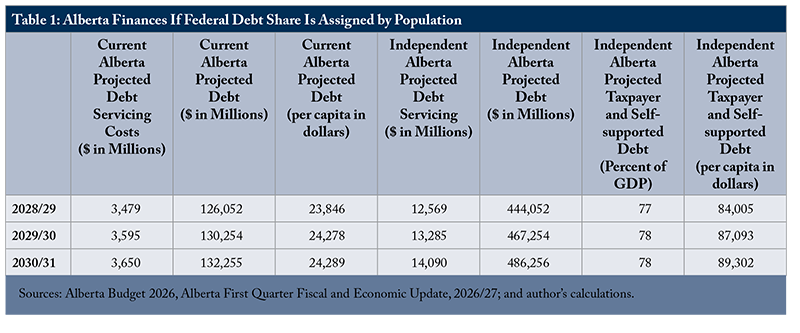
I project the Alberta government’s current provincial debt level will reach about $126 billion at March 31, 2029. Adding its share of the federal debt will boost that figure dramatically to $444 billion under the population scenario and almost $518 billion under the GDP formula. This would put the debt-to-GDP ratio at 77 percent or 90 percent, up from the current 22 percent.
The effect on debt-servicing charges is similarly large: Under the share of population scenario, the bill would be roughly $12.5 billion, and $14.5 billion using the share GDP scenario, up from the $3.5 billion in interest payments the Alberta is projected to pay if it stays.
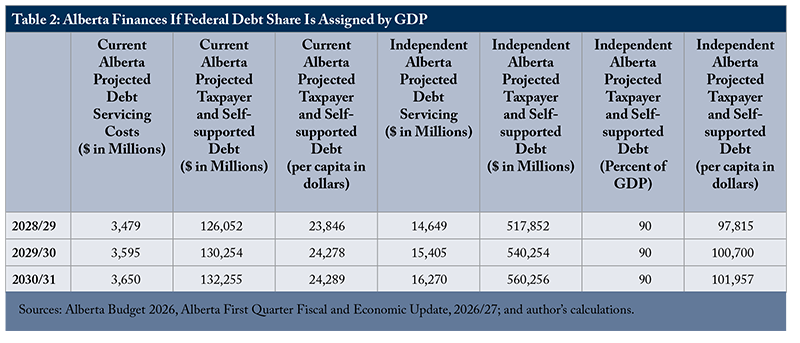
The Alberta government debt and debt servicing estimates outlined above are likely understated as they do not include the impacts of such elements as elimination of the federal GST, reductions in corporate taxes, and diverting a larger portion of royalty resource revenues in an expanded Heritage Savings Trust Fund; policies supported by many Alberta independence advocates.
Meanwhile, bond rating agencies and investors can be expected to want an interest rate premium for converting from Government of Canada to Government of Alberta paper, and the more acrimonious the debate becomes, the higher that premium may be. Research from Quebec and Scotland suggests an independent Alberta’s borrowing costs could be 50 to 150 basis points higher than Ottawa’s.
Ultimately, the division of federal debt is not straightforward and depends on whatever formula is ultimately used. The Alberta separatists should not assume that independence will automatically reduce deficits and debt.
Lennie Kaplan is a former senior manager in the fiscal and economic policy division of Alberta’s Ministry of Treasury Board and Finance and was Executive Director to the MacKinnon Report on Alberta’s Finances.
To send a comment or leave feedback, email us at blog@cdhowe.org.
The views expressed here are those of the author. The C.D. Howe Institute does not take corporate positions on policy matters.