



The Study In Brief
This study considers the issue of Crown corporation governance and whether there is an “optimal” or best approach. The annual commercial operations of Canada’s Crown corporations are equivalent to over 7 percent of Canadian GDP, yet there has been surprisingly little over-arching research on their role, operations, governance, financial performance, and policy impact.
The study focuses on two questions: (i) what shareholder governments should do to establish a rigorous approach to governance, which is called “framework governance”; and (ii) the specific governance instruments regularly used by shareholder governments and Crowns together, which is called “specific governance.”
Framework governance defines the Crown corporation’s purpose, market positioning, governance authorities, operating powers, and financial relationship with its shareholder. Crowns can be a dominant or monopoly service provider, compete with the private sector, or play a complementary role to build market capacity. A Crown can also be jointly owned with the private sector, and its role can evolve.
For a corporation that is jointly owned by government and private shareholders, defining in advance and in detail how a shareholder government could exercise influence over the Crown is arguably the most effective way to achieve the intended policy goals and avoid uncertainty.
A Crown’s formal mandate is best anchored in governing legislation that includes its governance structure and accountability relationships, detailed operating powers or authorities, and its financial relationship with the shareholder government. An authorized minister should be responsible for overseeing and reporting on the Crown’s mandate and operations. A commitment to a regular review, with public discussion, should ideally be part of the Crown’s legislated mandate.
Specific governance begins with defining the central role and selection of the board of directors, Chair and CEO. Good corporate governance practice suggests a Crown CEO should be appointed by the board, in consultation with the minister and government.
There should be close alignment between annual written policy guidance from the responsible minister, an annual Corporate Plan approved by the minister and government, and metrics for reporting on business and policy outcomes in the Crown’s Annual Report. A borrowing, capital or funding plan should accompany the annual Corporate Plan. A Crown can also be guided by a directive from the shareholder government or a Cabinet decision. The shareholder’s auditor should conduct an annual audit of the Crown’s financial results and undertake special examinations on occasion.
The governance approach developed in this study can be used to assess broad governance and policy issues facing Crowns, as well as the governance practices of specific Crown institutions and their shareholder governments.
Crown corporations, or what are often called state-owned enterprises (SOEs) more generically, are ubiquitous in the lives of Canadians.1To make a fine point, Crowns are not categorized as SOEs when they do not engage in commercial affairs and activities, for example the Canada Council for the Arts. Thanks to a reviewer who drew this distinction.
Crown activities range from producing, transmitting and distributing electricity, to selling alcohol and cannabis, to providing public transit, to managing ports, to delivering mail, to managing financial services. Federal, provincial and municipal Crowns are the dominant or sole service provider in some market segments, and an important player in many others.
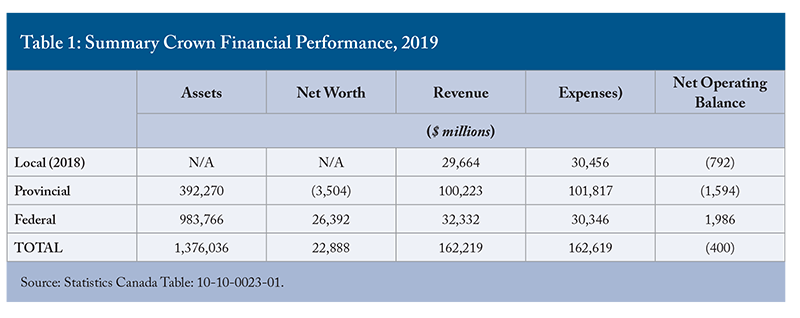
One way to appreciate the scope of Crown activities is to focus on recent Crown business results, assets and net worth, as provided in Table 1. Together, federal, provincial and local Crowns had annual revenues of $162 billion in 2019, although they generated a small collective net operating loss of $400 million. Federal and provincial Crowns had net assets of nearly $1.4 trillion in 2019, and net worth of almost $22.9 billion. (No collective balance sheet data are available for local, or municipal, Crowns, although data for revenues and expenses are.)
These financial data confirm the significant operating scale of Crowns but the operating deficits suggest that, in many cases, robust overall financial performance is not a top priority for Crowns or their various government shareholders. (See the Appendix to this paper for more a detailed discussion on recent Crown financial performance.)
Another approach to assessing their scope is comparing it to Canadian GDP. The annual commercial operations of federal, provincial and local or municipal Crown corporations are equivalent to over 7 percent of Canadian GDP – which is larger than the GDP of Atlantic Canada, or Saskatchewan and Manitoba combined, and similar to the GDP share of the oil and gas sector.
Yet despite their considerable economic footprint, there has been surprisingly little over-arching research on the role, operations, governance, financial performance, and policy impact of Canadian Crown corporations as a class of firms.
To help address the apparent research gap, this study considers the issue of overall Crown governance and whether there is an optimal or best approach. The focus is on two questions: (i) what shareholder governments should do to establish a rigorous approach to governance, and (ii) what specific governance instruments can be regularly used by shareholder governments and Crowns together. The governance approach developed in this study can then be used to assess broad governance and policy issues facing Crowns, as well as the governance practices of specific Crown institutions and their shareholder governments.
Critical Checklist for Optimal Crown Governance
Crown corporations are a form of public policy intervention designed to address market failure in various forms, and other pertinent socio-economic questions. The fundamental purpose of state ownership of enterprises should be to maximize value for society. If an entity in Canada: (i) has been established or is owned in whole or significant in part by the government; (ii) plays an identified public policy role; and (iii) operates in a commercial manner in whole or in part, it is de facto a Canadian Crown corporation.
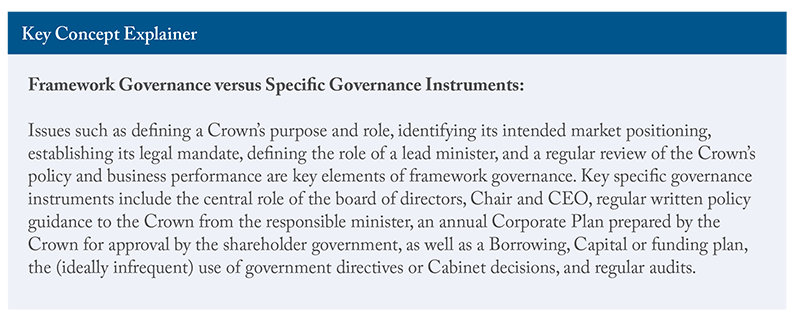
We draw a distinction in this study between “framework governance,” which should be a focus for shareholder governments, and more specific governance instruments and practices that are a focus for both Crowns and their shareholders.
Framework governance: The framework that defines the Crown corporation’s purpose, market positioning, broad governance, operating powers, and financial relationship with its shareholder government.
- Crowns can be positioned in the market in a number of different ways – as a dominant or monopoly service provider, competing with the private sector, or playing a complementary role in order to build market capacity. A Crown can also be jointly owned with the private sector, and its role can evolve.
- A public statement from the government on a given Crown’s existing or evolving role in addressing market failure and filling gaps, updated as required, would provide welcome policy clarity.
- The OECD advises governments to develop an “ownership policy” for each state-owned enterprise that defines the overall rationale(s) for the SOE and government ownership, the government’s role in the governance of SOEs, and how its ownership policy will be implemented. The policy should be disclosed to the general public, along with the public policy objectives that SOEs are expected to achieve.
- For a corporation that is jointly owned by government and private shareholders, getting governance right is critical to having it function smoothly. Defining in advance and in detail how a shareholder government could exercise influence over the Crown is arguably the most effective way to achieve the intended policy goals and avoid uncertainty and possible disagreements with the private shareholders.
- A Crown’s formal mandate is best anchored in governing legislation that should include its overall governance structure and accountability relationships, its detailed operating powers or authorities, and its foundational financial relationship with the shareholder government.
- The legislation should identify an authorized minister (or other elected representative in a municipality) that is responsible for overseeing and reporting to the legislature on the Crown’s mandate and operations.
- A commitment to a regular review, with public discussion, could ideally be part of the Crown’s legislated mandate (or within its ownership policy).
- Shareholder governments usually have multiple Crowns, so there is a need for adequate coordination, capacity building within government, setting of standards, overall and comparative performance evaluation, and public reporting for the government’s Crowns as a group. This function should be based in a central agency like the Treasury Board.
Specific governance: The key instruments include:
- Defining the central role of the board of directors, Chair and CEO; their selection, qualifications and responsibilities.
- Good practice in corporate governance suggests a Crown CEO should be appointed (and if necessary dismissed) by the board, in consultation with the minister and the government. A rigorous selection process with extensive evaluation and vetting of possible CEO candidates would help to mitigate CEO performance risk.
- A competency profile or matrix might be developed by the Crown to identify the skills and attributes of directors that would add value for the Crown.
- Regular (annual) written guidance to the Crown from the responsible minister, which should provide both broad and detailed policy guidance, and ideally should propose success metrics related to these priorities. The guidance could also identify and reinforce the government’s views on the Crown’s expected values such as transparency, its commitment to diversity, and its environmental practices.
- The annual Corporate Plan should identify the corporation’s operational and policy priorities for the coming year, reflecting and aligned with the government’s priorities identified in the minister’s policy guidance.
- A borrowing, capital or funding plan, to accompany the annual Corporate Plan.
- The Crown’s annual report. It should report on the priorities that were identified by the shareholder government and the commitments that were made in the Corporate Plan, in addition to the Crown’s business results and financial performance.
- A Crown might receive guidance via a directive from its shareholder government or a Cabinet decision.
- The shareholder jurisdiction’s auditor should conduct an annual audit of the Crown’s financial results and undertake special examinations on occasion.
In sum, the framework developed here can be used to focus on specific aspects of Crown governance and performance, to examine groups of Crowns with common mandates, and for case studies on individual Crowns.
1. Why Crown Corporations?
Why do state-owned enterprises, or Crown corporations in Canada, exist? Crown corporations are one form of public policy intervention designed to address market failures such as natural monopoly conditions, the presence of externalities (side effects on other parties), or information asymmetries that disadvantage some groups, and other pertinent socio-economic questions, such as ensuring access to good transit, or managing the distribution of alcohol and cannabis.22 For further discussion, see Iacobucci and Trebilock. 2012. “The Role of Crown Corporations in the Canadian Economy: An Analytical Framework,” pp.2-4.
Crowns specifically are designed to meet two objectives simultaneously and in a balanced fashion. As their core purpose, Crowns are expected to meet a public policy objective by delivering services and conducting business in the public interest. And because they are corporations, Crowns are expected to operate in a commercial or business-like manner.
Unlike government departments, Crown corporations are intended to operate at arm’s length from government. Their objectives are best implemented through a corporate or business-oriented operating model, which affords more autonomy, flexibility and client focus in terms of their operations and strategy. At the same time, as public-sector organizations, Crown corporations are accountable to the government, taxpayers and citizens, and are thus expected to comply with legislated mandates, regulations, and policies.3For a good overview, see Fremeth and Holburn. 2019. “Best Practice Principles of Corporate Governance for Crown Corporations,” p. 3.
As a first principle, if a Crown corporation is not delivering services or products in a commercial and customer-oriented fashion, it should arguably be a government department or some other kind of government agency that is closely held and controlled, not a Crown corporation. And if a Crown corporation no longer meets a clearly defined public policy objective, it probably should be considered for privatization or otherwise wound down.
That said, we would emphasize that these first principles are not black and white, nor should they be interpreted mechanically. There can be a large grey zone where a Crown is expected to play a public policy role and operate in a relatively commercial fashion in the marketplace, but it does not cover its operating expenses and therefore receives operating subsidies from government (for example, Via Rail and CBC/Radio Canada). For these subsidy-dependent Crowns in particular, there can be considerable public debate about their public policy purpose, whether the Crown’s role has been well defined by the current and past governments, its specific operating mandate, whether it overlaps or competes with the private sector, and the level of annual subsidy provided.
Governance is a key element in defining a Crown corporation’s performance. Good governance means creating a healthy operating environment where the interests of both the shareholder and the organization are well-aligned and promoted. As a first principle, a Crown that is “well governed” should be expected to achieve success at balancing the delivery of services and conducting business in the public interest, while operating in a commercial (i.e., business-oriented) manner.
However, actually demonstrating a positive relationship between good governance practices and desired performance results for Crown corporations is a complex task. There is little research that examines the overall relationship. Indeed, the available literature has found it difficult to reach general conclusions on the benefits of state ownership, due to the broad array of considerations facing Crowns – plus the fact that politics, not objective evidence-based analysis, often determines the ongoing positioning and performance of Crowns (Iacobucci and Trebilcock 2012, p.2). This suggests the relationship between governance and performance is likely best considered by focusing on specific aspects of both, by examining groups of Crowns with common mandates, and through case studies of individual Crowns.
2. What Qualifies as a Crown Corporation?
The OECD offers a very broad definition for state-owned enterprises. In its view, any corporate entity recognised by national law as an enterprise, and in which the state exercises ownership, qualifies as an SOE. This includes joint stock companies, limited liability companies and partnerships limited by shares (OECD 2015).
When the discussion on qualification criteria shifts to a complex federation like Canada, it isn’t always obvious what qualifies as a Crown corporation. There is no common or agreed definition of a Crown corporation among the federal and provincial governments and municipalities.
The federal government defines Crown corporations as “corporations [that are] wholly owned by the Crown and most are agents of the Crown. Each Crown corporation’s enabling legislation …sets out in broad terms the Crown corporation’s mandate, powers and objectives” and “[while] Crown corporations operate at arm’s length from the government, as public institutions, they are ultimately accountable to the government.”4From a 2002 TBS report as cited in PPF, “Crown Corporation Governance,” p.5.
The federal government has multiple tiers of Crowns and related entities as set out in the Financial Administration Act, with regular public reporting on Crown corporations and on other federal organizations and interests. These sources provide a list of all the federal Crown corporations as well as aggregate financial and other data. There were 43 federal Crown corporations listed as of the end of FY 2018/19.5See Consolidated Financial Information for Crown Corporations (Annual Report 2018-2019), Canada.ca.
Defining Crowns in provinces poses more of a challenge. Few provinces publish reports that provide a comprehensive definition and list of provincially owned enterprises. In some provinces this is not a serious issue. Saskatchewan, for example, has the Crown Investments Corporation, a holding company for about half of the province’s commercial Crown corporations, where the purpose and performance of most Crowns can be easily identified. But other provinces do not have a single repository or list of Crown corporations, nor common definition of what constitutes a Crown corporation.
For example, In Alberta’s Financial Administration Act, a distinction is made between Crown-controlled organizations and departments – where Crown-controlled organizations include “an unincorporated board, commission, council or other body that is not a department or part of a department” – as well as corporations where the Crown owns a majority of the issued voting shares, and corporations that are “responsible for the administration of public money or assets owned by the Crown” and where the Crown names some of the directors (Crisan and McKenzie 2013, p. 26).
In comparison, the Ontario government refers to all government-owned or government-funded entities as agencies, but uses many terms to describe them including boards, commissions, councils, authorities and foundations. Ontario defines a “classified” agency as a provincial government organization:
- which is established by the government, but is not part of a ministry;
- which is accountable to the government;
- to which the government appoints the majority of the appointees; and
- to which the government has assigned or delegated authority and responsibility, or which otherwise has statutory authority and responsibility to perform a public function or service.
These arm’s-length governance attributes are generally found in Crown corporations.
Ontario further uses the term “operational enterprise agencies” for entities that sell goods or services to the public in a commercial manner, which essentially makes them Crown corporations. The Deposit Insurance Corporation of Ontario, Ontario Lottery and Gaming Corporation, and Liquor Control Board of Ontario would all be on this list of operational enterprise agencies, or de facto Crowns (Ibid., p.2).
Next, there are hundreds of municipal or local Crown corporations and entities that operate in a commercial fashion, with no cataloguing of these entities. In the case of British Columbia, for example, past provincial reporting indicated there were 72 such municipal corporations operating in the following areas: forestry enterprise (26); economic development (14); land development (9); local government service (6); housing (3); municipal utility (2); other (12). Some of these corporations are owned by individual municipalities, and some (such as Translink, the regional public transit authority), by regional organizations such as the Greater Vancouver Regional District (Metro Vancouver) (Ibid., p.25).
With this wide array of definitions and a lack of consistent cataloguing and reporting in Canada, we suggest not getting too hung up on whether a given entity is formally labelled as a “Crown corporation.” Returning to the OECD definition, if an entity in Canada: (i) has been established or is owned in whole or in significant part by the government; (ii) plays an identified public policy role; and (iii) operates in a commercial manner in whole or in part, it is de facto a Canadian Crown corporation.
3. Market Positioning
The next broad issue to consider is market positioning, or the public policy role a Crown is expected to play in one or more specific market segments, which will help drive its financial performance. As noted earlier, Crowns exist to address some aspect of market failure, to fill market gaps, or occasionally to address other socio-economic priorities. The market failure being addressed by a given Crown may be present all or most of the time, or it may vary through the business cycle. A public statement from the government on a given Crown’s continuing or evolving role, updated as required, would provide welcome clarity.
Crowns can be positioned in the market in a number of different ways. A given Crown’s market positioning can have an important bearing on its governance practices, its relationship with its shareholder and specific governing authorities, its ongoing interaction with other market participants, the Crown’s engagement with customers, consumers and suppliers, and its financial performance.
3.1. Monopoly or Dominant Provider
A Crown can act as a monopoly or a dominant service provider to the public in a specific market segment, in particular where natural monopoly conditions exist. For example, municipalities and regions may own entities that are sole providers of various services in the relevant jurisdiction such as local electricity transmission and distribution to households and businesses, potable and wastewater services, or public transit. Provincial liquor (and now cannabis) boards are another example of Crowns with a monopoly or market-dominant mandate in many provinces, although they dominate the market for reasons of traditional public health and safety values and/or inertia, not natural monopoly conditions.
Traditionally, many Canadian telephone companies were provincial Crown corporations when landlines were the telephony inter-connection platform, which formed a natural monopoly. The alternative policy approach at that time was to regulate a private telecom monopoly, e.g., Bell Canada operations in Ontario and Quebec. As wireless telephony gained market penetration and broke down the natural monopoly conditions in the 1980s and 1990s, most provincial Crown corporation telecoms were eventually privatized (with Saskatchewan as an exception).
3.2. Provider of Last Resort
Crowns could act as a service provider of last resort when the private market is not willing or able to provide a specific service or serve a specific client base. This market positioning for a Crown can be an expensive operating model and Crowns may try to minimize or avoid being a service provider of last resort unless explicitly mandated to do so. VIA Rail is an example of a Crown service provider of last resort in passenger rail travel in most regions; a significant annual operating subsidy of $250 million or more is required from the federal government. (Note that many other modes of transit also benefit from implicit subsidies, such as public roads that are paid for by government budgets).
3.3. Market Competitor
A Crown can be an active market competitor where competition or service is judged to be inadequate in a specific market segment and/or jurisdiction. For example, the federal Crown financial institution Export Development Canada (EDC) actively competes in the export credit insurance market, a market segment where the other major participants are foreign-owned and controlled insurers. EDC has emphasized that it competes on the basis of customer service to Canadian exporters throughout the business cycle, not on the basis of price. Air Canada was a Crown corporation operating in a competitive air transport market until it was privatized in the late 1980s.
3.4. Complementary Role
Crowns can play a complementary role, partnering with the private sector to address certain specific market segments and aiming to build overall market capacity. This is particularly the case for federal Crown financial institutions. The Canada Infrastructure Bank has an explicit mandate to work with private investors and financiers to mobilize capital for investment in Canadian infrastructure. As its governing legislation states, “the purpose of the Bank is to invest, and seek to attract investment from private sector investors and institutional investors, in infrastructure projects in Canada or partly in Canada that will generate revenue and that will be in the public interest….”6Canada Infrastructure Bank Act, section 6.
EDC and the Business Development Bank of Canada (BDC) also play a complementary role with the Canadian banking system in some of the market segments they serve, with the aim of enhancing the availability of credit to Canadian businesses and thereby working to build overall Canadian financial market capacity.
3.5. Joint Ownership
A state enterprise or Crown can also be owned jointly by government and by private shareholders. Joint ownership usually occurs where a portion of a state enterprise’s shares are sold to the private market, i.e., partial privatization. In some cases, joint ownership may reflect a policy desire to expand private capital markets and reduce the state’s role in the economy, with a staged effort toward eventual privatization of one or more state enterprises. In other cases, it may reflect a desire to improve the operating performance of the enterprise, including increasing its access to private capital or reducing government debt obligations related to the enterprise (OECD 2012b).
There are numerous corporations with joint public-private ownership in other jurisdictions, notably in Europe and in emerging markets. Canada has only a few, such as Hydro One which is responsible for electricity transmission and distribution in Ontario. Full clarity on the rationale and purpose for a jointly owned entity, and how a shareholder government exercises influence over the Crown’s governance activities, are central governance issues for a Crown with joint ownership. For a jointly owned firm, a government might choose to retain majority ownership, might be the largest shareholder but not the majority owner, or might hold a golden (or controlling) share over key governance and operational decisions, explicitly or implicitly.
Getting governance right is critical to the smooth functioning of a corporation that is jointly owned by government and by private shareholders. Defining in advance and in detail how a shareholder government could exercise influence over the Crown is arguably the most effective way to achieve the intended policy goals and avoid uncertainty and possible disagreements with the private shareholders.
3.6. Evolving Market Positioning
It should be further emphasized that a Crown corporation’s market positioning may evolve over time as market conditions and policy expectations change. For example, a Crown that has traditionally been a monopoly provider for a specific service could shift its market positioning, such as by becoming a competitor in an open market, as market alternatives develop. Similarly, a Crown could shift from being a dominant provider in a market segment, to playing a complementary role by working with the private sector to build overall market capacity.
It is also possible for a Crown corporation to deliver numerous different services or lines of business and be positioned differently in each market segment it serves. For example, EDC plays a complementary role vis-à-vis Canadian and foreign private-sector banks by risk-sharing with the banks in certain aspects of business financing for Canadian exporters. However, as already noted, it competes with foreign-owned private insurers in the market for export credit insurance. These aspects of market positioning should be taken into account in deploying related governance practices.
4. Framework Governance
Let’s now consider the governance mechanisms that can be used to oversee the mandate, operations and performance of Crown corporations, which we have called framework governance. Optimal framework governance defines clearly the Crown corporation’s purpose and market positioning, provides the Crown corporation’s legislative mandate and authorities or powers, identifies the overall legislative accountability approach for the Crown, and describes how the Crown’s purpose and mandate are to be kept current.
Once these framework mechanisms are identified, we will then address as a separate topic the specific governance instruments and good practices that can be used to ensure appropriate oversight of the Crown’s business operations and performance.
4.1. Purpose and Role
The first step in optimal Crown governance is to define publicly the Crown corporation’s purpose, role and market positioning. According to the OECD, the fundamental purpose of state ownership of enterprises should be to maximize value for society (OECD 2015, Op. Cit., p.17). An important step in accomplishing this purpose would be to identify publicly the role a given Crown corporation is expected to play in one or more specific market segments. Two questions are relevant. Is the Crown expected to be a sole service provider, provide services that are complementary to the private sector, or be a market competitor? Does that market positioning continue to be appropriate, or has the Crown’s purpose and market positioning evolved over time? Defining a Crown corporation’s purpose, role and market positioning does not necessarily have to be included in its governing legislation (discussed next) although it could be included if the legislature choses to do so.
It is worth noting the OECD advises governments to develop what it calls an “ownership policy” for each SOE (or Crown) that defines the overall rationale(s) for the SOE and government ownership, the government’s role in the governance of SOEs, and how its ownership policy will be implemented (Ibid., p.17). The policy should be disclosed to the general public, along with the public policy objectives that SOEs are expected to achieve. The policy should also be subject to appropriate procedures of political accountability. This means that a Crown and its shareholder government should be subject to questioning and review by the legislature, and that the Crown’s mandate and accountability processes should be established in legislation (as discussed in the following sections). Ownership policies are generally not used in Canada in the author’s experience.
4.2. Mandate legislation
Defining a Crown corporation’s formal mandate is a key next or parallel step. Ideally, this means developing and approving legislation, or another legally recognized form of authority, that defines the Crown’s mandate. The Crown’s mandate legislation ought to include both its overall governance structure and accountability relationships, its detailed operating powers or authorities, and its foundational financial relationship with the shareholder government. The legislation should identify an authorized minister (or other elected representative) who is responsible for overseeing and reporting to the legislature on the Crown’s mandate and operations. A commitment to a regular review, with public discussion, would ideally be part of the Crown’s legislated mandate, or at least within its ownership policy. The Crown’s planned role and market positioning could also be included in legislation, although these elements are likely to evolve and can often be addressed adequately in an ownership policy.
The federal Parliament, provincial legislatures, or municipal councils should be the ultimate authority in a Crown’s governing legislation. This means that Parliament, a provincial legislature, or a municipal council is ultimately responsible for overseeing a specific Crown’s purpose and the authorized powers that define its operations, activities and performance – not the government of the day.
4.3. Ministerial Responsibility
As a foundational part of the Crown’s overall legislated governance structure, the legislation should identify an authorized minister (or other elected representative in a municipality) who is responsible for overseeing the Crown’s mandate operations and performance. That minister or elected representative should then be accountable for reporting to the federal Parliament / provincial legislature / municipal council and for any modifications to the Crown’s legislated mandate.
Experience suggests that having a sole minister in the lead for each given Crown, with access to related departmental policy expertise and support, is the best approach to ensuring appropriate ministerial oversight and accountability. A minister can draw upon the expertise of departmental staff when overseeing the Crown’s activities.
In contrast, shared responsibility among multiple ministers or elected representatives for a given Crown poses the risk of diffused (and potentially diminished) responsibility for that Crown or could create a situation where competing interests make it hard to form an appropriate consensus. An approach with shared ministerial or lead responsibility is therefore not advised as an optimal practice.7Municipal Crowns may be guided by a group of municipal counsellors where no one has an identified lead role. However, if responsibility for a given Crown corporation is indeed shared among elected representatives (such as may occur at the municipal level), it is advisable that one elected representative or minister be recognized as playing a primary role.
The head of government in any jurisdiction has many responsibilities of course and cannot be reasonably expected to provide close oversight for a given Crown. Instead, the responsible minister should provide the oversight and can always consult with the head of government and other ministerial colleagues as required on key decisions related to the Crown.
4.4 Government Coordination
A related issue is how a shareholder government should optimize the performance of its Crown corporations as a group of assets, to ensure that the highest possible policy, business and financial value is being attained from its Crowns collectively.
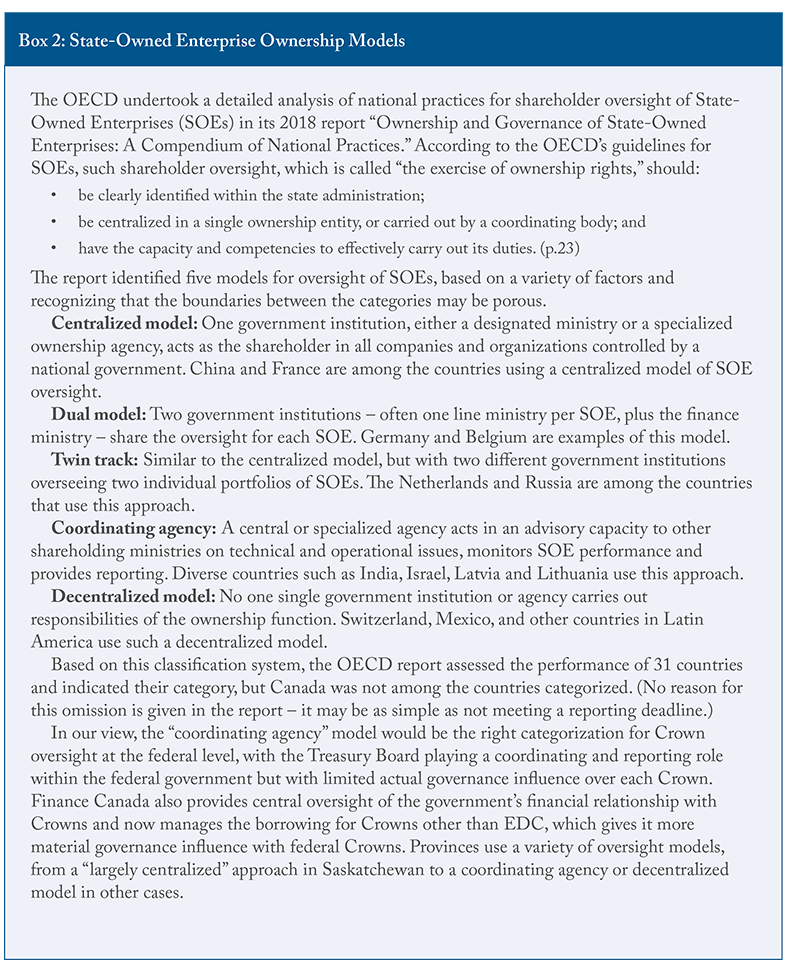
While having a sole minister in the lead for each given Crown is the best governance approach, with related departmental support, there is also a need within a government for adequate coordination, setting of standards, comparative and collective performance evaluation, and public reporting on the government’s Crowns as a group. This function could be based in a central agency like the Treasury Board, which ideally should develop and operate as a centre of expertise on Crowns within the government.
A centre of expertise on Crowns could also be established via a holding company model. As noted earlier, Saskatchewan has a Crown Investments Corporation as the holding company for about half of the province’s commercial Crown corporations. In other jurisdictions, Crowns appear to be managed largely as individual entities, and therefore may not be yielding the optimal policy, commercial or financial value they could achieve by being managed as a portfolio of productive public assets.
As discussed in the Appendix, the modest financial performance of Canadian Crowns as a group (despite their considerable economic size) suggests more could be done to ensure the policy, commercial and financial objectives of Crown corporations are being appropriately considered and balanced. A central or coordinating agency in each jurisdiction’s government would be ideally placed to play this role.
4.5. Regular Review
An additional desirable feature of framework governance is to conduct a regular review of the provisions and operations of the Crown under its governing authorization or legislation, with public discussion. As the OECD states, governments “should carefully evaluate and disclose the objectives that justify state ownership and subject these to a recurrent review” (OECD 2015, p.17). A regular review (such as every 10 years) is an important part of the overall accountability of a Crown to its overseeing minister, its governing legislature, and indeed to the public. Such a review could consider whether the Crown is fully deploying its mandate, examine its market positioning, and assess its operating effectiveness and overall business and financial performance.
A regular review, ideally with public discussion, could be part of the Crown’s legislated mandate or at least be addressed within an ownership policy (Ibid., p.17). EDC and BDC are examples of federal Crown corporations that have a requirement for a regular review in their governing legislation.
5. Specific Governance Instruments and Practices
Building on these framework governance mechanisms, a number of specific governance instruments and practices can be used to ensure appropriate oversight of Crowns’ operations and performance. The array of governance instruments used for federal Crowns provide a useful reference point on how to provide effective oversight, consistent with the guidance in the federal government’s “Open and Accountable Government” statement.8Open and Accountable Government | Prime Minister of Canada (pm.gc.ca), November 2015.
5.1. Board of Directors, and Chair
The anchor instrument for specific Crown governance is the board of directors and its Chair, who should be authorized in the Crown corporation’s enabling legislation to provide oversight of the Crown’s business activities, performance, and other affairs, based on clear criteria or guidelines provided by the shareholder government. To demonstrate the full confidence of the government, the board Chair should ideally be appointed by a central governance entity in the respective government on the recommendation of the minister. Members of the board of directors can be appointed for a fixed term by the Crown’s minister, with appropriate confirmation from within the shareholder government.
In addition to providing oversight of the Crown’s business activities, the board of directors generally, and the Chair specifically, should act as the link between the CEO and leadership team of the Crown, and the minister and government.
The creation and role of the board of directors is based on the premise that an expert board is better qualified and positioned to govern and oversee the Crown and its functions than the responsible minister or senior departmental officials. This separation of responsibilities is designed to advance the interests of the corporation by restricting the executive discretion of ministers and delegating it to an independent professional board, CEO and staff (Fremeth and Holburn 2019, p. 5). Crown boards exercise judgement and provide guidance in four main areas: establishing the corporation’s strategic direction; safeguarding the corporation’s resources; monitoring corporate performance; and reporting to the government (Ibid., p.5).
Past guidance provided by federal central agencies indicated that a board is responsible “for the oversight of a Crown corporation’s business activities and other affairs, has the duty to act in the best interests of the corporation and to exercise due care and diligence.”9Government of Canada, “Open and Accountable Government.” Section H3 Crown Corporations. Interpretation of the phrase “in the best interests of the corporation” has been the subject of considerable legal and operational debate and interpretation for corporations in general.
For private corporations, a much broader interpretation of what is in the corporate interest has now been established in Canadian law after decades of discussion. Specifically, the Canada Business Corporations Act was amended in 2020 and now provides an expanded interpretation of what is in the corporate interest. Under section 122 of the amended Act, directors (and officers) of a corporation are directed “to act honestly and in good faith with a view to the best interests of the corporation.”10Canada Business Corporations Act, last amended 2020-01-01. But they are then also directed to consider the interests of shareholders, employees, retirees and pensioners, creditors, consumers, and governments; the environment; and the long-term interests of the corporation.11Ibid.
Crowns have an explicit public policy mandate and are expected to act in the interests of society, so it would be logical to expect their boards to apply the same broad interpretation of how to act in the best interests of the corporation. Crown directors should thus be expected to take into consideration the interests of all the Crown corporation’s stakeholders, the Crown’s environmental and social impact, and its long-term interests, in addition to the more traditional immediate operational and financial interests of the Crown.
A related question concerns optimal Crown board composition, and whether government deputy ministers should be included on Crown boards. Crown boards ought to consist of directors with the necessary knowledge, ability, commitment, and independence to fulfill their role. Academics have suggested that Crowns should develop and use a competency profile or matrix to identify the skills and attributes of directors that would add value for the Crown (Fremeth and Holburn 2019, p. 8).
A purist approach might be concerned with a possible conflict of interest between the role of deputy ministers in providing advice to, and carrying out the decisions of, their minister, and their ability as possible Crown board members to serve the interests of the corporation. Reflecting this perception of conflict, a 2005 federal Treasury Board Secretariat’s Report to Parliament, “Review of the Governance Framework for Canada’s Crown Corporations,” advised the government to remove deputy ministers from some federal Crown Boards of Directors (Global Affairs Canada. 2018. EDC Review, p. 27).
However, it should be noted that this purist approach is not fully applied within the federal government. While federal deputies were removed from the boards of BDC, EDC, the Canadian Commercial Corporation (CCC) and Farm Credit Canada (FCC), other federal Crown corporations with financial responsibilities have continued to have multiple government representatives on their boards of directors, notably at the Canadian Mortgage and Housing Corporation (CMHC), and the Canada Deposit Insurance Corporation (CDIC). The deputy minister of the Department of Finance is also an ex officio member of the board of the Bank of Canada (Ibid., pp. 27-28). This latter board role makes good policy sense to ensure coordination between fiscal and monetary policy.
There is no simple resolution to the debate on the possible role of deputy ministers on Crown boards. While a conflict could exist between providing advice to and carrying out the decisions of their minister while serving the interests of the corporation as a board member, the balancing act of Crown board membership is not new; deputy ministers regularly have to balance competing interests in their role as policy advisors and implementers. Overall, this author believes deputy ministers would bring significant insights that could benefit Crown boards’ decision-making.
The 2018 EDC Review noted that without government representatives on the EDC board, its overseeing departments, Global Affairs Canada and the Department of Finance, do not have access to board briefing material to keep their ministers briefed on EDC operations (Ibid., p.28). Other specific governance tools, as discussed below, would need to be used to ensure close alignment with government policy priorities.
Overall, a strong commitment to public accountability, with a high degree of transparency, would go a long way to ensuring a Crown and its board are fully aligned with their public policy expectations of the shareholder and other stakeholders.
5.2. CEO Role
Day-to-day operations and performance are the responsibility of the Chief Executive Officer (CEO), who leads the Crown’s management team and staff. The CEO is accountable to the board for the overall management and performance of the corporation and its adherence to its mandate and should be a member of the board. Separation of the CEO and Chair roles is now accepted as good practice in corporate governance.
Furthermore, good practice in corporate governance would indicate a Crown CEO should be appointed by the board, in consultation of course with the relevant minister and the government. Direct appointment (or dismissal) of Crown CEOs by the minister/government does occur on occasion, but it poses the risk of undermining the key operational governance relationship between the CEO and the board. It also puts into question the arms-length nature of Crowns as commercial operating entities. Indeed, if a shareholder government is sufficiently unhappy with a CEO’s performance to consider dismissal that may also indicate dissatisfaction with the leadership and decisions of the Crown’s Chair and board. Prior to selecting a CEO, clarity on the Crown’s purpose and market positioning, and a rigorous selection process with extensive evaluation and vetting of possible CEO candidates, would help to mitigate CEO performance risk.
5.3. Regular Policy Guidance from the Responsible Minister
A second specific governance instrument is regular policy guidance to the Crown from the responsible minister. Ideally, this guidance would be in the form of an annual letter or memorandum that provides an update on the government’s priorities for the Crown and sets out expectations for the coming business year. Such a letter or memorandum could provide both broad and detailed policy guidance, and ideally would propose success metrics related to these priorities. Particular attention could be paid to the Crown corporation’s business operating environment, its market positioning, and the government’s policy priorities. The letter or memorandum could also identify and reinforce the government’s expectations on the Crown’s expected values such as transparency, its commitment to diversity, or its environmental practices. Early provision of such annual written policy guidance would help the Crown in preparing its Corporate Plan.
For federal Crown corporations, an annual Statement of Priorities and Accountabilities (SPA) letter from the responsible minister to the Crown is common practice. Some provinces use similar instruments. In Ontario, some Crown corporations make use of a Memorandum of Understanding among the relevant ministry, the board Chair, and the CEO. The MOU provides commercial and policy objectives, governance responsibilities, reporting requirements, performance expectations, and communication protocols. In British Columbia, Service Level Agreements set out each ministry’s performance expectations and reporting requirements (Ibid., p.7).
5.4. Annual Corporate Plan
Each year, Crowns should develop and submit a detailed Corporate Plan to their minister. The Corporate Plan ought to identify the corporation’s operational and policy priorities for the coming year, reflecting and aligned with the government’s priorities identified in the minister’s policy guidance. It should be shared early in the annual cycle with the minister’s department to allow them to brief the minister and seek their feedback and agreement. Ideally, the Plan should then be submitted to and approved by a central government body such as the Treasury Board and then tabled in the legislature.
The requirement for formal approval of the Corporate Plan by the minister, and subsequent approval by a government oversight body, provides an opportunity for discussion between the government and the Crown. Ideally, the Corporate Plan approval process should yield a high degree of alignment on the Crown’s priorities and objectives. It can then develop the priority areas in practice, put those plans into action, and report on how effectively it is meeting the overall public policy objectives.
The Crown’s annual report should report on the priorities that were identified and the commitments that were made in the Corporate Plan for the business year covered, in addition to the Crown’s overall business and financial performance. Annual report metrics should be aligned with the regular policy guidance from the responsible minister and with priorities in the Corporate Plan, and the metrics used should be consistent over time to allow for comparison between years.
5.5. Annual Capital Budget, Borrowing Plan or Fiscal Support Plan
In rough parallel with the Corporate Plan process, a Crown should develop and submit annually a detailed Capital Budget, Borrowing Plan and/or fiscal support plan for agreement by the responsible minister and by the minister of finance or chief financial officer for a municipality, and approval by a government oversight body such as the Treasury Board. Formal approval of the Capital Budget, Borrowing Plan and/or fiscal support plan is designed to ensure a high degree of alignment on the Crown’s operational activities, capital requirements and financial performance. Crowns with more commercial (i.e., profitable) operating models might also have a dividend policy agreed with the shareholder government. A dividend policy defines the conditions under which it would pay dividends, ideally when the Crown has sufficient capital and/or reserves to sustain its normal operations and meet any reasonable contingencies.
5.6. Government Directives
On occasion, a Crown might receive a directive from its shareholder government providing legally binding guidance on a specific aspect of its activities. A directive provided to the Crown would normally be at the behest of its minister. Examples would include the Crown’s alignment with various administrative practices of the government such as travel and hospitality directives.
Directives should be used infrequently and should focus on ensuring the Crown’s alignment with overall government policy and administrative practices. Repeated use of government directives may indicate weaknesses in the Crown’s governance relationship, or in the design and implementation of government policy. These should be addressed through changes to government policy, to the government’s Crown ownership policy, or to the Crown’s governing legislation.
5.7. Cabinet Decisions
Crowns are also guided by decisions of Cabinet, or the municipal or regional council, that are pertinent to the Crown’s mandate and operations. The Crown would expect to be closely involved with relevant government departments and agencies in the analysis of a specific matter before Cabinet or council, and in the development of policy options and recommendations.
Cabinet decisions applied to a Crown should also be infrequent. They should reasonably focus on: modifications to the government’s Crown ownership policy and to the Crown’s role; possible amendments to the Crown’s governing legislation; and/or changes to the Crown’s financial relationship with its shareholder, such as decision to allocate additional capital or budgetary support to the Crown in order to backstop a new or enhanced area of activity. Repeated Cabinet decisions related to a Crown may indicate deeper weaknesses in the governance or financial relationship. More fundamental changes may be required to government policy, to the Crown’s governing legislation, or to the financial relationship.
5.8. Financial and Performance Audits
As an optimal practice, the shareholder jurisdiction’s auditor should conduct an annual audit of the Crown’s financial results. The auditor should also undertake special examinations on occasion, such as a regular (e.g., five year) comprehensive audit, and reviews of action on any policy directives from the shareholder government.
6. Conclusion and Next Steps
This study set out to examine the issue of Crown governance and to define an optimal approach to the governance of Crown corporations, which could help ensure the best possible combination of policy and business performance. It has developed an approach that draws a distinction between what we have called “framework governance,” and more specific governance instruments and practices.
Issues such as defining a Crown’s purpose and role, identifying its intended market positioning, establishing its legal mandate, defining the role of a lead minister, and a regular review of the Crown’s policy and business performance are key elements of framework governance. Key specific governance instruments include the central role of the board of directors, Chair and CEO, regular written policy guidance to the Crown from the responsible minister, an annual Corporate Plan prepared by the Crown for approval by the shareholder government, as well as a Borrowing, Capital or funding plan, the (ideally infrequent) use of government directives or Cabinet decisions, and regular audits.
The approach outlined here can be used to examine various governance and policy issues facing Crowns and to assess the governance practices and performance of specific Crown institutions. In future analyses, we intend to produce a few such Crown governance assessments, examining issues related both to framework governance and specific governance instruments and practices.
Appendix: Recent Crown Financial Performance
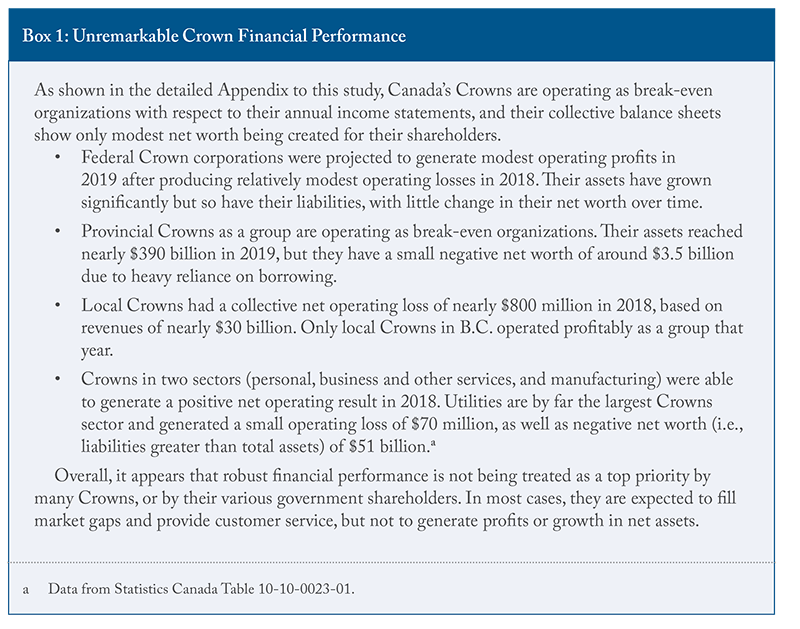
How Crowns perform financially, both individually and collectively, should be closely related to their purpose and intended market positioning. As a group, Canada’s federal, provincial, and local Crowns are essentially operating as break-even organizations with respect to their annual income statements, and their collective balance sheets show only modest net worth being created for their shareholders.
While there are considerable differences in financial performance among Crowns and across jurisdictions, the overall story from the available data suggests that robust financial performance is not treated as a top priority by many Crowns or their various government shareholders. In most cases, they are expected to fill market gaps and provide customer service, but not to generate profits or grow their net assets.
Federal Crowns
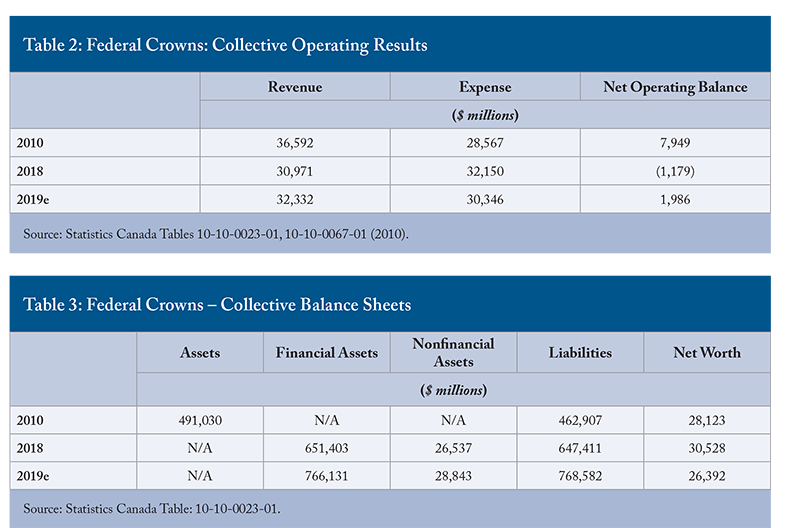
Beginning with federal Crowns, Table 2 provides some detail on the operating income of federal Crown corporations over a few recent years. As a group, federal Crown corporations produced solid profits in 2010, relatively modest operating losses in 2018, and were projected to generate modest operating profits in 2019.
In terms of their balance sheets, Table 3 shows that federal Crown corporations as a group have seen significant growth in their assets, but their liabilities (i.e., debt) have also grown, with the result being little change in their net worth over time.
These collective results do not capture underlying differences among individual federal Crowns in their financial performance. Some federal Crowns, notably the federal financial institutions BDC, EDC, FCC, CMHC, and the still relatively new Canada Infrastructure Bank (CIB) have the potential and capacity to generate healthy profits and strong balance sheets, while others like Via Rail or CBC/Radio Canada are mandated and designed to operate at a loss, as discussed in the section on Crowns’ purpose and market positioning.
Provincial and Territorial Crowns
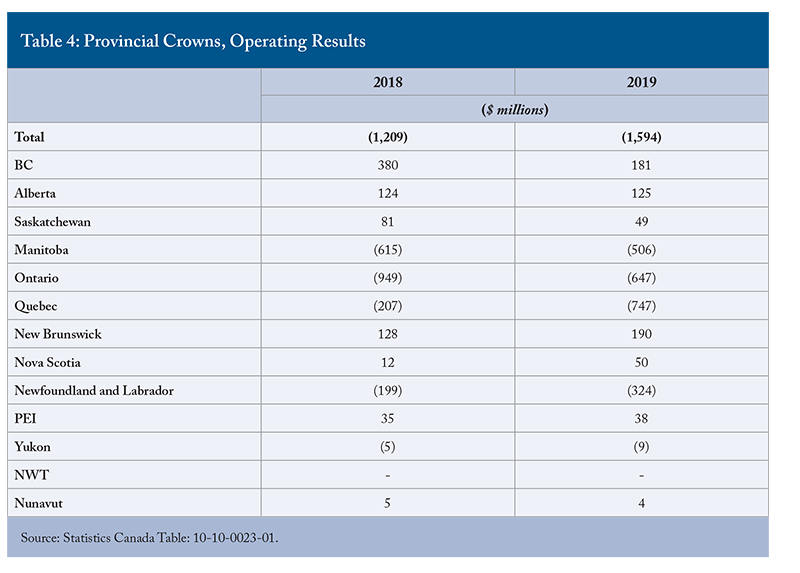
As a group, provincial Crowns are essentially operating as break-even organizations. Table 4 provides the collective operating income for provincial and territorial Crowns by jurisdiction in 2018 and estimated for 2019. Provincial Crowns are estimated to have collectively produced a relatively small net operating loss in 2019 of $1.6 billion, relative to revenues of nearly $100 billion, after generating similar numbers in 2018. Crowns in about half the provincial and territorial jurisdictions have operated in the black in recent years, with modest losses in most other jurisdictions.
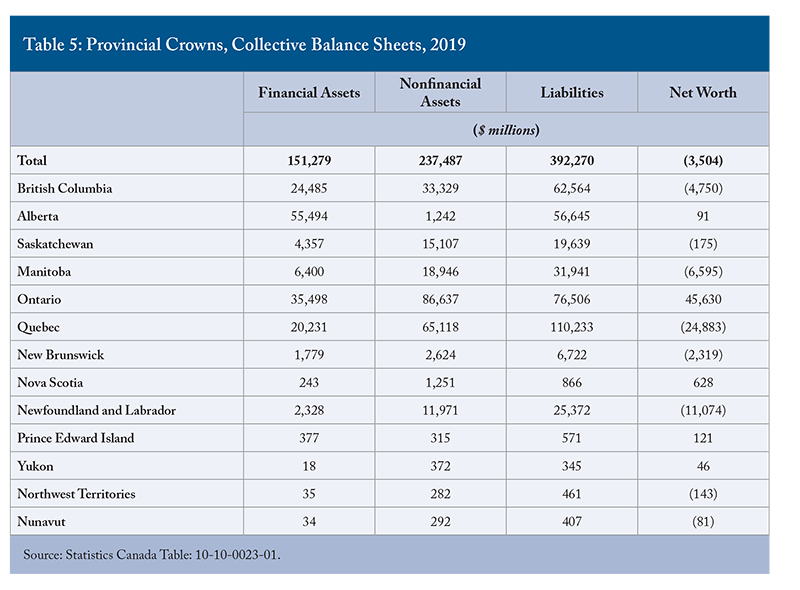
The financial and non-financial assets of provincial and territorial Crowns are estimated to have reached nearly $390 billion in 2019, slightly lower than their liabilities (notably borrowing), resulting in a relatively small negative net worth of around $3.5 billion as shown to Table 5.
As these two tables show, there are material differences in Crown financial performance across provincial and territorial jurisdictions. More detailed analysis would be required in each case to understand the financial performance of each jurisdiction’s Crowns.
Local Crowns
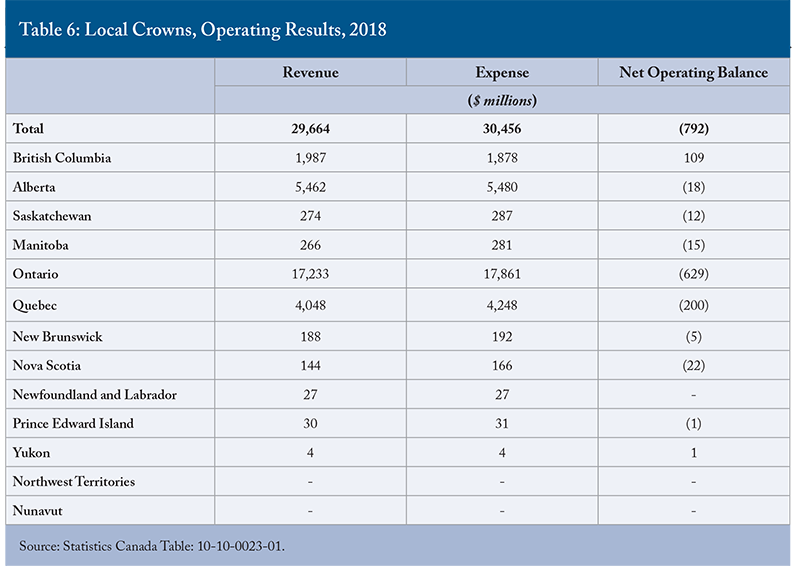
For local governments, available Statistics Canada data cover the current operations of what are formally called “Local Government Business Enterprises.” The overall business results provided in Table 6 are similar to those of federal and provincial Crowns, with a collective net operating loss of $792 million in 2018, based on revenues of nearly $30 billion. Results of course differ by enterprise and jurisdiction, although only local government Crowns in B.C. operated profitably as a group that year.
Sectoral Financial Performance
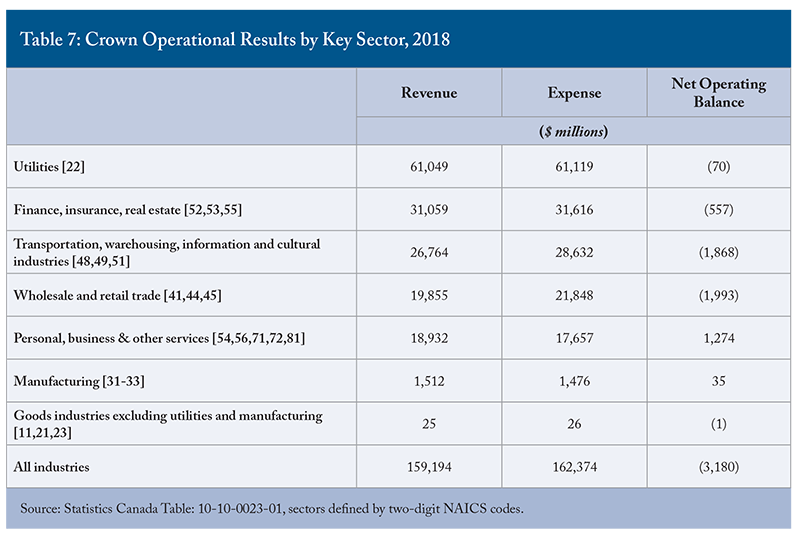
A final way to examine Crown financial performance is by business or industrial sector, cutting across jurisdictions. Table 7 provides the operational results for the collective of federal, provincial and local Crowns, grouped together into seven broad sectors defined by two-digit North American Industry Classification System (NAICS) codes.
In terms of their collective net operating balance, only the group of Crowns operating in two sectors – providers of personal, business and other services, and in manufacturing – were able to generate a positive net operating result in 2018. The other sectors showed negative net operating balances of varying sizes.
In the utilities sector, which is by far the largest sector by revenue and expenses, Crowns generated a small operating loss of $70 million collectively in 2018. This collective loss occurred despite these Crowns in many cases being a monopoly provider of things like electricity or water services, where the absence of competitive alternatives should mean an ability to set prices that fully cover operating costs. The varied operational business results by sector suggest a need for deeper analysis of the underlying business and policy conditions facing Crowns across jurisdictions.
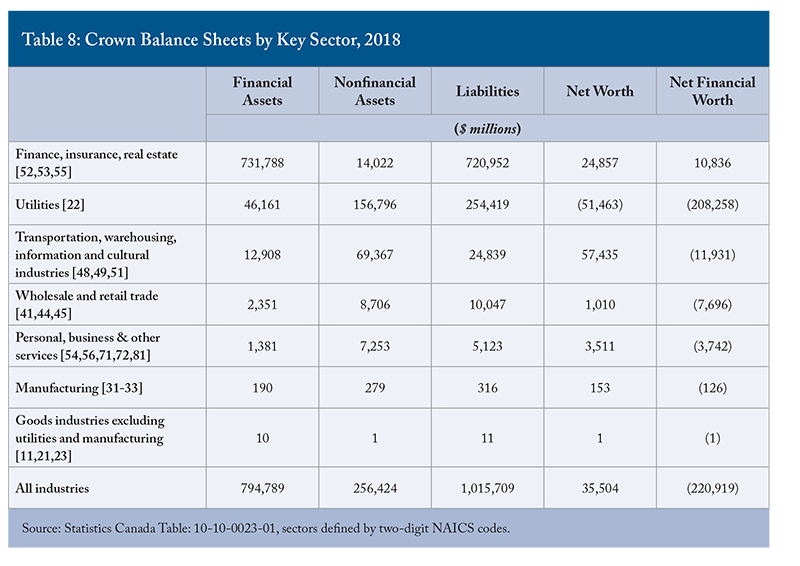
As for the collective Crown balance sheets by sector, it is noteworthy that Crowns in most sectors were able to demonstrate positive net worth in 2018. This means their net assets have been built up over time through asset appreciation, retained earnings and/or managing their liabilities. The exception was the utilities sector, which had collective negative net worth of $51 billion and negative net financial worth exceeding $200 billion. Again, this prompts questions about the operating model being employed in the broad Crown utilities sector, and whether policy, commercial and financial objectives are being appropriately balanced by the many Crowns involved, along with their shareholders.
References
Crisan, Daria, and Kenneth J. McKenzie. 2013. “Government-Owned Enterprises in Canada.” University of Calgary School of Public Policy Research Papers 6 (8), February.
Canada Business Corporations Act, last amended 2020-01-01.
Canada Infrastructure Bank Act, 2017.
Fremeth, Adam, and Guy Holburn. 2019. “Best Practice Principles of Corporate Governance for Crown Corporations.” Ivey Business School monograph, March.
Global Affairs Canada.2018. “Export Development Canada Review.”
Government of Canada. “Consolidated Financial Information for Crown Corporations.” Annual Report 2018-2019.
______. 2015. Open and Accountable Government | Prime Minister of Canada (pm.gc.ca), November.
Iacobucci, Edward M., and Michael J. Trebilcock. 2012. “The Role of Crown Corporations in the Canadian Economy: An Analytical Framework.” University of Calgary School of Public Policy, March.
OECD. 2015. “Guidelines on Corporate Governance of State-Owned Enterprises.”
______. 2018a. “Ownership and Governance of State-Owned Enterprises: A Compendium of National Practices.”
______. 2018b. “Privatisation and the Broadening of Ownership of State-Owned Enterprises: Stocktaking of National Practices.’
Public Policy Forum. 2016. “Crown Corporation Governance: Three ways to manage the tension between autonomy and control,” August.