






by Jeremy Kronick and Farah Omran
 In this E-Brief, we focus on the well-established link between regulation/policy and productivity,1See, for example, Competition Bureau Canada (2017); Heil (2017); Levine (1997, 2005). and explore the regulatory and policy changes needed to boost Canada’s overall and financial services productivity. We look at specific regulations and policies that hinder productivity growth through their impact on competition, the ability to attract foreign investment and the allocation of capital.
 - We argue for the continued removal of barriers to the development of innovative firms and their access to credit. Specifically, we recommend:
- a flexible regulatory approach ensuring regulations focus on the function and the function’s impact on the financial system should a failure occur;
- regulatory mandates that include more explicit competition mentions as a way of spurring innovation;
- implementing open banking;
- improving coordination, cooperation and the sharing of financial market data between federal and provincial regulators, and prioritizing the Cooperative Capital Markets Regulatory System initiative;
- improving SMEs’ access to affordable capital; and
- ensuring that the share of mortgage and business lending in the economy reflects the true underlying risk of both types of lending through modifying how mortgage insurance premiums are priced.
 In this E-Brief, we focus on the well-established link between regulation/policy and productivity,
For advanced economies like Canada’s, achieving long-term sustainable growth entails looking beyond the diminishing returns of labour and capital, and instead focusing on productivity growth through innovation and technological advancements. With this in mind, we update our earlier work, which assessed how Canada compares to other members of the Organisation for Economic Co-operation and Development (OECD) in terms of the country’s overall productivity and the productivity of its financial services sector. We zero in on the financial services sector due to its unique ability to boost both its own productivity and that of other sectors by optimally allocating resources in the economy.
Unfortunately, Canada continues to lag other OECD countries in aggregate productivity, with more scope for contribution from the financial services sector. This is particularly worrisome in today’s environment, in which the COVID-19 pandemic and ensuing crisis has highlighted and exacerbated pre-existing weaknesses and damaged productive capacity. When we enter the recovery stage, enhancing productivity growth will be essential to counter the adverse effects of the crisis.
Productivity
Overall Perspective
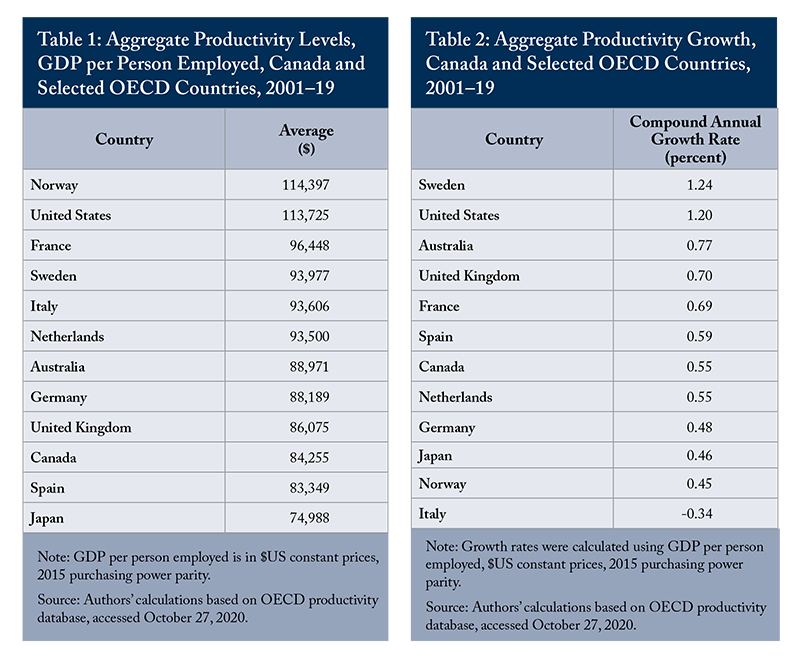
We start by looking at the level of overall productivity in Canada and select OECD countries. We use the OECD’s measure of gross domestic product (GDP) per person employed as our basis for comparison.2Productivity is commonly defined as the ratio of output to input use. Labour productivity – defined as the ratio of GDP to total hours worked or total persons employed – is a widely accepted measure of productivity (OECD 2008). Although the ideal measure would be based on hours worked, rather than persons employed, we use the employment-based productivity measures for the purpose of consistency, as the hours-worked-based industry contribution data are not available for some of the key countries we use in our comparison. As Table 1 shows, Canada was near the bottom over the 2001–19 period. The country’s ranking remained roughly the same before and after the 2007–08 global financial crisis, with a one-rank drop in the post-crisis period (2010-19) placing it second to last. While a look at Canada’s productivity growth paints a better picture (Table 2), being middle-of-the-pack with a below average growth rate is insufficient for it to catch up with its peers.3To test the credibility of the employment-based measures, we also rank countries in Tables 1 and 2 (the ones for which we have data) based on hours worked, and find a strong correlation between employment-based and hours-based rankings.
The Financial Services Sector
In this section, we shift our focus to the financial services sector, given its importance to the Canadian economy, where it has an international comparative advantage (Kronick 2018).
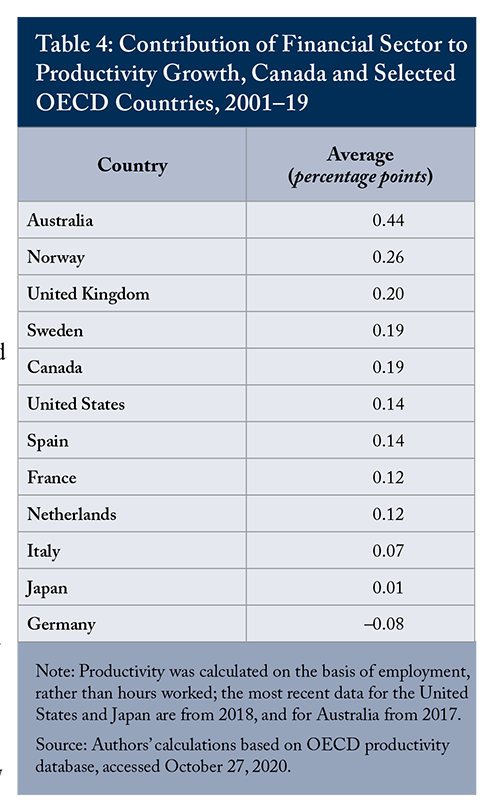
The financial services sector plays a vital role in any well-functioning economy, facilitating essential functions such as payments and investments. In Canada specifically, the sector employs relatively more people with postsecondary and postgraduate education than do other sectors,4Individuals with postsecondary or postgraduate degrees account for 50 percent of all employees in the financial services sector, but only 30 percent of employment in the entire economy (Forum of Labour Market Ministers, 2016 Labour Market Monitoring Toolkit, table MTK_T01). and its non-financial capital includes more intellectual property and information technology than does the overall economy on average. Furthermore, the sector is unique in its ability to boost not only its own growth and productivity, but also those of related and complementary services (such as communications and accounting). Indeed, as Table 3 shows, the financial services sector and related services and industries enjoyed more rapid growth in employment and higher earnings over the 2001–19 period than did the overall economy.
Is, then, Canada exploiting its financial sector’s full potential, and are these characteristics manifesting themselves in the sector’s contribution to overall productivity? The answers depend on the sector’s ability to channel funds efficiently toward activities that generate and sustain overall economic growth and the extent to which it diverts these resources from other productive sectors (Cecchetti and Kharroubi 2015).
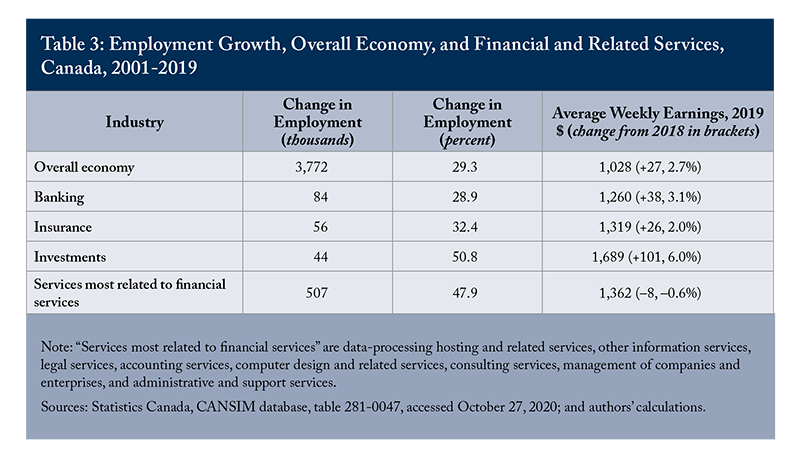
To answer these questions, we use the OECD’s measure of industry contribution to productivity across our OECD country sample.5Although the OECD itself has labelled the financial services sector as one of the more “[d]ifficult-to-measure industries” (OECD documentation on measuring productivity), it remains, to our knowledge, the only source for international comparability of productivity by sector. Moreover, our finding that Canada’s financial sector is lagging in its contribution to overall productivity is confirmed by other work (see, for example, Deloitte 2012, 3), which attributes this in part to “[u]nderinvestment in communications and technology.” This underinvestment in communications and technology is an issue for the economy as a whole, where the decline is pervasive in “finance, insurance, real estate, rental and leasing sector, as well as from information and cultural industries” (Mollins and St-Amant 2019, 13). The results show Canada in the middle of the pack over the 2001–19 period (Table 4), behind countries to which it is often compared – such as Australia, whose financial sector’s contribution is more than double Canada’s.6As in Tables 1 and 2, we rank the ten countries in Table 4 for which data are available based on hours worked, and find a strong rank correlation between employment-based and hours-based rankings. The good news, however, is that this represents an improvement in Canada’s ranking compared to the one we assigned in our previous survey (Omran and Kronick 2019).7Canada’s ranking also improved over the period since the financial crisis, reflecting a combination of regulation and policy changes, as well as a falling of the rankings of some countries, including Spain, the United States and the United Kingdom. For example, the United Kingdom had a contribution growth of 0.6 percent before the financial crisis (2001–06), but, having taken a big hit from the crisis, its contribution growth dropped to –0.1 percent during the 2010–19 period. With geopolitical pressures persisting throughout 2019 (Brexit), the United Kingdom has continued to be in negative territory over the past couple of years (around –0.2). We also note that there have been small revisions to the OECD’s “Productivity and ULC by main economic activity” database since our last report. Although Canada has inched up the leaderboard, its financial sector as a percentage of GDP ranks near the top, and as such Canada relies upon it to contribute more to productivity gains than do other countries.8For example, over the 2001–19 period, in terms of the countries we analyze, Norway’s financial services sector as a percentage of GDP was 4.3 percent, while Canada’s was 7.1 percent. As shown in Table 4, however, in assessing the contribution of the financial services sector to overall productivity, Norway ranked ahead of Canada.
How to Improve
The extent to which the success and growth of the financial services sector translates to strong economy-wide productivity growth largely depends on good governance and flexible regulations, a link that has been well established in the literature.9See, for example, Competition Bureau Canada (2017); de Serres et al. (2006); Heil (2017); Levine (1997, 2005); and Lumpkin (2009). A central finding in the literature is that robust productivity growth occurs when regulations and policies foster competition for the delivery of financial services, attract capital through foreign direct investment and produce an efficient allocation of capital and resources.10Heil (2017, 11) provides a full literature review of the subject and a nice summary of the link.
It is absolutely necessary to have regulations in place that protect consumers and maintain the stability of the financial system. Such regulations, however, should strike the right balance between protecting against potential risks and ensuring an appropriate level of competition, particularly from niche new entrants, in order to generate innovation and, in turn, productivity growth. At the same time, regulations should ensure an efficient financial system and allocation of credit to enable innovative firms to access the capital necessary for their growth, both domestically and from abroad (see Egger and Keuschnigg 2010; Schwanen 2017).
In the following sections, we assess Canada’s regulatory environment and its effect on productivity through the three main areas just described: competition, the ability to attract capital and the efficient allocation of credit and equity financing.
Increasing Competition
Competition is one of the most important drivers of innovation and productivity. Too little of it reduces economic incentives, while too much of it lowers potential returns, both of which lead to sluggish innovation (Howitt 2015). The evidence is mixed on the level of competition in Canada’s financial services sector, but there is general agreement that significant barriers to entry remain across crucial areas, including the lending and payments space (Competition Bureau Canada 2017). Our focus is on competition in the financial services sector, but we acknowledge that improving competition in financial markets can only go so far without ensuring there is also sufficient competition in product markets. In other words, improving competition for lenders is constrained if there is insufficient competition among borrowers.
Research shows that small and medium-sized enterprises (SMEs) in Canada face barriers to accessing financing (Competition Bureau Canada 2017). These will only get worse as a result of the COVID crisis, with SMEs unable to cut costs in line with drops in revenue (OECD 2020b), forcing them to take on increased debt, thus adding to their riskiness in the eyes of lenders.
These barriers, pre-dating the COVID crisis, have given rise to new technology-driven financial services providers, commonly referred to as “fintechs.”11For the purposes of this E-Brief, we use the Financial Stability Board’s definition of fintechs: “technologically enabled innovation in financial services that could result in new business models, applications, processes or products with an associated material effect on financial markets and institutions and the provision of financial services.” See https://www.fsb.org/work-of-the-fsb/financial-innovation-and-structural-change/fintech/. Although fintechs began as “disruptors,” today they are essential facilitators and enablers of important economy-wide functions. In Canada, however, these innovative companies still face significant obstacles, mainly in the form of under- or overregulation and a fragmented and complex regulatory system that makes it difficult for them to understand which regulations apply to them in the first place (Competition Bureau Canada 2017). For example, lending fintechs often find themselves facing regulations similar to those applying to traditional brick-and-mortar players, even though they might pose a different, often lower, level of risk to the overall stability of the financial system. On the other hand, payments fintechs are outside the purview of regulations that often focus on traditional payments service providers. The resulting regulatory gaps create uncertainty and costs for small fintechs trying to enter the market, and for consumers, who might perceive these unregulated service providers as riskier (Competition Bureau Canada 2017).
Canadian regulators understand these issues. In 2017, for example, the Competition Bureau recommended, among other things, that the regulatory burden be based less on the type of entity and more on the function performed, offering all consumers of the same service the same level of protection. The Bureau also said that regulations should be proportional to the risk the function poses: if failure does not pose a risk to the entire financial system – for example, if the function is small retail payments such as a buying a daily coffee – oversight need not be as strict as if failure puts the entire system in jeopardy, as would be the case with the failure of large interbank settlement payments. The Bureau further called for regulations to be technology-neutral and device-agnostic, to allow them to adapt to new technological advancements. And indeed, progress is being made on these issues to level the playing field. For example, in what could be the new retail payments oversight framework (Budget 2021 announced the federal government’s intention to introduce implementing legislation after further public consulations12As part of this legislation, the Bank of Canada will now be in charge of regulating payment service providers, like fintechs, that are not currently governed by another Canadian regulator.), rules have been adapted to match the level of risk at every stage of the payment process, from the moment consumers tap or insert their bank card to the moment vendors receive the money (see Canada 2019).13Other policies are in place in Canada to support innovative firms, such as the Canadian Securities Administrators’ regulatory “sandbox,” the Ontario Security Commission’s LaunchPad and, in Quebec, the Autorité des marchés financiers’ FinTech Group. All these initiatives are meant to create an experimental and competitive environment for innovative firms with a lower regulatory burden.
More, however, needs to be done, as the degree to which Canada continues to fall behind in the fintech space is notable. In 2019, fintech investment in Canada totalled US$2.3 billion, compared with US$60 billion in the United States and US$49 billion in the United Kingdom (KPMG International 2020). Although outlier deals can always inflate numbers – including, for example, one $42.5 billion deal in the United Kingdom in 2019 – this pattern is not new. In 2018, Canada’s investment in fintech totalled US$1.1 billion, the United States’ US$58 billion and the United Kingdom’s US$25 billion.
Canada can look to other jurisdictions for lessons and best practices to help encourage more competition and innovation. In the United Kingdom, for example, the Financial Conduct Authority has an explicit mandate to promote competition, with a clear link between competition and productivity.14As an example of what the FCA does in this regard, it has what is called a mobilization option to authorize prospective entrants into the banking sector. This program separates essential regulatory requirements from the non-essential, giving new entrants operational authorization but with restrictions on the types of activities they may perform while further regulatory evaluations are proceeding. This is not the case for many financial sector regulators in Canada, although the Ontario Securities Commission (OSC) recently set the stage for others to follow.15There are references to competition with reasonable risks in the mandate of the federal Office of the Superintendent of Financial Institutions (OSFI). In response to recommendations from the Capital Markets Modernization Taskforce to expand the OSC’s mandate to “include fostering capital formation and competition in the markets,” the OSC established explicit objectives for its newly established Innovation Office to “accelerate innovation, bolster capital formation and further progress on reducing regulatory burden” (Ontario 2020; OSC 2020). Then, as part of the Ontario government’s recent budget announcement, it said the OSC’s mandate will now officially include similar language around fostering competition and capital formation. These changes are welcome, and we hope to see more of them in other provinces and at the national level.
Beyond just the mandates of Canadian regulators, policymakers can undertake a number of practical steps to bolster productivity through competition. At the top of that list is the implementation of open banking. The big idea behind open banking is to give customers of financial institutions control over when and how to share their financial data and, by doing so, help spur the development of the types of tailored products and services that would create a more innovative and competitive market.16For a detailed implementation plan, see Koeppl and Kronick (2020).
Attracting Capital
Another critical thread connecting productivity in the financial sector and that of the overall economy is the ability to attract foreign capital, where, among other things, government policy and regulatory structures, including those in the financial sector, are important factors affecting foreign investment decisions.17According to a Conference Board of Canada report (2010, ii), “[i]n choosing locations for foreign direct investment, investors largely look at the quality of legal and regulatory governance, physical and communications infrastructures, and the workforce’s education and training level.” Alfaro, Kalemli-Ozcan, and Sayek (2009) also show that that the financial sector’s main role in translating this inflow of foreign capital, once it arrives, into overall economic growth occurs via increasing the efficiency of inputs such as labour and capital – that is by total factor productivity gains. Positive spillovers of FDI into the economy can occur via other channels as well, such as transfers of technology and know-how.
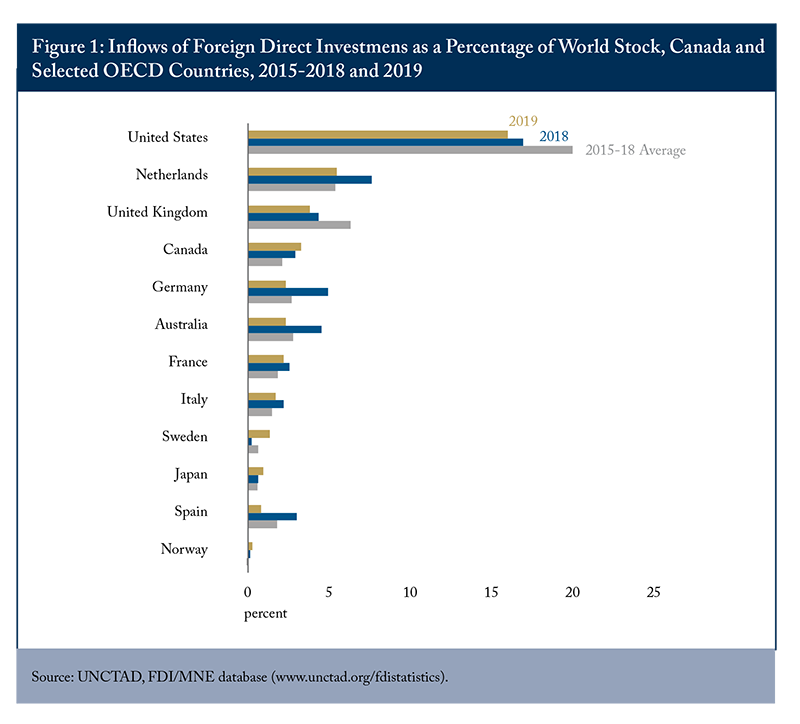
In assessing Canada’s international attractiveness to foreign capital, we compare the inflow of foreign direct investment (FDI) to Canada and its peers. Since 2018 was a special year, given the tax-induced repatriation of FDI from Europe (notably) to the United States, we compare Canada’s 2019 ranking to the 2015–18 average (Figure 1). Although Canada’s ranking for 2019 shows improvement, it was still behind the global leaders: the United States, the Netherlands and the United Kingdom.
Over the past decade, Canada’s economy-wide regulatory framework has undergone a great deal of change toward more liberalization and transparency around foreign investments. Compared to many of its peers, however, Canada remains significantly more restrictive to FDI. This is due mainly to stringent screening mechanisms on foreign acquisitions, requiring proof of net benefit to Canada, and restrictions on equity ownership. Schwanen (2018) has called for doing away with the current net benefit test for investments above a given threshold, and instead shift the onus on the government to show that a particular investment is not in the national interest. Schwanen also argues that the removal of ownership restrictions, except in cases of a clear public policy objective, such as national security or fostering competition, would help attract more FDI.
Meanwhile, Canada’s financial sector regulatory framework could benefit from looking at and conforming to international best practices in order to attract more capital flows into Canada. Although the International Monetary Fund (IMF) has praised the high quality of Canada’s financial sector oversight, the strong federal safety net and the alignment of its securities markets’ oversight with the objectives of the International Organization of Securities, it has also highlighted important areas for improvement (IMF 2019). These include better cooperation between federal and provincial authorities18The IMF (2019) found that, although coordination and cooperation among federal authorities and among provincial authorities work well, the problem lies at the federal-provincial level. And, although the IMF recognized that coordination between federal and provincial authorities has improved over time, it highlighted the need for further improvement and removal of barriers. and prioritizing the Cooperative Capital Markets Regulatory System (CCMRS) initiative in order to reduce risks from fragmented securities markets oversight.19The CCMRS is intended to “streamline the capital markets regulatory framework to protect investors, foster efficient capital markets and manage systemic risk while preserving strengths of the current system” (Cooperative Capital Markets Regulatory System, n.d.). The CCMRS calls for a single securities regulator, the Capital Markets Regulatory Authority (CMRA), to improve coordination and integrate markets within and outside Canada. To date, however, only seven provinces and one territory have agreed to join, with Quebec and Alberta notably absent. Due to this incomplete participation, the IMF also calls for having mechanisms in place to ensure cooperation between the CMRA and non-participating provincial securities regulators (IMF 2019). We note that on March 31, 2021, the Capital Markets Authority Implementation Organization, which was incorporated to help create the CMRA, paused its operations. It did so due to the delay in the legislation required to create the CCMRS.
Canada’s constitutional divisions of authority, which cause fragmentation at both the functional and geographical levels, obscure its efforts to conform to international best practices in financial services. Unlike other jurisdictions, Canada has both federally and provincially regulated deposit-taking institutions, insurers and private pension funds. There is no national regulator for securities; instead, securities regulation is the purview of the provinces.20Although the Canadian Securities Administrators exists to coordinate securities regulation, provinces are not obliged to adopt these rules since securities matters are under provincial jurisdiction in constitutional law. Finally, there is no formal statutory body (or twin bodies) in charge of prudential and market-conduct regulation, including systemic risk, at the comprehensive financial-sector level. By contrast, the Netherlands, the United Kingdom and Australia have a national dual authority system, one for prudential and one for market conduct.21Although the United States is at the top in attracting FDI and is a leader in productivity, while also having a fragmented regulatory system – separate federal and state securities regulators – we do not conclude, therefore, that a fragmented system is good for productivity. The United States has certain advantages in attracting capital that other countries do not, one being that it is the largest and arguably most important economy in the world and issuer of the world’s most widely used reserve currency by far.
Other studies have recommended ways Canada’s financial regulatory environment could better meet international best practices without losing sight of pragmatic issues and differences (IMF 2019; Le Pan 2017). These include a more unified approach to the collection and sharing of financial sector data across regulators, strengthening the regulatory approach and applying it more consistently to group-wide insurance supervision, focusing on business-conduct concerns (for which, in group-wide insurance supervision, there is no federal presence) and subjecting any financial institution deemed systemically important to clearly defined cooperative supervision.
Allocating Credit and Equity Financing Efficiently
In assessing our third area of focus, we start by looking at the state of SME lending in Canada. The OECD (2020a) highlights the lack of credit for Canadian SMEs, reporting that debt outstanding to all businesses in Canada grew by 9 percent in 2018, but by only 2.4 percent and 5.5 percent to small and medium businesses, respectively, reducing the SMEs’ share of total outstanding loans to its lowest level since 2000. This finding is consistent with other research showing that Canadian SMEs are more likely to rely on credit from informal channels such as family and friends than are their US counterparts – indicating less access to formal debt financing (Leung, Meh, and Terajima 2008).
This lack of access to debt financing comes despite the declining delinquency rate of SMEs’ 90-day loans, which sat at 0.55 percent in 2018, well below its 2007 level of 0.71 percent.22For context, the 31-to-90-day delinquency rate for SMEs in the United States ranged from 1.0 percent to 1.5 percent in 2018. For further Canadian context, in the third quarter of 2016, the small business 90-plus-day loan delinquency rate was 0.47 percent, compared with the national delinquency rate of 0.46 percent (Canada 2018). Given the strong link between SMEs and productivity growth (Decker et al. 2014), the need to address this lack of availability and affordability of credit to SMEs is critical. This will become all the more important in a post-COVID world, as SMEs have been hurt disproportionately by shutdowns, and traditional risk metrics will make it harder in future for them to access bank capital.
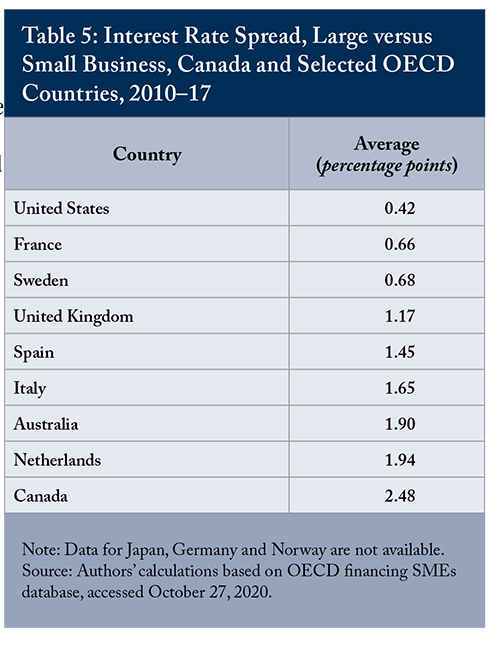
A possible explanation for the lack of SME credit is the higher prices that financial institutions charge SMEs than they do larger firms. As Table 5 shows, Canada has the largest spread between interest rates on loans to SMEs and those to large firms among a group of peer countries. Notably, the order of countries in Table 5 matches closely the order showing levels of aggregate productivity in Table 1.
The literature often chalks up these spreads to informational inefficiencies: lenders view SMEs as informationally more opaque (Berger and Udell 1998) and, in turn, charge them a higher rate to make up for the associated increased risk. Research has also highlighted SMEs’ lower negotiation power and the larger operational costs, relative to loan value, that lending institutions face when they provide credit to SMEs (Dietrich 2012).
One way policymakers could improve SMEs’ access to capital is by deepening Canada’s capital markets beyond domestic bank debt financing. According to the OECD, such financing was almost 60 percent of all SME financing in 2018 – and more than 80 percent if foreign banks, credit unions and caisses populaires are included. Bank of Canada research (see Kim and Witmer 2020) has shown that this lack of alternatives for raising funds means SMEs are more sensitive to unexpected interest rate changes than are large firms. Schwanen, Kronick, and Omran (2019) argue for a suite of policies aimed at enhancing investment opportunities and the availability of deeper, more patient equity capital – such steps should include exempting from taxation capital gains realized on the sale of certain small business shares.23Under this proposed policy, investors would qualify for the capital gains tax exemption if they have held qualified shares for at least five consecutive years. This is similar to a measure adopted under the US Small Business Jobs Act of 2010.
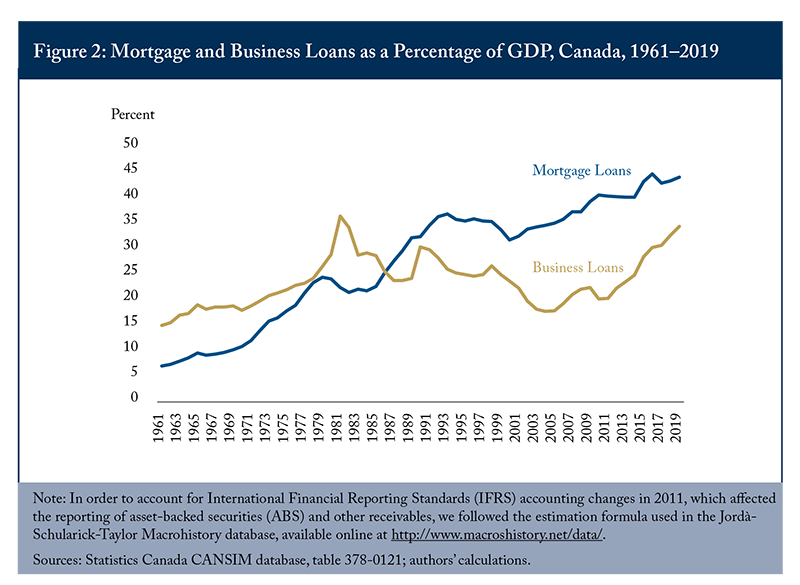
Another area for policymakers to focus on is operational costs. Canada Mortgage and Housing Corporation (CMHC) provides lenders of insured mortgages a 100 percent insurance guarantee,24Private insurers also provide such a guarantee, but if the insurer defaults the government covers only 90 percent. which renders residential insured mortgage lending much less risky than business lending, making the operational costs associated with the latter more binding.25Admittedly, outstanding insured mortgage debt as a percentage of total outstanding mortgage debt has been on a downward trend, going from 57 percent in the first quarter of 2015 to 41 percent in 2019, as more borrowers take on uninsured mortgages; 41 percent, however, remains a significant portion of the market. For more details, see CMHC (2019). Regulatory changes, including OSFI’s B-21, certainly have contributed to the shift in insured versus uninsured mortgages The crowding-out effect of business bank lending as a result of profitable mortgage lending is well established in the literature.26See, for example, Bezemer et al. (2018); and Chakraborty, Goldstein, and MacKinlay (2018). We note that none of these papers includes a review of Canada. Proving this effect can be difficult, but Canadian data clearly suggest that the two types of lending have grown at uneven rates. As Figure 2 shows, after moving largely in tandem up until 2000, in the lead-up to the financial crisis mortgage loans increased as a percentage of GDP while business loans actually decreased. Since the crisis, both have grown, and there is even some indication of catch-up.27This post-crisis catch-up would be even stronger if Figure 2 focused only on insured mortgages. That said, data that separate the two types of mortgage lending exist only for chartered banks (Figure 2 is for both chartered and quasi banks), leaving out a portion of the financial institutions we would like to consider. Nevertheless, the gap remains. Paradoxically, one might have thought that the 100 percent guarantee would open up room for more bank business lending, since it effectively makes insured mortgage loan risk weights – which banks use in calculating their capital adequacy ratios – zero.28In the case of private insurers, there is a capital cost to the lender to cover the insured portion of the mortgage not covered by the government guarantee. But that does not appear to be the case.29CMHC’s market share began shrinking in 2012 after Minister of Finance Jim Flaherty became concerned with its market presence. This date is potentially important, as we see business lending start to increase then (Figure 2). A formal analysis of the impact of the 2012 changes under Minister Flaherty is, however, beyond the scope of this E-Brief.
Since mortgage insurance is an effective tool to insulate the system from a housing crash (Koeppl and MacGee 2017), and thus has positive externalities, policymakers need to look for ways to change the incentive structure at the margins. One way would be to change the structure of mortgage insurance premiums lenders charge borrowers, which do not take into account differences in default risk.30To be clear, when we say that mortgage insurance premiums do not take default risk into consideration, we are referring to the transactional side of the story (what lenders charge borrowers). On the portfolio side, where insurers bid on mortgages from lenders, they do, of course, look at the risks inherent in the portfolio. Once borrowers qualify for mortgage insurance, they are charged the same amount for the same loan-to-value ratio, regardless of the borrowers’ characteristics, such as their credit scores.31In its financial system stability assessment, the IMF (2019) highlighted the need to improve risk-based pricing of insured mortgages in Canada to better differentiate between borrowers. Risk-based pricing ensures an efficient allocation of capital; in the case of mortgage lending, if borrowers were charged different premiums based on their risk profiles, this would better allocate credit in the mortgage space and perhaps free up more capital for lending to businesses.32See Koeppl and MacGee (2017) for more detail on this solution, which, for the purposes of their paper, was built around the problem of moral hazard.
Conclusion
For advanced economies such as Canada’s, productivity growth resulting from innovation and technological advancements is crucial for achieving long-term sustainable growth. This will be particularly true in a post-COVID world, in which much productive capacity has been destroyed. Productivity growth will be an essential driver of Canada’s economic recovery. With its unique ability to boost not only its own productivity but also that of the overall economy, the financial services sector – a sector in which Canada exhibits an international comparative advantage – should be a priority for Canadian policymakers.
We are happy this year to report an improvement in the financial sector’s contribution to overall productivity relative to last year, but Canada still lags many of its peers. The regulatory and policy hurdles that remain in place hamper competition in Canada’s financial services sector, its ability to attract foreign investment, and achieve an efficient allocation of capital.
To address these challenges, we recommend:
- a flexible regulatory approach ensuring regulations focus on the function and the function’s impact on the financial system should a failure occur;
- regulatory mandates that include more explicit competition mentions as a way of spurring innovation;
- implementing open banking;
- improving coordination, cooperation and the sharing of financial market data between federal and provincial regulators, and prioritizing the Cooperative Capital Markets Regulatory System initiative;
- improving access to affordable capital by small and medium-sized enterprises; and
- ensuring the share of mortgage and business lending in the Canadian economy reflects the true underlying risk of both types of lending by modifying how mortgage insurance premiums are priced.
The authors thank Daniel Schwanen, Alexandre Laurin, Miles Wu, anonymous reviewers and members of the Financial Services Research Initiative of the C.D. Howe Institute for comments on an earlier draft. The authors retain responsibility for any errors and the views expressed.
References
Alfaro, Laura, Sebnem Kalemli-Ozcan, and Selin Sayek. 2008. “Foreign Direct Investment, Productivity, and Financial Development: An Empirical Analysis of Complementarities and Channels.”
Berger, A.N., and G.F. Udell. 1998. “The Economics of Small Business Finance: The Roles of Private Equity and Debt Markets in the Financial Growth Cycle.” Journal of Banking & Finance 22 (6–8): 613–37.
Bezemer, D., J. Ryan-Collins, F.V. Lerven, and L. Zhang. 2018. “Credit Where It’s Due: A Historical, Theoretical and Empirical Review of Credit Guidance Policies in the 20th Century.” Institute for Innovation and Public Purpose Working Paper IIPP WP 2018- 11. December.
Canada. 2018. Innovation, Science and Economic Development Canada. “Incrementality Study of the Canada Small Business Financing Program.” Ottawa. March.
———. 2019. Department of Finance. “Report on the Review of the Canadian Payments Act.” Ottawa.
Cecchetti, S., and E. Kharroubi. 2015. “Why Does Financial Sector Growth Crowd Out Real Economic Growth?” BIS Working Papers 490. Basel: Bank for International Settlements. February.
Chakraborty, I., I. Goldstein, and A. MacKinlay. 2018. “Housing Price Booms and Crowding-Out Effects in Bank Lending.” Review of Financial Studies 31 (7): 2806–53.
CMHC (Canada Mortgage and Housing). 2019. “Mortgage Market Slowing & Share of Uninsured Mortgages Increasing: New CMHC Report.” Ottawa, July 16. Online at
Competition Bureau Canada. 2017. Technology-led Innovation in the Canadian Financial Services Sector – A Market Study. Ottawa. December.
Conference Board of Canada. 2010. “Best Policy Practices for Promoting Inward and Outward Foreign Direct Investment.” Ottawa. October.
Cooperative Capital Markets Regulatory System. n.d.
Decker, R., J. Haltiwanger, R. Jarmin, and J. Miranda. 2014. “The Secular Decline in Business Dynamism in the U.S.” Mimeo.
Deloitte. 2012. The Future of Productivity.
de Serres, A., S. Kobayakawa, T. Sløk, and L. Vartia. 2006. “Regulation of Financial Systems and Economic Growth in OECD Countries: An Empirical Analysis.” OECD Economic Studies 43. Paris: Organisation for Economic Co-operation and Development.
Dietrich, A. 2012. “Explaining Loan Rate Differentials Between Small and Large Companies: Evidence from Switzerland.” Small Business Economics 38 (4): 481–94. Egger, P., and C Keuschnigg. 2010. “Innovation, Trade and Finance.” Paper prepared for the conference on Trade and Finance, organized by GEP, University of Nottingham; CESifo, University of Munich; and the Murphy Institute, Tulane University; Munich, April 21–22.
Heil, M. 2017. “Finance and Productivity: A Literature Review.” OECD Working Papers 1374. Paris: Organisation for Economic Co-operation and Development.
Howitt, P. 2015. Mushrooms and Yeast: The Implications of Technological Progress for Canada’s Economic Growth. Commentary 433. Toronto: C.D. Howe Institute. September.
IMF (International Monetary Fund). 2019. Canada Financial System Stability Assessment. IMF Country Report 19/177. Washington, DC. June.
Kim, M.J., and J. Witmer. 2020. Corporate Investment and Monetary Policy Transmission in Canada. Bank of Canada Staff Analytical Note 2020-26. Ottawa. November.
Koeppl, T., and J. MacGee. 2017. Mortgage Insurance Deductibles: An Idea Whose Time Hasn’t Come. Commentary 485. Toronto: C.D. Howe Institute. July
Koeppl, T., and J. Kronick. 2020. Open Banking in Canada – The Path to Implementation. Commentary 579. Toronto: C.D. Howe Institute. September.
KPMG International. 2020. “Pulse of Fintech H1 2020.” Global Analysis of Investment in Fintech.
Kronick, J. 2018. Productivity and the Financial Sector – What’s Missing? Commentary 508. Toronto: C.D. Howe Institute. May
Le Pan, N. 2017. Opportunities for Better Systemic Risk Management in Canada. Commentary 491. Toronto: C.D. Howe Institute. September
Leung, D., C. Meh, and Y. Terajima. 2008. “Are There Canada-U.S. Differences in SME Financing?” Bank of Canada Working Paper 2008–41. Ottawa.
Levine, R. 1997. “Financial Development and Economic Growth: Views and Agenda.” Journal of Economic Literature 35 (2): 688–726.
———. 2005. “Finance and Growth: Theory and Evidence.” In Handbook of Economic Growth, ed., P. Aghion and S. Durlauf, 865-934. Amsterdam: NorthHolland Elsevier.
Lumpkin, S. 2009. “Regulatory Issues Related to Financial Innovation.” OECD Journal: Financial Market Trends 2009 (2): 91–121.
Mollins, J., and P. St-Amant. 2019. “The Productivity Slowdown in Canada: An ICT Phenomenon.” Bank of Canada Staff Working Paper 2019-2. Ottawa.
OECD (Organisation for Economic Co-operation and Development). 2008. “Labour Productivity Indicators.” Paris: OECD Publishing. June.
———. 2020a “Financing SMEs and Entrepreneurs 2020: An OECD Scoreboard.” Paris: OECD Publishing.
———. 2020b. “The Impact of COVID-19 on SME Financing: A Special Edition of the OECD Financing SMEs and Entrepreneurs Scoreboard.” OECD SME and Entrepreneurship Papers 22. Paris: OECD Publishing.
Omran, F. and J. Kronick. 2019. Productivity and the Financial Sector – How to Achieve New Heights. Commentary 555. Toronto: C.D. Howe Institute. October.
Ontario. 2020. Capital Markets Modernization Taskforce: Consultation Report. July.
OSC (Ontario Securities Commission). 2020. Office of Economic Growth & Innovation (Innovation Office). Charter.
Schwanen, D. 2017. Innovation Policy in Canada: A Holistic Approach. Commentary 497. Toronto: C.D. Howe Institute. December.
———. 2018. “Foreign Direct Investment in Canada – The Case for Further Openness and Transparency.” E-Brief. Toronto: C.D. Howe Institute. July 26.
Schwanen, D., J. Kronick, and F. Omran. 2019. “Growth Surge: How Private Equity Can Scale Up Firms and the Economy.” E-Brief. Toronto: C.D. Howe Institute. May 30.
This E-Brief is a publication of the C.D. Howe Institute.
Jeremy Kronick is Associate Director, Research, C.D. Howe Institute.
Farah Omran is a former Policy Analyst at the C.D. Howe Institute.
This E-Brief is available at www.cdhowe.org.
Permission is granted to reprint this text if the content is not altered and proper attribution is provided.
The views expressed here are those of authors. The C.D. Howe Institute does not take corporate positions on policy matters.