




June 4, 2026 – The C.D. Howe Institute’s Monetary Policy Council (MPC) calls for the Bank of Canada to keep its target for the overnight rate, its benchmark policy interest rate, at 2.25 percent at its next announcement on June 10, maintain it at that level until December of this year, and raise it to 2.5 percent by June 2027.
The MPC is chaired by Jeremy Kronick, the Institute’s President and CEO, and includes the chief economists of the six largest Canadian banks, alongside six leading academic economists and financial market experts.
Acting as a shadow Bank of Canada Governing Council, the MPC provides an independent assessment of the monetary stance needed to achieve the Bank’s 2-percent inflation target. Its formal recommendation for each interest rate announcement is the median vote of members in attendance. Members vote on the upcoming announcement, the subsequent announcement, and the announcements six months and one year ahead.
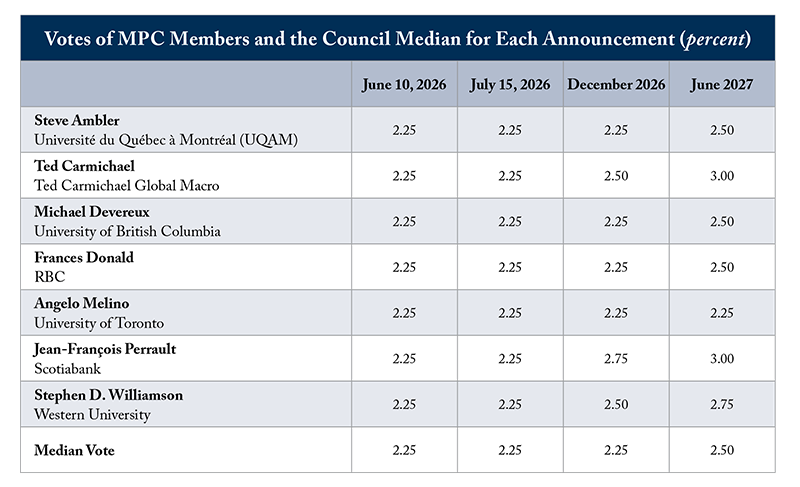
All seven MPC members in attendance called for the Bank of Canada to hold the overnight rate target at 2.25 percent next week. This unanimous vote to hold at 2.25 percent continued for the Bank’s next announcement in July. Six months ahead, in December, four members continued to vote to hold the overnight rate target at 2.25 percent, two members recommended increasing the rate to 2.5 percent, while the final member argued for a rate of 2.75 percent. By next June’s meeting, only one member argued for a hold at 2.25 percent, three voted for 2.5 percent, one argued for a target of 2.75 percent, while two members voted for a rate of 3 percent (see table below).
Members began the discussion with the news this week that Q1 2026 GDP had dropped slightly and, when combined with the fall in Q4 2025, Canada had entered a technical recession. However, members agreed that this approach to declaring a recession was too simplistic, and the economic data showed both weakness, such as aggregate business investment, and areas of strength, like rising imports, which indicate continued spending.
The Council also expressed difficulty in assessing whether the oil price shock stemming from the war in Iran was a classic example of the central bank needing to look through a short-term supply-side concern, or whether the effects were likely to be felt over a longer period and potentially require monetary policy tightening. The case for the central bank to look through includes the fact that inflation hasn’t yet spread to other parts of the economy, with core inflation measures steady around 2 percent. The case for longer-lasting effects includes the time it will take for any reopening of the Strait of Hormuz and the damage the conflict has already done to supply chains. Members also noted sharp increases in producer prices.
Members then turned to the output gap – the difference between actual and potential GDP. Evaluating potential GDP is difficult in the best of times and is made more complex by a falling population, including Canada’s first annual decline on record in 2025 and a drop in the last two quarters. It is also uncertain how policies around population growth will proceed as the central bank looks ahead.
The state of the housing market was another discussion topic. Members discussed signs of a rebound in the Ontario housing market in April and May following the removal of the HST from the purchase of qualifying new homes. Members noted that it remains unclear whether this rebound will lead to increased investment and new home construction.
Lastly, members discussed foreign factors. First, they examined the relative strength of the United States’ economy compared with those of other G7 countries. However, members argued that the concentration of that strength is in AI, and early signs of cooling in their household spending will mitigate the positive impact on Canada. Second, they discussed the upcoming CUSMA review. Some members were pessimistic about the chances of success and the impact an annual cycle of reviews would have on Canadian investment. Others were more optimistic that future reviews might be easier based on how midterm elections go. They also noted that the vast majority of goods pass tariff-free through to the United States, and that this is unlikely to change due to affordability concerns for the Trump administration.
The views and opinions expressed by the participants are their own and do not necessarily reflect the views of the organizations with which they are affiliated, or those of the C.D. Howe Institute. Forecasters’ recommendations may differ from their predictions.
The MPC’s next vote will take place on July 9, 2026, prior to the Bank of Canada’s overnight rate announcement on July 15.
* * * * *
For more information, contact: Lauren Malyk, Manager, Communications, 416-873-6168, lmalyk@cdhowe.org.
Want more insights like this? Subscribe to our newsletter for the latest research and expert commentary.