






To: GDP watchers
From: Don Drummond and Nicholas Dahir
Date: June 9, 2026
Re: The Canadian Economy Was Struggling Long Before GDP Growth Turned Negative
Canada has entered what some are calling a “technical recession.” Real GDP declined in the fourth quarter of 2025 and again in the first quarter of 2026, meeting what is often, but incorrectly, considered to define a recession as two consecutive quarters of negative growth.
The headlines have ignited concerns about the Canadian economy. They should. But they also reveal how long it has taken for concern to mount about the Canadian economy because attention has been focused on the wrong measure.
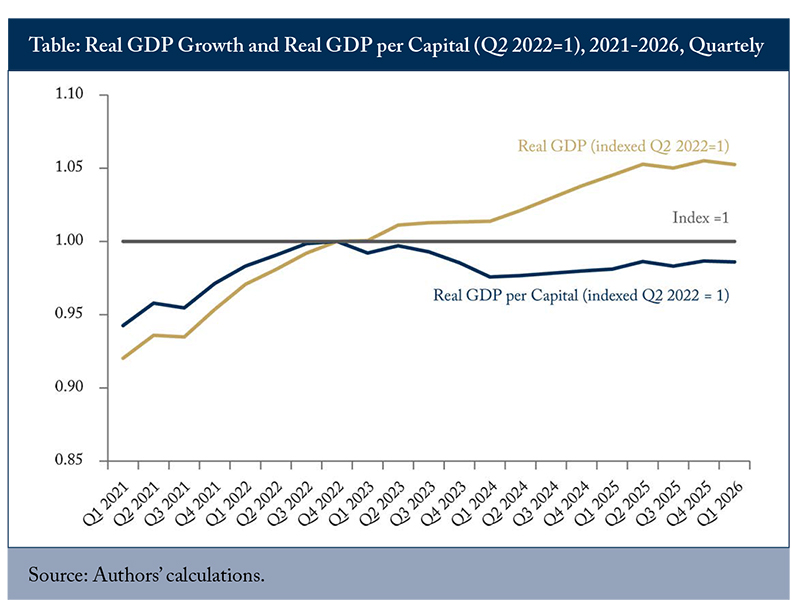
Consider two facts. Compared to the post-pandemic peak in the second quarter of 2022, Canada's real GDP per capita has fallen by roughly 1.4 percent. Yet over the same period, real GDP has risen by more than 5 percent.
Those two facts seem contradictory. How can the economy be growing while output per person is falling?
The answer: Dramatic swings in population growth.
Over much of the period from 2022 to 2024, Canada’s population grew at around 2.5 percent annually, adding nearly three million people, driven largely by immigration. With an abrupt shift to much lower immigration targets, population growth has slowed dramatically and has even declined. These unprecedented swings created a large gap between the story told by aggregate GDP and the story told by GDP per person.
That distinction matters because recessions are conventionally judged using changes in real GDP, which measures the total output of the economy. Even then, two consecutive quarters of negative GDP growth are only a rule of thumb, not a definitive test. Economists also consider the magnitude of the decline, whether weakness is broad-based, labour market conditions and the possibility of future data revisions.
Real GDP per capita provides a better indication of how economic activity is experienced by individuals because it adjusts for changes in population. While no single measure perfectly captures living standards, GDP per capita is much closer to the economic reality facing individuals than aggregate GDP.
And by that measure, Canada’s growth problem began years ago.
The Prime Minister is correct to note that slower population growth is responsible in good part for the recent weakness in aggregate GDP. During the years of exceptionally rapid population growth, the same underlying economy was able to post positive headline growth. Now that population growth has slowed sharply, the weakness that was previously obscured appears starkly in the aggregate numbers.
Where does that leave us?
For all those suddenly alarmed by a whiff of recession, the latest GDP figures do not reveal a new problem. They reveal an old one: A growth problem that has been years in the making.
And addressing this problem will be no small feat. The latest GDP figures may have brought Canada's growth problem into sharper focus, but they do not change the difficult outlook facing the economy.
As a recent C.D. Howe Institute paper showed, Canada’s ageing population and declining immigration numbers and the consequent slowing labour force growth are likely to weigh heavily on future economic performance. Applying demographic projections to historical trends in productivity, labour force participation and hours worked suggests that real GDP growth could average only about 0.5 percent annually this year and next, accompanied by modest declines in employment.
In other words, the recent weakness in GDP should not be viewed as a temporary stumble from an otherwise healthy economy. Canada faces powerful demographic and productivity headwinds that will make stronger growth increasingly difficult to achieve. Without meaningful improvements in productivity, investment and labour force performance, the economy could continue moving sideways for years. Bold action is long overdue.
Don Drummond is a Fellow-in-Residence at the C.D. Howe Institute and Stauffer-Dunning Fellow at Queen’s University, while Nicholas Dahir is a Research Officer at the C.D. Howe Institute.
To send a comment or leave feedback, email us at blog@cdhowe.org.
The views expressed here are those of the authors. The C.D. Howe Institute does not take corporate positions on policy matters.