




From: Brian Livingston
To: Natural Resources Canada
Date: September 28, 2026
Re: A Suggested Regime for Regulating Vehicle Emissions
The federal government recently announced regulations to formally repeal its requirement that all light vehicles – the cars, pickups, vans and SUVs driven by most Canadians – be emission-free by 2035.
This is both wise and necessary. Ottawa’s Electric Vehicle Availability Standard was never going to meets its targets, as I outlined in a C.D. Howe Institute paper last fall. The issue was a demand problem, not a supply problem. Simply put, only about 10 percent of Canadian buyers wanted zero-emission vehicles (ZEVs) – the other 90 percent wanted non-ZEVs (mostly gasoline and hybrids).
The federal mandate effectively prohibited the sales of non-ZEVs, raising the prospect that vendors of light vehicles would have to stop selling them.
As part of its announcement, the government said it would consult in the upcoming weeks on how to strengthen greenhouse gas (GHG) emission light vehicle performance standards in line with Canada’s revised target of 75 percent EV sales by 2035 and 90 percent by 2040.
In response, I make a simple suggestion. The federal policy should be a technology agnostic set of rules that do not mandate sales numbers for each type of vehicle. It would let different companies use different vehicle mixes to meet an overall emissions cap. As the cap declines, vehicle mixes can adjust over time.
This would achieve emissions reductions without forcing battery electric vehicles on customers who don’t want them.
Some numbers to back up this suggestion.
The Figure 1 shows ZEV (including hybrid) sales in Canada since the first quarter of 2024. Battery electric vehicle (BEV) sales, driven by federal and provincial incentives, increased in the fourth quarter that year to 14 percent of total sales, only to, fall dropped dramatically as the incentives were eliminated.
Volume in 2026 has only recovered to early 2024 levels and currently represent about 7 percent of total sales. Plug In hybrid electric vehicles (PHEV) sales have remained constant throughout the period at about 3 percent of sales. The real surprise is that hybrid sales increased over the period from 8 percent to 17 percent, despite being ineligible for most purchase incentives. The Iran war and its effect on the price at the pump is likely one factor. Canadians are prepared to buy hybrids that get better gas mileage but still have gasoline engines as a backup and the industry has them covered.
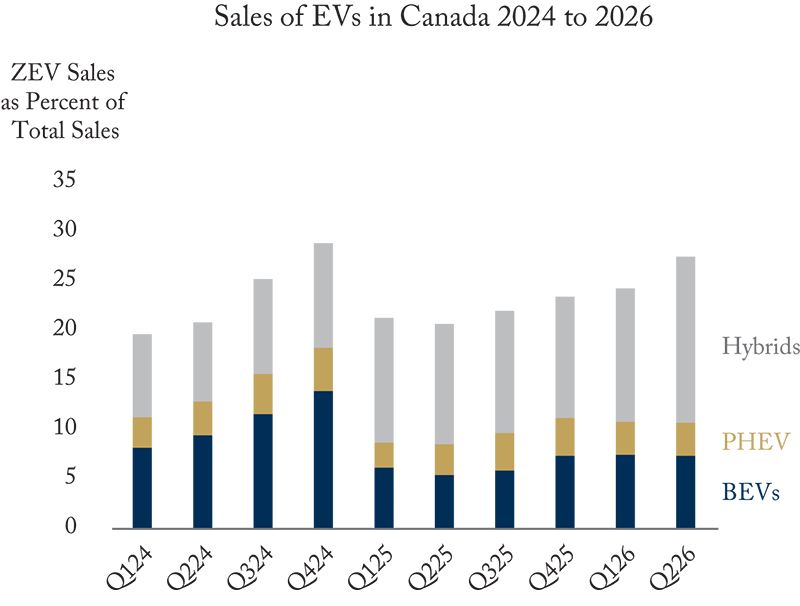
Source: Statistics Canada’s new vehicle registration quarterly report.
The proposed regime would set a limit for the total emissions of all vehicles sold by a vendor. The vendor would have the choice of technology. Some would sell more BEVs and therefore be able to sell more gasoline vehicles. Others would sell fewer BEVs and more PHEVs and hybrids, which would reduce the number of gasoline vehicles that it could sell.
Finally, some suggestions as to the details of design.
- Use the KISS philosophy (Keep It Simple Stupid) by making the emissions calculation simple. Set a number for each model sold and make assumptions for annual mileage. For example, a Toyota Corolla goes 15,000 kilometres a year and emits 0.2 tonnes per thousand kilometres, resulting in annual emissions of three tonnes of greenhouse gasses.
- Some companies, such as Tesla, will be well below their emissions cap, and others above it. If the Teslas gain additional revenue from selling excess emissions credits, it would be in effect a windfall gain. A better system would be for the federal government to sell these excess emission credits to the companies exceeding their caps.
- A key feature would be what happens if an individual vendor exceeds its overall emissions cap. Ottawa should impose penalties, but not prohibit gasoline vehicle sales. It should be like the luxury tax in baseball, where a club must pay money if it exceeds the salary cap.
Bottom line is, this system would work because it reflects the reality of the market in which Canadians are increasingly turning to lower emission hybrid vehicles. The model would be flexible for vendors and compliance would be simple. Ottawa should beat a path to its door.
Brian Livingston, a C.D. Howe Institute Senior Fellow, is Executive Fellow with the School of Public Policy at the University of Calgary.
To send a comment or leave feedback, email us at blog@cdhowe.org.
The views expressed here are those of the author. The C.D. Howe Institute does not take corporate positions on policy matters.