To: Alberta referendum voters From: Herbert Emery Date: September 17, 2026 Re: Whither Exports in a Sovereign Alberta? This is another in a series the C.D. Howe Institute is presenting to better inform the public about the policy issues and complexities of the potential separation of Alberta, and its consequences on Albertans, businesses and the […]
To: Concerned Canadians From: Jeremy M. Kronick and Kate Koplovich Date: September 14, 2026 Re: Introducing an Alberta Referendum Series: From Talking Points to Realities Canada is at a pivotal moment in its history. We are repositioning ourselves as a country open to investment. But we do so alongside headwinds. Trade uncertainty with our largest […]
Data from the federal government’s Major Project Inventory shows that oil and gas projects declined 76 percent in Canada between 2017 and 2025, while global energy investment continued to find opportunities in regions around the world. Canada can capture more of that investment through much-needed regulatory reform. George Vegh and Kate Koplovich point to a […]
In this episode, George Vegh and Kate Koplovich discuss what’s holding back Canada’s major projects — and what it will take to restore investor confidence. From pipelines and energy infrastructure to mining, transportation, and nation-building projects, the conversation explores why regulatory certainty, efficient approvals, and effective governance are essential for Canada’s economic future.
In this episode, George Vegh and Kate Koplovich discuss what’s holding back Canada’s major projects — and what it will take to restore investor confidence. From pipelines and energy infrastructure to mining, transportation, and nation-building projects, the conversation explores why regulatory certainty, efficient approvals, and effective governance are essential for Canada’s economic future.
September 8, 2026 – As Canada brings together global investors for the Canada Investment Summit and looks to accelerate the building of major projects, a more predictable regulatory process is needed to give investors and proponents the confidence to commit capital, according to a new C.D. Howe Institute report. In Clear the Way: Does the […]
8 septembre 2026 – Alors que le Canada réunit des investisseurs du monde entier dans le cadre du Sommet canadien de l’investissement et cherche à accélérer la réalisation de grands projets, un processus réglementaire plus prévisible est nécessaire pour donner aux investisseurs et aux promoteurs la confiance nécessaire pour s’engager financièrement, selon un nouveau rapport […]
by George Vegh and Kate Koplovich Canada needs to build major energy and natural resource projects faster to attract private investment and improve productivity. The federal government has responded by enacting the Building Canada Act (BCA), standing up the Major Projects Office (MPO), and proposing further regulatory reforms. None of these mechanisms address the fundamental sources […]
From: Ed Waitzer and Gerry Rocchi To: Climate change watchers Date: September 1, 2026 Re: Climate Change Adaptation Needs to Start Now A survey of 2026 news reveals the contradictions, and opportunities, that characterize this moment in climate change response. Canada announced yet another expert group to finalize a taxonomy of green investing intended to facilitate the country’s net-zero […]
Under the new federal-Alberta memorandum of understanding carbon pricing agreement, net carbon pricing across oil sands barrels for 2026 (actual) and the projected distributions for 2030 and 2050 all remain largely under $5 per barrel, with 2030 costs largely under $2 (in 2026 dollars). This is much less than the federal output-based pricing system and […]
by G. Kent Fellows This Commentary estimates how Alberta’s Technology Innovation and Emissions Reduction (TIER) system, the province’s industrial carbon pricing system for large emitters, affects the marginal costs of oil sands production. Using project-level production and emissions data, it estimates carbon pricing costs in 2023 and projects how those costs evolve under the recently […]
August 13, 2026 – The recently updated federal-Alberta carbon pricing agreement is projected to cost an average oil sands facility less than $2 per barrel, and to keep industrial carbon pricing costs below $5 per barrel (bbl) for every oil sands facility analyzed through 2050, according to a new C.D. Howe Institute report. In “Buckets […]
Membership Application
Interested in becoming a Member of the C.D. Howe Institute? Please fill out the application form below and our team will be in touch with next steps. Note that Membership is subject to approval.
"*" indicates required fields
Member Login
Not a Member yet? Visit our Membership page to learn more and apply.




 To: Alberta referendum voters From: Herbert Emery Date: September 17, 2026 Re: Whither Exports in a Sovereign Alberta? This is another in a series the C.D. Howe Institute is presenting to better inform the public about the policy issues and complexities of the potential separation of Alberta, and its consequences on Albertans, businesses and the […]
  To: Concerned Canadians From: Jeremy M. Kronick and Kate Koplovich Date: September 14, 2026 Re: Introducing an Alberta Referendum Series: From Talking Points to Realities Canada is at a pivotal moment in its history. We are repositioning ourselves as a country open to investment. But we do so alongside headwinds. Trade uncertainty with our largest […]
  Data from the federal government’s Major Project Inventory shows that oil and gas projects declined 76 percent in Canada between 2017 and 2025, while global energy investment continued to find opportunities in regions around the world. Canada can capture more of that investment through much-needed regulatory reform. George Vegh and Kate Koplovich point to a […]
 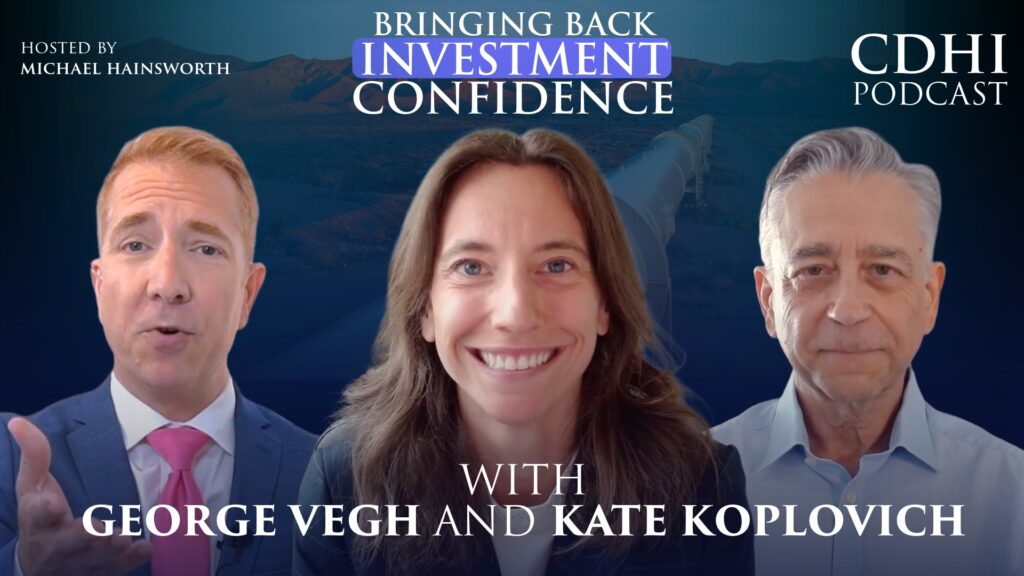 In this episode, George Vegh and Kate Koplovich discuss what’s holding back Canada’s major projects — and what it will take to restore investor confidence. From pipelines and energy infrastructure to mining, transportation, and nation-building projects, the conversation explores why regulatory certainty, efficient approvals, and effective governance are essential for Canada’s economic future.
  September 8, 2026 – As Canada brings together global investors for the Canada Investment Summit and looks to accelerate the building of major projects, a more predictable regulatory process is needed to give investors and proponents the confidence to commit capital, according to a new C.D. Howe Institute report. In Clear the Way: Does the […]
  From: Ed Waitzer and Gerry Rocchi To: Climate change watchers Date: September 1, 2026 Re: Climate Change Adaptation Needs to Start Now A survey of 2026 news reveals the contradictions, and opportunities, that characterize this moment in climate change response. Canada announced yet another expert group to finalize a taxonomy of green investing intended to facilitate the country’s net-zero […]
 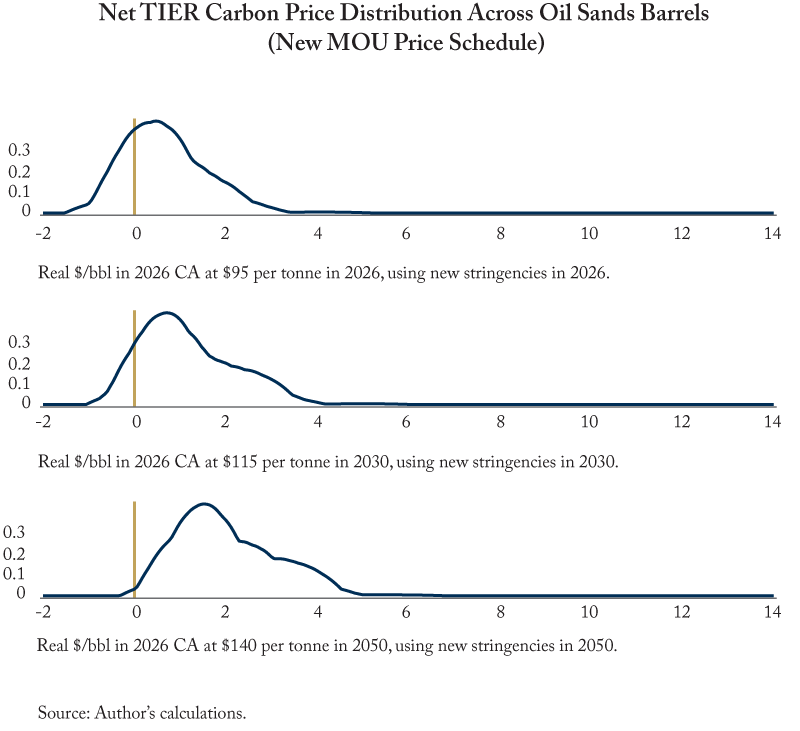 Under the new federal-Alberta memorandum of understanding carbon pricing agreement, net carbon pricing across oil sands barrels for 2026 (actual) and the projected distributions for 2030 and 2050 all remain largely under $5 per barrel, with 2030 costs largely under $2 (in 2026 dollars). This is much less than the federal output-based pricing system and […]
  by G. Kent Fellows This Commentary estimates how Alberta’s Technology Innovation and Emissions Reduction (TIER) system, the province’s industrial carbon pricing system for large emitters, affects the marginal costs of oil sands production. Using project-level production and emissions data, it estimates carbon pricing costs in 2023 and projects how those costs evolve under the recently […]