



Shaky Assumptions: The Hazards of Relying on Energy Scenarios in Federal Policy
 Governments around the world rely on the predictions of global energy agencies to inform their own domestic energy policies and regulations. The most notable agencies include the International Energy Agency (IEA), the Organization for Petroleum Exporting Countries (OPEC), and the US Energy Information Administration (EIA). This paper explores the role of forecasts and scenarios […]
 Mind the Gap: The Impact of Budget Constraints on Ontario’s Net Zero Plans
 Climate change’s urgency demands that rigorous cost-benefit analysis be performed on each energy transition expenditure. This publication calculates if there is a potential funding shortfall for Ontario’s net zero targets relative to its current cost projections and the available sources to pay for it. Under an aggressive adoption scenario, annual available funding in Ontario […]
 Energy Policy Council
 The C.D. Howe Institute’s Energy Policy Program looks at the economics of energy use and development in Canada: its contribution to national prosperity and the regulatory and fiscal changes that could enhance that contribution. The Program applies the latest thinking in public finance and resource policy to assess how governments can improve the global competitiveness of the […]
 Esam Hussein – Nuclear is Coming Back. What About Canada’s Fuel Supply Chain?
 To: Canadian Nuclear Observers From: Esam Hussein Date: April 5, 2024 Re: Nuclear is Coming Back. What About Canada’s Fuel Supply Chain? Canada appears on the verge of a nuclear-power renaissance instigated by the need for reliable carbon-free energy, with the provinces and the federal government putting their weight behind a wide range of initiatives. How did we get here […]
 Don Drummond on Power & Politics – More Than 200 Economists Signed a Letter Defending Carbon Tax
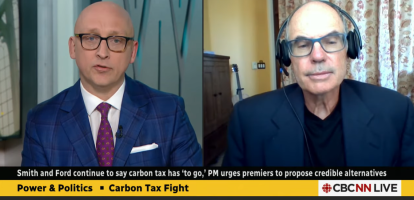
Stephen Gordon, an economics professor at Laval University, and Don Drummond, a Fellow-in-Residence at the C.D. Howe Institute and adjunct professor at the School of Policy Studies at Queen’s University, join CBC’s Power & Politics to discuss the debate on the carbon tax.
Garbutt, Harker – Choosing Which “Critical Minerals” Should Be Subsidized Is Problematic
 From: Jonathan Garbutt & Michael Harker To: The Honourable Chrystia Freeland, Minister of Finance of Canada Date: March 26, 2024 Re: Choosing Which “Critical Minerals” Should Be Subsidized Is Problematic Finance Canada has proposed amendments via Bill C-59 to the Income Tax Act that expand Canada’s flow-through share (FTS) tax incentive program to include mining projects […]
 Charles DeLand – Fewer, Stronger Policies Would Help Fill Emissions Investment Gap
 To: Natural Resources Minister Jonathan Wilkinson, and Finance Minister Chrystia Freeland From: Charles DeLand Date: March 22, 2024 Re: Fewer, Stronger Policies Would Help Fill Emissions Investment Gap Last month, Canada’s Minister of Natural Resources declared he’d like to see more green investment action by industrial greenhouse gas emitters, specifically those in the oilsands. Around the same time, a […]
 Brian Livingston – The Real Story of the Future of EVs
 From: Brian Livingston To: Canadians interested in the future of EVs Date: March 11, 2024 Re: The Real Story of the Future of EVs C.D. Howe Institute author Brian Livingston responds to a critique of his publication. In a recent study for the C.D. Howe Institute, I highlighted the near-impossibility of procuring enough Zero Emission Vehicles […]
 Faut-il déchirer sa chemise pour Northvolt ? – La Presse
Pas facile de se faire une tête dans ce dossier, où promoteurs et opposants présentent des arguments valables, mais aussi des positions critiquables. Prenons de la hauteur pour en juger.
L’argument central avancé dans ce journal par le ministre de l’Économie, de l’Innovation et de l’Énergie, Pierre Fitzgibbon, est de « développer au Québec une économie basée sur des secteurs d’avenir » et de « réduire notre écart de richesse avec le reste du Canada » pour financer la santé et l’éducation.
Des objectifs louables, certes, mais le gouvernement de la CAQ ne semble appliquer qu’une moitié de la stratégie préconisée pour lutter contre le réchauffement climatique, qui est de s’attaquer tant aux risques…
Lawrence Herman – The Coming War Over Chinese Electric Vehicles
 To: Canadian trade watchers From: Lawrence Herman Date: February 15, 2024 Re: The Coming War Over Chinese Electric Vehicles Standing back and looking at today’s global trading picture, one can see that it’s not pretty – destabilized by the wars in Ukraine and Gaza, by the unsettled multilateral situation at the World Trade Organization and by innumerable regional trade disputes. […]
 Brian Livingston – Ottawa’s Blind EV Optimism
 To: The Hon. Steven Guilbeault, Minister of Environment and Climate Change From: Brian Livingston Date: February 14, 2024 Re: Ottawa’s Blind EV optimism By 2035, only zero-emission cars and light trucks can be sold according to the federal government’s recently finalized mandate regulations. That leaves just 11 years and reasonable forecasts of production and sales make clear that […]
 Ottawa’s EV timeline is way too optimistic – Financial Post
The federal government recently finalized regulations for its “zero-emissions vehicle” mandate. The mandate requires sellers of light vehicles (passenger cars and light trucks) to sell a rising minimum of zero-emissions vehicles — basically, electric vehicles or EVs — every year, culminating with 100 per cent EVs in 2035, just 11 years from now. Reasonable forecasts of production and sales make clear that Ottawa’s timeline is unrealistic.
The mandate states that new light vehicles must be at least 20 per cent EVs in 2026, 60 per cent in 2030 and, as mentioned, 100 per cent in 2035. The theory is that these requirements will guarantee a market for EVs and therefore encourage imports, construction of domestic manufacturing…