



Ottawa Needs a Clear Fiscal Anchor: Fiscal and Tax Working Group
September 14, 2020 – Ottawa must adopt a clear fiscal anchor to guide and control expenditure choices, says the C.D. Howe Institute’s Fiscal and Tax Working Group. The group of experts in both the private sector and academia is co-chaired by John Manley, former federal minister of finance; and Janice MacKinnon, former minister of finance of Saskatchewan.
At their recent meeting, working group members discussed the importance of fiscal sustainability in ensuring government’s ability to provide public services, and the appropriate fiscal anchor to impose discipline over budgetary decisions.
If left unanchored, public debt can eventually be monetized, as the central bank buys up government bonds, leading to higher…
Graph of the Week: Overnight Rate and 12-Month Change in House Prices, 2018-2024 (July)
 Graph of the Week is a new series from the C.D. Howe Institute’s Graphic Intelligence that presents valuable and easily digestible data. Each Monday we unveil one new captivating chart or graph with interesting insights, explaining it in two-to-three sentences. Dive into the data with us. In the ensuing months after the Bank of Canada […]
 Minding the Purse Strings: Major Reforms Needed to the Federal Government’s Expenditure Management System
 The federal government’s expenditure management system (EMS) has many desirable characteristics but needs substantial reform to achieve its objectives of ensuring that programs are effective, efficiently delivered, aligned with government priorities, and represent value for money. Evaluation of government transfer payments is the cornerstone of the EMS, but its impact is diminished by: Excluding measures […]
 Another Day Older and Deeper in Debt: The Fiscal Implications of Demographic Change for Ottawa and the Provinces
 Canada’s changing demographics matter for public finances. Canada’s baby boom from the late 1940s through the mid-1960s was large. The subsequent decline in the national fertility rate was steep. As a result, some 65 years after the baby boom’s peak, Canada’s population is aging fast. Rapid population aging creates challenges for public finances. Departures from […]
 Graph of the Week: The 5-Year Fixed Interest Rate
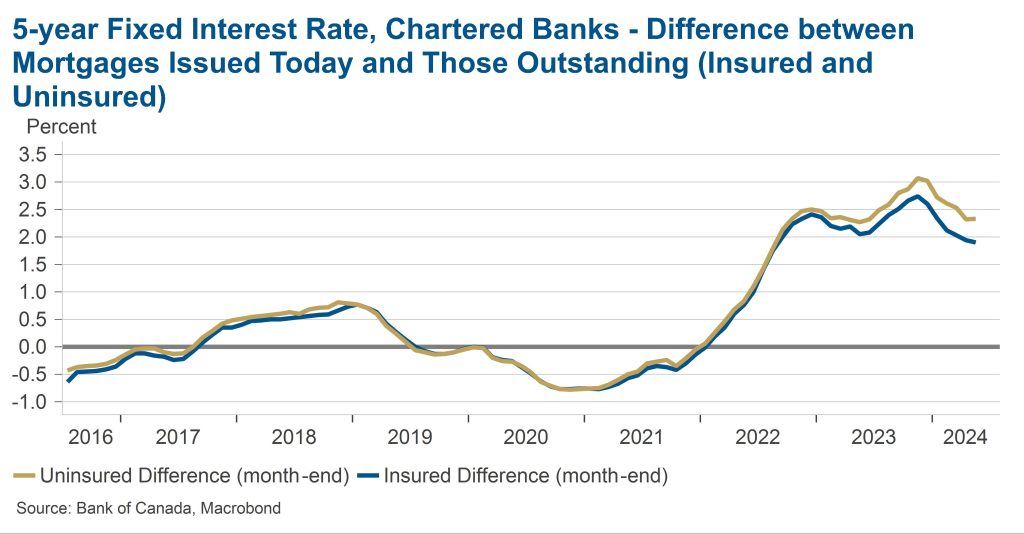 Introducing Graph of the Week, a new series from the C.D. Howe Institute’s Graphic Intelligence that presents valuable and easily digestible data. Each Monday we will unveil one new captivating chart or graph with interesting insights, explaining it in two-to-three sentences. Dive into the data with us. The 5-year fixed interest rate is the most […]
 Spurring R&D: Canada Needs Focused Reforms to SR&ED and an IP Box
 Finance Canada is conducting a review to modernize and improve the scientific research and experimental development (SR&ED) tax incentive program, and is considering the creation of a Patent Box for Canada. The review of SR&ED should recognize that its raison d’être is to encourage R&D, which benefits society through knowledge spillovers. Separate programs should […]
 William B.P Robson – Government Must Clarify or Drop the 2024 Budget’s Capital Gains Tax Changes
To: Canadian taxpayers From: William B.P. Robson Date: May 6, 2024 Re: Government Must Clarify or Drop the 2024 Budget’s Capital Gains Tax Changes The 2024 federal budget announced higher capital-gains taxes that will be effective June 25. Instead of paying tax on half of all gains under current rules, individuals will pay tax on half of gains under […]Fiscal and Tax Competitiveness Council
 The ways governments spend, raise revenue, and manage their assets and liabilities have huge effects on living standards now and in the future. Improving the effectiveness and efficiency of government programs is a continuing task. Ensuring that the structure and rates of taxation do not discourage work, saving and investment in Canada is vital. Maintaining […]
 Kronick, Ambler – No Rate Cut Yet. Here’s Why There Should Have Been
 To: Interest rate watchers From: Jeremy M. Kronick and Steve Ambler Date: April 26, 2024 Re: No Rate Cut Yet. Here’s Why There Should Have Been The latest data indicate that the battle against inflation is almost over. Despite this, the Bank of Canada again held its policy rate at 5 percent this month. What gives? The Bank, like many other central […]
 Drummond, Robson – The 2024 Federal Budget Gets a Grade of D
 To: Canadian Budget Watchers From: Don Drummond and William B.P. Robson Date: April 24, 2024 Re: The 2024 Federal Budget Gets a Grade of D Before the federal budget, we laid out a 10-point grading scheme. We were hoping the document would deserve better than the ‘D’ we gave the government’s fall economic statement. Unfortunately, it falls well short of what […]
 William B.P. Robson – An Unserious Budget With Unserious Projections
 To: Canadian public finance watchers From: William B.P. Robson Date: April 23, 2024 Re: An Unserious Budget With Unserious Projections Last week’s federal budget showed again – as if it were needed – that this government is not serious about public finances. It was late, given that the 2024/25 fiscal year started more than two weeks ago. It […]
 The budget got one thing right — living standards are slipping. Then it made things worse – Financial Post
This week’s federal budget paid passing lip service to the challenge of Canada’s dismal productivity and falling living standards. In an over-long and mostly self-congratulatory preamble, the budget acknowledged: “Canada has struggled with productivity growth — how much more income we are able to generate with each hour worked. This has led to a longstanding productivity gap, notably with the United States. Expanding the productive capacity of the Canadian economy and overcoming Canada’s productivity challenges are essential.”
Important words, but whoever wrote them seems to have had no influence over what came next. The budget’s projections and measures prefigure nothing but more handouts, higher taxes, mounting debt and…