



Canada’s shadow banks are now too big to ignore – National Post Op-Ed
In Canada the financial services sector weathered the 2007-08 global “credit crunch” better than it did in many other developed countries. One argument for why, certainly in contrast to the U.S., was the smaller size of our “non-bank financial intermediation” (NBFI) sector, more commonly referred to as “shadow banking.” But rapid growth in the shadow sector since the crisis suggests this resilience might be under threat. What does that mean for monetary policy, financial stability and regulation? As it turns out, a lot.
Broadly speaking, the shadow sector includes investment funds, private lenders like mortgage finance companies, companies that offer private-label securitization like asset-backed securities, and more. Shadow…
Predicting Financial Crises: The Search for the Most Telling Red Flag in the Economy
 February 13, 2020 – Canadians’ level of indebtedness is raising concerns on the basis of several traditional measures, but the most reliable predictor of trouble ahead is the debt-service ratio, says a new report from the C.D. Howe Institute. In “Predicting Financial Crises: The Search for the Most Telling Red Flag in the Economy,” authors […]
 S2 E2 – Inequality and Monetary Policy
 Michael Hainsworth sits down with the Institute’s Jeremy Kronick to talk about income inequality’s effect on inflation, and the rising non-bank financial intermediary sector that could be diluting the effectiveness of monetary policy.
 Water in the Wine? Monetary Policy and the Impact of Non-bank Financial Intermediaries
 February 4, 2020 – The rapid growth of the non-bank financial intermediation sector, formerly called shadow banking, appears to dilute monetary policy effectiveness in Canada and poses a risk to financial stability, according to a new report from the C.D. Howe Institute. In “Water in the Wine? Monetary Policy and the Impact of Non-bank Financial […]
 Jeremy Kronick on BNN – Growth in Non-bank Financial Intermediaries Could Weaken Monetary Policy

Jeremy Kronick, Associate Director of Research at the C.D. Howe Institute, joins BNN Bloomberg to discuss the rapid growth of the non-bank financial intermediation sector and its possible impact on the Bank of Canada’s monetary policy use.
For the Bank of Canada, what a difference a few months makes – Globe and Mail Op-Ed
The Bank of Canada announced last Wednesday that it’s continuing to hold its overnight target rate constant at 1.75 per cent. No surprise there. What is interesting, however, is a major turn of events in the economic outlook.
The global economy appears to have gone from being a drag on Canadian growth to a strength, whereas the domestic Canadian economy, once a growth driver, appears to be slowing down. The Bank of Canada still faces a balancing act – although it at least has the tools to fight domestic weakness.
The target rate in Canada has remained constant since December, 2018. Elsewhere, several major central banks lowered their policy rates in response to earlier signs of weakness in the world economy and major…
Monetary Policy, Income Inequality, and Inflation – What’s the Link?
 The Bank of Canada should weigh how income inequality affects monetary policy effectiveness as it pursues its 2 percent inflation target, says a new report from the C.D. Howe Institute. In “Monetary Policy, Income Inequality, and Inflation—What’s the Link?” authors Jeremy Kronick and Francisco Villarreal investigate the link between monetary policy, income inequality and inflation […]
 Jeremy Kronick on BNN – Income inequality has flatlined since financial crisis
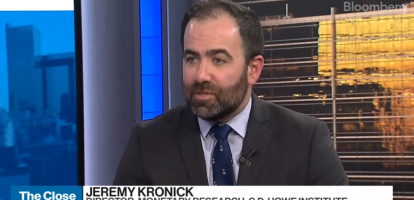
Jeremy Kronick, Associate Director of Research at the C.D. Howe Institute, joins BNN Bloomberg to discuss the link between monetary policy, income inequality and inflation in Canada.
Bank of Canada Should Hold Overnight Rate at 1.75 Percent through July, Cut to 1.50 by Next Year: C.D. Howe Institute Monetary Policy Council
January 16, 2020 – The C.D. Howe Institute’s Monetary Policy Council (MPC) recommends that the Bank of Canada keep its target for the overnight rate, its benchmark policy interest rate, at 1.75 until July 2020. 1.75 percent was the median vote of the nine members attending the meeting, and is the Council’s formal recommendation. By January of 2021, with four members calling for a cut in the target at some point, and three calling for an increase, the Council’s median recommendation was 1.50.
The MPC provides an independent assessment of the monetary stance consistent with the Bank of Canada’s 2 percent inflation target. William Robson, the Institute’s President and CEO, chairs the Council. Council members make…
Glen Hodgson – Five Key Issues for 2020
From: Glen Hodgson To: Canadians Concerned about 2020 Date: January 6, 2020 Re: Five Key Issues for 2020 Global growth is being deeply affected by the trade turmoil fomented by Donald Trump and uncertainty abounds, with slower growth in many places and plenty of policy risk. Here are five key issues to watch in 2020. […]Five key economic growth risks to keep your eye on heading into 2020 – Globe and Mail Op-Ed
Global growth is being deeply affected by the trade turmoil fomented by U.S. President Donald Trump and uncertainty is at the forefront, with slower growth in many places and plenty of policy risk. Here are five key issues to watch in 2020.
Expect little overall improvement in global economic prospects. It would be unrealistic to expect a material improvement in economic performance. Both the International Monetary Fund and Organization for Economic Co-operation and Development project the global economy will not strengthen by much; growth in 2020 will remain below 3.5 per cent, after 3 per cent projected for 2019. That would be the weakest period of global growth since the 2008-09 financial crisis and recession.
…
The Bank of Canada and the uncertain outlook for inflation – Globe and Mail Op-Ed
The Bank of Canada announced on Wednesday that it was holding its overnight rate target constant at 1.75 per cent. Many analysts had been predicting a lowering of the rate since at least Oct. 30, when the bank also held the rate steady and the U.S. Federal Funds Rate dropped a quarter percentage point.
A recent Reuters poll reports that a majority of forecasters now expect the Canadian central bank to hold its rate constant right through the end of 2020. That will, of course, depend on the course of inflation.
In 2018, the bank was engaged in a tightening cycle and seemed to be on a course toward its long-run “neutral” rate in the range of 2.25 per cent to 3.25 per cent (compatible with an economy at full…