



Jon Johnson – Court Ruling on Constitutional Challenge to Section 232
From: Jon Johnson To: Canadians Concerned About Section 232 Tariffs Date: April 22, 2019 Re: Court Ruling on Constitutional Challenge to Section 232 The US Court of International Trade issued on March 25 an opinion on the constitutional challenge to Section 232 of the Trade Expansion Act of 1962 brought by the American Institute for […]Christopher Sands – Washington and the USMCA Delay: Cause for concern?
To: Hon. Chrystia Freeland, Minister of Foreign Affairs From: Christopher Sands Date: April 11, 2019 Re: Washington and the USMCA Delay: Cause for concern? Four months after its signing, the United States Congress still has not acted on approval the replacement for NAFTA. Why not? And should Canadians be worried? International trade is assigned by […]Christopher Sands – Washington and the USMCA Delay: Why is this happening?
To: The Hon. Chrystia Freeland, Minister of Foreign Affairs From: Christopher Sands Date: April 10, 2019 Re: Washington and the USMCA Delay: Why is this happening? Four months after Prime Minister Justin Trudeau signed the Canada United States Mexico Agreement (CUSMA, or USMCA as it is known in the United States) the US Congress still […]Glen Hodgson – The Consequences Of China’s Slowdown
 From: Glen Hodgson To: Canadians concerned about China Date: April 3, 2019 Re: The Consequences of China’s Slowdown China has sustained spectacular economic growth for nearly four decades and it has made a great leap forward in the living standards and personal ambitions of much of its population. However, a growing number of signs indicate the prolonged period […]
 Navigating the ever-changing world of sanctions is a struggle for Canadian businesses – Op-Ed
Economic sanctions are a growing risk factor for Canadian companies engaged in international business, involving traps for the unwary, including, in the most serious cases, criminal charges against senior officers and against the company itself.
Despite these risks and the exposure to criminal penalties, the world of sanctions is not fully understood in many quarters. Here’s a short primer.
To start with the obvious, sanctions are unilateral prohibitions applied by governments to restrict foreign transactions in specific sectors or with individuals that have been identified as corrupt or morally reprehensible. In some cases, sanctions cover both categories.
Sanctions tend to go in one direction, mostly applied by…
Lawrence Herman – On Investor-state Disputes, Nafta Can’t End Too Soon
 From: Lawrence Herman To: Canadians concerned about NAFTA Chapter 11 Date: March 12, 2018 Re: On Investor-State Disputes, NAFTA Can’t End Too Soon With the NAFTA arbitration award against Canada in the controversial Clayton-Bilcon case finally being released – a mere $7 million – it seems timely to review these investor-state disputes and see where matters stand in the […]
 The End Of China’s Growth Miracle – Globe And Mail Op-ed
China has sustained spectacular economic growth for nearly four decades and it has made a great leap forward in the living standards and personal ambitions of much of its population. However, a growing number of signs indicate the prolonged period of rapid growth is coming to an end, with consequences for Canada and the world.
China’s growth miracle began in the late seventies with reforms led by Deng Xiaoping that recognized the advantages of private initiative and market forces – combined with massive continuing investment by the state and a gradual opening to the world economy. Growth rates began to take off in the eighties and soared into double digits at times. Chinese per capita income grew rapidly and is now approaching US…
Jon Johnson – Us Approval Of The New Nafta – Pitfalls?
 From: Jon Johnson To: Canadians Concerned About the USMCA Date: February 21, 2019 Re: US Approval of the new NAFTA – Pitfalls? US Trade Representative Robert Lighthizer on January 29 initiated the process under the Bipartisan Congressional Trade Priorities and Accountability Act of 2015 (the “TPA Law”) for approving the US Mexico Canada Agreement, by delivering to Congress a description of […]
 Robson, Laurin – Tax Relief for the 2019 Federal Budget
 To: The Honourable Bill Morneau, Minister of Finance From: William B.P. Robson and Alexandre Laurin Date: February 11, 2019 Re: Tax Relief for the 2019 Federal Budget The C.D. Howe Institute’s Shadow Federal Budget for 2019 last week aims to enhance Canada’s competitiveness and dynamism, while setting the stage for a return to surpluses during the next Parliament. Today we examine […]
 Less Debt, More Growth: A Shadow Federal Budget for 2019
 February 7 – Ottawa should spur growth through better tax competitiveness and get back into the black by curbing overspending, says the C.D. Howe Institute’s annual Shadow Federal Budget. In “Less Debt, More Growth: A Shadow Federal Budget for 2019”, authors William B.P. Robson and Alexandre Laurin show Ottawa could balance its budget in 2023/24 […]
 Glen Hodgson – Four (Macroeconomic) Reasons to Worry
 From: Glen Hodgson To: Concerned Canadians Date: February 1, 2019 Re: Four (Macroeconomic) Reasons to Worry The American economy is adrift, like a huge sailing ship. When tides are high and winds are favourable, it can be headed in the right direction. But when conditions darken, the US economy will have no mooring or anchor. It could even […]
 Bill Robson on BNN – On U.S.-China tensions, we have to be closer to the U.S.
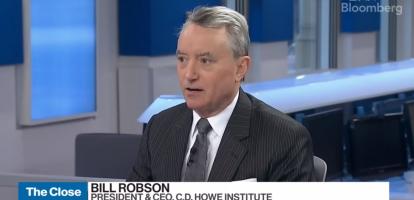
A new round of trade talks between the U.S. and China started Wednesday amid tensions over the criminal probe against Huawei. Bill Robson, president and CEO of the C.D. Howe Institute, weighs in on where Canada fits in.