






by Kenneth J. Klassen and Nick Pantaleo
- The importance of Canada Revenue Agency (CRA) audits to the administration of the Canadian tax system is self-evident. So is the need for CRA to conduct high-quality audits. While audit outcomes are subject to appeals and court challenge, it is not desirable to rely frequently on appeals and the courts to ensure that the tax rules are fairly applied.
- In this paper, we explore incentives CRA faces, and some evidence on how CRA conducts audits, the time it takes CRA to conduct an audit, and the accuracy of CRA’s reporting of the results of their audit efforts. These aspects of the audit process matter.
- Building on the analysis in Klassen (2016), we note that incentives to increase assessments have been amplified by recent funding for the CRA that carries an expectation that additional tax revenues of $5 will be collected for each $1 spent, a “return” that is much higher than in the past. As well, these additional tax revenues are explicitly linked to the CRA’s measures of how much tax revenue theoretically exists versus how much is actually paid voluntarily (the tax gap).
- Practitioners express concerns over poor CRA audit-process quality. The duration of CRA audits, the very high proportion of reassessments that are issued in the final two months of its fiscal year, and the rate at which reassessments are eventually ruled in the taxpayer’s favour lend some evidence to these concerns.
- We recommend calibrating the performance of CRA compliance activities to reduce emphasis on fiscal impact (an incomplete measure of revenues collected), and that fiscal impact be adjusted for final taxpayer assessment amounts, which does not occur at present. CRA has developed a measure of overall compliance and confidence that taxes will voluntarily be paid called, “validated risk,” which can offset incentives arising from the emphasis on fiscal impact, and we recommend that this metric’s use be expanded and emphasized.
Taxpayer compliance – applying the tax rules to a taxpayer’s economic circumstances to compute and remit any taxes due – is critical to the integrity of the Canadian tax system. The CRA plays a crucial role through various activities to assist taxpayers with their compliance obligations (Klassen 2016). In particular, the prospect of being audited by CRA and any negative audit outcomes serve to encourage taxpayer compliance, particularly in a self-assessment tax system like the one in Canada.
Since it is an obvious impossibility for CRA to audit every transaction of every taxpayer for every taxation year, CRA must necessarily conduct selective audits. CRA conducts risk-based audits that select taxpayers and transactions that CRA considers likely to be subject to non-compliance. The risk determination may include (i) the taxpayer’s history of compliance (for example, does the taxpayer have a history of making errors); or (ii) the nature of the taxpayer’s operational activities that raises the risk of transactions being mischaracterized or mistreated for tax purposes (for example, taxpayers with international operations).
In this paper, we explore incentives that CRA faces, and some evidence on how CRA conducts audits, the time it takes CRA to conduct an audit, and the accuracy of CRA’s reporting of the results of their audit efforts. The process matters, and it does impact the results. The ultimate taxpayer outcome includes the cost of reaching the end – in terms of time, dollars, and reputation – to the audited taxpayer, to the CRA, and to the country.
Recent Developments and Concerns over Audit Incentives
Individuals respond to the incentives that they are given. Like much of the Canadian economy, the Canadian tax system is successfully built upon this premise. Klassen (2016) analyzes the incentives CRA auditors face, at least to the extent that can be gleaned from publicly available information.
Klassen (2016) also reviews academic research that demonstrates even when auditors are trying to assess the “correct” amount of tax, they do not have perfect information and therefore will sometime assess more or less than is “correct.” In this context, we put quotations around “correct” because the tax liability in practice is both unknown to any party, and in many cases is not a single, correct amount, as the academic research often assumes. It is not a stretch to think of “correct” as a “fair” tax liability that may have a range of values.
Beyond the effort of CRA auditors to uncover their best estimate of the taxes owing, Klassen (2016) also analyzes the incentive issues around the use of the tax assessments from an audit as a metric for evaluating CRA audit activities. Measuring audit yields is commonly used by tax administrators to assess their compliance activities. One of the ways CRA assesses, monitors and reports on the effectiveness of its compliance activities is by measuring and reporting its audit results through the audits’ “fiscal impact” (as discussed below). Other metrics CRA reports include the percentage of returns filed and paid on time, the proportion of known businesses registered for GST/HST, and information on other efforts, including letter campaigns. These metrics and activities are consistent with CRA’s goal of ensuring taxpayer compliance within the tax system.
CRA defines fiscal impact in its Department Results Report as follows, “Fiscal impact consists of tax assessed, tax refunds reduced, interest and penalties, and present value of future federal tax assessable arising from compliance actions. It does not account for the impact of appeals, reversals and uncollected amounts” (CRA 2018a at p. 35). The definition of fiscal impact clearly states that the calculation of additional revenues is not reduced by reassessments that are overturned or if revenues are not collected.11 Tax assessed is directly related to the internal metric, tax earned by audit or TEBA (AGC 2014). Elsewhere, it is made clear that fiscal impact also includes provincial taxes (e.g., CRA 2018b). As Klassen (2016) asserts, this approach creates incentives to increase assessed amounts because their reversal subsequently is not part of reported fiscal impact.
Klassen (2016) identifies academic research that shows that a group performance objective such as fiscal impact will alter the behavior of individual workers, even when the evaluation metric is not used for individual auditors. Consequently, he asserts that some auditors may, perhaps unconsciously, be auditing in ways that satisfy the evaluation system used by CRA rather than with a view to the fairest amount of tax due.
Since the publication of Klassen (2016), new developments have occurred that potentially amplify the incentives’ role in the CRA audit process.
Additional Funding Creates New Expectations
The first significant development was the granting to CRA of an additional $444 million, over five years, in the 2016 federal budget, and a further $524 million, over five years, in the 2017 budget. The related budget documents state the expected outcome of this spending is an additional $5.1 billion in federal revenues from improved compliance, or approximately $5 for each $1 spent. The commitment of CRA to show a ‘return’ on the investment of public funds is understandable in the current environment in which governments are under pressure from the public and various watchdog organizations to demonstrate the value of public spending.22 For example, the Auditor General for Canada in its 2018 review concludes that the tax targets should be raised because they are being consistently exceeded (AGC 2018, par. 7.70).
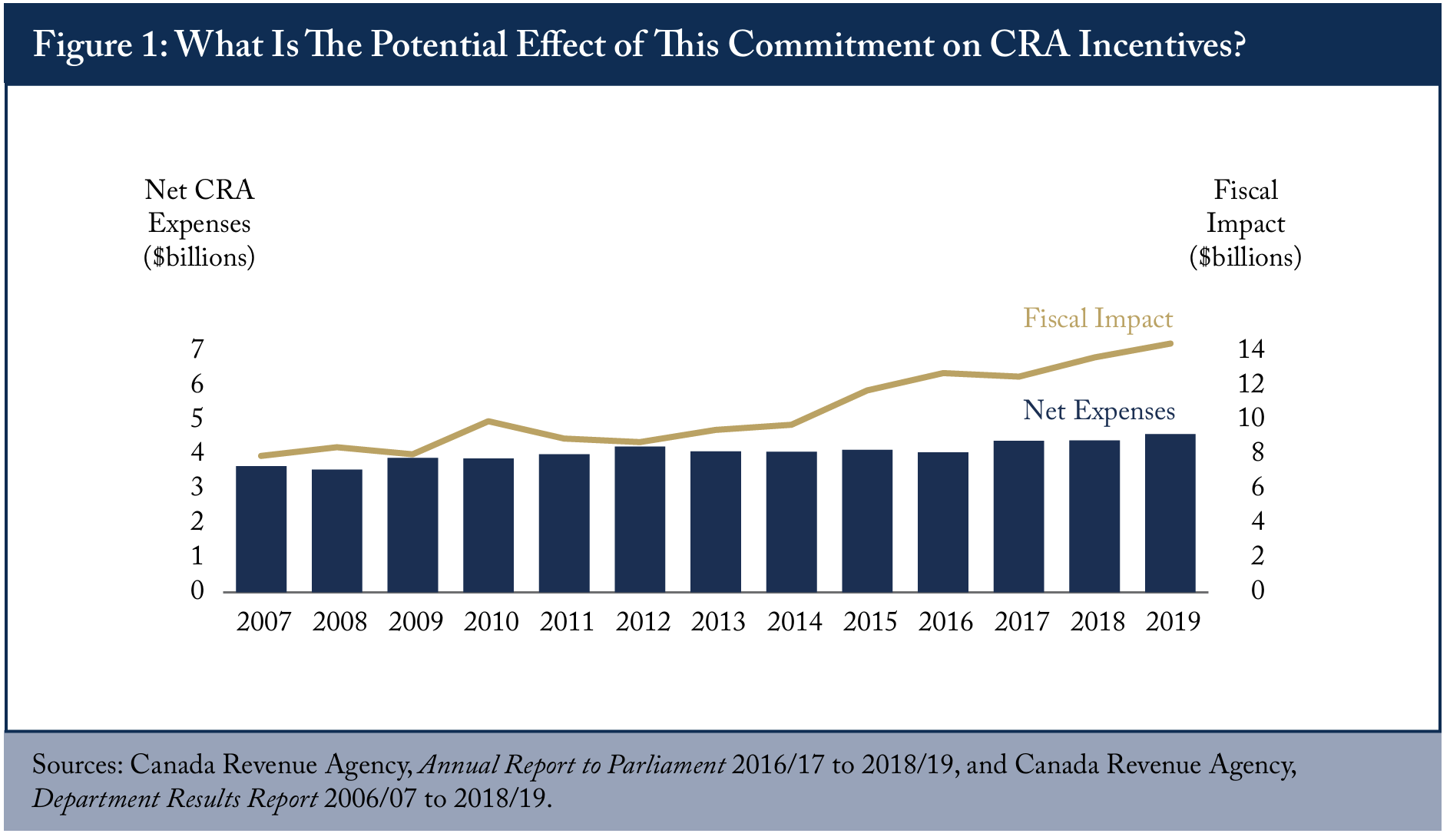
Figure 1 plots the fiscal impact and net spending for the Agency as a whole. In spite of the extra funding of approximately $200 million per year recently, the expenses of running the Agency, net of fees paid to CRA, have been quite flat in nominal dollars dating back to at least 2007 (represented by bars in Figure 1, left scale). In particular, even with the increase, funding has risen from over $3.5 billion to $4.6 billion, an annualized nominal increase of slightly over 2 percent.
In the period through 2014, the Agency typically generated a fiscal impact of approximately $2 per $1 of expenses (represented by the line in the figure, right scale). While these values are for the CRA as a whole because breakdowns by taxpayer are not disclosed consistently, large corporations and international business account for approximately two-thirds of the fiscal impact throughout the period, making corporations a key aspect of achieving these outcomes. We were unable to determine a similar breakdown of expenses.
The historical average of $2 for each $1 would suggest that the promise to Parliament to generate $5 for each additional $1 is ambitious. However, incremental impact from additional, targeted spending might exceed the average impact because the funding went to compliance efforts specifically, and these make up only a fraction of the total spending.33 In an effort to understand the relation between changes in funding and changes in fiscal impact, we regressed fiscal impact for 2008 to 2014 on lagged net CRA expenses. The coefficient on lagged net expenses is 2.2 with a t-statistic of 2.44, which is statistically greater than zero at a 3% level of statistical significance. It is also statistically smaller than 5 at a 1.3% level of probability. This approach assumes past changes to expenses mirror the current increase in funding. Therefore, historical trends would suggest that incremental funding is unlikely to achieve $5 of fiscal impact for every extra dollar of funding. Whether $5 is a stretch for the Agency or not is hard to determine objectively; however, such an explicit tie of funding to resulting fiscal impact does focus significant new attention on this metric. The Figure shows a dramatic increase in fiscal impact since 2014, going from approximately two times expenses to over three times expenses.
To put the current size of the fiscal impact on corporate income tax auditing into context, CRA reported that its total fiscal impact was $13.6 billion in 2017-2018, of which $8.0 billion involved international and large businesses and at least $1.5 billion from small and medium-sized enterprises.44 The 2017-2018 international and large business value is given in CRA (2018a). The small and medium-sized enterprise number is not reported; however, the numbers in prior years were $1.3 billion in 2014-2015, $1.7 billion in 2015-2016, and $1.6 billion in 2016-2017. Thus, we assume the 2017-2018 value is at least $1.5 billion. Thus, the CRA reports a total fiscal impact from corporate audits of approximately $9.5 billion. Using the total federal and provincial tax revenues from corporate income tax in Canada of approximately $70.5 billion as a comparison, the fiscal impact suggests corporate revenues were underreported by more than 15 percent.55 This is the average for fiscal 2015-2016 to 2017-2018 and excludes Quebec and Alberta which audit their own corporate tax returns. Tax revenue values for 2018-2019 were not available at the time of writing. It is our understanding that corporate tax revenues in these Statistics Canada data are calculated independently from the CRA based on assessments issued, including reassessments that arise from audit activities in the year, so the total revenues would include much of the fiscal impact of compliance activities. Thus, the under reporting is approximately 9.5/(70.5 – 9.5) = 15.6%.
CRA attributes the large increase in fiscal impact to the Agency’s risk-based audits and targeted efforts around aggressive taxpayers.66 For example, CRA, 2018a at p. 30. CRA also points to its significant investment in technological improvements that are directed at improving the efficiency of audits.
In general, significant stakeholder pressure to demonstrate numerical results creates environments in which opportunistic reporting might occur. For example, academic research into corporate financial reporting has clearly demonstrated that companies will apply judgement within accounting standards in ways that achieve managerial goals, which include higher share prices for equity issuances or bonus determination, and reducing regulatory impacts including taxation.77 See, as just one example, Healy and Wahlen (1999). In the context of CRA, reporting and monitoring of specific numerical targets can similarly induce auditors, either consciously or unconsciously, to work to achieve the numerical targets.
New Federal Government Metric – Tax Gap Estimates
A second significant development was public and parliamentary pressure on CRA to produce a “tax gap” calculation. Tax gap is the theoretical difference between the amount of tax collected and the amount of tax that should have been collected if all taxpayers were fully compliant. Other countries, such as the United States, the United Kingdom and Australia, report tax gap estimates, though the approach to the calculation varies widely across countries.
A dedicated unit within CRA was established to examine different parts of the tax gap, including personal and corporate income tax and goods and services tax/harmonized sales tax. Five studies were published from June 2016 to June 2019 (CRA 2019a). From the wording of the tax gap reports, one infers that CRA would like to show a fiscal impact of its activities that largely reduces this tax gap.88 For example, CRA (2019b) states the following with respect to the impact of its audits on the tax gap relating to large corporations: “Based on these statistical techniques, the federal tax gap in 2014 is estimated to be between $6.7 billion and $7.9 billion for large corporations before considering any audit results or between 17% and 20% of the overall federal corporate income tax revenue. Assuming audit results for tax year 2014 are similar to a prior year, CRA audits are expected to reduce the tax gap by $5.0 billion or by 64% to 75%. After considering CRA audit activities, the tax gap for large corporations for tax year 2014 is estimated to be between $1.7 billion and $2.9 billion or between 4% and 7% of overall federal corporate income tax revenue.” (emphasis in the original, p.23) This point was picked up in media coverage. For example, Russell (2019) in Global News. Highlighting the fiscal impact in discussions of the tax gap links the two concepts in ways that raises the expectation that the former will or could solve the latter, putting further pressure on the Agency audit division to assess more corporate income tax.
Computing a tax gap is very difficult in practice because it requires the tax authority to estimate the amount of tax that taxpayers should have paid if they were fully compliant. A common approach to computing the tax gap is to randomly select taxpayers for audit, even though they are expected to be compliant. This approach is costly, both in terms of audit resources used to audit taxpayers who are compliant and in terms of delays to estimate the tax gap. Because the objective is to estimate the “real” tax liability against which the filing is compared, it is important to complete the entire auditing process, including waiting for objections and court challenges to be concluded, before computing the tax gap.
With respect to corporations, the CRA used random audits to estimate the tax gap for small and medium-sized enterprises; however, the estimate for large corporations used previous risk-based audit data (CRA 2019b). These data would be subject to the auditor incentives described above. It is unclear if the audit data employed were updated for objections and appeals but given the CRA’s inability to track these outcomes in 2011 (the year of the audit data used), such adjustment seems unlikely.
Overall, the tax gap estimates help to satisfy the public and Parliament, and are consistent with many other countries that routinely calculate such numbers. However, we strongly encourage that the CRA not use the tax gap estimates as a way to calibrate the effectiveness of CRA enforcement efforts and that final tax liabilities be used where possible.
CRA Assessment Methods Supplemented
At present, CRA continues to use fiscal impact in its reporting to Parliament. However, the CRA has introduced an audit outcome performance measure, “validated risk”, for large businesses, similar to the concept of “tax assured” proposed by the OECD (OECD 2014). This type of measure indicates CRA’s level of confidence in the tax system based on the risk assessment process and taxes being paid voluntarily.
This new approach is described in the CRA responses to the 2018 Tax Executives Institute,99 https://tei.org/sites/default/files/advocacy_pdfs/TEI 202018 CRA Liaison Meeting Questions 26 Responses (FINAL).pdf. and the 2019 Canadian Petroleum Tax Society Roundtable.1010 https://taxinterpretations.com/cra/severed-letters/2019-0816111c6. The measure, particularly in the time series, can provide an indicator of compliance level, complementing the tax gap that indicates non-compliance. A high-quality risk validation of a large business taxpayer at the early stages of the engagement will be added to the validated risk outcome measure, permitting the auditor to gain credit for the audit, potentially offsetting the incentives provided by the fiscal impact target.
Currently, this measure is only reported internally. We believe that this new tool could mitigate the impact of the incentives discussed above that could influence audit behaviour and should be reported more broadly.
In addition, a recent CRA internal audit report recommends using an audit yield metric that adjusts fiscal impact for appeals and uncollectible amounts (CRA 2020). The report concludes that “[m]easuring audit yield provides a more fulsome and transparent performance story and understanding of the CRA’s results because it reports dollars coming into government coffers as a result of its audit efforts.”
Section Summary
CRA reports its fiscal impact to Parliament as one key metric of its use of taxpayers’ funds; reporting the fiscal impact creates an incentive for auditors to work hard to achieve its fiscal goals. The additional funding received from Parliament and requirements to estimate the tax gap have increased the intensity of those goals and have focused considerable attention on increasing audit assessments. To achieve these goals, the Agency can encourage its auditors to focus on places more likely to yield additional revenue through risk assessments or other means, but also auditors might see more revenue in the places they are looking. Evidence from the time series of fiscal impact is consistent with CRA dramatically increasing its fiscal impact in recent years.
Recent CRA efforts to supplement performance metrics through the validated risk measure will help offset these incentives and the reporting of this metric should be expanded and emphasized. To the extent possible, the tax gap estimate should be disconnected from the fiscal impact.
Evidence on CRA’s Compliance Process
The CRA has been given strong incentives to show that its efforts are successful at improving administration of the tax system, more broadly, and at ensuring compliance of specific taxpayer groups specifically. This includes increased pressure to report strong fiscal impact numbers, as described above. How have heightened incentives and pressure affected CRA’s audit and compliance process? Unfortunately, objective public data on CRA’s activities are very limited.
In this section, we discuss the evidence we were able to identify, data that result almost exclusively from the work of the Auditor General of Canada (AG). We generally focus on corporate audits due to the data availability and author experience.
Recently, the AG released two reports on the activities of CRA’s compliance activities: in 2016 and in 2018 (AGC 2016, 2018). The focus of the 2016 AG report was on whether CRA was efficiently managing income tax objections, while its 2018 report focused on whether CRA applied the Income Tax Act consistently during compliance activities and accurately reported the results of its compliance activities. The AG’s findings raise questions about the quality of CRA audits and the audit process and the accuracy of CRA’s reporting of its compliance activities.
Duration of Audits
The AG observed that the duration of audits of large and small companies varies across the country. For example, for offshore and aggressive tax planning compliance, taxpayers’ audits in one region of Canada took an average of 541 days to complete while taxpayers’ audits in another region took 323 days. There were also differences for international and large business and small and medium enterprises.
While the AG rightly raised concern over the differences between regions, a more fundamental question is whether the audits are simply taking too long to complete. This is a longstanding concern of tax professionals and is related to concerns over CRA’s quality in planning and executing risk-based audits (Pantaleo in Abrary et al. 2019). According to a study by Her Majesty’s Revenue and Customs in the United Kingdom, Canada takes the longest average time at 276 days while the average across seven other countries is 70 days (HMRC 2011).1111 The other countries are Australia, France, the Netherlands, New Zealand, South Africa, and the United Kingdom. The number of is for personal income tax formal dispute resolution. New Zealand was the next closest at 152 days. Similar values for corporate returns are not included in this study. Though there are brief mentions of corporate audit “cycle times,” no statistics are reported. While these data are quite old (based in 2009) and for personal income taxes, the comparison number is considerably smaller than Canada’s period, suggesting that there are opportunities for performance improvements.
Assessments Issued to Meet Reporting Targets and Deadlines
While the audits themselves take a long time, the AG provides some evidence of the concern that targets may be leading to biased assessments. The report makes a poignant observation that “[b]ecause the calculations of additional revenues were not adjusted if assessments were overturned or revenues not collected, targets may have pushed auditors to close files early” (AGC, 2018, par. 7.76). The suggestion that reassessments may be issued to meet CRA targets (i.e., metrics) for a specific period is a challenge to the objectivity and fairness of CRA assessments. This is consistent with the reaction to audit incentives that Klassen (2016) anticipated.
Data provided by the AG show a trend for CRA to close files and assess additional taxes toward year-end. Based on the monthly average of reassessments issued in the five-year period ended March 31, 2018, the AG reports that almost 40 percent of audit files were closed in February and March. The AG noted that this coincides with CRA’s deadline to meet its annual targets by March 31.1212 It has been the experience of one of the authors for CRA to issue surprise proposed assessments in this time period. CRA (2020) also shows that fourth-quarter assessments are disproportionately high and finds the limited data available (relating to GST/HST) show evidence that fourth-quarter assessments are more likely to be disputed and reversed more frequently. Thus, while the audit may take a long time to complete, the evidence suggests that the final reassessment itself is rushed to meet a reporting deadline.
Objections to Tax Assessments Are Very Successful
The taxpayer success rate on appealing reassessments is also revealing. The 2016 AG report concludes that in the five-year period ended March 31, 2016, 65 percent of objections reviewed by CRA resulted in decisions that favoured taxpayers in full or in part;1313 The AG reported that a total of 366,905 objections were received in the period representing about $17.877 billion in disputed tax. Although about 90 percent of the number of objections related to personal income tax, 77 percent of the dollar amount in dispute related to corporate income tax. the 2018 report notes that the rate was 60 percent for the five-year period ended March 31, 2018. For dollars of disputed corporate income tax, the success was 42.5 percent. It should be noted that it is not clear what the target success rate should be because the CRA must balance reining in aggressive tax planning on the part of taxpayers while not excessively burdening taxpayers’ compliance efforts. Using success in dollars under dispute, a more recent PwC study reports that CRA’s dispute success rate is fifth worst among 15 countries studied (PwC 2019).
Overall, such a large percentage of rejected assessments is consistent with concerns expressed about CRA audit selection, quality and process (Abrary et al. 2019).
For the five-year period ended March 31, 2016, 60 percent of successful appeals were because of new facts not previously requested or received or new facts that were not previously obvious, while another 24 percent pertained to new facts that were previously requested but not received. In total, 84 percent of reassessments were overturned due to information not being considered during the audit (AGC 2016, Exhibit 2.5).
Additional information may be supplied after the conclusion of the audit for several reasons. Certain taxpayers are undoubtedly unresponsive or uncooperative, particularly when auditors are requesting disputed information such as tax accrual working papers. It is difficult to imagine taxpayers withholding information that would support their filing position, and the AG’s findings suggest this occurred in only about one-third of the assessments overturned. In other circumstances, information may be supplied at Appeals level because CRA rushed to make the assessment before March 31, or because of poor audit management. Taxpayer experiences suggest that successful appeals can result from inadequate engagement by CRA auditors with the taxpayer during an audit, a significant complaint of large corporations and in-house and external advisors (Abrary et. al. 2019). A more thorough analysis of these data, including the reasons for the reversals and the causes of the additional information would be beneficial to improving the audit process. According to private discussions with CRA, Appeals has introduced a feedback loop to help CRA monitor and analyze reversals at the objections and litigation stages.
Impact of Inadequate Reporting
The 2018 AG report points out that “parliamentarians and the public need complete and transparent information to assess whether the Agency is successfully cracking down on tax evasion and tax avoidance” (Par 7.62). However, the report notes that “the Canada Revenue Agency did not know the full results of its compliance activities” (Par 7.59) and came to the conclusion that CRA’s reporting of its compliance activities (to the public and to Parliament) did not “accurately report the results of its compliance activities” and that “the impact on the government’s fiscal results was significantly less than what the Agency estimated” [Par 7.92 and 7.19, respectively, emphasis added].
Overstating the results of its compliance activities is consistent with the types of behaviour that is driven by the incentives CRA faces.
With respect of CRA’s compliance activities on the federal government financial reporting, the Department of Finance determines tax revenues based on amounts assessed or reassessed and from estimates of amounts not yet assessed or reassessed based on cash received.1414 See CRA 2018a: Financial Statements. Taxes under objection or under appeal in court are part of tax assessed, so they are included in tax revenues even though they are being contested by taxpayers. If CRA ultimately loses, it records a charge at that time. Revenues are reduced by an “allowance for doubtful accounts,” or estimates of amounts that will not be collected either due to taxpayers’ successful challenge or taxpayer nonpayment. The relation between these values and CRA’s compliance activities is unclear.
We believe it is relevant to track over time taxpayer objections that appear in the allowance for doubtful accounts relative to the amount of tax that is under objection or within the courts. The trend in this ratio might be particularly revealing in light of rapid increase in the fiscal impact observed above. We were unable to compute such a ratio from public information.
Section Summary
In this section, we have attempted to uncover whether there is evidence to suggest CRA audits are responding to incentives outlined in the first section. While the data are sparse, the AG’s 2016 and 2018 reports contain data that are consistent with such a possibility. Further, the reports are critical of certain aspects of CRA’s audit process and of its reporting of its compliance activities. As a consequence, we conclude that the incentives described in this report should be considered carefully.
Implications of the COVID-19 Crisis
As this report goes to press, the country continues to be in a health crisis the likes of which has not been experienced in our lifetime. This health and economic crisis has been met by strong social and fiscal measures at both the federal and provincial levels. While these measures are generally viewed as being necessary, they are costly. Less attention has been given to the future when the benefits will be verified for eligibility and the sources of funds to pay for them are considered.
We anticipate that the future will involve new calls on the CRA to enforce the fiscal measures and to raise additional revenues to meet government goals. We would caution against such an approach. As described above, the CRA is already under pressures that are creating poor outcomes for taxpayers. We fear that further strengthening of CRA’s incentives to collect taxes will adversely affect the CRA’s ability to work with taxpayers to create a tax system that will flourish as the economy recovers.
Conclusion
The role of the CRA in ensuring compliance of all Canadian taxpayers is important to the integrity of the tax system. There are considerable challenges to determining the fair amount of tax to assess particularly when taxpayers have an obvious incentive to plan their activities to pay less tax. CRA auditors, however, have incentives to increase their assessments, and show larger fiscal impacts that are not adjusted for subsequent reversals. We recommend adjustments for these reversals to offset the incentives. We recognize that this would have its own challenges because it would create tension for the appeals process, as appeals would then more directly affect CRA’s performance metrics. We also acknowledge that taxpayers, particularly corporate taxpayers, are often able to redirect their resources more effectively in their tax compliance activities than CRA is able to do in its enforcement activities.
Recent developments have amplified concerns about audit incentives, consistent with taxpayer and tax practitioner concerns over poor audit practice and audit behaviour. Not surprisingly, corporate taxpayers would generally be supportive of the conclusion that CRA’s metrics potentially lead to overassessment of tax owing following an audit.1515 Practitioners would also point out other factors leading to poor-quality audits and audit behavior, including lack of a formal settlement process at the audit stage (see Abrary et al. 2019). While those who maintain that, in particular, large corporations do not pay their fair share of tax, may be dismissive of such criticisms as being anecdotal or biased, the recent AG reports suggest at least some of such criticisms are not unfounded.
In conclusion, we recommend the following:
- First, that the CRA’s efficacy not be determined, and externally reported, based on its fiscal impact, at least as currently computed. The new validated risk metric should be further developed for external reporting to improve its visibility and offset the external pressure to show high fiscal impact.
- Second, to the extent that fiscal impact continues to be used in some manner, it should be adjusted for subsequent reversals. While time lags can be long, estimates of an allowance for doubtful accounts already exists, suggesting that estimates, with subsequent adjustment, is at least plausible. Tracking of subsequent outcomes is also critical to informing risk assessments, audit selection, and field performance. The audit yield measure as discussed in CRA (2020) would be an alternative substitute for such an adjusted fiscal impact.
- Third, tax gap estimates should be revisited and their nature as estimates emphasized. The direct link between the tax gap estimate and the CRA’s fiscal impact should be avoided.
- Fourth, governments should resist the urge to pay for COVID-19 measures and the loss of tax revenues during this crisis by calling upon CRA to simply raise more revenue by more aggressive enforcement.
References
Abrary, N., M. Munoz, N. Pantaleo, and D. Powrie. 2019. “CRA Audits of Large Corporations,” in Report of Proceedings of the Seventieth Tax Conference, 2018 Conference Report. Toronto: Canadian Tax Foundation, 34:1-25.
Auditor General of Canada (AGC). 2006. 2006 May Status Report of the Auditor General of Canada: Chapter 8—Canada Revenue Agency—Collection of Tax Debts.
_______________. 2014. 2014 Spring Report of the Auditor General of Canada, Chapter 3—Aggressive Tax Planning.
_______________. 2016. 2016 Fall Reports of the Auditor General of Canada: Report 2—Income Tax Objections—Canada Revenue Agency.
_______________. 2018. 2018 Fall Reports of the Auditor General of Canada: Report 7—Compliance Activities—Canada Revenue Agency. Canada Revenue Agency (CRA). 2018a. Departmental Results Report 2017-18.
_______________ 2018b. Evaluation Study – Horizontal Compliance Management: GST/HST Audit Program. Audit, Evaluation, and Risk Branch. May.
_______________. 2019a. “Tax Gap and Compliance Results for the Federal Corporate Income Tax System.” News release last accessed on August 14, 2020 at https://www.canada.ca/en/revenue-agency/news/2019/06/tax-gap-and-compliance-results-for-the-federal-corporate-income-tax-system.html.
_______________. 2019b. Tax Gap and Compliance Results for the Federal Corporate Income Tax System.
_______________. 2020. Internal Audit and Program Evaluation Reports: Evaluation—Audit Yield.
Healy, P.M., and J.M. Wahlen. 1999. “A review of the earnings management literature and its implications for standard setters.” Accounting Horizons. 13(4): 365-383.
Her Majesty’s Revenue and Customs (HMRC). 2011. International Tax Benchmarking.
Klassen, K.J. 2016. “Auditing the Auditors: Tax Auditors’ Assessments and Incentives.” C.D. Howe Institute E-Brief 234. C.D. Howe Institute: Toronto. April.
PricewaterhouseCoopers (PwC). 2019. Disputed Tax Amounts: Treatment in Selected Jurisdictions.
Russell, A. 2019. “Canadian companies avoid up to $11B in taxes in 2014, CRA report says.” Global News (June 18), last accessed on August 14, 2020 at https://globalnews.ca/news/5403203/canadiancorporations-tax-dodge-11-billion-canadian-revenue-agency/.