





From: Don Drummond and Nicholas Dahir
To: Fiscal and monetary policy decision-makers
Date: July 29, 2026
Re: Canada Has the Advantage on Borrowing Costs: Let’s Keep It
We previously presented how the Canadian-US bond yield differential has evolved to produce a borrowing-cost advantage for Canada. In this Memo we broaden our scope to see how Canada compares internationally.
Canada has steadily strengthened its attractiveness to investors among its G7 peers. How we got here serves as a reminder that sound monetary and fiscal policies are the foundation of lower borrowing costs critically needed to bolster Canada’s flagging investment and productivity.
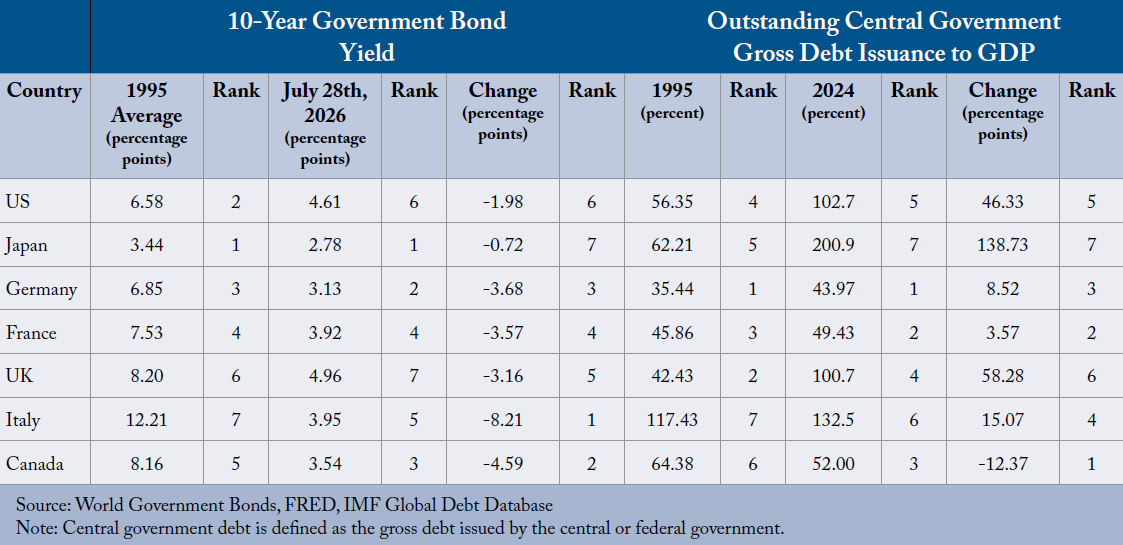
As of yesterday, Canada's 10-year government bond yield stood at 3.54 percent, the third-lowest in the G7. Only Germany and Japan have lower borrowing costs, while the US equivalent yield is around 4.61 percent.
This gives Canada a significant borrowing cost advantage and that advantage matters.
It lowers borrowing costs for businesses at a time when Canada sorely needs stronger investment and productivity growth. Lower yields also help households through lower fixed mortgage rates and it limits the economy-wide risks from the renewal of mortgages taken out during the exceptionally low-rate environment of 2021 and 2022.
Canada did not always enjoy this borrowing-cost advantage. In 1995, Canada’s 10-year government bond yield was 8.16 percent on average, the fifth-highest among G7 countries. Only Italy and the United Kingdom paid more to borrow while the US 10-year yield was 6.58 percent, giving the United States a significant borrowing cost advantage.
Since 1995, borrowing costs have fallen across the G7. Compared to today, yields across the G7 have fallen 3.73 percent on average since 1995. This is largely the result of the sustained lower inflation experienced since the 1990s. Despite this overall trend Canada stands out. Canada’s rate decline topped 4.6 percentage points – the second largest decline after Italy (8.25 percentage points) – while the US decline was under 2 percentage points and Japan registered a 0.66-percentage-point drop.
A main factor is the difference in fiscal pictures. When financial markets notice fiscal deterioration investors begin to demand higher rates as compensation for the greater risk. And on this front the story developed much to Canada’s favour.
In 1995, Canada’s central government debt to GDP ratio stood at about 64 percent of GDP compared to the G7 average of 61 percent – the second highest debt load in the G7 behind only Italy. South of the border, US debt to GDP stood at 56 percent.
In the late 90s and early 2000s Canada’s debt burden moderated and even declined. By 2024, the central government debt-to-GDP ratio had fallen to around 52 percent, the only G7 nation with a lower figure in 2024 than in 1995.
The debt level in other advanced economies, notably the United States climbed ever higher. In 2024 G7 average had soared to 97 percent and the United States, Japan, the United Kingdom and Italy all had ratios above 100 percent.
Italy and Japan were outliers. Italy’s large decline in bond yields reflected institutional factors, including its adoption of the euro and the support provided by the European Union and the European Central Bank. Meanwhile, Japan, with its decades of ultra-low inflation and an aging population of savers, has the lowest yields despite carrying by far the highest public debt.
With these exceptions in mind, it becomes clear that Canada’s improved standing reflects a combination of policy choices. The adoption of inflation targeting in the early 1990s saw inflation become low, stable, and increasingly aligned with other advanced economies while our relative fiscal restraint demonstrated a credible commitment to fiscal sustainability and strengthened Canada’s appeal among investors.
The lesson is not that this advantage has created room for fiscal expansion. It is that this advantage can and should be solidified.
Canada should build on the progress it has made by continuing efforts to reduce its debt burden and renewing its inflation targeting agreement with the Bank of Canada later this year.
Don Drummond is a Fellow-in-Residence at the C.D. Howe Institute and Stauffer-Dunning Fellow at Queen’s University, while Nicholas Dahir is a Research Officer at the C.D. Howe Institute.
To send a comment or leave feedback, email us at blog@cdhowe.org.
The views expressed here are those of the authors. The C.D. Howe Institute does not take corporate positions on policy matters.