


From: Don Drummond and Nick Dahir
To: Federal spending observers
Date: November 25, 2026
Re: Canada's 2026 Budget Is Not Restraining Spending
Despite references to spending restraint and savings from a spending review first introduced in the 2025 budget, federal program spending (total spending less public debt charges) remains well above historical benchmarks.
The 2026 budget continues this pattern. Program spending has increased, while the spending-to-GDP ratio remains historically high.
First, some historical context. Since 1966, federal program spending excluding net actuarial losses has averaged 15.5 percent of GDP. Before the 1990s, it averaged 16.9 percent. In the 1990s, it averaged 14.5 percent, and in the 2000s, it fell to 12.8 percent. Spending gradually increased through the 2010s, averaging about 13.5 percent, before spiking to almost 30 percent during the pandemic. Since the pandemic, program spending has remained above its pre-pandemic level, averaging 15.6 percent of GDP. The federal public accounts released this month show program spending at 15.4 percent of GDP in 2025/26.
In the Spring Economic Update (SEU), program spending, excluding net actuarial losses, was projected to fall modestly to 15.1 percent of GDP in 2030/31, well above the 13.4-percent average that prevailed between 2003/04 and 2019/20. Outside the last several years, the pandemic and the Great Recession, this would be a larger share than in any year since 1994/95, immediately before the 1995 budget and program review ushered in decades of more controlled spending. Returning to the 13.4-percent benchmark by 2030/31 would have reduced annual spending by approximately $67 billion relative to the SEU projection. Together with lower public debt charges, those savings would have been sufficient to move the budget into surplus.
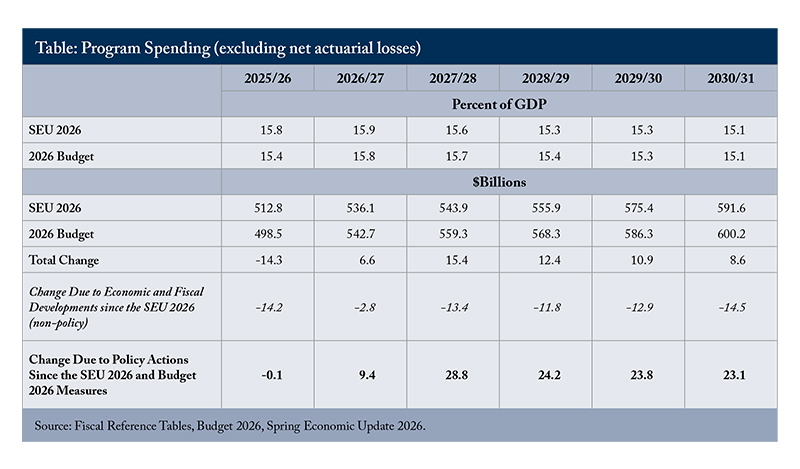
The budget shows spending at 15.1 percent of GDP in 2030/31, unchanged from the SEU. But, this was not due to spending restraint. The fiscal and economic developments since the spring that lowered spending projections and raised the forecast for nominal GDP obscure the scale of policy actions since the SEU. The budget does not provide a clear reconciliation of the changes in program spending since the SEU, but this can be inferred by manipulating information in the budget tables, as we do below. A look at the policy actions since the SEU including measures announced in the November 5 budget reveals that spending is going in the opposite direction, adding an average of $25 billion annually to program spending from 2027/28 to 2030/31 compared to the SEU.
In 2030/31 alone, they add $23.1 billion. All else equal, that increase would have raised the projected spending-to-GDP ratio from 15.1 to approximately 15.5 percent. But the $23.1 billion increase from policy actions is offset by a $14.5-billion reduction from economic and fiscal developments.
All told, program spending rises $8.6 billion, from $591.6 billion in the SEU to $600.2 billion in the Budget. Meanwhile, nominal GDP rises from approximately $3,924 billion to $3,975 billion. Together, these changes were sufficient to leave the spending ratio unchanged.
The downward pressure on program spending to GDP deserves some scrutiny. The budget reduces its 2025/26 program spending estimate by approximately $14.3 billion relative to the SEU, and this reduction appears to carry forward through the forecast.
The budget offers only a vague explanation, making it difficult to determine whether these are lasting savings or adjustments to the timing and estimation of spending. As others have noted, this lack of transparency makes the revisions difficult to assess.
The unchanged spending ratio is no evidence of restraint. Even after the downward revisions and higher GDP forecast, the budget projects more program spending than the SEU. Policy decisions have added substantially to spending, while the underlying problem of historically high spending remains unaddressed.
The more favourable outlook presented in the budget for revenues and pre-policy spending opens the door to an even more tantalizing prospect. Applying a program spending to GDP ratio of 13.4 percent to the 2026 budget projection of pre-policy deficits – averaging $23.3 billion from 2027/28 to 2030/31, would push the budget balance into large surpluses. Or would offer the opportunity for significant tax reductions that would be supportive of economic growth and affordability.
Don Drummond is the Stauffer-Dunning Fellow and an adjunct professor at the School of Policy Studies at Queen’s University, and fellow-in-residence at the C.D. Howe Institute where Nicholas Dahir is a research officer.
To send a comment or leave feedback, email us at blog@cdhowe.org.
The views expressed here are those of the authors. The C.D. Howe Institute does not take corporate positions on policy matters.