





From: Don Drummond and Nicholas Dahir
To: Fiscal policy decision-makers
Date: August 27, 2026
Re: Back to the Future: Guidance from a Historical Perspective of Canada’s Finances
Fiscal anchors, or “guardrails,” are meant to keep governments’ minds on long-term fiscal sustainability as they make annual decisions about revenue, spending and borrowing. In recent years, Ottawa has proposed several guardrails only to miss them or quietly forget them. Luckily, history offers advice on achieving fiscal stability.
The 2026 Spring Economic Update (SEU) illustrates the problem. A simple fiscal anchor would be to balance the budget, but the SEU instead projects deficits of over $50 billion annually through 2030/31. Less demanding would be a declining net-debt-to-GDP ratio, but the SEU projects its rising through 2028/29 with only marginal declines thereafter. Former Bank of Canada Governor David Dodge has suggested an anchor that would keep public debt charges under 10 percent of revenues, but the SEU projects more than 13 cents of every dollar of revenue going toward servicing the debt in 2030/31.
The government’s new “operating balance” offers another approach. This, defined as revenues less spending not classified as “investment,” has not received broad support and may be entirely moot as it does not appear in the SEU’s Summary Statement of Transactions. As a fiscal anchor, it is hardly meaningful when the dividing line between “operating” and “investment” spending remains unclear. It also risks giving governments license to run persistent deficits so long as they can be attributed to yet-to-be-defined “investments”. This undermines the guardrail’s very purpose in maintaining long-term fiscal sustainability. Finally, tax hikes or spending cuts could both improve the operating balance whereas we believe the action should be concentrated on the latter.
So where does this leave us in gauging the long-term stability of federal finances? Recent history offers some lessons. A look at federal revenues and program spending over the last few decades offers clear guidance about how the federal government has previously put its finances on a sustainable path.
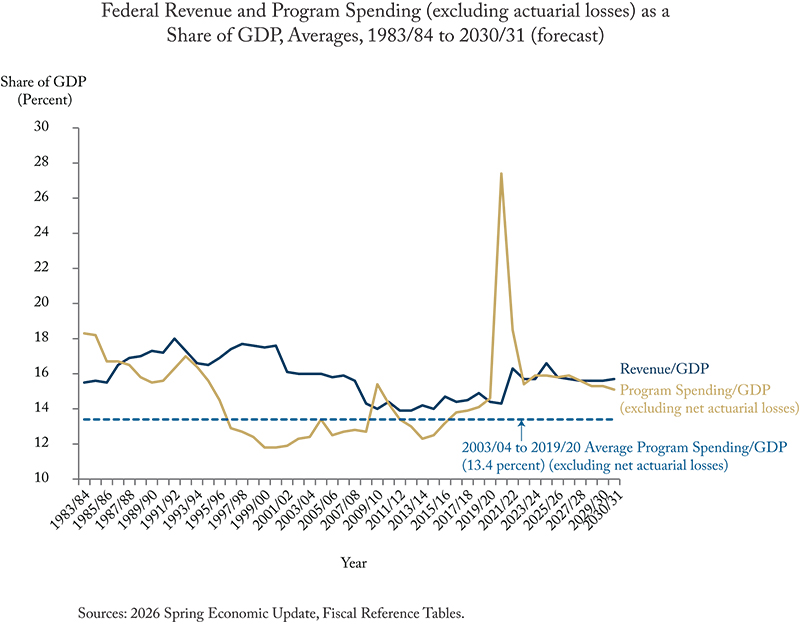
From 1983/84 to 2025/26, federal revenues averaged 15.9 percent of GDP. The 2026 Spring Economic Update projects revenues to average 15.6 percent of GDP through 2030/31, close to the long-run average, but higher than the 14.8 percent average recorded between 2003/04 and the subsequent pandemic in 2019/20.
That net debt-to-GDP remained below 40 percent from 2003/04 to 2019/20 should be of keen interest. This comparatively low debt burden era did not coincide with an increase in federal revenue as a share of the economy.
Meanwhile, between 1983/84 and 2025/26, federal program spending (excluding net actuarial losses) averaged 14.8 percent of GDP. We see sharp distinctions over time. From 1983/84 to 1994/95, program spending averaged 16.6 percent of GDP. Following the 1995 Budget and its Program Review, spending fell below 12 percent of GDP for three years before settling at an average of 13.4 percent from 2003/04 to 2019/20.
In the 2025 Budget and the SEU in 2026, the Government emphasized spending cuts. Spending is projected to be lower than it might otherwise be, and the ratio declines from 15.8 percent in 2025/26 to 15.1 in 2030-31, the highest ratio outside the pandemic since 1994/95. It greatly exceeds the 13.4 percent average from 2003/04 to 2019/20 or the average for the three years prior to the pandemic (14.2 percent). This historical perspective reveals that the government’s current intention is not to restrain spending over the next five years but to maintain it at historically elevated levels relative to the size of the economy.
This history provides a straightforward guide - get program spending back down to the share of GDP that prevailed before the pandemic.
If program spending in 2030/31 were 13.4 percent of GDP rather than 15.1 percent, it would amount to a level of spending roughly $66.7 billion below that in the SEU. This would be more than enough to balance the budget, especially once induced savings to public debt charges were to be factored in.
Indeed, spending at this lower level could provide the pay-off of a lower tax burden unless further postponed by the commitment to raise defence spending (core and associated) to 5 percent of GDP by 2035; a commitment far from fulfilled in the SEU’s projections through 2030.
Returning spending to a lower and more normal ratio to GDP will not be easy. A comprehensive review of spending in line with or exceeding the efforts of the mid-1990s will be required. As defence spending is likely off limits, and indeed will need to be increased further, the cut to non-defence spending must be quite deep, necessitating tough choices . The review must encompass not just departmental operating budgets, as seems to be the focus in the current exercise, but also transfers to individuals and to provinces and territories and include subsidies and tax expenditures.