




From: Colin Busby and Nick Dahir
To: Defence spending observers
Date: November 9, 2026
Re: Making Sense of Defence Spending and Canada’s NATO Pledge in Budget 2026
Last week’s federal budget left behind many questions about Canada’s defence commitments even as it clarified some elements of the upward trajectory of that spending and how it will affect the federal government’s finances.
The document effectively backloads the largest increases needed to meet to meet the 5-percent NATO spending pledge by 2035, which puts off the hardest decisions.
The shows a few positive developments. It plans to further the sharp increase in defence spending over the last four years and into the next fiscal year. Core defence spending – on personnel, machinery and equipment directly relevant to military capabilities – is projected to rise from 43.9 billion in 2024/25 to 75.1 billion in 2026/27, 2.2 percent of GDP on a cash basis, and eventually to 88.9 billion and 2.6 percent of GDP in 2027/28. It’s a large, meaningful, increase that will help bolster the capabilities of Canada’s military.
The budget also clearly presents how defence spending – both on core defence spending and spending on roads, bridges, ports and other things that can support defence and security – is expected to grow for the rest of the budget’s projection horizon. This helps to remedy the shortcomings of the 2025 budget and spring economic update, which lacked this critical information and reassures Canadians that we are indeed meeting our NATO commitments.
Further, there is a clear breakdown of cash versus accrual. This allows us to see how spending towards our NATO commitment, which is accounted for on a cash-basis, affects our public finances, which are accounted on an accrual basis. This is also a welcome improvement in transparency.
That said, the increases in core defence spending fall off the trajectory required to meet Canada’s 3.5-percent cord defence spending target by 2035.
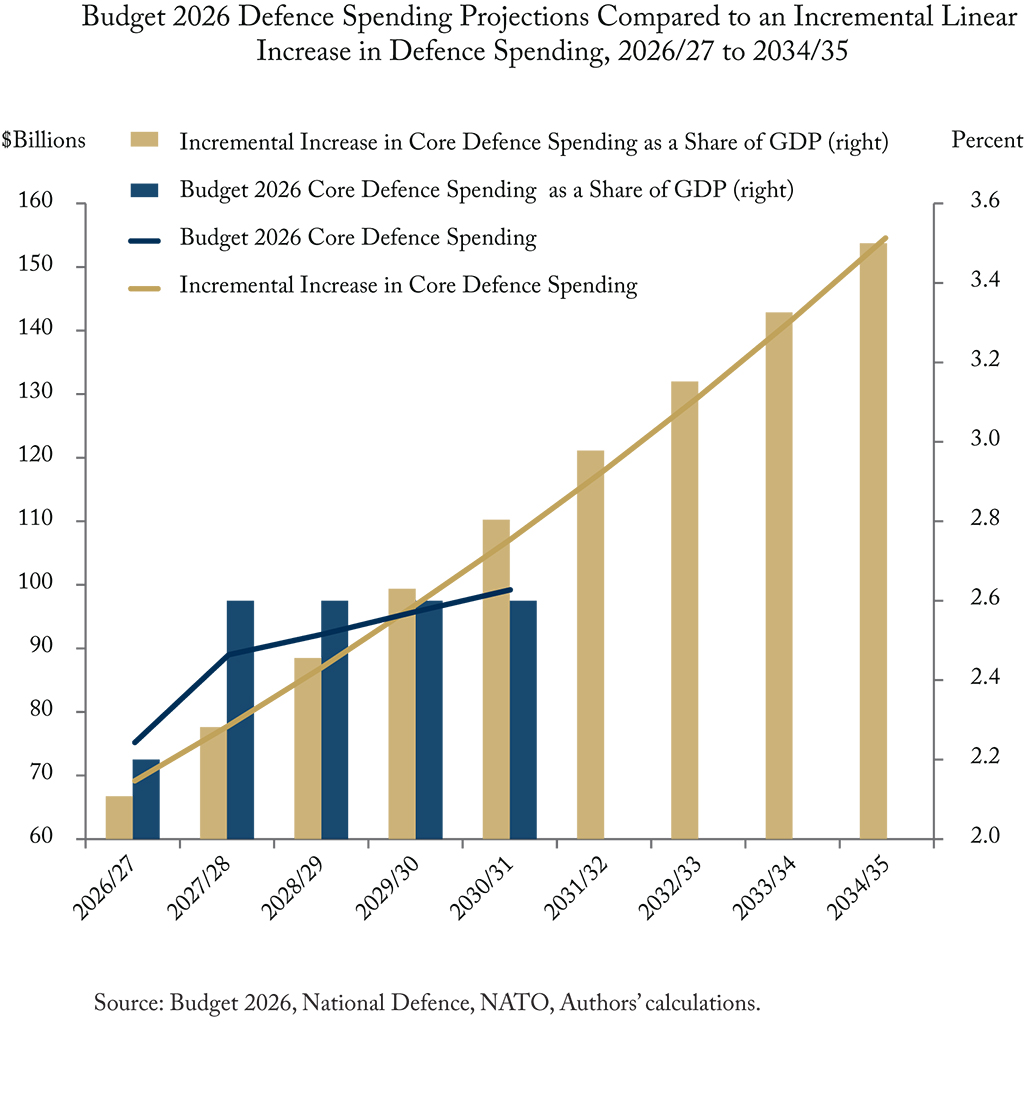
We estimated the spending required for Canada to meet that target by January 1, 2035. The figure below compares this estimate with the budget’s numbers. Based on our linear path to 3.5 percent, the federal government is front-loading spending. We estimate that Canada would need to spend over $438 billion on a cash basis between 2026/27 and 2030/31 to follow a linear incremental path to 3.5 percent of core defence spending, while the budget projects $450 billion over the same period.
From 2026/27 to 2028/29, the budget’s projections come in about $22 billion higher than what we estimate would be required to incrementally achieve 3.5 percent by 2035 over that same period, with core defence spending jumping from 2.2 percent of GDP to 2.6 percent between 2026/27 and 2027/28.
After that, however, it falls short of a linear trajectory, coming in around $10 billion less than the linear trajectory requires between 2029/30 and 2030/31. Not to mention that after that date, to hit the later spending target, it would require a very sharp increase in funds.
While the budget has some encouraging elements, there is more work to be done, and uncertainty to clear up. If Canada means to meet its commitments to NATO, it will have to increase its core defence spending beyond 2.6 percent of GDP between 2030 and 2035. With public debt charges growing fast over this period, this will require tough fiscal choices – around taxation and non-defence spending – that cannot be avoided.
Colin Busby is director, policy engagement, at the C.D. Howe Institute where Nicholas Dahir is a research officer.
To send a comment or leave feedback, email us at blog@cdhowe.org.
The views expressed here are those of the authors. The C.D. Howe Institute does not take corporate positions on policy matters.