




August 27, 2026 – The C.D. Howe Institute’s Monetary Policy Council (MPC) calls for the Bank of Canada to keep its target for the overnight rate, its benchmark policy interest rate, at 2.25 percent at its next announcement on September 2, and maintain it at that level over the next year.
The MPC is chaired by Jeremy Kronick, the Institute’s President and CEO, and includes the chief economists of the six largest Canadian banks, alongside six leading academic economists and financial market experts.
Acting as a shadow Bank of Canada Governing Council, the MPC provides an independent assessment of the monetary stance needed to achieve the Bank’s 2-percent inflation target. Its formal recommendation for each interest rate announcement is the median vote of members in attendance. Members vote on the upcoming announcement, the subsequent announcement, and the announcements six months and one year ahead.
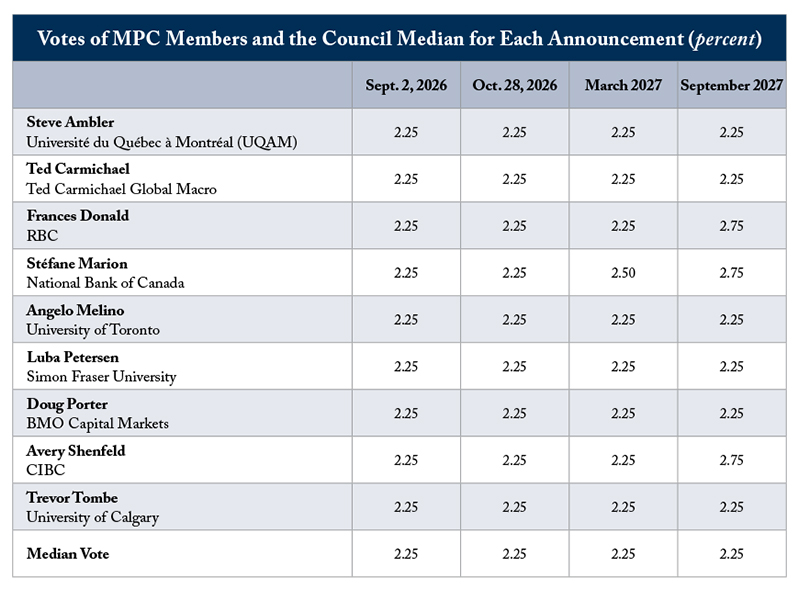
All nine MPC members in attendance called for the Bank of Canada to hold the overnight rate target at 2.25 percent next week. Members again unanimously voted to hold the overnight rate target at 2.25 percent at the next announcement in October. Six months ahead, in March 2027, eight members voted to hold the overnight rate target at 2.25 percent, while the remaining member recommended increasing it to 2.5 percent. Looking ahead to September 2027, six members recommended holding the rate at 2.25 percent, while the other three called for an increase to 2.75 percent (see table below).
The prevailing theme of the meeting was uncertainty stemming from the ongoing trade war with the United States. Members highlighted the difficulty forecasting economic activity in this environment. Data in Canada had looked strong before trade negotiations broke down: exports had rebounded, labour market data were positive, and housing markets had shown signs of recovery. With headline inflation above 3 percent, some members said they had been considering a hike. But with market access to the United States in jeopardy, the threat to investment and to employment outweighed any positive momentum from previous data. Indeed, some members who voted to hike one year out mentioned that their recommendations relied on heroic assumptions that the two sides would return to the negotiating table and reach a mutually agreeable deal.
Members mentioned that while headline inflation was still elevated – at 3 percent in July – core measures were at or around 2 percent, with little breadth to inflationary pressures. This made it easier for the Bank to hold the overnight rate in place, while assessing how the breakdown in trade negotiations unfolds.
The group also discussed the pass-through of tariffs and countertariffs. They noted that there were both goods chosen from highly competitive industries, which would make it more difficult to pass the tariffs through to consumer prices, and goods chosen from less competitive industries, where pass through would be greater. This led to a range of possible outcomes on the total pass through to inflation in Canada.
Members also mentioned federal government support for affected industries. They highlighted that the estimated countertariff revenue would more than offset the increased spending from these supports. They also pointed to rising foreign investor demand for Canadian government bonds. However, members tempered that excitement by arguing that a high percentage of foreign ownership of government debt could become a problem if those investors are spooked by Canada’s potential lack of US market access.
Finally, members discussed the continuing period of unprecedented demographic change, with population growth declining over the last three quarters. This demographic change, combined with the possibility of stagnant investment because of the uncertainty surrounding US market access, makes it a challenge to estimate the economy’s potential output. As a result, members mentioned that even weak actual growth might still be inflationary if potential growth is weaker still.
The views and opinions expressed by the participants are their own and do not necessarily reflect the views of the organizations with which they are affiliated, or those of the C.D. Howe Institute. Forecasters’ recommendations may differ from their predictions.
The MPC’s next vote will take place on October 22, 2026, prior to the Bank of Canada’s overnight rate announcement on October 28.
* * * * *
For more information, contact: Raquel Schneider, Communications Officer, 647-805-3918, rschneider@cdhowe.org.
Want more insights like this? Subscribe to our newsletter for the latest research and expert commentary.