



From: Charles Lammam
To: Ontario economy observers
Date: November 3, 2026
Re: Ontario’s Fiscal Update Points to a Slightly Worse Fiscal Outlook
Ontario’s 2026 fall fiscal update has a puzzle at its centre. The province expects to collect more revenue this year than its last budget projected, yet it plans a larger deficit: $16.9 billion, up from $13.8 billion. The government chose to set aside more money instead of holding the line on total spending. That choice, together with weaker tax revenue in later years, pushes the balanced budget out to 2029/30. That’s a year later than the March budget promised and two years later than last fall’s plan.
The economy is projected to be weaker. Real GDP, which strips out inflation, is projected to grow just 0.5 percent this year – half the budget’s 1-percent forecast. Oil is assumed at US$83 a barrel, up from $59 in the budget, which raises costs for manufacturers already dealing with punishing US tariffs.
Revenue for 2026/27 comes in at $232.6 billion, $2 billion higher than the budget due to a combination of federal transfers, income from provincial enterprises, and some other tax revenue.
Total spending rises by more, up $4.4 billion from the budget, to $247.3 billion. Of that, $3.8 billion is a top-up to the contingency fund, money not yet assigned to any program. The government says it is there for compensation pressures, public services, and trade risks. New initiatives add only $449 million and the reserve grows by another $700 million. Without the top-up and the larger reserve, the deficit would be about $1.4 billion smaller than the budget showed.
With trade tensions persisting, this extra caution is a reasonable call. But it is a choice. Revenue came in ahead of plan, with the government choosing to put more than all of the gain into protection against bad news.
The cost of that choice is a delayed path to balance. The 2025 budget and last fall’s update both showed a small surplus in 2027/28. The 2026 budget moved it one year to 2028/29. This update moves it to 2029/30, when the surplus is only $0.2 billion – landing in advance of the next scheduled provincial election. Added up, deficits over the next three years total $36.3 billion, against $19.3 billion in the budget.
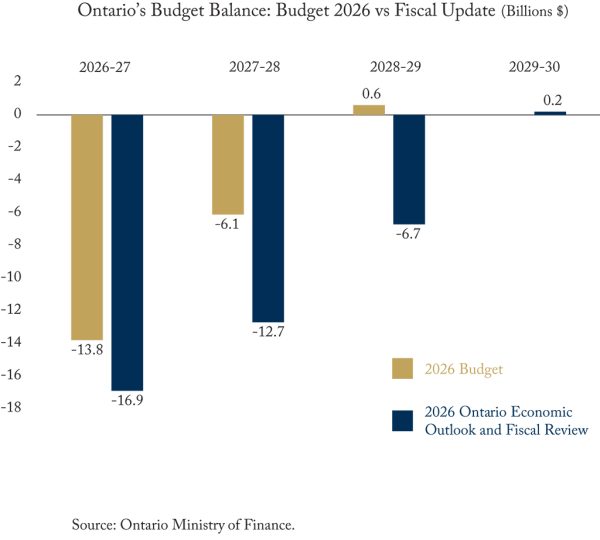
The story is different in later years. Revenue is now projected $3.9 billion lower in 2027/28 and $4.9 billion lower in 2028/29. That accounts for roughly 60 to 70 percent of the added deficit in those years, which is $6.6 billion and $7.2 billion worse than in the budget. The rest comes from a larger reserve, part of it meant to cover a pre-announced tax initiative (more on that later) and from somewhat higher spending and interest costs.
The plan to close the gap rests on restraint. Core program spending is set to grow 1.4 percent a year through 2028/29, while revenue grows 3.5 percent a year. The update shows how sensitive that arithmetic is to relatively small changes in the fiscal data. A revenue reduction of $4 billion to $5 billion, along with a bigger reserve, was enough to push balance back by a year.
The deficit was about 1.0 percent of GDP last year and rises to about 1.3 percent this year. Net debt rises from 37.4 percent of GDP in 2026/27 to a peak of 38.9 percent in 2028/29, then dropping to 38.3 percent in 2029/30, staying below the government’s self-imposed 40-percent maximum.
Interest costs are the steadiest part of the picture and the Ontario government deserves some credit for it. Interest on the debt is $17.4 billion this year, only $100 million above the budget. Ontario has issued $167.1 billion in bonds of 30 years or longer since 2010/11, almost a third of its debt, and the average term is 11.2 years. So as bond yields rise around the world, the effect reaches Ontario’s treasury more slowly. Even so, interest grows to $20.4 billion by 2028/29, which is 7.5 percent of revenue and below the government’s ceiling for this ratio.
The update also matches the federal “productivity mega deduction,” which lets businesses write off many investments immediately. The government puts the tax relief at more than $8 billion across five years, and more than $12 billion once earlier write-off measures are included. While there are economic benefits to this move, it is a large claim on a budget already in deficit.
That leaves the rest of the tax agenda waiting. Ontario’s personal income tax rates on highly skilled workers remain uncompetitive in a North American and international context. They are not only high but kick in at relatively low-income levels. And the top two brackets are not indexed to inflation, so more people are pushed into them each year. And the statutory corporate tax rate advantage Ontario once had over the United States is gone.
Each fix would cost revenue. With a $16.9 billion deficit this year and balance not due until 2029/30, the government will have to find that money by spending less elsewhere, raising revenue through tax reform, or growing the economy faster.
Charles Lammam is senior advisor at the C.D. Howe Institute.
To send a comment or leave feedback, email us at blog@cdhowe.org.
The views expressed here are those of the author. The C.D. Howe Institute does not take corporate positions on policy matters.