



From: Charles Lammam
To: Concerned Canadians
Date: October 21, 2026
Re: No single reform will fix our productivity problem – it’s a puzzle with many pieces
Some analysts believe governments have already tried every fix for Canada’s long-standing productivity problem and failed. I see it differently. We’ve got some things right, but many of the pillars that drive productivity were never addressed. For about a decade, policy even worked against it. Ottawa is now starting to change course, though no single fix will do.
In recent C.D. Howe Institute work, my colleagues and I built the Productivity Blueprint. It shows how eight connected pillars need reform to lift productivity, including tax and regulatory reform, more competition, a stronger human capital base, and better trade and transportation infrastructure.
Productivity is how much we produce per hour of work. Over time, it’s the biggest driver of rising incomes and living standards. When productivity stalls, pay raises get harder to sustain and governments have less revenue to fund public services.
While Canada’s productivity has long been weak, lately it has gotten worse. In 1994, an hour of work in Canada produced about 89 percent of what an hour in the United States did. By 2024, it was just 71 percent. Over those 30 years, Canada’s productivity growth beat only France’s among nine advanced economies.
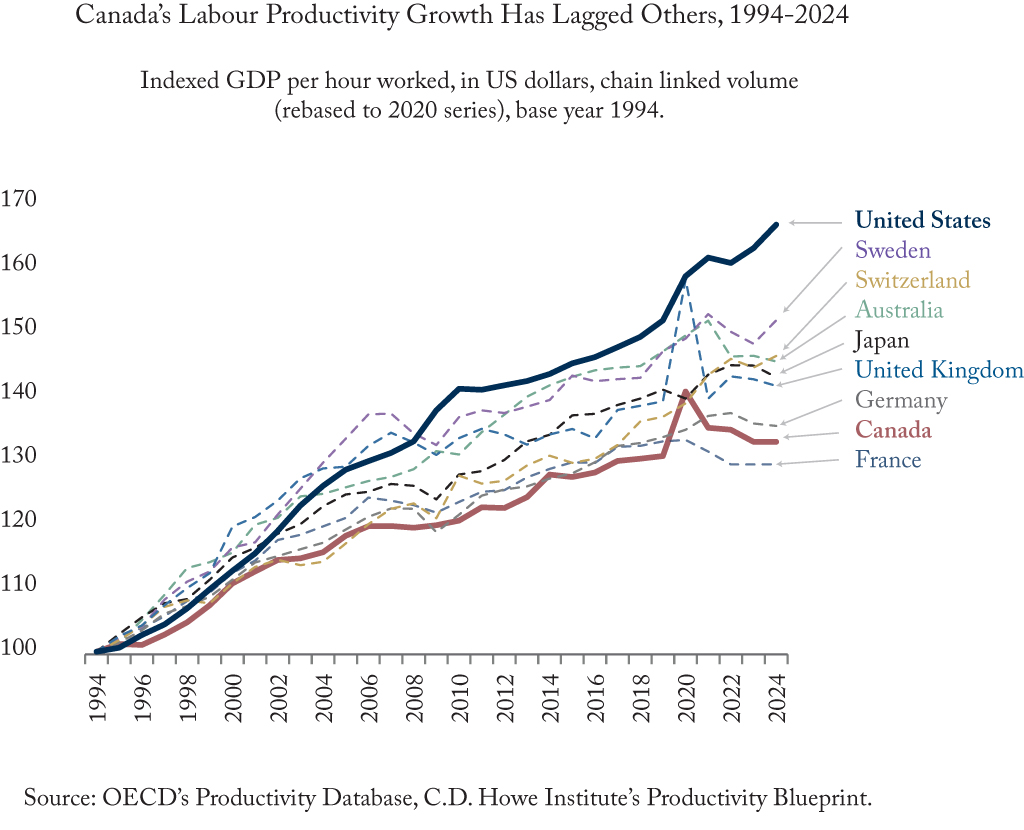
The result is falling living standards relative to peer countries. From 2014 to 2024, Canada’s gross domestic product (GDP) per person grew just 3.5 percent, versus 20.2 percent in the United States, the weakest of nine advanced economies.
Some respected analysts argue that public policy isn’t the problem. A 2011 assessment found that governments had carried out roughly 70 percent of the productivity agenda, leaving business to shoulder the blame. A 2025 paper from the Centre for the Study of Living Standards made a similar point: “It has not been the lack of pro-productivity policies that explains the slowdown.” A recent policy podcast said the standard fixes have been tried for decades with little to show.
These assessments are only partly right. Canada has taken big, cross-partisan steps before such as its free trade deals and the fiscal consolidation of the 1990s, with the corporate tax cuts that followed. The problem is that many observers focus too narrowly on trade, inflation, debt, and business tax rates, which cover only a few key policy pillars, and none fully. Competition, regulation, skills, innovation, and transportation infrastructure get far less attention.
Blaming corporate Canada for weak management skills, timid investment, or too little innovation ignores how businesses behave. Firms invest and innovate when the incentives are right. Two matter most: How much competition they face and how much of the reward they keep upon success. Canada falls short on both. Protected sectors dull the push to innovate and a tax system that punishes success dulls the payoff. Next to the United States, with its deeper capital pools and bigger market, these gaps matter even more. Even past reforms have a limited shelf life, because productivity policy has no finish line. Think of it less like a race and more like staying fit.
Canada’s federal-provincial corporate tax cuts in the early 2000s gave us a clear edge over the United States by the early 2010s. Then the United States cut its own federal rate in 2017 erasing that advantage. What matters is how Canada stacks up against competitors on each pillar, yearly. Then came a decade of policy that eroded productivity pillars. From 2014 to 2024, Canada’s business investment per worker fell 19 percent, while it rose by nearly a third in the United States.
The oil price shock played a role, but so did several policy-induced factors: a regulatory climate that made big projects hard to approve, tax changes that weakened Canada’s appeal to investors relative to the United States, and rising policy uncertainty. Immigration policy also drifted toward temporary, lower-skilled admissions and away from higher-skilled economic migrants. Even newcomers with strong credentials often ended up in jobs well below their skill level.
Federal and provincial finances deteriorated, especially since the pandemic. Governments keep adding debt and losing the fiscal flexibility to handle the next crisis. At the same time, public sector employment grew much faster than private sector employment. Ottawa has since scaled back its payrolls, set up a Major Projects Office, brought in Bill C-39 to cap project reviews at one year, and proposed the “productivity mega deduction,” a bigger, permanent business investment write-off. It has also begun to recognize how much trade infrastructure capacity matters. These are good signs, but each is one piece of a much bigger puzzle.
Take the productivity mega deduction. It makes new equipment more attractive to buy, but it’s one measure in a tax system that hasn’t had comprehensive reform in nearly 40 years. Personal income tax rates remain high and kick in at low incomes, hitting the founders, engineers, and managers who make investments pay off. The previous government raised the top federal rate and several provinces did the same. The proposed capital gains tax change, later cancelled, no doubt helped fuel an entrepreneurial exodus, along with changes to how private corporations are taxed. And special tax breaks for small firms, while well-intended, continue to discourage their growth. But even a more competitive tax system won’t work fully unless firms feel real competitive pressure to protect or grow their market share.
Canada has shielded some sectors from the forces that drive productivity gains – including in telecommunications, air travel, dairy, and parts of the banking sector – with either ownership restrictions, regulations, tariffs, or barriers to entry. Governments also own many businesses in markets that private firms could serve just as well, spanning electricity, liquor retail, mail delivery, broadcasting, auto insurance, and venture capital. Statistics Canada counts 308 active government business enterprises responsible for $210.7 billion in 2024 revenue, or roughly 7 percent of GDP.
Now imagine a firm that faces rivals without the same constraints and seeks to grow. It needs room to reach economies of scale, and even though Canada has no tariffs between provinces, different licensing, certification, regulations, and procurement rules shrink a small internal market like a tariff would. One estimate suggests that removing internal trade barriers, equal to a 9 percent tariff, could raise real GDP by nearly 7 percent over the long run. Firms that can’t grow large enough at home go abroad.
Firms that stay and sell to other markets face transportation infrastructure (rails, roads, and ports) that isn’t up to the job. In the World Bank’s latest ranking of container port efficiency, Vancouver—our largest port—placed 375 out of 400. You can sign all the trade deals you want, but if the goods sit on the dock, the deals don’t pay off. This is why the “tried and failed” productivity story misleads. A positive tax change without removing barriers to entry falls short. So does competition without a big enough market, or a big market without a way to ship goods.
When the next announcement gets billed as the fix, we should ask which piece it covers, which pieces are still missing, and how we compare with other countries. Canada has pulled one or two levers at a time. Productivity growth takes all of them.
Charles Lammam is senior advisor at the C.D. Howe Institute.
To send a comment or leave feedback, email us at blog@cdhowe.org.
The views expressed here are those of the author. The C.D. Howe Institute does not take corporate positions on policy matters.