



Charles DeLand – Alberta Needs a Stable Policy Approach to Power
 From: Charles DeLand To: The Hon. Nathan Neudorf, Alberta Minister of Affordability and Utilities Date: December 19, 2023 Re: Alberta Needs a Stable Policy Approach to Power Background It’s all electricity all the time in Canada these days as we come to grips with the green transition and its electric vehicles, its electric heat pumps […]
 Leonard Waverman – Why Government Electric Vehicle Mandates Won’t Work
 From: Leonard Waverman To: Canadian automotive observers Date: December 18, 2023 Re: Why Government Electric Vehicle Mandates Won’t Work On Dec 31 2022, the federal Liberal government mandated that in 2035, 12 years from now, no internal combustion engine cars and light trucks can be sold in Canada. This ban takes place gradually, beginning at 20 percent of electric […]
 Has Ottawa destroyed its own carbon tax? Canada needs a climate Plan B – Globe and Mail
Suggestions that carbon pricing is not working because Canada’s emissions have kept rising miss the mark, as a large chunk of the increase is due to rapid population growth. The country’s energy efficiency has, in fact, improved considerably under the carbon tax introduced by the federal government.
But unfortunately for carbon price supporters, Ottawa has directly contradicted the principle underlying the tax. In late October, it decided to selectively pause its application to heating oil, a fuel used primarily in homes in Atlantic Canada, ostensibly on affordability grounds, but largely viewed as a cynically political move. Quite logically, provincial leaders immediately asked for exemptions covering fuels used in their regions…
Putting Together a Holiday Dinner Basket
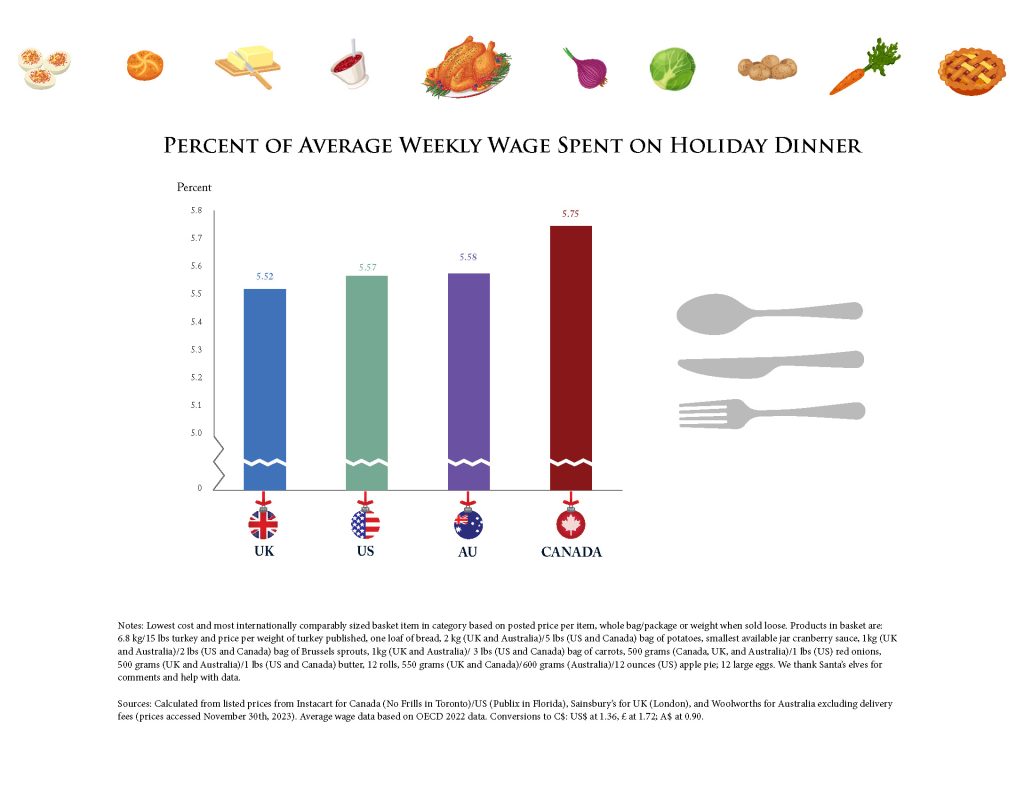 We at the C.D. Howe Institute wish you a happy holiday season. We also wish we could wish you an affordable one. We asked how big a bite a holiday dinner for ten would take out of the average weekly wage of a worker in Canada, Australia, the UK and the United States. The painful answer is […]
 Business investment ‘awful’ in Canada – Financial Post
 William Robson, CEO of the C.D. Howe Institute, talks with Financial Post’s Larysa Harapyn about how capital per worker has been falling for the first time since the 1930s and what it means to the economy.
 How the Price of Milk Threatens Canada’s Auto Industry with Bill Robson and Martha Hall Findlay

How would the price of milk threaten Canada’s auto industry? Bill C-282 risks upturning trade negotiations with the world, especially our biggest trading partner. And if Donald Trump returns to the White House, Martha Hall Findlay tells the Institute’s Bill Robson and Michael Hainsworth that all bets are off.
Freeland’s new hidden tax on everything and everyone – Financial Post
Tucked into the 500-page Notice of Ways and Means Motion Finance Minister Chrystia Freeland released last month is an insidious measure that urgently needs to be withdrawn. First announced as part of Budget 2023, it imposes an additional $3 billion of federal income tax on “financial institutions” over the next five years. We all know how popular financial institutions are. A tax imposed on big banks and insurance companies will appeal to many people. But who really will pay this tax is: everyone — despite the government’s cynical attempt to try to convince us all that someone else will ultimately bear its burden.
It is a fundamental principle of Canadian income taxation that corporate profits should be taxed…
Consumers Would Reap Rewards from a Fast Payment System in Canada
Canada is lagging behind peer countries in implementing fast payments for transactions that involve consumers, merchants and financial service providers, says a new report from the C.D. Howe Institute. According to the study, the introduction of the Real-Time Rail (RTR) Fast…The Need for Speed: The Benefits of Faster Payments and How to Achieve Them
 In this study, we estimate the efficiency gains associated with the introduction of the Real-Time Rail (RTR), Fast Payment System (FPS) in Canada. In a benchmark scenario, we estimate that these gains will amount to $3.24 billion over the first five years after introduction of the system. These gains will arise mainly from: 1) the […]
 Kearney, Johnson – Unpacking some of the Limitations of the Competition Bureau’s Report on Competitive Intensity in Canada
 From: Elisa Kearney and Paul Johnson To: Canadian competition law observers Date: December 14, 2023 Re: Unpacking some of the Limitations of the Competition Bureau’s Report on Competitive Intensity in Canada The Competition Bureau’s new report on competition may have drawn flattering headlines, but what makes a good newspaper headline does not make sound policy. We urge caution before drawing […]
 Canada must stem the surge in temporary foreign workers and international students – Globe and Mail
Recent years have seen an unprecedented increase in Canada’s non-permanent resident population, far surpassing increases in annual admissions of new permanent residents. The unbalanced growth in Canada’s temporary and permanent migration inflows will inevitably result in a growing undocumented population and forced deportations. Both developments risk inflaming Canada’s immigration politics and undermining public confidence in the immigration system.
It is imperative that the government take immediate steps to stem the continuing growth in foreign student and temporary foreign worker entries.
Several factors have contributed to the non-permanent resident (NPR) population surge, including ad-hoc programs aimed at expanding…
Grant Sprague – Frameworks and Emission Caps: Another No-Consultation Ottawa Initiative
 To: Canadians Concerned about Climate Change From: Grant Sprague Date: December 14, 2023 Re: Frameworks and Emission Caps: Another No-Consultation Ottawa Initiative Our federal environment minister went to Dubai for COP and all we got was a framework on an oil and gas emissions cap. No matter how the details of this “cap” and framework end up, there are […]