







By Benjamin Dachis, Bev Dahlby and Jack Mintz
 With Toronto City Council due to discuss an increase in the land transfer tax (LTT) on high-end homes at an upcoming meeting, this independent analysis of the impacts of such a move is intended to help inform the deliberations.
- In this E-Brief, we evaluate the economic cost of raising LTT revenues in Toronto. Economic studies have generally found that a land transfer tax has a relatively high economic cost because the LTT discourages people from moving to more favourable locations or housing when they can do so.
- When combined with the provincial LTT, we find that the current combined rate of 5 percent on homes in excess of $2 million is highly distortionary and is close to the rate that maximizes total LTT revenues for the city and province combined.
- Any further increase in the top LTT rate by Toronto, while increasing its own revenues, would reduce the government of Ontario’s LTT revenues by more than Toronto’s.
- We argue that the top LTT rate should not be increased, but rather reduced because it is a costly source of revenue to the wider economy.
 With Toronto City Council due to discuss an increase in the land transfer tax (LTT) on high-end homes at an upcoming meeting, this independent analysis of the impacts of such a move is intended to help inform the deliberations.
Land transfer taxes (LTTs) have become an important source of revenue for several provincial and municipal governments, including the City of Toronto, which has levied an LTT since 2008. Toronto relies on the LTT to supply nearly 6 percent of its total revenues. Provinces also collect considerable LTT revenues. British Columbia collected $1.6 billion, and Ontario $3.1 billion in transfer tax revenues in 2019/20.1These figures also include amounts paid on non-resident transfer taxes, which are 15 percent in both provinces.
Recently, Toronto City Council passed a motion instructing the city manager and the chief financial officer and treasurer to provide the council with an estimate of the revenue that the city would obtain and a study of the economic impact of an (unspecified) increase in the municipal land transfer tax for homes valued at or over $2 million, $3 million and $4 million, respectively.2http://app.toronto.ca/tmmis/viewAgendaItemHistory.do?item=2021.EX21.1
In this E-Brief, we evaluate the economic cost of raising LTT revenues in Toronto. Economic studies have generally found that a land transfer tax has a relatively high economic cost because the LTT discourages people from moving to more favourable locations or housing when they can do so.3These studies tend to focus on residential property only. The LTT also applies to non-residential property, discouraging business investment. However, unlike housing, the LTT is complicated to apply, and could be avoided, since a “purchaser” is not easy to define. For more details on this and LTTs elsewhere, see Dahlby and Mintz (2021). Instead, owners stay longer in their home, electing perhaps to renovate it. Based on an estimate of the impact of the LTT on land transfers in Toronto by Dachis, Duranton, and Turner (2012), we find that the current combined rate of 5 percent on homes in excess of $2 million is highly distortionary and is close to the rate that maximizes total LTT revenues for the city and province combined. Any further increase in the top LTT rate by Toronto, while increasing its revenues, would reduce the government of Ontario’s LTT revenues by more than Toronto’s. We argue that the top LTT rate should not be increased, but rather reduced because it is a costly source of revenue to the wider economy. Indeed, the top LTT rate should be dramatically reduced, as even reducing the combined provincial-municipal top LTT rate from 5 to 4 percent would still leave the LTT as perhaps the most economically costly major revenue source in the province. If Toronto wishes to increase its revenues, especially from residential property worth more than $2 million, it should study an increase in the annual property tax rate on such properties.
Evaluation of Land Transfer Taxes
It is hard to justify an LTT as a source of revenues. Unlike income, wealth and consumption that are related to some measure of well-being for individuals, a land transfer tax is only paid when a purchaser buys residential or non-residential property (see Box 1 for the issues in non-residential application). It is thus a tax on those who move to new locations and does not apply to people or businesses who do not move. It is unrelated to services provided by governments, unlike the property tax which is arguably related to municipal services. So, on philosophical grounds, it is a strange tax since it is neither related to public benefits nor the well-being of individuals engaged in a land transfer. These taxes are politically popular, however, as they are administratively easy to levy on residential transactions and in any given year apply to a smaller number of people than broad-based taxes, like consumption or property taxes.
Focusing on the residential LTT, the property purchaser is responsible for the payment of the land transfer tax in Ontario. However, in some studies, the incidence of a land transfer tax on residential property has been found to fall more heavily on the seller of housing property. Sellers may bear the effective burden of a land transfer tax, in whole or in part, if property prices are suppressed because a land transfer tax is levied on real estate transactions. Studies of the incidence of land transfer taxes, such as Besley, Meads and Surico (2014), suggest that if the housing market is tight, with few properties for sale relative to potential demand, sellers will have more bargaining power than buyers. In these circumstances, a seller can command the top price for the property; i.e., the maximum amount that a buyer is willing to pay for the property.
A land transfer tax, by adding to the cost of a real estate transaction, reduces the amount that a buyer will pay for the property. Accordingly, sellers will tend to bear more of the land transfer tax burden in a tight housing market, as currently exists in Toronto. Of particular relevance is the study by Dachis, Duranton and Turner (2012) which examined the impact of the introduction of the land transfer tax in Toronto based on data for the 2006-to-2008 period. That study found that housing prices declined by the amount of the tax, a result that is consistent with the prediction that in a tight housing market, such as Toronto’s, sellers bear most of the land transfer tax burden.
On the other hand, if the land transfer tax is not shifted to owners and is fully borne by home buyers, it would impose an additional burden on those who move more frequently – sometimes with limited choice because of changes in the location of employment. In other words, frequent movers will pay more often, and infrequent movers will pay less. Although younger cohorts are more likely to be renters initially, over their lifetimes they will on average purchase homes more frequently than older cohorts, which means that a non-shifted land transfer tax will generally impose a larger burden on younger generations. The LTT will also hurt immigrants moving into Toronto if the tax is largely borne by the purchaser.
A land transfer tax could reduce the number of real estate transactions because the tax raises the cost of a land transfer. People have a choice to move or stay at a location and perhaps renovate their home instead of moving. The economic losses from a decline in housing market sales are real. For example, some families do not move to homes that are more suited to their needs (e.g., a family needing a larger home) or to a location closer to employment. The dollar value of the loss of well-being from a reduction in housing transactions can exceed land transfer tax revenues; i.e., the tax creates a deadweight loss. The magnitude of these economic losses will depend on the impact of a land transfer tax on the volume of housing market transactions. Dahlby and Larson (2019) review 11 econometric studies of the impact of land transfer taxes on the volume of housing market transactions.4The literature review shows that the estimated semi-elasticity, which is the percentage change in the number of transactions from a one percentage point increase in a land transfer tax rate, ranged from zero (no effect) to -25.6 with a median estimate of -12.7. The bulk of these studies found a significant reduction in housing market transactions. Of note is the study by Dachis, Duranton, and Turner (2012) which found that the introduction of a 2 percent land transfer tax in Toronto reduced the number of house sales by 14 percent.
Based on the Dachis, Duranton and Turner (2012) result, we use a semi-elasticity of -7.0 to calculate the marginal cost of public funds (MCF), which is the cost to the private sector in raising an additional dollar of tax revenue from a land transfer tax: this cost includes one dollar of revenue plus the economic loss from raising one additional dollar of revenue.5See Dahlby (2008, 2020) on the concept and measurement of the MCF. Why the economic loss? In general, taxes impose a loss or cost on the economy if they alter taxpayers’ consumption, production, and asset allocation decisions, leading to a less efficient allocation of resources. Raising an additional dollar of tax revenue costs the private sector more than a dollar if the allocation of resources in the economy becomes more distorted and less productive. The MCF indicates which taxes impose the greatest economic losses in generating additional revenues.

Land Transfer Taxes in Toronto
The City of Toronto, under the authority of Ontario’s City of Toronto Act, 2006, is the only municipality in Ontario that has the authority to impose its own LTT. The top marginal tax rate was originally 2 percent on transactions above $400,000. In 2017, Toronto introduced a new top marginal rate of 2.5 percent of the value of a house above $2 million and an additional bracket to match the province’s rate. The province also added a top bracket at the same time, and the provincial LTT, which also applies outside of Toronto, now applies the same rates to the same brackets as Toronto’s. Both the provincial government and Toronto allow a rebate of LTT paid for first-time home buyers, albeit only on the value of a purchase up to $368,333 for the provincial tax and $400,000 for the Toronto tax, making this rebate inconsequential for our analysis at the top marginal rates.
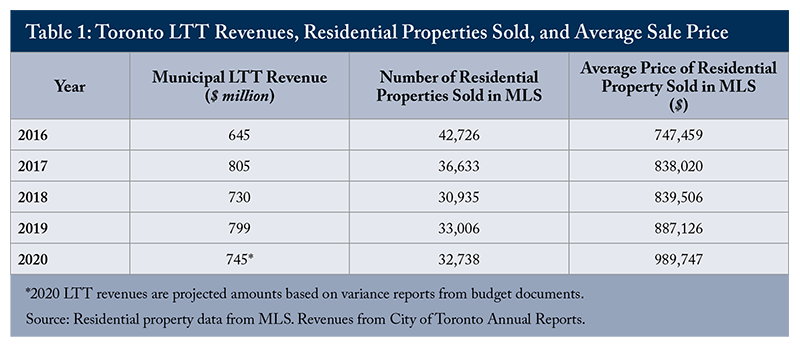
In 2019, the latest year as of writing in which full year totals are available, Toronto collected just under $800 million in LTT (Table 1), which represented 5.6 percent of its total revenue that year, 7.3 percent of own-source revenue, 18 percent of total municipal property taxes, and 28 percent of municipal residential property taxes. The province collected $2.9 billion in 2019/20, representing 2 percent of total revenues.6In 2019/20, the province also collected $171 million in Non-Resident Speculation Tax, a 15 percent tax on residential properties in the Greater Golden Horseshoe Region by non-citizens of permanent residents of Canada. See data available at: https://www.fin.gov.on.ca/en/bulletins/nrst/ We also calculated the total revenues that would be paid on transactions of residential resales covered by the Multiple Listing Service (MLS). These sales represent about 60 percent of total Toronto LTT revenues. For 2021, Toronto is forecasting just under $750 million in LTT revenues (Toronto 2021).
Evaluation of the Land Transfer Tax in Toronto on Residential Sales
To determine the economic cost of the LTT in Toronto, we have collected information on all resale housing transactions from 2016 to 2020 according to data in the Multiple Listing Service.
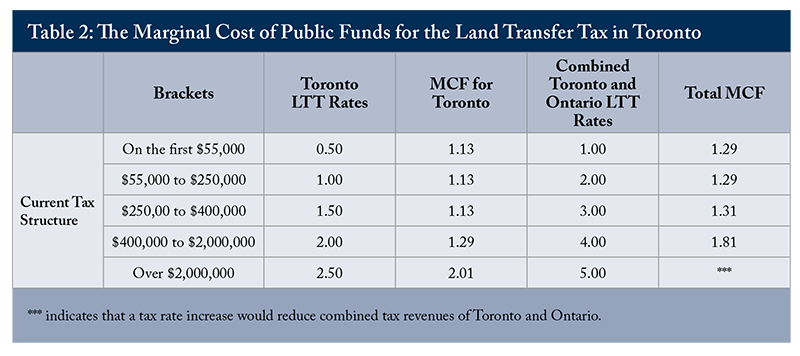
The calculations in Table 2 are based on the 2020 MLS data on the number and value of condo and freehold housing sales in Toronto.7The distribution of sales was similar in the previous two years, meaning that our choice of year has no bearing on interpreting results. The calculations of the MCFs are based on the tax sensitivity of land transfers from the Dachis, Duranton and Turner (2012) study for Toronto (see the Technical Appendix for a description of the methodology used to calculate the MCFs). The fourth column shows the MCFs by tax bracket from Toronto’s perspective; i.e., evaluated at Toronto’s tax rates. In the absence of the Ontario LTT, the Toronto-only MCFs are quite low, especially in the first four tax brackets.8These calculations do not take into account the first-time buyer’s credit, with the rebate on the first $400,000 in LTT paid. The last column shows the total MCFs, which are evaluated at the combined Toronto and Ontario tax rates. As expected, the MCFs are higher in the first four tax brackets. The MCF could not be computed for the top tax bracket of sales above $2 million because the calculation implies that a small increase in the top tax rate, the 5 percent combined Toronto and provincial rate, would reduce total provincial and municipal LTT revenues. With an increase in the top tax rate, the number of land transfers will decline and therefore the government of Ontario’s LTT revenues will decline. In other words, if Toronto increased its top tax rates, Toronto’s revenues would increase, but the government of Ontario’s revenues would decline by more than the increase Toronto’s revenues.
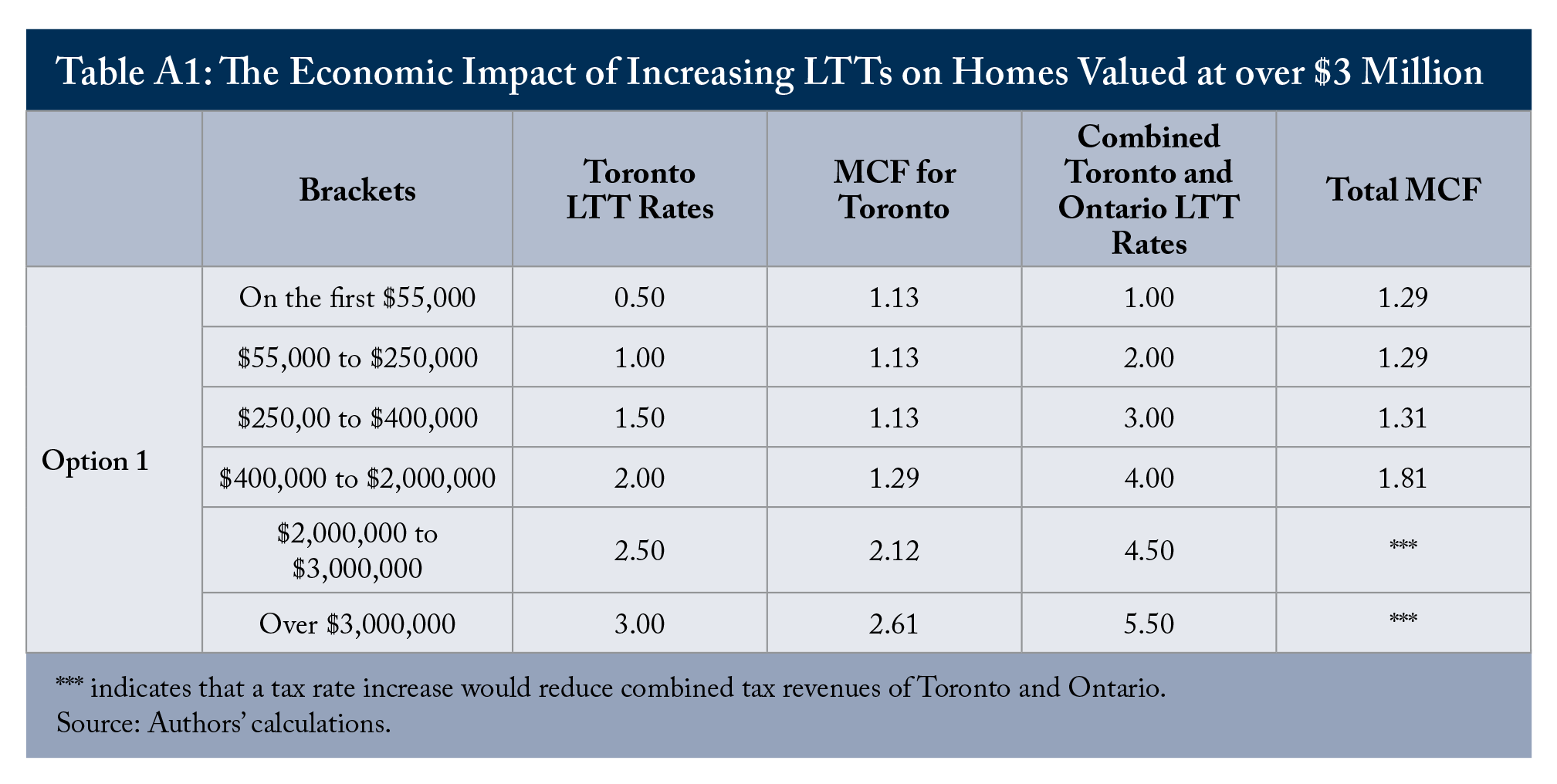
In Appendix 1 below, we have calculated the MCFs for options that are being considered by the Toronto. Given that the status quo is close to maximizing total LTT revenues in Toronto, it is not surprising that in all these options that involve an increase in Toronto’s top LTT rate by 0.5 percentage points, Toronto’s revenues will increase while the revenues for the government of Ontario will decline. From this broader perspective, none of these options are attractive to Ontario taxpayers or by extension the government of Ontario.
The LTT tax rate in the top tax bracket – on homes worth more than $2 million – that maximizes total LTT tax revenues, given the combined tax rates in the other tax brackets, is 4.98 percent. In other words, the current combined top tax rate of 5 percent is very close to the rate that maximizes total LTT revenues for the city of Toronto and the government of Ontario in 2020. The MCF at the tax rate that maximizes revenues; i.e., at the peak of the Laffer curve9The Laffer curve, named after the economist Arthur Laffer, is useful in demonstrating that tax rates can reach a point after which the revenues raised actually decline with a further tax rate increase. In such cases, cutting tax rates can result in increased total revenues for the government. for LTT revenues, is infinite because a small tax rate increase harms the owners of property in that tax bracket, but it does not raise any additional tax revenues. On that basis, the top tax rate should be set below the revenue maximizing tax rate.
To gain some appreciation of how distortionary the top LTT rate is, if the combined rate were reduced from 5 percent to 4 percent the MCF would still be 10.49, higher than Dahlby and Ferede (2018) estimates of the MCFs for Ontario’s corporate income tax of 2.62 and personal income taxes of 6.76 based on 2020 tax rates. If the top rate were 3 percent, the MCF would still be 3.28. This confirms the widely held view among economists that the LTT is a high-cost source of tax revenues. Because the supply of available housing is generally quite inelastic, a residential property tax is generally considered to be a non-distortionary tax. A better alternative to the LTT, especially for a local government, is to increase local residential property taxes.
Some may argue that the LTT should be a highly progressive tax and maximizing the tax revenues from those wealthy households with homes worth more than $2 million is consistent with the growing appreciation that the tax system should be more progressive. However, if a local government wants to make its tax collection more progressive, a better alternative would be to consider a higher annual property tax rate on residential property above a certain threshold, say $2 million. Although a so-called “mansion tax” would add some complications to the tax assessment process and would no doubt increase the number of appeals around the threshold, it would not reduce the number of property transfers. Such a measure is worth further study ahead of increasing the LTT.
Conclusion
Toronto’s LTT has a high economic cost. Raising the top marginal rate in Toronto, as is being considered by Toronto City Council, would have the effect of reducing overall government revenues when the fiscal effect to the province is taken into account. The combined 5 percent tax rate on homes over $2 million is the highest LTT rate in Canada except for the province of British Columbia, which imposes a 5 percent rate on homes over $3 million.
It is difficult to justify a land transfer tax. It is unrelated to services provided by governments, unlike the property tax which is arguably related to municipal services. Land transfer taxes tend to reduce the number of residential real estate sales, imposing a real burden on households that would otherwise prefer to move to a different home. The land transfer tax is also a volatile source of tax revenues that increase rapidly during a housing market boom, but then decline sharply when housing markets crash. This volatility makes them unsuitable for municipal governments with relatively stable expenditures and the need to balance their budgets every year. To the extent that the land transfer tax is shifted to sellers, a land transfer tax is capitalized in housing prices and the distribution of the land transfer tax is similar to a residential property tax. To the extent that the land transfer tax falls on buyers, it will impose a larger burden on younger generations and immigrants to the city or on households that move more frequently because of changes in the location of employment. A better alternative is for the city to rely on property taxes.
The fact that the LTT is levied by both Toronto and the government of Ontario means that when Toronto or Ontario raises its rate, the other level of government’s LTT revenues decline because of the reduction in the number of transfers and the capitalization of the tax increase in lower housing prices. This negative tax spillover effect can lead to myopic tax policy decisions in which governments do not consider the impact of their tax increase on the other level of government’s tax revenues. This is a ubiquitous situation in Canada given that both the federal and provincial governments levy income, sales, and excise taxes and provinces and municipalities both levy property taxes in most cases. The LTT levied by both the Toronto and the government of Ontario illustrates the potential for myopic and biased tax policy decisions in these other contexts as well.
Appendix 1: Alternative LTT Options and Those Studied by Toronto City Council
In this appendix, we estimate the economic impact of increasing LTTs on homes valued at over $3 million (by creating a new tax bracket that applies at sale values above this amount and increasing the top marginal rate by 0.5% – see option 1), and over $4 million (by having the new bracket start at this higher level and increasing the top marginal rate by 0.5% – see option 2). This analysis also provides insight on the economic harm of the LTTs on house prices between $2 and $3 million. This provides context for the Toronto Council debate on July 14 and 15 that will discuss rate increases at these price thresholds. In all price brackets above $2 million, both the existing top rate, let alone increasing rates, has a greater economic cost than the revenue raised as it reduces province of Ontario revenues by more than Toronto tax revenues increase.
References
Besley, Timothy, Neil Meads, and Paolo Surico. 2014. “The Incidence of Transaction Taxes: Evidence from a Stamp Duty Holiday.” Journal of Public Economics 119 (July): 61-70.
Dachis, Ben, Gilles Duranton, and Matthew A. Turner. 2012. “The Effects of Land Transfer Taxes on Real Estate Markets: Evidence from a Natural Experiment in Toronto.” Journal of Economic Geography 12 (May): 327-354. DOI: 10.1093/jeg/lbr007.
Dahlby, Bev. 2008. The Marginal Cost of Public Funds: Theory and Applications. MIT Press, Cambridge Mass.
Dahlby, Bev, and Ergete Ferede. 2018. “The Marginal Cost of Public Funds and the Laffer Curve: Evidence from the Canadian Provinces” FinanzArchiv 74:1 (June): 173-199.
Dahlby, Bev, and Braeden Larson. 2019. “Should Alberta Adopt a Land Transfer Tax?” SPP Research Papers, 12
Dahlby, Bev. 2020. “The Marginal Cost of Public Funds: Concept, Measurement, and Applications.” In Policy, Program and Project Evaluation: A Toolkit for Economic Analysis in a Changing World, edited by Anwar Shah, Palgrave McMillan: 107-130.
Dahlby, Bev, and Jack Mintz. 2021 “Options for Reforming Land Transfer Tax in Manitoba.” Working Paper. Toronto: C.D. Howe Institute.
Toronto, City of. 2021. “2021 Operating Budget Submission.” January.
The authors thank Alex Laurin, Jeremy Kronick, Gilles Duranton, Almos Tassonyi, Alan Tennant, Tom Wilson and anonymous reviewers for helpful comments on an earlier draft. The authors retain responsibility for any errors and the views expressed.