





by Daniel Schwanen
- Artificial intelligence (AI) holds the potential to raise productivity and living standards, but how much Canada benefits will depend on competitive conditions in markets across different layers of the AI “stack” – infrastructure, development, and deployment.
- Large global technology players hold significant positions in AI infrastructure and advanced model development. But competition remains dynamic and innovation-driven, with new entrants, open-source models, and government initiatives helping expand access to critical computing capacity and AI tools.
- Given the rapid evolution of technologies, business models, and alliances, reliance on rigid product market definitions or assumptions concerning the existence or use of market power risk mischaracterizing competition in the field of AI and its applications.
- This Commentary lays out a framework for how Canada’s Competition Bureau should assess competition in the AI stack – emphasizing case-by-case analysis, attention to innovation and access to key inputs, and clear guidance that addresses genuine anti-competitive conduct without undermining scale, investment, and growth.
Introduction
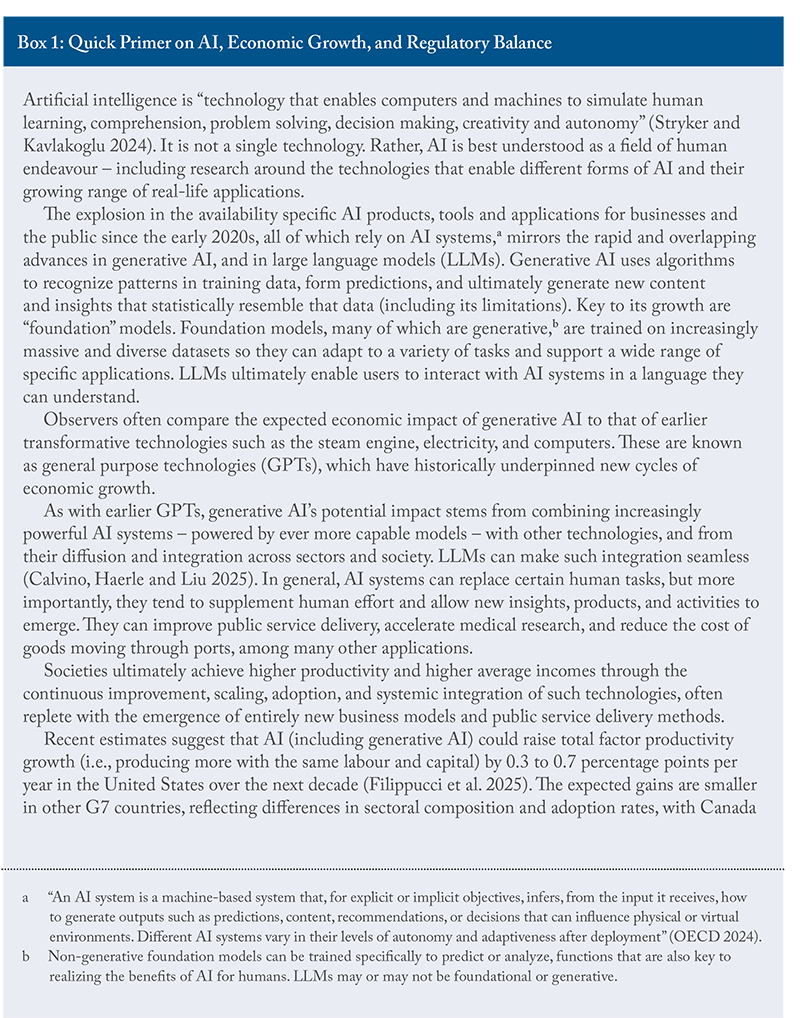
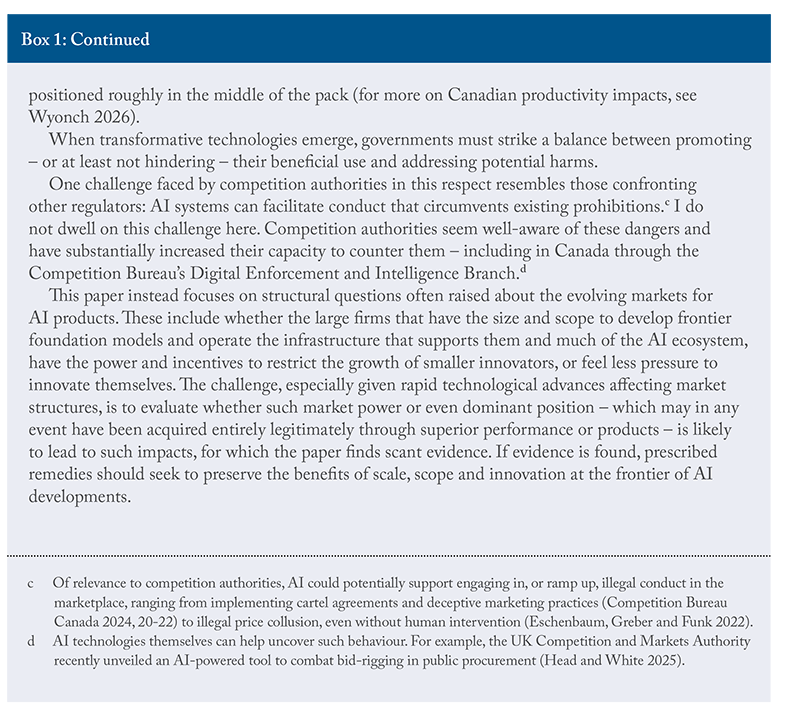
Canada, like other countries, is grappling with the implications of rapid developments in artificial intelligence (AI). How much an economy benefits from these developments depends in part on the competitive environment in which firms develop and commercialize AI technologies and build the infrastructure on which they run.
In this Commentary, I look at the evolving competitive forces within and across the different layers of the AI “stack,” and their implications for competition policy and its application. For each layer, I highlight potential policy challenges and policy approaches that can help grow and capture the benefits of AI technologies, while addressing any potentially problematic market structures forming around AI and digital technologies more generally.
The main takeaway is that, given the rapid and shape-shifting evolution of AI and digital markets themselves, and the fluid state of competition in them, Canada’s Competition Bureau should use a case-by-case, evidence- and effects-based approach, with a particular focus on the state of innovation. It should provide clearer guidance on how it will evaluate the state of competition, or the likely state of competition in fast-evolving markets, when it considers potential cases of abuse of dominance, or the impact of certain conducts in the marketplace, or when it assesses the impact of mergers.
Such an approach is warranted because AI technologies and business models are changing rapidly. These changes include potential convergence among different layers of AI technologies and between these technologies and a range of economic sectors. As a result, authorities should avoid any temptation to define AI “markets” too rigidly, including when evaluating potential anti-competitive effects of mergers and acquisitions, or the dominance of specific firms.
Attempts by competition authorities at second-guessing the development or applications of AI technologies risk stifling beneficial innovation while offering no compensatory benefit. Instead, they should pay particular attention to competitive conditions in so-called “innovation markets” that encompass competition through research and development and the building and acquisition of talent and intellectual property (IP) – the sources from which new AI technologies and applications emerge and through which they spread.
Government intervention can also act as a pro-competitive force by giving smaller players and innovators access to the tools and markets they need to grow. This is generally the case when governments support more – and more accessible – AI infrastructure. It also applies to policies that support open-source models or increase the availability of data, a vital input into AI models
and systems.
Competition authorities should take these interventions into account when assessing the competitive vibrancy of AI-related markets. Where other government policies already promote access, the Bureau should exercise forbearance in assessing the impact on competition of players they consider dominant. Where policies create barriers to competition, the Bureau should advocate for change in these policies.
Given increased government intervention to support emerging players, competition authorities should also explicitly recognize the benefits of scale and scope that large firms provide to the AI ecosystem. Frontier innovation in AI requires enormous investments, and there is little evidence that competition at that frontier is not intense.
That said, when market structures or business arrangements suggest bigger players in the infrastructure layer could wield sufficient market power to stifle access for emerging competitors across the stack, this paper suggests ways that the Competition Bureau can best use its recently strengthened powers (as well as the public directly) under the revamped Competition Act to address anti-competitive practices and agreements.
Competition and Intervention in AI
In a two-year-old discussion paper (“the Paper”) prepared to inform consultations on the impact of AI on competition, Canada’s Competition Bureau noted the lack of consensus on the definition of AI. But it goes on to refer to it as a “sector” comprised of a few layers of AI “markets,” each with its own type of potential competition concerns and affecting many other “sectors” of the economy (Competition Bureau Canada 2024, 25, 8).
The Paper conceptualizes these layers, often described collectively as the AI “stack,” each comprising various markets as follows:
- Markets that supply the computing and related powers and the data essential to the development and functioning of AI technologies (“AI Infrastructure”);
- Those that develop AI “technologies” such as models, algorithms, and architecture (“AI Development); and,
- Markets that deploy customer-facing AI products or services in various sectors of the economy (“AI Deployment”) (Competition Bureau Canada 2024, 8).
The Paper, along with the subsequent “What We Heard” document summarizing consultation results (Competition Bureau Canada 2025a), expanded on potential competition concerns within each layer, and on those stemming from vertical integration of activities across the stack. These concerns mainly revolve around the theoretical possibility that firms that straddle the infrastructure layer and downstream layers could make it difficult for independent competitors downstream to access the infrastructure they need (ibid., 8).
I will use this classification to discuss the state of competition and related policy concerns in markets in which AI is built, developed, and deployed.
AI Infrastructure
The first layer of “AI markets” concerns the availability of, and competition in, specialized AI chips, computing power, data centres, cloud computing, and data. Competing in this layer often involves large investments and sophisticated, reliable supply chains to build and operate infrastructure securely, including protection against physical and cyber threats. Without this layer, no firm or government can develop or deploy AI systems further downstream.
Producers in this foundational AI layer face hard physical and economic constraints affecting the cost and availability of the inputs required to build or operate the AI infrastructure, including storage and management of the data. The cost of computational power (“compute”) can rise exponentially for organizations pushing the frontier of AI innovation. Data centres – which house computing equipment, store data, and support large-scale models – now represent a rising share of electricity demand.11 Former Google CEO Eric Schmidt estimates that by 2050, AI may account for more than half of total energy consumption in advanced economies (Van Lierop 2025). In response, several firms operating data centres have begun building or securing their own dedicated power sources. Securing certain minerals critical to the production of semiconductors22 Necessary for the of production integrated circuits (microchips). is also key to a functioning physical AI infrastructure (Baskaran and Schwartz 2025).
These constraints drive firms to pursue greater physical efficiency – achieving the same performance with less “compute” or lower energy use, including by building as energy-efficient data centres as possible.33 That is, with the lowest power usage effectiveness (PUE), measured as the ratio of total energy used by a data centre relative to the energy used by the IT equipment only. This quest is a global source of innovation and competition, involving firms ranging from industry leaders in North America, China, and Europe, to startups offering specialized technologies that contribute to that goal.
The industry is also characterized by significant economies of scale. Firms can spread high fixed costs over a growing market for AI-related services that depend on the facilities provided by the infrastructure layer. Given these characteristics – large upfront costs, but significant economies of scale – it is unsurprising to find that some of the world’s largest companies are prominent actors in this layer.
As of 2024, NVIDIA, the world’s most valuable public company at the time of publication, held almost 90 percent of the “AI accelerator market,” comprised notably of graphics processing units (GPUs, a type of microchip) and other hardware necessary for running data centres and AI training, but competition is emerging in this rapidly expanding market (Silicon Analysts 2026). Established semiconductor firms such as Advanced Micro Devices (AMD) and Intel, which predate NVIDIA by a generation, are now seeking to carve more space specifically in AI-specific chips. Foreign competitors are also entering the market. In addition, large cloud infrastructure providers such as Amazon are designing their own specialized chips to better address their needs.
As mentioned, it is not surprising that some of the world’s largest companies offer infrastructure-intensive AI-related cloud services, including data storage, hosting, training, and managing foundation models.44 Model management is “the process of organizing, tracking and deploying machine learning and artificial intelligence models in a systematic manner.” See: https://h2o.ai/wiki/model-management/. The markets for such cloud services are increasingly contested, however, thanks in particular to the growth of on-premise providers.
Perhaps because data is so foundational to AI modelling and the functioning of AI systems, the Competition Bureau includes data itself as a component of the infrastructure layer. By contrast, the US Federal Trade Commission (FTC 2025, 8, 12-14) classifies data in the development layer in its study of cloud service providers and AI model developers. I follow the Competition Bureau’s nomenclature by first addressing data as belonging to the infrastructure layer, while returning later to the crucial role of data when discussing the development layer.
Data, Data Centres, and Competition
Although data is an essential input for foundation models, firms can compete in this space through multiple pathways. No competitive foundation AI model is trained exclusively on proprietary data. Firms also train models using publicly available and licensed content, including public-domain texts and structured datasets around dozens of fields of knowledge.
Cross-platform combinations, such as Google and YouTube, or Facebook and Instagram, allow firms to assemble multi-modal datasets (including images and videos) that can yield rich behavioural insights, potentially leading to more powerful AI models. That said, inferences based on widespread user-generated content raise the issue of the results’ trustworthiness. Improving reliability remains an active area of research. Ironically, “fine-tuning” models for practical applications often requires direct human input rather than additional digital accumulation.
The key point is that while proprietary data can be embedded in some firm’s AI modelling strategy, as in the examples just above, it does not by itself confer an insurmountable competitive advantage. The current frontier of innovation concerns how to make the most of the data, training foundation models on smaller or more targeted datasets to improve performance while lowering costs across a widening array of applications. As The Economist (2025) put it: “To really stand out in the crowded marketplace [of large language models] an AI lab needs not just to build a high-quality model, but to build it cheaply.” Reducing training time and prioritizing higher-quality data have become central competitive dimensions. “The efficiency drive is the new frontier.”
Of note, while some analysts have expressed concerns about growing partnerships between the largest players in the AI space55 Often referred to as “hyperscalers,” a term which does not, however, carry any significance in terms of evaluating their competitive position in the various markets they may operate in. and emerging innovators, competition authorities in the US, UK, Germany and elsewhere decided, after investigation, not to act on these concerns (Griza 2025, FTC 2025). The worry was that these partnerships, at the intersection of the infrastructure and development layers, could favour affiliated innovators over independent rivals and entrench leadership in foundation models (see Martens 2024; joint statement by the European Commission, UK Competition and Markets Authority, US Department of Justice, and US Federal Trade Commission [FTC] 2024; FTC 2025).
UK and EU regulators reportedly are contemplating a “broader range of potential theories of harm” to competition arising from such partnerships through their effects on the competitive “ecosystem” (Jordan et al. 2025), but the worry remains speculative. The US FTC, under new leadership since early 2025, has backed away from the idea of further investigating them. There is, instead, evidence that such partnerships constantly evolve and, in fact, allow new companies to grow and gain a measure of strategic independence from the more established, infrastructure-rich partner (Groza 2025).
Indeed, given the high costs of producing, operating, and improving on frontier models, the “coopetition,” or the simultaneous collaboration and competition between competitors, can expand the range of available foundation models and facilitate wider AI diffusion at lower cost (Martens 2024). If competition authorities take a less benign view of them, they should focus on investigating mechanisms that limit a junior partner’s ability to exit – such as mandatory use of proprietary application programming interfaces (APIs).
In general, however, competition in the AI infrastructure layer remains intense, particularly around cost efficiency and performance, as firms seek to remain “on the knife’s edge of innovation” (Del Rey 2025).
Oracle’s recent emergence as a major AI player illustrates the intensity of incipient competition in that layer. Founded in the late 1970s as a software company, Oracle now offers AI platform aggregation, hosting services for businesses, and secure cloud services, creating new opportunities for emerging players in the AI development layer. And, just as infrastructure firms have made moves to secure their upstream energy supplies, development-layer firms such as Canada’s Cohere are spurring investments in new AI-focused data centres built by companies such as CoreWeave, from which they secure specialized GPU capacity (Castaldo 2025).
Government’s Increasing Role in Boosting AI Infrastructure
At current growth rates, North American demand for cloud services, and for AI-related capacity specifically, exceeds the supply. Data centre vacancy rates are very low (CBRE 2026). Given the shortfall and rising costs of physical inputs such as energy, chips and construction labour in the United States, and regulatory delays, prices for renting existing capacity in North America have shot up by some 67 percent in the four years since the height of the pandemic (CBRE 2026).
Furthermore, not all data centres are optimized or even suitable for the research, development, and management of AI models. Nor is all the existing capacity widely available on commercial terms. Firms often reserve capacity for their own AI development or allocate it to long-term strategic clients. Space shortages and increased input costs naturally put a strain on potential uses by emerging AI firms or non-profit researchers, even as governments seek to promote AI research, innovation, and adoption. In Canada, limited access to “compute” has been identified as a major barrier to AI deployment.
Where governments evaluate that lack of “compute” infrastructure, or adequate access to it, pose obstacles to innovation and AI-supported economic growth, they have intervened to subsidize or seek to remove barriers to investments in, or access to, infrastructure.
For example, the US AI Action Plan calls for building and maintaining “vast AI infrastructure and the energy to power it” (The White House 2025, 1). It proposes removing or preventing regulations that could hinder AI infrastructure, development, and deployment. The plan also includes a menu of measures to boost “access to large-scale computing power for startups and academics,” including developing spot and forward markets for “compute” capacity (The White House 2025, 4-5). Such markets would in effect “commoditize” part of the market for compute, creating more flexibility, transparency and predictability for potential users.
The United States government has also taken a stake in Intel, the only US manufacturer of AI chips. (NVIDIA and AMD design chips but manufacture them elsewhere). NVIDIA itself has invested in Intel to reduce reliance on foreign manufacturing. In addition, the United States is using tariff policy to encourage Taiwanese firms to boost domestic chip production (Boak and Tang 2026).
These direct government interventions in the marketplace, and acceptance of partnerships between competitors that competition authorities might otherwise frown on, aim to expand the quantity and quality of domestic US microchip production, in addition to reshoring this production for security reasons. In that sense, they can support the expansion of “compute,” and hence boost competition and innovation in the other AI layers – where physical infrastructure constraints are binding.
For similar reasons, Canada’s “Sovereign AI Compute Strategy,” launched in 2024 with an initial funding of $2 billion, promotes private investment in “compute” infrastructure, commits public investments in such infrastructure, and helps fund access for organizations positioned to advance and benefit from AI development (Canada 2025). The strategy also encourages pooling complementary AI resources and strengths across the country. Provinces (and states) are also touting their specific advantages for data centre investment. For example, Alberta emphasizes power capacity and a climate providing natural cooling capabilities (Alberta 2024).66 Cooling accounts for a significant portion of data centres’ energy costs. At the same time, governments must manage local concerns about the environmental footprint and resource demands of large-scale data infrastructure.77 For example, Alberta’s recently introduced Bill 8 encourages data centres over a certain size to “bring their own power” to minimize the impact on existing users.
“Sovereign AI” strategies in Canada and elsewhere aim to provide “compute” capacity for domestic innovators who might otherwise face limited access to such capacity. As clarified in the 2025 federal budget, a large portion of that federal funding ($925.6 million, of which $800 million was from the original $2 billion funding envelope) will be devoted to support projects meeting the criteria of an “AI Sovereign Compute Infrastructure Program,” with the aim of not only boosting “compute” capacity overall, but aiming to ensure that sensitive data remains in domestic hands, subject to domestic laws.
As mentioned, there is rapid growth in the deployment of on-premise AI capabilities, or of hybrid AI (train a model in the cloud, using the model locally on new data). On-premise AI capabilities can be key to handling particularly sensitive data and tasks that require, for example, local encryption controls or even transmission over locally-owned telecommunications companies.
In addition to major new Canadian AI infrastructure projects, such as Telus’ “sovereign AI factories,” these technological and business developments show an AI infrastructure market that is agile and able to respond to users’ preferences, including with respect to the protection of sensitive data.
AI Development
The second layer of “AI markets” concerns the development of AI models, algorithms, and architecture. By all accounts, it is multifaceted, characterized, as the Paper notes, “by the presence of large technology companies, start-ups, and academic research groups” (12).
This description suggests a highly dynamic competitive environment. Indeed, a dizzying array of AI models has hit the marketplace over the years. Epoch AI tracks over 3,200 models in its database, the vast majority released since 2010, that is, in the era of “deep learning” or “machine learning models that mimic human brain function”(Stryker and Kavlakoglu 2024). These include many domain-specific models, such as in biology, math, or robotics, or others that are improved versions of themselves (Epoch AI 2026). Epoch AI identifies 982 of these as “notable” in terms of state-of-the-art improvements, training costs, significant use, citations, and “historical significance.” This last criterion highlights that current AI models build on a rich history of innovation, even as they face rapid obsolescence. About half of these notable models have been released in the past five years (since the end of 2020), including by Canada’s Cohere.
Amidst this innovative field, however, the narrower list of just over 40 “frontier” models released since the end of 2020 gives pride of place to technology companies with very substantial financial or technical backing, which is not surprising given the investments and costly inputs required for the most advanced models.
As the Competition Bureau (2024 and 2025a) noted, some worry that the market power that some firms may hold in the infrastructure layer could limit competition down the stack – and thus limit the growth of emergent innovators, notably in the development layer examined here. Classic business practices leveraging market power could lead to such an outcome in any industry: self-preferencing (systematically favouring one’s own products regardless of the client’s needs), exclusive dealing (conditioning access or preferential terms on the use of goods, services, or data from a single provider), and tied selling (bundling products or services that a client or users need with others they may not need or prefer to source elsewhere).
In theory, such practices can be used to limit users’ access to competing products and services – for example, by restricting the interoperability between an emerging firm’s products and those of incumbents, or even by foreclosing access to key inputs or customers. However, in competitive markets, these practices can also benefit business users and consumers by promoting product efficiency, scale, and convenience. Because these practices may generate both harms and benefits, authorities should assess them on a case-by-case basis.
In the AI development market, an important pro-competitive force is the availability of open-source, open-weight, and more generally open-access models, available under more or less permissive licensing conditions.88 Open-source models make their source code, architecture weights (parameters that define the model’s behaviour), documentation, and sometimes training data available to users and can be modified and used by them under licence for a variety of purposes. Open-weight models are ones where only the parameters are shared. Open access is a fuzzier category, often simply meaning users can access and use the model under certain conditions (e.g., non-commercial use). For example, Meta, the seventh-largest firm in the world at the time of writing, leverages its vast data resources, originally built through its social media business model, to develop an open-access foundation model that can serve as an alternative to the large commercially available AI models.99 Which is not to say that Meta does not benefit from this feature, for example, by learning from others’ improvements or diverse uses of its models. Investing in the performance and reliability of open-source models is one way to promote a more competitive AI development market.
As we saw, governments can intervene directly in the infrastructure layer to boost access to “compute.” These interventions can address worries about modelling capacity being preferentially accessible to long-term clients and partners of larger firms. Canada can, in this respect, emulate aspects of the White House action plan designed to facilitate access to “compute” and models for small and medium-sized enterprises and independent researchers. These measures include the push for a spot market for “compute” – potentially at a North American scale for data flows that do not threaten sovereign control over sensitive data – to offset any bias toward long-term contracts that may impede access for smaller players. They also include greater availability and connections to open-source and open-weight models, which the White House document describes as having:
“…unique value for innovation because startups can use them flexibly without being dependent on a closed model provider. They also benefit commercial and government adoption of AI because many businesses and governments have sensitive data that they cannot send to closed model vendors. And they are essential for academic research, which often relies on access to the weights and training data of a model to perform scientifically rigorous experiments” (4).
Meanwhile, although AI development and adoption rely heavily on intangible data, they increasingly depend, as we saw, on “hard” inputs acquired in the open marketplace: construction services for data centres, energy, microchips, research talent, and increasingly, external financing even for large firms in the infrastructure layer. This reliance should make pricing for data-centre services, AI models, and modelling facilities more transparent and easier for market participants to track. In turn, greater transparency should enable the Competition Bureau to better monitor these markets for signs of lack of competition, abuse of market power, or other anti-competitive behaviour.
That said, when contemplating action that might boost competition in the deployment layer, authorities should refrain from acting based on general assumptions about the future shape of so-called “AI markets.”
We saw this type of dynamic at work during the rise of digital technologies in the early 2000s. Given AI’s general-purpose and still emerging nature, new competitors may arise from across the ecosystem, including firms with more cost-efficient modelling approaches, novel applications of AI technologies, or entirely new business models that challenge incumbents. Historical experience with digital technologies suggests that early assumptions about market concentration do not always hold, as innovation and shifting business models can reshape competitive dynamics over time (see Schwanen 2021). Contemporary examples include Microsoft’s Bing and X’s Grok trying to give Google a run for its money in the search market, coming at it from completely different platforms, as well as Google’s own AI-enhanced search results potentially competing with its advertising-based revenue model.
A recent US District Court decision finding that Meta did not hold a monopoly in social media vividly illustrates the potential for the competitive landscape to shift rapidly. Since the FTC’s 2020 filing to declare Meta (owner of Facebook, Instagram, and WhatsApp) an illegal monopoly, TikTok, not even mentioned in the 2020 filing, has become a formidable rival. To quote the judge: “While it once might have made sense to partition apps into separate markets of social networking and social media, that wall has since broken down” (Ortutay 2025).
Looking forward, it is similarly unclear which AI model, if any, will dominate particular applications – or whether revolutionary technologies such as quantum computing will shift the position of even the largest players in the field. Accordingly, the Bureau should be wary about defining the “relevant market” too narrowly or treating its boundaries as permanent when assessing potential harms to competition in a highly innovative space – particularly one touted as the fount of a new general-purpose technology.
This fuzziness or likely impermanence complicates Canada’s recent shift to a structural (or “presumptive”) approach to evaluating the impact of mergers and acquisitions on competition, enshrined in the 2023 reform of the Competition Act. That approach automatically assumes greater potential anti-competitive effects – harm to competition – based on market share in a defined market. Market players can seek to rebut that presumption, and if market boundaries are inherently unstable, they will have an easier time doing so.
Rather than focusing primarily on size and market share, authorities could more specifically assess the impact of specific practices on innovation, including the types of potentially anti-competitive tactics discussed above. For example, they could regularly survey smaller innovators about the arrangements with large players that may constrain their business options.
The Bureau should intervene, along with sister national competition authorities, when there is clear evidence that a firm’s suite of products or ecosystem risks becoming so dominant that innovative products cannot reach the market. Such interventions should not be based only on theoretical concerns, and they should seek to preserve existing economic benefits of scale and scope. Remedies could include enforceable commitments to provide users with greater choice, as Microsoft recently committed to vis-à-vis the EU.1010 See: https://partner.microsoft.com/en-US/asset/collection/microsofts-commitments-to-the-european-commission-partner-resources#/. With respect to tied selling, the trade-off can be addressed by allowing users to access basic versions that work well, just without the bells and whistles, much as Microsoft offers Windows without Teams.
AI Deployment
This layer concerns the production of “any products or services which applies or integrates technology” produced in the AI development layer, or “AI product” (Competition Bureau Canada 2024, 13). As the Bureau notes, these products are used across many industries. Examples include “AI-powered assistants and chatbots, self-driving vehicles, recommendation systems, speech-to-text software, content generation, and AI-powered search” (Competition Bureau Canada 2024, 13). Unless developed in-house, firms offering AI products need to access the necessary technology inputs through partnerships or licensing or through intermediary vendors. In turn, they become vendors to companies that deploy AI products in their own operations.
The number of AI products being integrated into a wide variety of products and services, the number of companies producing them, and the financing they attract have grown by leaps and bounds globally and domestically.1111 See, for example: Forbes (2025); Canadian Venture Capital & Private Equity Association (2024); Vector Institute (2025); OECD/BCG/INSEAD (2025) Figure 2.12. Other than constraints related to the availability of AI infrastructure and skilled AI developers, few technological barriers appear to limit the supply of ever-more useful AI systems and applications.
However, significant barriers to deployment exist on the demand side. Adoption rates suggest that Canadian businesses lag behind leading peers. In 2024, Canadian businesses placed smack in the middle of the 25 Organisation for Economic Co-operation and Development (OECD) countries for which comparable data on business use of AI are available (OECD ICT Access and Usage by Business Database 2025).
Numerous reports have examined human (e.g., AI literacy, training, leadership), organizational (e.g., data governance), and structural (e.g., lack of “compute,” regulatory uncertainty) barriers to adoption.1212 On these factors, see Mckay (2025) and Higazy (2026, forthcoming), with KPMG (2025) and IMF (2024) that give relevant background rankings respectively on training and literacy and on infrastructure. Barriers may also lurk in the AI vendors’ market itself. A recent global survey suggests that many firms struggle to select the right vendor for their needs (OECD/BCG/INSEAD 2025).
Inevitably, because AI systems often integrate deeply into a client’s operations, businesses may hesitate before the costs and risks involved in switching from legacy systems (see also IBM 2026).
Information asymmetries may also come into play. Vendors can offer a suite of different products tailored to individual business circumstances, but customers may feel inadequately informed to confidently make a choice. The issue might rest in a lack of AI literacy which in any event should be addressed because it slows down AI adoption overall (Higazy 2026, forthcoming).
Finally, the lack of openness to competition in the Canadian economy may also be a significant culprit in Canada’s low AI adoption rate. AI and digital technologies often disrupt existing delivery mechanisms for goods and services. The people who benefit from incumbent systems may seek to preserve them (Hilbert 2020, 191). At times, Canadian governments and public bodies have responded by protecting incumbents that use old technologies rather than encouraging adaptation to new technologies and emerging forms of competition. This regulatory dynamic has appeared in public healthcare and in markets ranging from retail and taxis to finance, logistics, entertainment, and markets for information itself.
Governments should be aware that, by slowing down AI deployment, such protections ultimately slow down the growth and competitiveness of both Canada’s AI sector and the broader economy. The Bureau’s advocacy and competition promotion branch should therefore identify and address areas where regulation or public policy unnecessarily inhibits AI adoption.
Implications for Competition Policy: Fostering Responsible Innovation and Growth
The previous sections have outlined several features of the layers of AI-related goods and services relevant to competition authorities and regulators:
- Continued rapid technological evolution and changing business alliances;
- Increased reliance on costly “hard” inputs and infrastructure (e.g., energy, AI chips, data centres), making scale important to reduce costs;
- Intense competition increasingly focused on quality of data, model performance, and efficient use of inputs such as energy;
- Increased direct government intervention to facilitate access to computing power and to open-source models by smaller players;
- Growing requirements for protecting sensitive data and de-risking AI systems against hostile actors.
Canadian competition law has been significantly updated over the past four years. Changes that are most relevant to companies operating in the AI space include:
- Adoption of a “structural presumption” approach, under which market share indicators gauge whether a merger or acquisition is anti-competitive on its face, with the onus shifting to the merging companies to show that it does not lessen competition;
- Removal of the efficiencies defence that could be invoked in support of mergers that would otherwise reduce competition;
- Authority for the Bureau to seek remedies against companies whose actions, individually or jointly, “substantially lessen or prevent competition” (SLPC) without necessarily having to show that they have engaged in specific anti-competitive acts;
- Introduction of a right of private action before Canada’s Competition Tribunal;
- Expanded authority to seek – and the Tribunal to order – very large Administrative Monetary Penalties (AMPs) for deceptive marketing practices (such as “drip” pricing) and abuse of a dominant market position;
- Strengthened ability to challenge mergers after they have closed (up to three years for non-notified mergers) and a requirement that remedies sought by the Bureau restore competition to pre-merger levels; and,
- Greater scrutiny of anti-competitive agreements and behaviour affecting the ability of rivals to access inputs or customers, including prohibitions on no-poaching agreements and enhanced review of business partnerships that may resemble mergers in their competitive impact.
The move to structural presumptions was said to be justified partly by the rapid changes in the marketplace and the potential high costs and delays in assessing the anti-competitive effects of each significant merger or acquisition. Those same considerations supported shifting the burden of justifying a challenged merger onto the merging companies.
The new “direct” route to finding abuse of dominance based on a substantial lessening or prevention of competition – without requiring proof of anti-competitive intent – was meant to address instances in which it was feared that market evolution itself (for example, through network effects that are feared to produce a “winner-take-all” outcome) would foreclose the emergence of competitors.
The availability of large and potentially arbitrary AMPs for abuse of dominant position, the ability to disallow some mergers long after the fact, and the tougher remedies for mergers that have harmed competition (combined with the easier threshold created by structural presumptions), also give the Bureau more significant powers to intervene in the market. This expansion increases the importance of clear guidance on how those powers will be exercised all the more important. Unfortunately, the Anti-Competitive Conduct and Agreements (ACCA) Enforcement Guidelines, released by the Bureau on October 31, 2025 (Competition Bureau Canada 2025b), paint a rather broad and imprecise picture of the potential ways it can interpret conduct and market developments.
To be effective in this rapidly changing space, the Bureau should issue clearer guidance about the anti-competitive effects it seeks to prevent or remedy, and the market indicators it might monitor to assess such risks, including in innovation markets.
Enforcement should be grounded in evidence regarding the effects or likely effects of a particular conduct or agreement, in light of market conditions, rather than directed at firms solely because they are large or even dominant, as has sometimes been the case in the EU.1313 However, this observation needs to be put in context: the EU already has an entire apparatus dedicated to regulating the conduct of so-called large tech “gatekeepers,” the Digital Markets Act, which already regulates market conduct and structure that competition authorities might have otherwise addressed. This author has consistently argued that special rules for certain companies over others do not help promote growth and innovation.
An effects-based framework would allow for more explicit and reasoned recognition of the positive impact of scale and scope in providing for AI-related goods and services, while ensuring that smaller innovators and potential users retain access to each other and to growth opportunities. If evidence shows that a firm, regardless of how it achieved its position, controls a uniquely valuable “chokepoint” that innovators must access, or exerts a “chokehold” over bundled offerings that users must accept, the Bureau could seek solutions that address the specific harm to competition, for example through commitments to expand choice or share access to inputs such as data or facilities. What they should avoid, however, are breakups that would sacrifice economies of scale or scope and risk entrenching a low-productivity equilibrium.
The Bureau should offer to proactively engage with parties to significant mergers or acquisitions. It could offer pre-emptive discussions on how proposed transactions can comply with enforcement guidance, effectively creating a safe harbour where plans satisfy clearly articulated standards, while retaining the ability to follow up, through monitoring or market studies, if outcomes diverge from expectations.1414 And, over time, issuing more frequent merger remedies studies to guide market participants’ expectations of how to shape their plans. The Bureau should similarly be proactive in speaking with market participants in cases involving conduct. A proactive approach would help reconcile the uncertainty around the potential use by the Bureau of its of greater powers, with the needs of market participants to remain agile in capturing AI opportunities in a fast-moving marketplace.
Emphasizing actual competitive effects would, admittedly, take a leaf from the current White House Action Plan that aims to ensure FTC investigations “do not advance theories of liability that unduly burden innovation” (The White House 2025, 3). In practice, this means avoiding frameworks that impose ex ante liability based solely on firm size or market share in markets whose boundaries are fluid and evolving.
Other changes to the Act may more directly foster innovation and market discipline in the digital and AI spaces generally. The right of private action can complement the Bureau’s more direct approach I mentioned of surveying players in the AI space, addressing the threat of refusals-to-deal by dominant players or access to chokepoints.
Likewise, the renewed focus on input markets – as exemplified by the ban on anti-poaching agreements – is promising. Antitrust scholars and practitioners have long been thinking about – and acting on – the impact of competition on the innovation market (Lane 2018). A benefit of this approach is that it can be tailored to the Canadian market, using indicators such as access to research and development inputs. Given the global reach of large AI companies, it would be ineffective to base enforcement solely on their perceived Canadian market share or size. However, authorities should be concerned if their strategies impede the growth of new entrants – Canadian or not – due to a stranglehold on needed inputs.
The availability of reliable, competitive, and state-of-the-art open-source models is another indicator of the possibility for smaller competitors or new entrants to compete effectively. Authorities should consider the availability and viability of such models when assessing the openness to competition of the development ecosystem.
Competition authorities should use a light touch or sandbox approach to partnerships. Recent developments suggest that collaborations, even the largest firms and smaller innovators, are not a one-way street (as seen, for example, in Open AI’s rapidly diversifying partnerships beyond Microsoft).Authorities should likewise recognize that certain cooperative arrangements, ranging from large-scale collaborative projects such as the Stargate initiative in the United States to shared data or patent pools, may limit rivalry in form, while advancing broader policy objectives.
Finally, as noted earlier, the Bureau should proactively consult market participants about barriers that may prevent them from growing. The goal should be to ensure that emerging firms have reasonably open access to a variety of suppliers and customers.
Conclusion
In this paper, I have reviewed key aspects of the recent evolution of markets in AI-related goods and services and the competition concerns they may raise. I have also outlined elements of a competition regime that would best help Canada capture the benefits of AI while addressing its potential downsides. Such a regime must consider the rapid pace of technological change and the fluidity of market structures in AI. Accordingly, its application should remain flexible and grounded in case-by-case analysis.
But the principles guiding the Bureau’s evaluation of mergers, conduct, and overall competitive conditions should be clear. The Bureau should focus on removing barriers to innovation, including by not stifling the myriad benefits that come from the economies of scale and scope brought by large and growing market participants.
The author extends gratitude to Nicholas Dahir, John Lester, Harvey Naglie, Alan Veerman, Rosalie Wyonch, and several anonymous referees for valuable comments and suggestions. The author retains responsibility for any errors and the views expressed.
REFERENCES
Baskaran, Gracelin, and Meredith Schwartz. 2024. “From Mine to Microchip: Addressing Critical Mineral Supply Chain Risks in Semiconductor Production.” CSIS Briefs, Center for Strategic & International Studies. October. Accessed at: https://www.csis.org/analysis/mine-microchip.
Boak, Josh, and Didi Tang. 2026. “Trump Administration Reaches a Trade Deal to Lower Taiwan’s Tariff Barriers.” The Globe and Mail. February 13. https://www.theglobeandmail.com/investing/markets/indices/SRIN/pressreleases/194736/trump-administration-reaches-a-trade-deal-to-lower-taiwan-s-tariff-barriers/.
Brodsky, Sascha. 2026. “The Hidden Costs of AI.” IBM Think Insights. Accessed at: https://www.ibm.com/think/insights/ai-economics-compute-cost?utm_source=copilot.com.
Calvino, Flavio, Daniel Hearle, and Sarah Liu. 2025. “Is Generative AI a General-Purpose Technology? Implications for Productivity and Policy.” OECD Artificial Intelligence Papers 40. June. Accessed at: https://www.oecd.org/en/publications/is-generative-ai-a-general-purpose-technology_704e2d12-en.html.
Canada. 2025. “Canadian Sovereign AI Compute Strategy.” Industry Science and Economic Development Canada. Updated October 31. Accessed at: https://ised-isde.canada.ca/site/ised/en/canadian-sovereign-ai-compute-strategy.
Canadian Venture Capital & Private Equity Association. 2024. “Mapping the Growth of AI in Canada Through Investment.” CVCA Central. September 10. Accessed at: https://central.cvca.ca/data-analysis/mapping-the-growth-of-ai-in-canada-through-investment/.
Castaldo, Joe. 2025. “CoreWeave to operate AI data centre in Cambridge, Ont., with Cohere as customer.” The Globe and Mail. July 2. Accessed at: https://www.theglobeandmail.com/business/article-coreweave-ai-data-centre-cambridge-ontario-cohere/.
Competition Bureau Canada. 2024. Artificial Intelligence and Competition Discussion Paper. March. Accessed at: https://competition-bureau.canada.ca/sites/default/files/documents/AICompetition-Discussion-Paper-240320-ver3-e.pdf.
______________. 2025a. Consultation on Artificial Intelligence and Competition: What We Heard. January 27. Accessed at: https://competition-bureau.canada.ca/en/how-we-foster-competition/education-and-outreach/consultation-artificial-intelligence-and-competition-what-we-heard.
______________. 2025b. Anti-Competitive Conduct and Agreements. Enforcement Guidelines. October 31. https://competition-bureau.canada.ca/en/how-we-foster-competition/consultations/anti-competitive-conduct-and-agreements.
Coldwell Banker Richard Ellis (CBRE). 2026. North America Data Center Trends H2 2025. Accessed at: https://www.cbre.com/insights/books/north-america-data-center-trends-h2-2025.
Del Rey, Jason. 2025. “Amazon CEO Andy Jassy unleashed a meticulous 8-minute defense of AWS’ standing in the AI arms race amid investor stock freakout.” Fortune. July 31. Accessed at: https://fortune.com/2025/07/31/amazon-aws-ai-andy-jassy-earnings-defense/.
Epoch AI. 2026 “Data on AI Models.” Accessed March 26, 2026, at: https://epoch.ai/data/ai-models.
Eschenbaum, Nicolas, Nicolas Greber, and Michael Funk. 2022. AI and Its Effects on Competition. Swiss Economics. Accessed at: https://swiss-economics.ch/blog-en/items/ai-and-its-effects-on-competition.html.
European E&M Consultants. 2012. Input and Customer Foreclosure: Non-Horizontal Merger Guidelines. Accessed at: https://www.ee-mc.com/fileadmin/user_upload/Input_Customer_Foreclosure.pdf.
European Commission, with UK Competition and Markets Authority, US Department of Justice, and US Federal Trade Commission. 2024. “Joint Statement on Competition in Generative AI Foundation Models and AI Products.” July 23. Accessed at: https://competition-policy.ec.europa.eu/about/news/joint-statement-competition-generative-ai-foundation-models-and-ai-products-2024-07-23_en.
Federal Trade Commission (FTC), Office of Technology Staff. 2025. Partnerships Between Cloud Service Providers and AI Developers. FTC Staff Report on AI Partnerships & Investments 6(b) Study. January. Accessed at: https://www.ftc.gov/system/files/ftc_gov/pdf/p246201_aipartnerships6breport_redacted_0.pdf.
Fekete, Michael, and John Salloum. 2025. “Data Sovereignty in light of the CLOUD Act: Back to the Future?” Osler Updates. October 7. Accessed at: https://www.osler.com/en/insights/updates/data-sovereignty-in-light-of-the-cloud-act-back-to-the-future/.
Filippucci, Francesco, Peter Gal, Katharina Laengle, Matthias Schief, and Filiz Unsal. 2025. “Opportunities and Risks of Artificial Intelligence for Productivity.” International Productivity Monitor 48. Spring. Accessed at: https://www.csls.ca/ipm/48/OECD_Final.pdf.
Forbes. 2025 “AI 50 List – Top Artificial Intelligence Companies Ranked.” Edited by Rashi Shrivastava. April 10. Accessed at: https://www.forbes.com/lists/ai50/.
Freedman, Lawrence. 2013. Strategy: a history. New York: Oxford University Press.
FrenchWeb. 2025. “L’Europe face au piège du cloud souverain : indépendance ou dépendance masquée ?” Trends. Accessed at: https://www.frenchweb.fr/leurope-face-au-piege-du-cloud-souverain-independance-ou-dependance-masquee/452208.
G7. 2025. “Leaders’ Statement on AI for Prosperity.” June 17. Accessed at: https://g7.canada.ca/en/news-and-media/news/g7-leaders-statement-on-ai-for-prosperity/.
Government of Alberta. 2024. “Artificial Intelligence Data Centres Strategy.” Accessed at: https://www.alberta.ca/artificial-intelligence-data-centres-strategy.
Groza, Teodora. 2025. “AI Partnerships Beyond Control: Lessons from the OpenAI-Microsoft Saga.” Stanford Law School Blog. March 21. Accessed at: https://law.stanford.edu/2025/03/21/ai-partnerships-beyond-control-lessons-from-the-openai-microsoft-saga/.
Head, Louis, and White, Alistair. 2025. “CMA unveils AI-powered tool to combat bid-rigging in public procurement.” DLA Piper. 17 January. Accessed at: https://www.dlapiper.com/en/insights/publications/2025/01/cma-unveils-ai-powered-tool-to-combat-bid-rigging-in-public-procurement.
Higazy, Amira. 2026. The AI Literacy Deficit: Understanding Canada’s Barriers to AI Adoption. Commentary. Toronto: C.D. Howe Institute. (Forthcoming).
Hilbert, Martin. 2020. “Digital technology and social change: the digital transformation of society from a historical perspective.” Dialogues in Clinical Neuroscience 22(2) 189-194. June. Accessed at: https://pmc.ncbi.nlm.nih.gov/articles/PMC7366943/.
International Institute of Communications (IIC). 2019. “Convergence Brings a New Era of Competition Regulation.” Blog post. October 28. Accessed at: https://www.iicom.org/feature/the-new-era-of-competition-regulation/.
Jordan, Sarah, Mavroghenis, Stephen C., Anuj Ghai, Laurenz Bové, and Samuel Honnywill. 2025. “UK and EU antitrust authorities target AI partnerships in expansion of merger control rules.” Global Competition Review. September 22. Accessed at: https://globalcompetitionreview.com/guide/digital-markets-guide/fifth-edition/article/uk-and-eu-antitrust-authorities-target-ai-partnerships-in-expansion-of-merger-control-rules.
Karadeglija, Ana. 2024. “Canada is a force in AI research, so why can’t we commercialize it?” The Canadian Press. June 26. Accessed at: https://www.thecanadianpressnews.ca/business/canada-is-a-force-in-ai-research-so-why-cant-we-commercialize-it/article_a194ceda-527e-53b0-a451-975dbbe0f47a.html.
KPMG. 2025. Trust, attitudes and use of artificial intelligence: A global study 2025 – Canadian insights. Accessed at: https://assets.kpmg.com/content/dam/kpmg/ca/pdf/2025/07/trust-in-ai-en-report.pdf.
Lane, Matthew. 2018. “The History of Innovation in Antitrust Law.” DISCO Disruptive Competition Project. July 12. Accessed at: https://project-disco.org/competition/061218the-history-of-innovation-in-antitrust-law/.
Lester, John. 2025. “An Economic Strategy for Canada’s Next Government.” Special Policy Report. Toronto: C.D. Howe Institute. April 4. Accessed at: https://cdhowe.org/publication/an-economic-strategy-for-canadas-next-government/.
Leyton-Brown, Kevin, Cinda Heeren, Joanna McGrenere, Raymond Ng, Margo Seltzer, Leonid Sigal, and Michiel Van de Panne. 2025. “AI Is Not Rocket Science: Ideas for Achieving Liftoff in Canadian AI Adoption.” Verbatim. Toronto: C.D. Howe Institute. October 1. Accessed at: https://cdhowe.org/publication/ai-is-not-rocket-science-ideas-for-achieving-liftoff-in-canadian-ai-adoption/.
Machine. 2024. “Open-AI co-founder Ilya Sutskever: Peak Data is here and the end of pre-training is nigh.” Machine. December 16. Accessed at: https://www.machine.news/ilya-sutskever-peak-data-ai-openai/.
Martens, Bertin. 2024. “Why artificial intelligence is creating fundamental challenges for competition policy.” Bruegel Policy Brief. July 18. Accessed at: Why artificial intelligence is creating fundamental challenges for competition policy.
Maslej, Nestor, Loredana Fattorini, Raymond Perraults, Yolanda Gil, et al. 2025. “The AI Index 2025 Annual Report.” AI Index Steering Committee, Institute for Human-Centered AI, Stanford University. April. Accessed at: https://hai.stanford.edu/ai-index/2025-ai-index-report.
Mckay, Reid. 2025. “Bridging the Imagination Gap: How Canadian companies can become global leaders in AI adoption.” RBC Thought Leadership. June. Accessed at: https://www.rbc.com/en/thought-leadership/the-growth-project/bridging-the-imagination-gap-how-canadian-companies-can-become-global-leaders-in-ai-adoption/#:~:text=Only%2012%25%20of%20Canadian%20firms,for%20AI%20than%20other%20nations.
McDowell, Adam. 2025. “Artificial intelligence was made in Canada. How can we be world leaders once again?” The Hub. February 14. Accessed at: https://thehub.ca/2025/02/14/artificial-intelligence-was-made-in-canada-so-why-arent-we-leading-the-ai-race/.
OECD. 2024. “Explanatory Memorandum on the Updated OECD Definition of An AI System.” OECD Artificial Intelligence Papers 8. March. Accessed at: Explanatory memorandum on the updated OECD definition of an AI system (EN)
______. 2025a. “ICT Access and Usage by Business Database.” Accessed at: https://data-explorer.oecd.org/.
______. 2025b. “AI adoption by small and medium-sized enterprises.” OECD Discussion Paper for the G7. December. Accessed at: https://www.oecd.org/en/publications/ai-adoption-by-small-and-medium-sized-enterprises_426399c1-en.html.
OECD/BCG/INSEAD. 2025. The Adoption of Artificial Intelligence in Firms: New Evidence for Policymaking. Paris. OECD Publishing. Accessed at: https://www.oecd.org/en/publications/the-adoption-of-artificial-intelligence-in-firms_f9ef33c3-en.html.
Ortutay, Barbara. 2025. “Meta prevails in historic FTC antitrust case, won't have to break off WhatsApp, Instagram.” The Canadian Press. November 18. Accessed at: https://ca.finance.yahoo.com/news/meta-prevails-historic-ftc-antitrust-181049540.html.
Plant, Charles. 2017. “Canada’s Patent Puzzle.” An Impact Brief. University of Toronto Impact Centre. May. Accessed at: https://narwhalproject.org/wp-content/uploads/2017/10/Canadas_Patent_Puzzle.pdf.
Schwanen, Daniel. 2017. Innovation Policy in Canada: A Holistic Approach. Commentary 497. Toronto: C.D. Howe Institute. December. Accessed at: https://cdhowe.org/publication/innovation-policy-canada-holistic-approach/.
______. 2021. “Shopper’s Choice: The Evolution of Retailing in the Digital Age.” E-Brief 322. Toronto: C.D. Howe Institute. December 16. Accessed at: https://cdhowe.org/publication/shoppers-choice-evolution-retailing-digital-age/.
______. 2023. Calibrating Competition Policy for the Digital Age. Commentary 636. Toronto: C.D. Howe Institute. February. Accessed at: https://cdhowe.org/publication/calibrating-competition-policy-digital-age/.
Silicon Analysts. 2026. “NVIDIA GPU Market Share 2024-2026: 87% Peak, What Comes Next.” February 21. Accessed at: https://siliconanalysts.com/analysis/nvidia-ai-accelerator-market-share-2024-2026
Stryker, Cole, and Eda Kavlakoglu. 2024. What Is Artificial Intelligence? IBM Think. Accessed at: https://www.ibm.com/think/topics/artificial-intelligence.
The Economist. 2025. “Forget DeepSeek. Large language models are getting cheaper still.” February 12. Accessed at: https://www.economist.com/science-and-technology/2025/02/12/forget-deepseek-large-language-models-are-getting-cheaper-still.
The White House. 2025. America’s AI Action Plan. July. Accessed at: https://www.whitehouse.gov/wp-content/uploads/2025/07/Americas-AI-Action-Plan.pdf.
Van Lierop, Wal. 2025. “How to Become an Energy Superpower.” Forbes. July 14. Accessed at: How To Become An Energy Superpower.
Vector Institute. 2025. Ontario AI Snapshot 2024-25. Produced in partnership with Deloitte Canada. June 18. Accessed at https://vectorinstitute.ai/ontario-ai-ecosystem-report-2024-25/.
Wu, Tim. 2018. The Curse of Bigness: Antitrust in the New Gilded Age. New York: Columbia Global Reports.
Wyonch, Rosalie. 2026. From Hype to Output: How AI Investment Translates to Real Productivity Gains. Commentary 712. Toronto: C.D. Howe Institute. April. Accessed at: https://cdhowe.org/publication/from-hype-to-output-how-ai-investment-translates-to-real-productivity-gains/.