






by George Vegh and Kate Koplovich
- Canada needs to build major energy and natural resource projects faster to attract private investment and improve productivity. The federal government has responded by enacting the Building Canada Act (BCA), standing up the Major Projects Office (MPO), and proposing further regulatory reforms. None of these mechanisms address the fundamental sources of uncertainty in Canada’s regulatory system: political decision-making over individual projects and open-ended criteria that require regulators to consider broad public policy objectives.
- The BCA does not resolve these underlying problems. Rather, it creates a new process for a subset of projects and further centralizes decision-making in the federal executive. It also leaves important questions unresolved, including how “national interest” will be defined, how listing interacts with existing regulatory approval processes, and the “additionality” of the MPO – that is, what it adds to existing federal efforts to coordinate and streamline project reviews.
- This paper focuses on the federal regulatory regime applied to pipeline infrastructure to make the case that Canada should instead undertake broader regulatory reform. Expert regulators should have final authority to make evidence-based approval decisions; regulatory reviews should focus on criteria directly related to a project and the regulator’s mandate, while governments address broader policy questions; and statutory timelines should be enforced for governments, proponents, and intervenors, with extensions permitted only for unforeseen circumstances. These reforms would create a less political, less complicated, and more predictable regulatory approval system.
Introduction
Canada is facing a combination of sovereignty, security, and economic challenges stemming from weak productivity, due in part to a lack of private sector investment, and an upended relationship with the United States.
To help address these challenges, there is broad consensus that large projects need to move forward faster, and there is no question Canada’s current regulatory regime is one reason they do not.11 See Bishop and Sprague (2019); Business Council of Alberta (2023); Business Council of Alberta (2026); Ballos, Crisan, Tripathi, and Tombe (2025); Canadian Climate Institute (2023); and Gilmour (2024).
On June 26, 2025, Parliament enacted the Building Canada Act (BCA) to “urgently advance projects throughout Canada,” and in addition to the BCA, on May 8, 2026, the federal government released a discussion paper proposing further reforms to regulatory processes (Government of Canada 2026). The objective of the BCA and the proposed reforms in the discussion paper are admirable and necessary – Canada is sorely in need of private sector investment to rectify its tepid productivity growth, and speed and predictability are critical factors to incentivize investment. However, we argue that neither solves the fundamental challenges of Canada’s regulatory regime for energy and natural resources projects. In fact, the BCA establishes new processes for selected projects, deemed to be in the national interest, and maintains executive power for approvals.
Canada’s regulatory approval processes, specifically at the federal level, are both unpredictable because politicians make the final decision on whether to approve a project, and lengthy because reviews rely on open-ended policy criteria. From a proponent and investor perspective, competitiveness depends on timely reviews, clear criteria, reduced duplication, practical information requirements, and durable approvals. Addressing these issues requires changes to the scope and finality of regulatory reviews.
Fixing these systems is a governance challenge consisting of two basic questions: What criteria should determine whether projects are approved, and who should make those decisions? This involves diagnosing the root causes of Canada’s regulatory failures and designing a regulatory system to mitigate them.
What Canada needs is a depoliticized and simplified system of regulatory approvals that applies to all projects. Some progress on this front is already underway through Ottawa’s Red Tape Review initiative that directs federal departments and agencies to “review regulations, including how they are administered, and develop reports detailing their progress”22 Government of Canada. 2026. “Red Tape Review.” https://www.canada.ca/en/government/system/laws/developing-improving-federal-regulations/red-tape-reduction-office/red-tape-review.html. and envisions “one project, one review” agreements between the federal and provincial governments.33 Government of Canada. 2026. “Working Together on Major Projects: Basics of Co-operation in Federal Impact Assessments.” https://www.canada.ca/en/impact-assessment-agency/programs/impact-assessments-101/cooperation.html. While these examples show improvements are underway, they do not address the main challenges with pipeline regulatory approvals: Who makes the final approval decision and with what criteria?
Our recommendations include removing political decision-making from the approval process, simplifying review criteria, and setting enforceable time limits for reviews. These steps are transformational and necessary to build confidence in Canada’s regulatory approval process after years of uncertainty. They will create a system more effective than the BCA because the results will be less political, less complicated, and more focused on direct project effects and approval issues.
Current State of Major Projects in Canada
Canada’s Major Energy and Natural Resources Projects Inventory (MPI) tracks energy, mining, electricity, and forestry projects within Canada that meet a $50 million investment threshold for energy and mining projects and a $20 million investment threshold for electricity and forestry projects.44 Natural Resources Canada. “Major Energy and Natural Resources Projects Inventory.” https://natural-resources.canada.ca/science-data/data-analysis/major-energy-natural-resources-projects-inventory
The total number of projects in the inventory declined in 2018, then rose gradually through 2021 before registering a significant decline in 2022, followed by a partial rebound and another decline in 2025 (Figure 1).55 2016 is currently the earliest available year for inventory data. In 2025, there were 472 major projects at some stage of project development.

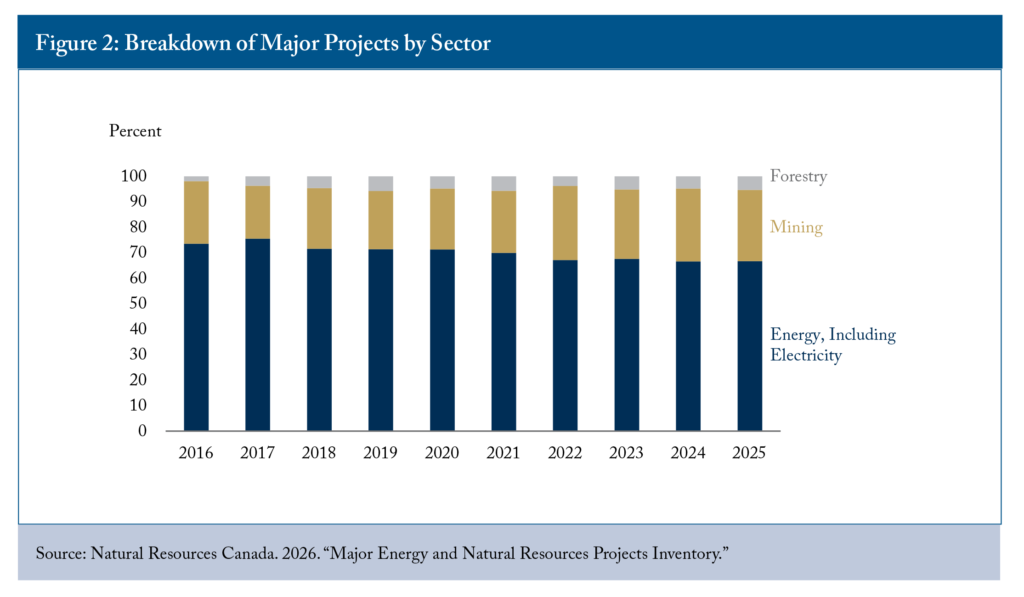
Energy projects as a portion of the total have decreased from a high of 76 percent in 2017 to 67 percent in 2025, with mining increasing to over a quarter of projects in the inventory (Figure 2).
A look at energy projects shows these projects have not returned to their pre-pandemic levels. Indeed, even with oil price rebounds post-pandemic, oil and gas projects specifically have not recovered (Figure 3). While electricity projects have grown 60 percent since 2016, oil and gas projects have decreased 76 percent between 2017 and 2025. Many electricity projects (e.g., generation and intra-provincial transmission) are under provincial jurisdiction and not subject to the same regulatory regime, including government approval, as oil sands or offshore oil projects (which together make up most of the oil projects in the inventory).
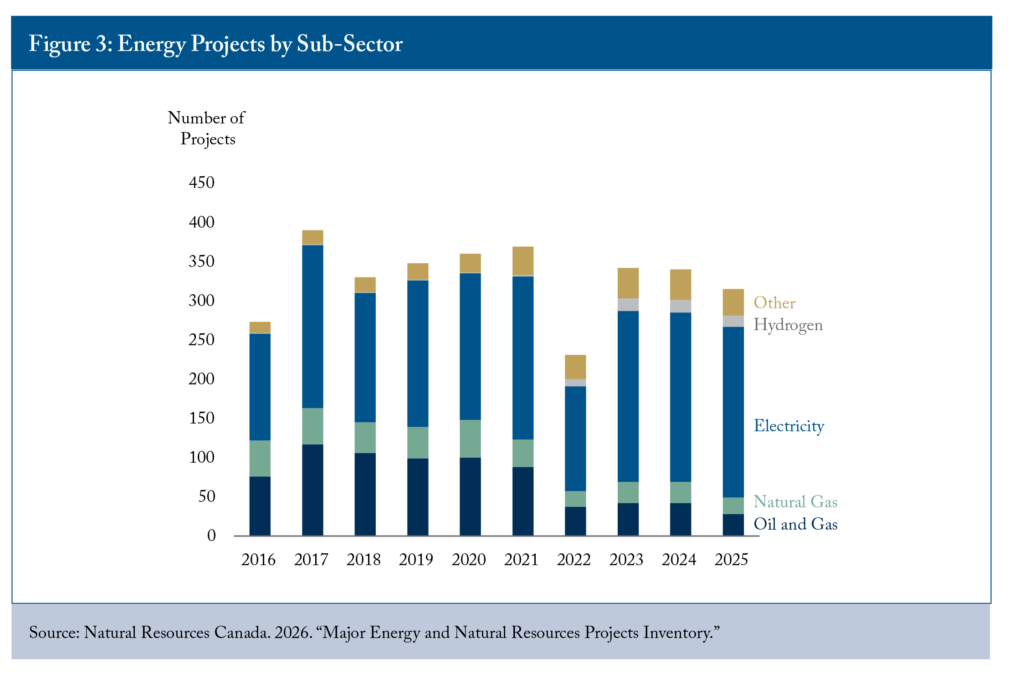
Of course, across the time horizon analyzed, oil and gas projects in Canada and around the world were impacted by global economic factors like swings in commodity prices, the war in Ukraine, innovation in extraction technologies such as hydraulic fracturing, and changes to various types of risks, including regulatory risks. Although oil prices rebounded following the pandemic66 Annual average West Texas Intermediate oil prices derived from daily prices between 2016 and 2019 were $54.95/bbl, whereas oil prices between 2022 and 2025 were $77.23 (all in nominal values). Data retrieved from: Federal Reserve Bank of St. Louis. 2026. “Crude Oil Prices: West Texas Intermediate (WTI) – Cushing, Oklahoma.” FRED. https://fred.stlouisfed.org/series/DCOILWTICO. and Canadian oil and gas producers have continued to increase their efficiencies, thus reducing their operating costs, the number of oil and gas projects in the inventory is now at its lowest level in a decade. The decline in Canadian oil and gas projects shown in Figure 3 does not align with other jurisdictions’ upstream oil and gas investment trends (IEA 2026). The latest International Energy Agency World Energy Investment Report (2026) shows regions such as the Middle East, Africa, and Central and South America maintaining or increasing upstream oil and gas investments between 2020 and 2025, while North American investments declined between 2023 and 2025.
It is also possible that changes in the regulatory landscape, including the enactment of the Greenhouse Gas Pollution Pricing Act (GGPPA) in 2018 and the Impact Assessment Act and the Oil Tanker Moratorium Act in 2019, began to significantly deter planned investments in some projects.77 Wittevrongel, Krystle. 2025. “Canada’s Impact Assessment Act is a Bureaucratic Chokehold.” National Post. April 12. https://nationalpost.com/opinion/krystle-wittevrongel-canadas-impact-assessment-act-is-a-bureaucratic-chokehold.
The Major Projects Inventory also tracks the project stage of each project: announced and planning, in review, approved, and under construction. As shown in Figure 4, consolidated in the “other” category, additional stages were added to the inventory in 2016 and between 2021 and 2023.
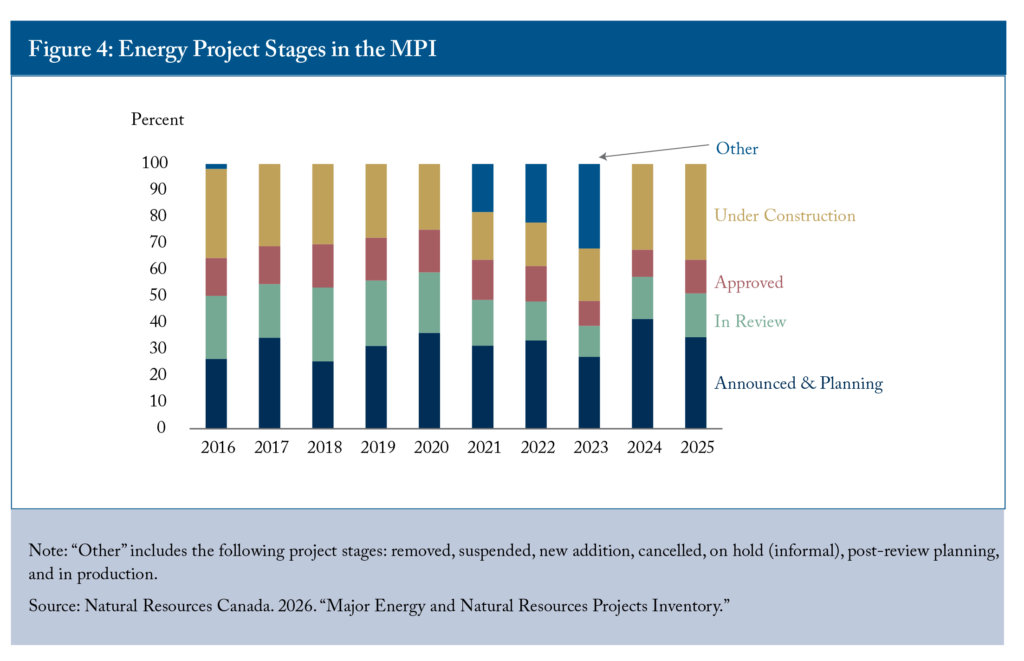
Projects in the announced and planning stage can signal confidence and positive expectations of project execution. Specifically for energy projects, the share of projects in this stage has been volatile, increasing from 2018 to 2020, declining from 2021 to 2023, resurging in 2024, and finally declining in the most recent year. Also of note was the limited proportion of projects under construction in 2021, 2022, and 2023, with the share increasing in recent years, indicating a potential renewed confidence in energy projects in Canada and much-needed movement towards building the infrastructure Canada needs. Overall, the stagnation and even declines in oil and gas projects from 2017 onward suggest the need to address Canada’s regulatory challenges to building major projects.
How Canada Regulates Major Pipeline Projects
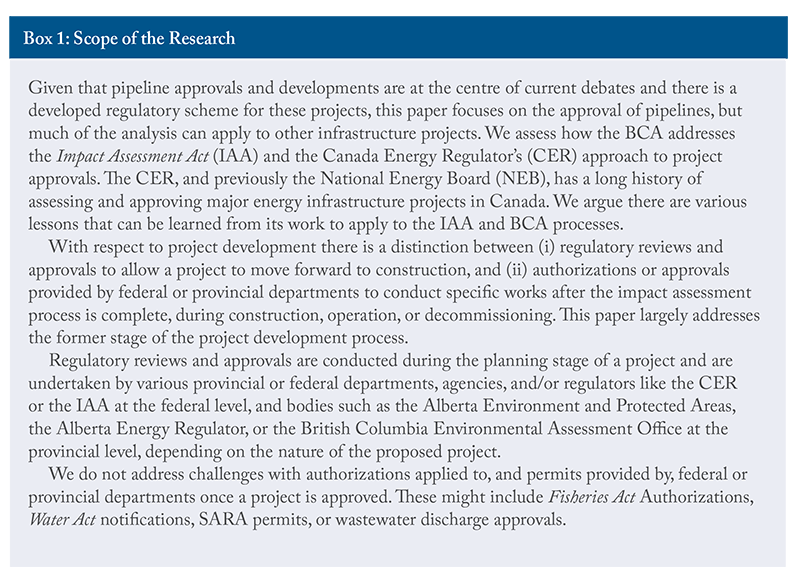
As mentioned in Box 1, this research focuses its analysis on legislation related to major pipeline projects, which is especially timely given the current infrastructure discussions such as the Canada-Alberta memorandum of understanding88 Prime Minister of Canada. 2025. “Canada-Alberta Memorandum of Understanding.” Government of Canada. November 27. https://www.pm.gc.ca/en/news/backgrounders/2025/11/27/canada-alberta-memorandum-understanding. and the recently announced Northern Shield Energy Corridor between Alberta and Ontario. The current regulatory regimes for major pipeline projects are centred on two pieces of legislation: the Canadian Energy Regulator Act (implemented by the Canada Energy Regulator) and the Impact Assessment Act (implemented by the Impact Assessment Agency).
The Canada Energy Regulator (CER) is the lifecycle regulator for oil, gas, and other commodity pipelines that cross interprovincial or international borders, as well as international and interprovincial power lines. The CER also regulates the trading of energy products, oil and gas exploration and production activities offshore and on frontier lands, and offshore renewables and power lines.99 Canada Energy Regulator. 2024. “What We Regulate.” https://www.cer-rec.gc.ca/en/about/how-we-regulate/regulatory-framework-101/what-we-regulate/.
The Impact Assessment Agency (IAA) leads all reviews of major resource projects in areas of federal jurisdiction, conducting impact assessments to identify and mitigate adverse effects to the environment and humans, including Indigenous Peoples and communities.1010 Impact Assessment Agency. December 2025. “Mandate of the Impact Assessment Agency of Canada.” https://www.canada.ca/en/impact-assessment-agency/corporate/mandate.html. A federal impact assessment is required for activities included in the Physical Activities Regulations,1111 Physical Activities Regulations, 2019, SOR\2019-285. Generally these activities cover: the construction, operation, decommissioning, and/or abandonment of projects in a wildlife area or marine conservation area, on Parks Canada lands, or related to defence; certain mines over specified capacities, nuclear facilities, and oil and gas facilities above set capacity thresholds; certain international or interprovincial electricity transmission lines; offshore oil and gas pipelines, pipelines over 75 km; and certain renewable energy, transportation infrastructure, hazardous waste facilities, and water projects. many of which could be major projects.
The CER has processed 104 pipeline applications since its creation in 2019. The IAA and the CER have the authority to jointly review pipeline applications for interprovincial or international pipelines that are 75 kilometres or longer and that require a new right of way. No pipeline applications have been processed under the Impact Assessment Act, so the Impact Assessment Agency has not processed any.1212 The Gazoduq Project application was filed and referred to a review panel but was terminated when the applicant failed to provide required information within the IAA’s three-year timeline. See: Impact Assessment Agency of Canada. 2024. “Gazoduq Project.” June 26. Canadian Impact Assessment Registry. https://iaac-aeic.gc.ca/050/evaluations/proj/80264.
Both the CER and the IAA processes require the consideration of pipeline applications through adjudicative hearings that grant certificates to construct and operate a pipeline. These hearings apply a broad range of factors identified in their respective home statutes. However, currently, neither the CER nor the IAA have final decision-making authority to grant certificates. Instead, they make recommendations to cabinet on whether to authorize the certificate. It is cabinet, not the CER or the IAA, that determines whether a pipeline should be approved.
How Long Do Project Approvals Take?
Regulatory timelines are critical to much of the discussion within this paper. One of the stated objectives the federal government has for the Building Canada Act and the Major Projects Office is to reduce timelines for regulatory approvals.
For pipelines under the CER’s authority, there is a maximum statutory timeline of 450 days. It has also set targets for different pipelines depending on their length. In its 2024/25 annual report, the CER reports all its non-hearing decisions were made within the statutory timelines, with its average time of 111 days (Canada Energy Regulator 2025).
According to its Red Tape Reduction Progress Report, the IAA now decides whether an impact assessment is required within 60 days, down from 90 days. Furthermore, the minister and Governor in Council (which in practice means the federal cabinet) can only extend time limits once during the decision phase, rather than an unlimited number of times as was previously the case. The IAA has also committed to conducting its reviews within two years.
However, an important nuance is that these standards and timelines do not include requested pauses or stoppage by a project proponent. A request from a proponent stops the clock on these statutory timelines. This creates a distinction between calendar days (which do not account for stoppage of time by request) and statutory timelines (which do).
To assess how many, and which types of projects under the Impact Assessment Act meet the proposed two-year review standard,1313 The May 8, 2026, discussion paper proposed reducing review timelines to one year. we analyzed data from the Canadian Impact Assessment Registry.1414 Impact Assessment Agency of Canada. June 2025. “Canadian Impact Assessment Registry.” https://iaac-aeic.gc.ca/050/evaluations/index?culture=en-CA. Crucially, we counted the number of calendar days rather than statutory timeline days a project had been in the impact assessment process.1515 Calendar days capture the total elapsed time a proposal sits in the system, what proponents actually experience, regardless of which party requested a pause.
Between January 2019 and April 1, 2026 (when the data was accessed), most of the Impact Assessment Agency decisions have been early decisions with no further assessment required, with review of those projects averaging 0.6 years to complete (Table 1). The type of assessment that takes the longest is an impact assessment by review panel, at around seven years to complete, but this type of assessment has only occurred three times in the past seven years for the following projects: Suncor Base Mine Extension Project, GCT Deltaport Expansion – Berth Four Project, and Amisk Hydroelectric Project.1616 The Amisk Hydroelectric Project Development Corporation terminated the impact assessment process on June 22, 2026. Its start date, according to the Canadian Impact Assessment Registry, was December 16, 2015, a duration of more than 10 years. Removing this project from the average brings the average duration of an impact assessment by review panel to 5.8 years, down from 7.3 years.

When dissecting the data by types of projects, compared to the average assessment duration, there is room for improvement to achieve the government’s objective of two-year – and now one-year – reviews across all project types. Oil and gas projects average around a year and a half to completion, with highways and roads currently having the longest duration (Table 2). When looking at the types of projects assessed within one year, oil and gas projects are the only projects whose status changes. Those projects do not meet the one-year target but do meet the two-year target.

As these are average calendar days, it is worth noting there will be projects on either side of this average. That said, while there remains work to do to speed up Impact Assessment Agency assessments, since 2019, the Agency has preferred to make early decisions and, on average, is taking roughly two years to complete assessments.
The Building Canada Act
The Building Canada Act was given royal assent on June 26, 2025, to fast-track major project approvals for select projects deemed to be in the national interest – a signal that Canada is serious about fixing its regulatory approval process challenges, especially in the current global and economic context. The BCA is short, constituting 11 pages. One of the reasons for its brevity is that it is largely enabling legislation. Rather than comprehensively reform – or exempt from – existing regulatory approval processes, it allows cabinet to maintain control over regulatory processes and outcomes and circumvent existing regulatory processes for a selected group of projects which meet criteria laid out in the Act.
The BCA also established that the Major Projects Office (MPO) has a mandate to coordinate the exercise of powers and the performance of duties and functions under the BCA and other regulatory statutes and to serve as a source of information and point of contact for the proponents of those projects. The desire for collaboration and streamlining federal processes is not new,1717 For example, in 2023, the CER entered an MOU with Natural Resources Canada, Canadian Nuclear Safety Commission, Environment Canada, Transport Canada, Fisheries and Oceans Canada, Indigenous and Northern Affairs Canada, and the Canadian Environment Assessment Agency to work collaboratively, known as the Major Projects Management Office (MPMO) Directive. More recently, in 2025, the federal government directed these same agencies and departments to conduct red tape reviews aimed at removing duplication or overlap across other jurisdictions and regulators, streamlining inefficient processes, reducing burdens associated with authorizations and project approvals, adopting modern tools and processes, or improving service delivery and delivery of regulatory decisions. though the BCA creates a legislative process intended to shorten review timelines.
The BCA sets out what we describe as a ministerial process (Figure 5), which includes key ministerial decisions such as defining the terms and criteria of “national interest” (step one); consulting with provincial, territorial, and Indigenous governments (step two); drafting an order designating a project to be of “national interest” (step three); maintaining a public registry with information about the project (step four); ensuring specified requirements are met before authorization (step five); and providing the project with an authorization document as required under a project’s home legislation (step six).
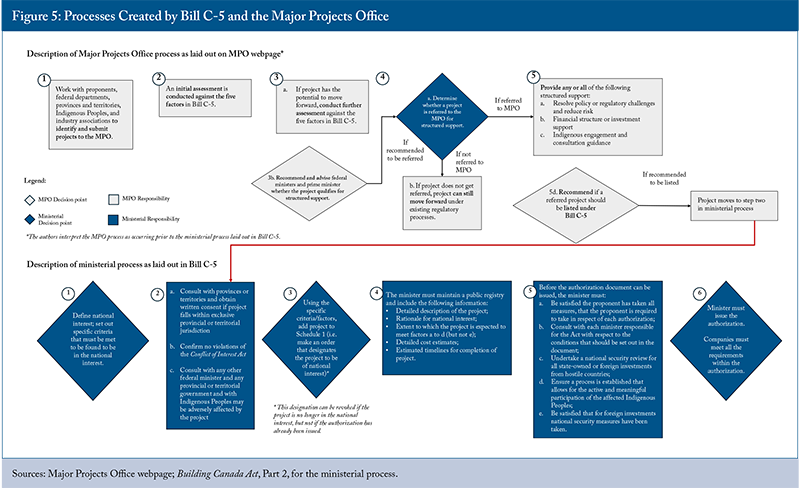
The second process in Figure 5 describes the activities of the MPO, as laid out on its webpage at the time of writing.1818 The authors acknowledge that the role of the MPO continues to evolve and that it may change in the future. Greater transparency on its role, the activities it undertakes, and its collaboration with government and regulators would be helpful. This process is not included in Bill C-5, the One Canadian Economy Act.1919 One Canadian Economy: An Act to Enact the Free Trade and Labour Mobility in Canada Act and the Building Canada Act, 1st Sess., 45th Parl., 2025. Based on our interpretation, this process occurs prior to the ministerial process described in Bill C-5, and once complete, begins the ministerial process at step two.
As described on the MPO website, the MPO process includes multiple assessment points using the criteria set out in Bill C-52020 See section in this paper, “The BCA: Lack of Clarity in Defining National Interest.” (steps two and three) before the MPO recommends to ministers and the prime minister whether a project qualifies for tailored support, at which time the minister formally determines whether a project is referred to the MPO. Furthermore, as can be seen in step five of the MPO process, recommending listing under Bill C-5 is one of four structured supports that can be provided to a proponent’s project. A project can be referred to the MPO and never be recommended for listing. If the MPO recommends listing under the BCA, the project moves to step two of the ministerial process, which includes consultation with provinces and territories if the project falls exclusively within their jurisdiction, confirming no conflicts of interest, and consultation with Indigenous Peoples.
The details laid out in Figure 5 raise several implementation questions regarding how the new processes will interact with existing regulatory processes and whether they will achieve their intended objectives. We posit that they also do not remove two critical sources of unpredictability and delay in Canada’s regulatory system: political decision-making and the use of regulatory approvals to respond to broad policy objectives.
Why Canada’s Project Approval Process Is Uncertain
Studies of the Canadian regulatory system have identified two root causes of uncertainty in the Canadian regulatory process: the political nature of pipeline approvals and the incorporation of open-ended policy issues in the approval process.
Political Decision-Making in Project Approvals
According to the Business Council of Alberta (2023), Canada’s review and permitting processes are obstacles to attracting investment. The Council based this position on information from project proponents with experience in navigating regulatory processes. It found that “project proponents can spend years and considerable internal resources trying to clear regulatory hurdles without a line of sight to beginning construction,” and “companies are putting all that time and effort into a process that’s subject to a political decision at the end.”
The report emphasized the problems and solutions to political decision-making in regulatory processes. It suggested Canada’s regulatory processes should be free from politics and the whims of the federal government at the time when a regulatory decision is made and should be evidence-based and expert-driven. The Council’s latest report (2026) recommends moving the political approval to the beginning of the regulatory review process; however, political risk remains.
The Canadian Climate Institute has expressed the same view. Their research, focusing on the need to build infrastructure necessary for clean growth projects, similarly emphasized the need to remove governments from regulatory decision-making.2121 Canadian Climate Institute. 2023. “Need for (regulatory) speed.” May. https://climateinstitute.ca/need-for-regulatory-speed/. Likewise, in a C.D. Howe Institute report analyzing Bill C-69, which created the Impact Assessment Agency and replaced the National Energy Board with the CER, the authors argued the proposal should not eliminate the role for an ultimate cabinet decision on a project, but rather the approval process should require a “significant” threshold or standard for a project’s effects before involving political decision-makers (Bishop and Sprague 2019). It also argued political decision-making should not diminish the role for independent regulatory review to ensure decisions were objective and evidence based.
These concerns are not just theoretical. Both the Northern Gateway Project and the Energy East projects were ultimately disallowed, not because of regulatory decisions, but because the government withdrew its political support.2222 There are often conflicting versions of why decisions to abandon pipeline projects are made. The Energy East Project demonstrates this complexity. It was originally supported by a coalition of governments in Quebec, New Brunswick, Canada, Alberta, and British Columbia. When that coalition fell apart, Canada claimed it was a business decision, and others blamed the political changes in the provinces: See: Poitras, Jacques. 2018. Pipe Dreams. Penguin Random House Canada. Especially “Prologue: Suspended” pp. 1-11. Although the Trans Mountain Pipeline Expansion project was not cancelled, the political dispute between Canada, Alberta, and British Columbia killed its economic viability as a private sector investment, and it could only be completed after it was nationalized. The former private proponent of Trans Mountain noted the difficulties in building a pipeline through jurisdictions whose governments did not see eye to eye (Poitras 2018).
Clearly, transferring decision-making to independent regulatory agencies is necessary to demonstrate that a state is committed to achieving the policy credibility needed to attract long-term investment. Baldwin, Cave, and Lodge (2012) agree that private investment, especially in those industries characterized by a high degree of asset specificity, requires legislative consistency without fear of discretionary regulatory action outside the boundaries of legitimate expectations.2323 See also: Gatsios and Seabright, “Regulation in the European Community,” Oxford Review of Economic Policy (1989), p. 46; and Giandomenico Majone, “The Regulatory State and Its Legitimacy Problems,” West European Politics (1999); and Fabrizio Gilardi, chapter 4 in The Politics of Regulation.
This is clearly the case here. Under the current system, Canadian regulatory approvals do not provide a credible commitment to infrastructure policy because the government – and any future government – retains the right to change its position. Related to the issue of political decision-making is the practice of requiring regulators to engage in open-ended policy considerations in regulatory proceedings.
Open-Ended and Policy-Based Criteria in Project Approvals
Under the CER Act, the CER, through its Commission, makes a recommendation to cabinet on whether to approve a pipeline. To do this, the CER’s Commission conducts a hearing that involves public participation and the right to challenge evidence in writing or through live cross-examination. Under s. 183 of the CER Act, the Commission is required to consider an application for a certificate considering many factors (Box 2).
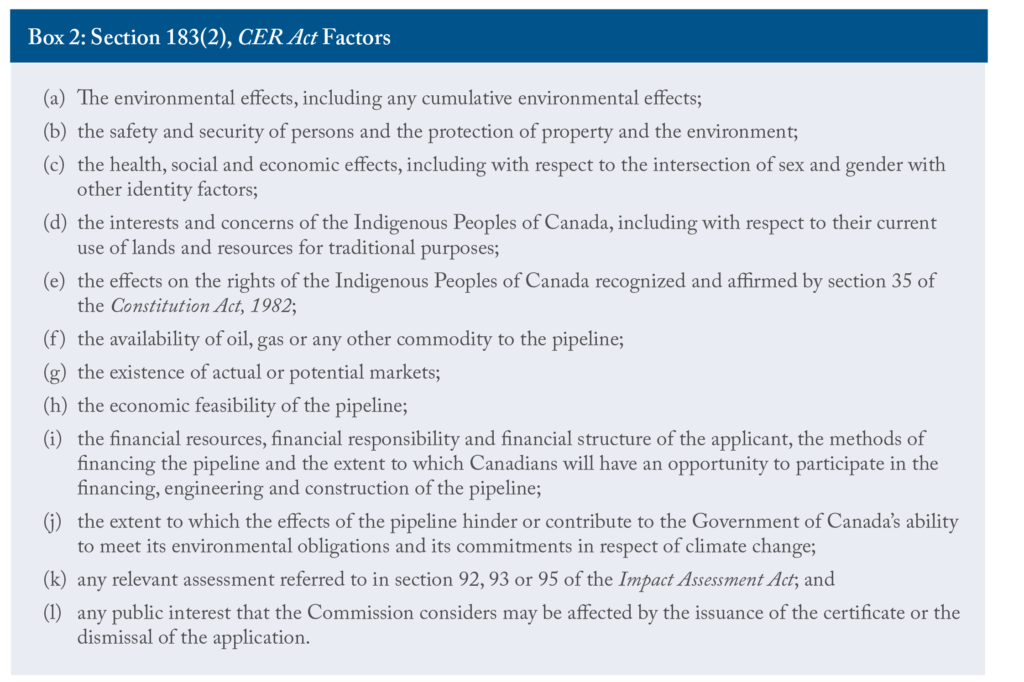
The hearing culminates in a written report by the CER’s Commission (an adjudicative body) to the federal cabinet with a recommendation whether cabinet should order the CER to grant a certificate and on what conditions (there are often dozens and in some cases over 100). Cabinet may order the CER to issue a certificate or dismiss the application, or to reconsider its decision.
This broad list of factors is concerning. These factors, including those related to gender and sex (c), supporting the achievement of the government’s climate policy objectives (j), and any public interest (l), create the opportunity for debates on public policy that should be determined in other forums.2424 Canadian Association of Petroleum Producers. 2019. “The federal government is damaging Canada’s economic future with Bill C-69.” PR Newswire by Cision. June 12. https://www.newswire.ca/news-releases/the-federal-government-is-damaging-canada-s-economic-future-with-bill-c-69-capp-835068426.html.
These issues can then be addressed through fixed standards and treated as a compliance matter. For example, if there are emissions limits that pipelines must comply with, those can be set by standards authorities and applied by regulators. If there are gender and sex considerations, those can also be addressed through specific expectations that must be met. The point is that they do not need to be debated in regulatory forums.
Interestingly, the suggestion that broader policy questions should be considered by regulators was rejected by the panel of experts who recommended the creation of the IAA and the replacement of the NEB with the CER (Lauzon et al. 2017). The experts’ report suggests major project approvals are compromised by the inclusion of national policy questions into regulatory hearings, and this inclusion necessarily means Canadians are not involved in or privy to these debates, nor is the CER commission accountable to all Canadians (Lauzon et al.).
The Impact Assessment Act also incorporates these policy considerations in its list of factors to be considered by the Impact Assessment Agency. Section 22(1) of the Act has a list of factors to be considered in approving a project, including, but not limited to:
(h) the extent to which the designated project contributes to sustainability;
(i) the extent to which the effects of the designated project hinder or contribute to the Government of Canada’s ability to meet its environmental obligations and its commitments in respect of climate change; and
(s) the intersection of sex and gender with other identity factors.
These provisions have also been subject to similar criticisms. Bishop and Sprague (2019), referring to the mandates of the IAA (and equally applicable to the CER), stated that including such factors invites broad policy concerns into the review process, significantly prolonging the assessment process and exacerbating uncertainty for project approvals.
This reflects a broader concern about how the mandates of regulatory agencies have become weighed down by requiring them to consider a wide range of factors that have little bearing on the direct impacts of the projects themselves or the expertise of the regulator. When one project is expected to address many policy objectives, this can create delays and set it up to fail.
These broad policy considerations are related to the issue of political approvals. Rather than ask regulators to hear and wade into policy debates, the solution is to remove these considerations from the approval process so the regulator focuses on key issues that relate to their mandate and the direct risks relating to a project, such as safety, environmental protection, and consultation with Indigenous Peoples. These broader policy issues should be left to governments.
Ultimately, the Canadian regulatory system creates significant unpredictability, namely due to the role of governments in making regulatory decisions as opposed to providing clear policy direction and the open-ended, policy-laden nature of many of the criteria for approving projects.
By laying out the BCA and MPO processes in the context of the sources of uncertainty and delays in Canada’s regulatory system, specific issues become evident:
- the centralization of executive power (including the reliance on executive federalism);
- lack of clarity of national interest definition (and the concomitant grant of discretion);
- unclear consequences and impact of listing;
- misalignment with existing regulatory approval processes; and
- the lack of additionality2525 Here the authors define additionality as the ability for the Major Projects Office to provide net new services or value to proponents within Canada’s regulatory approval system. of the Major Projects Office.
There has been some speculation around the longevity of the BCA and its viability as a temporary measure to spur private investment in the hopes the listing process is no longer necessary in the future. While it is true that the power to designate “national interest” projects (NIPs) expires five years after the BCA came into force (i.e., until June 26, 2030), it should be noted that the legislation itself remains in place after that and the listing process continues to be in effect.
Further, the status quo of requiring political approval of a project that has already been approved through a regulatory process is not impacted by the expiration of the BCA’s listing power. If nothing else changes, once the listing power expires, the approval regime will revert to the existing, flawed process. There is no indication of any plan to remove political decision-making from the project approval process.
The BCA: Centralizing Executive Power
The BCA incorporates and uses two main components of executive power in Canada. First, the workings of cabinet government in Canada, which is marked by discretion and concentration of power exercised by the Prime Minister’s Office (PMO) and the Privy Council Office (PCO), and second, the workings of executive federalism.
This growing power of cabinet is another example of centralization of power in Canada through the offices of the PMO and PCO, which is long recognized as a problem. As this power is practically unconstrained in the BCA, it amounts to a significant centralization of discretionary power.
An expert survey ranked the Canadian prime minister as the most powerful executive office among Parliamentary democracies (Loat and MacMillan 2014). Though many authors have focused on how this weakens the role of cabinet and Parliament,2626 See Simpson, Jeffrey. 2001. The Friendly Dictatorship. McClelland & Stewart; Coyne, Andrew. 2026. The Crisis of Canadian Democracy. Sutherland House; and Savoie, Donald. 1999. Governing from the Centre: The Concentration of Power in Canadian Politics. University of Toronto Press. the issue here goes beyond the internal governance of decision-making and extends to the effectiveness of unconstrained discretionary power in contrast with transparent and fact-based regulatory processes.
Flyvbjerg and Gardner (2023), too, addressed the challenges with centralized political decision-making and how it tends to reinforce prior assumptions and excludes critical decision-making by choosing to use knowledge when serving its power and suppressing knowledge when it does not. In a book analyzing the risks associated with global megaprojects, Flyvbjerg, Bruzelius, and Rothengatter recommend that an explicitly formulated regulatory regime is necessary to achieve effective project development results (Davies 2005). This is what is missing in the BCA process.
Holburn (2018) analyzed the impacts of replacing regulatory oversight on electricity projects in Canada with the executive powers of governments and concluded the absence of regulatory review adversely impacts megaproject decisions, as was particularly the case of Muskrat Falls. Other electricity projects like the Maritime Link, Darlington nuclear refurbishment, and Western Alberta Transmission Line had sufficient regulatory oversight that resulted in improved project management by the developer (Holburn 2018). This evidence suggests that the combination of centralized power in the PMO and lack of regulatory oversight creates a higher risk of ultimately less effective decision-making.
This is especially the case where the choice of which project is to be ordered a “national project” carries with it costs – such as financing or constrained approvals capacity. This involves an allocation of scarce resources. It is important to have meaningful criteria when choosing from among them (Goulding 2026; Jones and Fariha 2026).
Related to the challenges of centralized unconstrained decision-making is the challenge of executive federalism, which has clearly informed the government’s early determinations of which projects should be assigned to the MPO. These two issues are related, especially in how they facilitate political decisions over fact-based decisions.
One challenge of executive federalism is the “joint decision trap.” The joint decision trap was first described in the context of the European Union and applies in Canada as well, when interdependent actors committed to consensus decision-making seek to make decisions. In the process of decision-making, the time and cost of coordination and consensus escalate, or sub-optimal solutions are pushed forward, as political concerns of each party dominate over the substantive issues being debated (Cameron and Simeon 2002).
The prime minister sometimes refers to the various agreements made with the premiers as cooperative federalism.2727 See, for example: Prime Minister of Canada. 2026. “Canada and Alberta Advance West Coast Pipeline Project Proposal and Pathways Project Carbon Capture Initiative – to Build a Stronger, More Resilient Canadian Economy.” July 2. https://www.pm.gc.ca/en/news/news-releases/2026/07/02/canada-and-alberta-advance-west-coast-pipeline-project-proposal-and. We argue the current federal government’s approach better resembles executive federalism.
Cooperative federalism allows the overlap of federal and provincial legislative authority. This contrasts with traditional notions that the division of powers requires jurisdictions to operate in watertight compartments. Through cooperative federalism, courts enable Parliament and provincial legislatures to empower agencies to effectively share jurisdiction.
The Supreme Court of Canada, in a decision related to Canadian securities, wrote that cooperative federalism allows different levels of government to cooperate to establish a regulatory regime to solve areas of joint concern.2828 Reference re Pan-Canadian Securities Regulation 2018 SCC 48, paragraph 19. In the regulatory approval context, examples of cooperative federalism are found in legislation enabling regulation of offshore energy facilities by combined federal and provincial agencies, such as the offshore energy regulators in Nova Scotia and Newfoundland, and in the “one project, one review” approach in environmental impact assessments.
This concept is distinct from executive federalism. Executive federalism addresses how executive powers are used by federal and provincial governments to negotiate bilateral arrangements outside of the legislative process. As noted, the concern with executive federalism is that policies are made through political deal-making among the prime minister and premiers through the centralization of executive power outside the oversight of the legislative branch and away from the expertise of regulatory oversight.
Executive federalism has been expressly incorporated into the BCA and the federal practice of identifying national projects (see Figure 5). None of the concerns about political decision-making have been rectified by the BCA. Instead, the BCA expands the role for cabinet, and thus political decision-making.
The BCA provides that before designating a project, the cabinet must consult with the provincial government of the province or territory where the project is carried out and obtain its consent if the project falls within exclusive provincial jurisdiction.
It has also been a key operating principle in the determination of NIPs. Following the initial First Ministers’ meeting that addressed national interest projects, Ontario Premier Doug Ford highlighted that the federal government would review proposed projects and determine which would ultimately receive listing, highlighting the discretionary role of executive decision-making in the process.2929 Groen, Danielle. 2025. “Morning Update: Canada’s not-quite-so-fast track.” The Globe and Mail. June 3. https://www.theglobeandmail.com/canada/article-morning-update-canadas-not-quite-so-fast-track/
Similarly, in response to concerns raised by Premier David Eby of British Columbia, whose province was not party to the federal government’s memorandum of understanding with Alberta concerning a west coast oil pipeline, the federal government continued to treat the issue as one that should be addressed through political bargaining. Both the minister of energy and natural resources and the prime minister have noted most projects referred to the MPO are in British Columbia and suggested that if British Columbia does not support the west coast oil pipeline, the federal government may look elsewhere for future projects.3030 Blanchfield, Mike. 2025. “Pipeline deal is not a ‘baked cake’, Canada’s energy minister says.” Politico. November 18. https://www.politico.com/news/2025/11/28/carney-energy-minister-00670687. Winter, Jesse. 2026. “Carney cautions B.C. not to drag out pipeline debate.” The Globe and Mail. May 20. https://www.theglobeandmail.com/canada/article-carney-cautions-bc-not-to-stall-on-pipeline/. Indeed, British Columbia and the federal government have since entered into a similar memorandum of understanding related to major projects supported by the federal government.3131 Prime Minister of Canada. 2026. “Canada and British Columbia strike new cooperative prosperity partnership to build a stronger, more sustainable economy.” July 2. https://www.pm.gc.ca/en/news/news-releases/2026/07/02/canada-and-british-columbia-strike-new-cooperative-prosperity.
True, the government commitment to a project in the BCA is made at the beginning, not the end of the process, but projects can be added and subtracted from the list through continual decision-making. This is especially acute in the context of a long-term commitment to a significant capital investment like a pipeline. Given election cycles, any decision will have to endure at least two, and more likely three, governments. It is true that, because of parliamentary supremacy, a future parliament can always change legislation and overturn a regulatory decision. But the politicization under the BCA is particularly acute. The problem with a NIP listing is that it is an explicitly political act, achieved after lobbying by proponents and their provincial government supporters. By associating a decision with a particular government and prime minister, there is a real risk that the project becomes even more politicized, with an invitation for a future political party to campaign against a project. In other words, a NIP listing is an invitation to become the focus of political debate.
A simple way to mitigate this issue is to grant regulatory agencies final decision-making authority so that the ultimate approval of a project is determined by the fact-based decision-making of an expert regulator. Although political decision-making has been part of the pipeline regulatory approval process since the creation of the National Energy Board in the 1950s, these are extraordinary times that call for more fundamental reforms of the Canadian regulatory system.
Requiring the CER to make final approval decisions respecting facilities would mirror its ability to make final decisions respecting tariffs and tolls and operational safety. This is not to suggest that government policy has no role in regulatory processes. A key goal of a regulator is to implement government policy. So, it is perfectly appropriate for government to provide policy direction and for the regulator to implement it.
The government has the authority to provide policy direction to the IAA and the CER. With respect to the CER, cabinet may pass binding policy orders that “give to the Regulator directions of general application on broad policy matters with respect to the Regulator’s mandate.”3232 Canadian Energy Regulator Act, s 13(1), S.C. 2019, c. 28, s. 10.
The federal government has not used this authority. But it could be an important mechanism to address policy accountability without turning every regulatory decision into a political one.
Janisch (1996) has commented on how this type of directive power could be combined with regulatory independence and ministerial accountability. This approach could “maintain the integrity and worth of regulatory agencies, but not at the expense of ultimate political accountability.” This type of instrument has been used by the United Kingdom to provide policy and strategic directions to its energy agencies.3333 Department for Energy Security & Net Zero. 2026. “Strategy and Policy Statement for Energy Policy in Great Britain.” January 6. https://www.gov.uk/government/publications/overarching-national-policy-statement-for-energy-en-1-2025/overarching-national-policy-statement-for-energy-en-1-2025-accessible-webpage#assessment-principles.
The BCA: Lack of Clarity in Defining National Interest
The central feature of the BCA is the concept of a “national interest” project. As discussed, the BCA provides that the cabinet may order that a project be defined as such.3434 Building Canada Act, Part 2, s 5(1), An Act to enact the Free Trade and Labour Mobility in Canada Act and the Building Canada Act. Despite the centrality of the concept of a national interest project, the term is not defined in the Act, other than in section 2, with the notion that a national interest project is a project that is ordered by cabinet to be a national interest project.
The power to designate a project as in the national interest is almost entirely unconstrained. The BCA provides that, in making an order that a project is in the national interest, cabinet may “consider any factor that [it] considers relevant, including the extent to which the project can”:
- strengthen Canada’s autonomy, resilience, and security;
- provide economic or other benefits to Canada;
- have a high likelihood of successful execution;
- advance the interests of Indigenous Peoples; and
- contribute to clean growth and to meeting Canada’s objectives with respect to climate change.
These factors are not binding; they are a non-exhaustive list of some factors that may be considered. Further, it is hard to imagine any project that would not meet one of these criteria, and it is unlikely that any project that cabinet supported would fail to qualify. True, projects that meet the description could include projects that diversify export markets, but it could also include projects that increase oil exports to the United States, as outlined in Jones and Fariha (2026).
In the absence of detailed criteria, the ability to order any project to be in the “national interest” is highly discretionary. The Act permits, but does not require, cabinet to define the “national interest” as it relates to projects. If cabinet does provide such a definition, it is also required to “set out specific criteria that must be met by the proponent of a project in order for a project to be found in the national interest” (s. 2). This could be interpreted as the criteria are project- and proponent-specific, or alternatively the criteria must apply to all projects deemed to be in the national interest. In other words, the concept of national interest does not provide a set of criteria that is applied against projects on a going-forward basis to determine if the project complies. Rather, it is a set of conditions that will apply after the project has been identified.
The Act does purport to impose some consequence for the failure to define the national interest. However, that has already proved to be ineffectual. The BCA provides that, if cabinet does not provide a definition of national interest, it must table a report to Parliament “that sets out the reasons for the delay and expected timeline for the making of the order” (s. 4[3]). However, the first example of this exercise does not provide much comfort that any consequences will arise or that a definition of national interest will be provided.
A 2025 government report stated that no order defining “national interest” had been made, and the Privy Council Office later stated this requirement was “discretionary.”3535 Murray, Nick. 2025. “What is ‘national interest’? Major projects law still hasn’t defined it.” The Canadian Press. October 20. https://globalnews.ca/news/11486302/major-projects-law-national-interest-definition/. As it stands, there is no indication the government will define “national interest” more specifically than the five criteria set out within the BCA.
The BCA: Unclear Effects of National-Interest Listing
The next issue relates to the consequences of designating a NIP. The ostensible purpose of the BCA is to streamline and simplify the decision-making process for the approval of national projects. In fact, it makes it more cumbersome and complicated.
Under current legislation (the CER Act and the IAA), the federal cabinet has the decision-making authority over federal projects. For example, under the current CER Act, a proponent is required to apply to the CER for a certificate to build and operate a pipeline (CER Act, s. 180). The Commission of the CER then holds a hearing to determine whether a project meets its statutory criteria (described above) and recommends whether the project should be approved, i.e., whether a certificate should be granted and, if so, under what conditions (CER Act, s. 183). The cabinet then determines whether to accept or reject the recommendation (CER Act, s. 186[1]). The Commission is then required to implement cabinet’s determination, for example, by granting the certificate.
There are two key differences to this process under the BCA. The first difference is that the BCA creates the office of the “minister” (hereinafter the “BCA Minister”). The BCA Minister is responsible for implementing various portions of the BCA (see Figure 5). The BCA Minister is to be distinguished from the minister that is responsible under current legislation for regulatory approvals (the “Enactment Legislation” and the “Enactment Minister,” respectively). Under the BCA, the Enactment Legislation is the CER Act and the IAA Act; and the Enactment Minister in the case of the CER is the minister of energy and natural resources (NRCan), and in the case of the IAA, the minister of environment, climate change, and nature (ECCN).
The second major difference is that, under the BCA, the cabinet may, on the recommendation of the BCA Minister, determine that a project is in the “national interest” (the lack of specific criteria for this determination notwithstanding). If so, the project is added to Schedule 1 of the Act. The consequence of this listing is that the determinations, findings, and opinions made for the NIP are made in favour of the project moving ahead.3636 Building Canada Act, Part 2, s 6(1), An Act to enact the Free Trade and Labour Mobility in Canada Act and the Building Canada Act.
After a project is designated to be a NIP, the BCA Minister is required to issue an authorization to the proponent that includes conditions identified by Enactment Ministers through their Enactment Legislation. Before issuing the authorization, the BCA Minister must ensure:
(a) the proponent has provided necessary regulatory information and made payments (i.e., application fees that would otherwise apply under Enactment Legislation), as required;
(b) consultation with all ministers responsible for authorizations;
(b.1) a national security review for all state-owned or foreign investments from hostile countries in any national interest project;
(c) consultations with Indigenous Peoples who may be adversely affected by the project; and
(d) assessment of any foreign investments to protect national security interests.
Cabinet remains the decision-maker. However, for a designated project under the BCA, it bases this approval on the decision of the BCA Minister, not the recommendation of the CER Commission.
The third major effect of the BCA is that cabinet may, on the recommendation of the Enactment Minister, make regulations that exempt or vary the application of an existing provision of the Enactment Legislation.3737 Building Canada Act, Part 2, s 22, An Act to enact the Free Trade and Labour Mobility in Canada Act and the Building Canada Act. No such regulations have yet been passed. In the absence of regulations, the role of the regulators, and their statutory factors, is unclear. The interaction between the listing process and the existing regulatory process is addressed below.
The BCA: Misalignment with Existing Regulatory Approval Processes
While the stated purpose of the BCA is to streamline multiple decision points for federally regulated projects and to minimize uncertainty for proponents, there are still several areas that remain unclear.
The main reason for the lack of clarity is that the BCA is quite limited in how it impacts the regulatory approval process. It specifically provides that the consequence of listing is to deem that findings and opinions are made in favour of a project for the purposes of an “authorization.” An authorization is a defined term and it applies differently in different legislation. In the CER Act, an authorization is specifically limited to authorizations granted under ss. 186(1) and 262(1) of that Act. These sections authorize the Governor in Council to order the CER to issue a certificate to a pipeline or electricity transmission company to build the facility. The result is that, upon the listing of a national interest project, cabinet is deemed to approve its construction. However, the BCA does not otherwise exempt a proponent from bringing an application to the CER for approval or direct the CER to depart from how it proceeds with an application. Combining this new deeming provision with the existing regulatory review process raises a number of questions on how these interact.
First, what is the role of the CER and the Impact Assessment Agency where a project has been designated as a national interest project? It appears that the BCA does not replace existing regulatory requirements. As noted above, the BCA states that listing does not exempt a proponent from taking all measures required to receive a regulatory authorization, and the BCA Minister must be satisfied that all measures have been taken to achieve that authorization. This would suggest the process starts with the BCA Minister’s determination of whether to approve the project. The CER would then provide advice as to the necessary conditions based on a technical review of the project within the Enactment Legislation.
But this raises several questions. If the CER does make recommendations, what are those recommendations based on? Are they based on the existing statutory criteria, or on new, restricted criteria provided by regulations made under section 22 of the BCA? How does the CER make that determination? Does the Commission hold a hearing as it would under existing legislation? If the government has already approved the project, what is the point of the regulator’s hearing and recommendation on a decision that has already been made?
This idea has been previously examined by a 1977 Law Reform Commission of Canada report which characterized this practice as a “joint Cabinet-NEB policy making process” under which cabinet provided the prior approval of a project and “the NEB was there to merely facilitate the approval about the engineering, financial and environmental background.” 3838 See: Savage, Sonya. 2016. “Bill C-38 and the Evolution of the National Energy Board: The Changing Role of the National Energy Board from 1959 to 2015.” Occasional Paper 52. Canadian Institute of Resources Law, p. 16. Citing Lucase and Bell. 1977. The National Energy Board: Policy, Procedure and Practice. Ottawa: Law Reform Commission of Canada, at p. 5.
This conclusion was aligned with a 1974 submission by a pipeline applicant’s counsel who stated that, “The national interest, having been established,” the NEB’s role was to evaluate evidence “directed primarily to matters of design, location, proposed methods of construction and economic feasibility.”3939 Ibid.
Sonya Savage, a former pipeline executive and Alberta Minister of Energy, writing in 2016, stated that, “by today’s standards, [that submission would] be an outrage.”4040 Ibid. Similarly, a former National Energy Board member stated that “this has clearly not been the case”: cabinet did not have that authority, and there was “no working relationship” between it and the NEB, as it would interfere with the NEB’s regulatory independence (Harrison 2013).4141 Harrison, Rowland. 2013. “The Elusive Goal of Regulatory Independence and the National Energy Board: Is Regulatory Independence Achievable? What Does Regulatory ‘Independence’ Mean? Should We Pursue It?” Alberta Law Review 50(4): 757–795. It is not clear whether the BCA seeks to establish such a working relationship between the PMO and the CER.
Further, most regulatory recommendations are not simple yes-or-no decisions; they include conditions for approval, often dozens of them. One might assume these conditions become part of the authorization issued by the BCA Minister, validated by all relevant Enactment Ministers.
On the other hand, the BCA also suggests that existing regulatory processes will not apply and, instead, the BCA Minister will make their determinations based on a different set of factors than those listed in the CER Act. For example, section 17 of the BCA provides that the BCA Minister must receive confirmation from the CER Commission “that it is satisfied that issuing the document [authorizing the project] will not compromise the security of persons or regulated facilities.” This is only a subset of one of the 12 factors listed in s. 183 of the CER Act. It is worth looking at the differences between the two provisions in detail because it illustrates both the general uncertainty of how they are to work together and substantive issues of how safety and environmental protection will be considered for NIPs. The different criteria are set out below (Table 3).
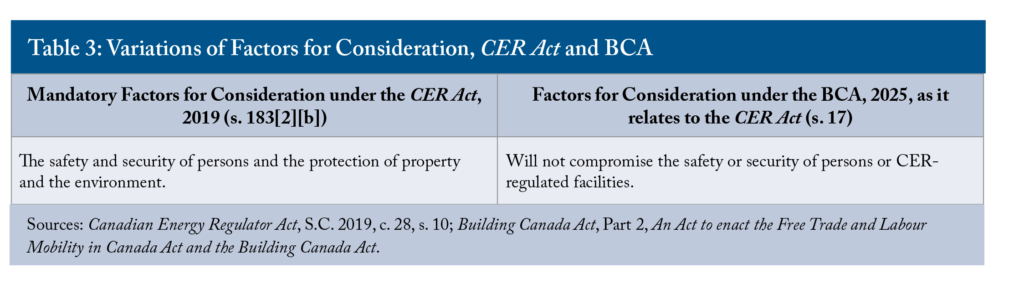
These factors vary in two important ways. First, the CER Act refers to the “protection of property and the environment.” The BCA only covers “safety and security of regulated facilities.” This excludes security of property other than regulated pipeline facilities; in other words, private sector land and facilities owned by persons other than pipeline companies are not included.
Second, the BCA factors do not explicitly include environmental protection. Beyond the factors identified in Figure 5, the BCA requires the minister to maintain a public registry including a variety of information (see step four in Figure 5) but omits the “national interest” criteria related to “clean growth and to meeting Canada’s objectives with respect to climate change” (section 6). Does this mean that impacts on air, water, and wildlife (through things such as accident risk and spill prevention measures) will not be considered? The preamble of the BCA states that the “Government of Canada is committed to upholding rigorous standards with respect to environmental protection” while section 4 refers to advancing projects of national interest in a way that protects the environment. Further, in announcing the enactment of the BCA, the government stated that it will be “protecting the environment.” It is not clear how this will be addressed without consideration or mitigation of environmental harm when evaluating pipeline projects.
The question remains – which factors are to be used to authorize a NIP? Critics who argued that the broad policy criteria in s. 183 of the CER are not the proper considerations of a regulatory proceeding did not propose overlooking the impact on the protection of property or the environment. It is hard to believe that Canadians would want this outcome. This would suggest that the narrow criteria should not fully replace all the existing statutory factors the CER is supposed to consider.
On the other hand, if the BCA does not replace the CER Act criteria, then presumably both criteria apply. This expands the review process; it does not streamline it.
A procedural but important issue is how the CER Commission confirms to the minister that issuing the certificate will not compromise the security of persons or regulated facilities. The Commission has an independent adjudicative function that is statutorily protected and with a mandate to make “transparent decisions, orders and recommendations” with respect to pipelines (s. 11[a]). This requires it to make its recommendations based on evidence received through a hearing. Again, that expands the review process by adding more issues to a hearing; it does not streamline it.
Several factors considered in a hearing under s. 183 to make a recommendation have distinctly Indigenous considerations, including any Indigenous knowledge that has been provided to the Commission; the interests and concerns of Indigenous Peoples, including with respect to their current use of lands and resources for traditional purposes; and the effects on the rights of Indigenous Peoples recognized and affirmed by section 35 of the Constitution Act, 1982. Prior to listing, the BCA requires Indigenous Peoples affected by the project to be consulted, and before an authorization is issued, a process must be established that allows for the active and meaningful participation of affected Indigenous Peoples.
In this regard, it is worth recognizing that the process set out within the BCA includes multiple points requiring Indigenous consultation and participation.4242 See Building Canada Act, Part 2 sections 5(6)(d), 6.1(7), 6(2), 7(2)(c), 7.2.1, 8(3)(b), and 24(3). This adds potential complications, time, and risk because, as identified in the Northern Gateway and Trans Mountain examples, every government decision that may adversely affect Indigenous rights or interests must be subject to appropriate consultation. Each decision point in the BCA thus creates another occasion on which a failure by the government to adequately consult with Indigenous Peoples could delay or prevent a project from proceeding.
So there remains considerable uncertainty over how the BCA approval process will work with existing regulatory approval processes and whether the BCA replaces or adds to the existing processes. This is not unusual. As Fiona Haines (2011) noted, “Overall, and despite the stated intentions of governments to deregulate and simplify, more regulation, not less, seems to be the result.” In other words, attempting to circumvent current regulatory approval processes is more complicated and leads to greater uncertainty than simply removing the underlying problems.
The Major Projects Office: What is its Additionality?
Finally, the Building Canada Act establishes the Major Projects Office specifically to “coordinate the exercise of powers and the performance of duties and functions under this Act and the enactments with respect to projects that are in the national interest and to serve as a source of information and point of contact for the proponents of those projects.”4343 Building Canada Act, Part 2, s 20, An Act to enact the Free Trade and Labour Mobility in Canada Act and the Building Canada Act.
No projects have been added to Schedule 1 as NIPs at the time of writing, although five projects are currently under consideration for listing under the BCA, and the government has referred 18 projects to the MPO.4444 Major Project Office. 2026. “Projects referred to the MPO.” May 19. https://www.canada.ca/en/privy-council/major-projects-office/projects/national.html. As laid out in Figure 5, this referral occurs at step four of the MPO process, which means steps one through three, including two assessments against the criteria in Bill C-5, have already occurred. However, this is not the end of the road for these referred projects. The MPO may recommend that all, some, or none of them be designated as NIPs. Once designated as an NIP, a project must undergo the authorization process laid out in the Ministerial Process in Figure 5.
Step five in Figure 5 outlines the remaining structured support the MPO may provide, including coordinating regulatory processes and resolving policy challenges, financial structure and investment support, or Indigenous engagement and consultation guidance.
As already mentioned in this paper, all federal departments and agencies related to project reviews and approvals are working to codify the “one project, one review” approach and streamline their processes, while the IAA deems itself the point of contact for projects under its purview.
For a project to be referred to the MPO for structured support, the project must have been deemed to “advance the interests of Indigenous Peoples,” one of the five criteria in Bill C-5, and one would expect it is already partnering, engaging, and consulting with Indigenous Peoples.
Finally, related to financial structure and investment support, the BCA does not include the authority to structure financing for projects of national interest. While the BCA itself does not establish project financing authorities, the MPO’s inclusion of financial structure and investment support in its own process could suggest a role in helping proponents navigate available federal programs, financing mechanisms, and investment opportunities as its value-add in this process.
In sum, the additionality of the MPO is in question. The government recommends projects to the MPO (which is under the responsibility of the BCA Minister), and the BCA Minister may then recommend to cabinet that they be added to Schedule 1 and thus eligible for an order authorizing an approval by the BCA Minister and eligible for an exemption or variance from regulatory requirements by the Enactment Minister.
The long-standing challenges with Canada’s regulatory processes will not be resolved by adding an additional federal agency with limited additionality, nor through increased politicization and centralization of project decisions.
Getting Major Projects Built in Canada: The Discussion Paper
A federal discussion paper released on May 8, 2026, titled “Getting Major Projects Built in Canada – Discussion Paper on Proposed Legislative, Regulatory, and Policy Reforms” suggests the creation of a “simpler, more coordinated process in Canada, where federal decisions for major projects could be completed in shorter timelines” with the goal “to make it clear that major projects can be built efficiently in Canada while maintaining strong environmental protections and respecting the rights of Indigenous Peoples.”
The discussion paper contains positive proposed improvements to administration and processes we argue need to change, such as single project authority and making strides to streamline the existing regulatory environment. Yet, there are concerning aspects of the discussion paper that must be considered before enshrining these changes into legislation.
First, there is no mention of Bill C-5 nor the Major Projects Office within the discussion paper. As such, it is unclear how any newly proposed expedited process interacts with processes outlined in Bill C-5 and described by the Major Projects Office. While it may be the beginning of a more fulsome process, the paper does not seek to address the sources of regulatory uncertainty and delay explored in this research, nor does it address the challenges we find with Bill C-5 and the MPO. In fact, the discussion paper describes yet another process for yet another category of project. Furthermore, for projects not referred to the Major Projects Office, and not defined as a “major project” – more on that below – what improvements exist?
Second, the discussion paper refers to major projects as “mines, ports, airports, pipelines, nuclear facilities, and transportation infrastructure.” While it is not explicitly defined, it does not seem this process applies to referred or designated national interest projects. Natural Resources Canada’s definition used to track projects on their Major Energy and Natural Resources Project Inventory includes an investment dollar threshold and projects in the energy, mining, and forestry sectors. This would not include the airports or ports encompassed by the discussion paper. If none of the existing definitions apply, legislation must define why there needs to be yet another category of major projects receiving special treatment.
Third, the discussion paper proposes continuing to politicize the approval process, granting ministers authority to exempt, negate, or adjust legislative requirements or conditions for projects of national interest. This maintains the instability and unpredictability felt by project proponents if a switch in governing parties means shifting priorities.
Fourth, the Department of Justice’s own backgrounder 4545 Department of Justice Canada. 2021. “Backgrounder: United Nations Declaration on the Rights of Indigenous Peoples Act.” December 10. https://www.justice.gc.ca/eng/declaration/about-apropos.html. on the United Nations Declaration on the Rights of Indigenous Peoples Act is clear that free, prior, and informed consent (FPIC) describes processes that “occur sufficiently prior to a decision so that Indigenous rights and interests can be incorporated or addressed effectively as part of the decision-making process.” With pre-approval of projects and giving cabinet and ministers authority to adjust conditions, it is difficult to see how allowing early construction activities before an impact decision is made does not undermine the intent of FPIC.
Finally, assessment studies and authorizations achieve different objectives. Assessment studies identify potential adverse effects on the environment and communities’ safety and health. Authorizations, for specific Acts like the Fisheries Act, Species at Risk Act, or the Canadian Navigable Water Act, approve work plans and mitigations for specific effects.
Conducting these simultaneously may appear to reduce timelines; operationally, it is unclear how this can be executed. Authorizations need project specifics like routing, engineering details, and time of year for seasonal work activities that can only be confirmed once a project is planned and studies conducted. If modifications are required, authorizations will need to be re-authorized. These details cannot be known while an assessment study is being undertaken – or alternatively, will require proponents to bring detailed project plans to the regulator, which will take upfront costs and time to develop.
The proposed reforms do not yet have enough substance and detail for a full assessment; however, they raise further concerns rather than address those outlined in this paper.
Once and For All: Reforming Major Project Approvals
It is encouraging to see the need for expediency and efficiency in Canada’s regulatory processes finally taken seriously. However, we argue Bill C-5, the MPO, and the recently released discussion paper have not addressed Canada’s fundamental regulatory challenges, specifically related to interprovincial pipelines.
Creating a new federal agency and two new processes through which to assess a selected group of projects does not comprehensively transform the country’s regulatory system. To meet this critical moment and ensure a stable and efficient regulatory system for decades to come, Canada needs a process that gives pipeline developers and investors the confidence to build at scale. We envision a process in which expert regulators assess and approve pipeline proposals based on clear criteria focused on the potential direct effects of each project.
Remove Political Decision-Making from Project Approvals
Politicization of Canada’s regulatory processes slows the process and creates uncertainty about final outcomes. Project developers across sectors are reluctant to invest in projects where, following an expert review, the final decision is left to politicians.
It is true that changing this approach as proposed here is a significant departure from the status quo, but the status quo does not work, and there is an opportunity to change it. Significant changes are necessary if one can realistically expect a revised process to lead to different results over the long term. From a development perspective, if a project meets substantive legislative requirements, it is unclear why the project should also require political approval to move forward.
It is misguided to believe that infrastructure projects are inherently political and therefore require political endorsement. For example, projects under provincial regulatory approval do not require sign-off from provincial premiers. Similarly, in the US system, presidential approval is only required for projects that cross the US border. Other projects are approved based on legislative requirements.
In other words, the executive is not inherently required to endorse otherwise compliant projects. After all, the political attractiveness of projects changes over time. The current regime may see a project as solving a political problem. A future regime may see it differently. It is not unusual for new governments to revise previous governments’ executive directions.4646 The consumer carbon tax, part of the GGPPA, was repealed by the prime minister on April 1, 2025. The Impact Assessment Act (2019) replaced the Canadian Environmental Assessment Act (2012), and the Canadian Navigable Waters Act (2019) replaced the Canadian Navigation Protection Act (2012). Bills C-377 and C-525 passed in 2014 and 2015 – updates to the Income Tax Act – were negated by the passing of Bill C-4 in 2017. Political popularity is a slender reed on which to base long-term, expensive, and impactful investments.
Finally, Parliament has the authority to pass legislation overturning a regulatory decision. Parliament will remain supreme. The issue here is whether the government should be routinely given the option to overturn a regulatory decision. We argue that it should not.
Update Legislation with Clearly Defined Assessment Criteria
The problems of timeliness and political decision-making in the current process are interrelated. The timeliness concern relates to the effort required to have policy concerns addressed in a hearing. It takes time to prepare, defend, and respond to evidence on, for example, demonstrating how a project contributes to meeting climate objectives. These are complex issues projects cannot achieve on their own, and furthermore, legislation already exists under which proponents must comply. These broad factors also open hearings up to lengthy debates on these policy issues.
The goal is to remove these debates from the hearing process to both make the hearing process more focused and to move these broader issues into generic policy considerations applied evenly across the economy, not in project-specific reviews. For example, addressing greenhouse gas emissions requirements for pipelines should be set in government regulations and/or standards applied to all projects rather than debated for each proposal individually in a regulatory proceeding.
Enforce Statutory Timelines for All Parties
While Canadian Impact Assessment Registry data suggest progress is being made to shorten timelines through early decisions by the Impact Assessment Agency, and several types of project assessments take on average less than two years to complete, more work remains to reduce timelines across all types of projects, especially to achieve the now-proposed one-year review timelines.
We propose enforcing statutory time limits for government agencies and departments, proponents, and intervenors by removing time-limit extensions unless proponents can show a need for an extension due to unforeseeable circumstances. Requiring regulators to deny time-limit extension requests, unless warranted, removes the opportunity for any party to leverage them to elongate timelines.
Enforcing statutory time limits will incentivize all parties to submit complete and adequate documentation while encouraging agencies and departments to respond more quickly to proponent submissions, whether approving or rejecting them.
Conclusion
The need to improve Canada’s regulatory system to bring projects on more quickly is well known. There is clarity on the main challenges for moving forward: decision-making on projects has become politicized, and regulators are assessing projects using open-ended regulatory criteria.
The BCA was enacted to have projects built more effectively but does not address any of the underlying concerns examined herein. Instead, it adds to the uncertainty by creating a complex new regulatory framework, reinforcing political decision-making, centralizing power, and complicating an already complicated regulatory process.
If Canada is to “build at a scale not seen in generations,”4747 Prime Minister of Canada. 2026. “Canada and British Columbia strike new cooperative prosperity partnership to build a stronger, more sustainable economy.” July 2. https://www.pm.gc.ca/en/news/news-releases/2026/07/02/canada-and-british-columbia-strike-new-cooperative-prosperity the solution lies in transforming its regulatory system to truly streamline the regulatory processes and remove politics from infrastructure outcomes.
The authors extend gratitude to Mawakina Bafale, Stephanie Bailey, Colin Busby, Nicholas Dahir, Daniel Schwanen, Grant Sprague, and several anonymous referees for valuable comments and suggestions. The authors retain responsibility for any errors and the views expressed.
References
Baldwin, Robert, Martin Cave, and Martin Lodge. 2012. Understanding Regulation: Theory, Strategy and Practice. 2nd ed. Oxford University Press.
Bishop, Grant, and Grant Sprague. 2019. A Crisis of Our Own Making: Prospects for Major Natural Resource Projects in Canada. Commentary 534. Toronto: C.D. Howe Institute. February.
Business Council of Alberta. 2023. Future Unbuilt: Transforming Canada’s Regulatory Systems to Achieve Environmental, Economic, and Indigenous Partnership Goals. June.
Business Council of Alberta. 2026. From Barriers to Breakthroughs: Building a Regulatory System that Supports Investment. March.
Cameron, David, and Richard Simeon. 2002. “Intergovernmental Relations in Canada: The Emergence of Collaborative Federalism.” Publius 32(2): 49–71.
Canada Energy Regulator. 2025. 2024–25 Annual Report of the Commission of the Canada Energy Regulator.
Cohn, Margit. 2011. “Law and Regulation: The Role, Form and Choice of Legal Rules.” In Handbook on the Politics of Regulation. David Levi-Faur (editor). Edward Elgar Publishing.
Davies, Adrian. 2005. “Book Review of Flyvbjerg, Bruzelius and Rothengatter, Mega-projects and Risk 2003.” Long Range Planning, 38(2).
Flyvbjerg, Bent, and Dan Gardner. 2023. How Big Things Get Done: The Surprising Factors That Determine the Fate of Every Project, from Home Renovations to Space Exploration and Everything In Between. Crown Currency.
Goulding, A.J. 2026. “Beyond ‘Energy Superpower’: Market-Friendly Planning for Canada’s Power Sector.” E-Brief 380. Toronto: C.D. Howe Institute. January.
Government of Canada. 2026. “Getting Major Projects Built in Canada – Discussion Paper on Proposed Legislative, Regulatory, and Policy Reforms.” May 8.
Haines, Fiona. 2011. The Paradox of Regulation: What Regulation Can Achieve and What it Cannot. Edward Elgar Publishing.
Harrison, Rowland. 2013. “The Elusive Goal of Regulatory Independence and the National Energy Board: Is Regulatory Independence Achievable? What Does Regulatory “Independence” Mean? Should We Pursue it?” Alberta Law Review 50(4).
Holburn, Guy. 2018. “Regulating Mega-Projects: The Case of Muskrat Falls.” Ivey Business School.
International Energy Agency. 2026. World Energy Investment 2026. May 28.
Janisch, Hudson. 1996. “In Search of the Cat’s Pajamas: Regulatory Institutions and the Restructured Industry.” In Has Monopoly's Moment Passed? Ontario Hydro at the Millennium. McGill-Queen's Press.
Jones, David, and Tasnim Fariha. 2026. Nation-Building in Practice: A Framework for Prioritizing Major Projects in Canada. Commentary 705. Toronto: C.D. Howe Institute. February.
Lauzon, Helene, Gary Merasty, David Besner, Wendy John, and Brenda Kenny. 2017. Forward, Together – Enabling Canada’s Clean, Safe, and Secure Energy Future. May 15.
Loat, Allison, and Michael MacMillan. 2014. Tragedy in the Commons: Former Members of Parliament Speak Out About Canada’s Failing Democracy. Penguin Random House Canada.
National Petroleum Council. 2025. Bottleneck to Breakthrough: A Permitting Blueprint to Build. December 3.
Poitras, Jacques. 2018. Pipe Dreams. Penguin Random House Canada.