




by Jeremy Kronick, Steve Ambler, and Thorsten Koeppl
- This E-Brief is the fourth and final in a series examining the Bank of Canada’s 2026 renewal of its inflation-targeting agreement with the federal government. It considers whether housing should play a more prominent role in monetary policy decisions, concluding that housing should remain an important consideration but not become an explicit policy objective.
 The Bank of Canada lacks the tools to address Canada’s structural housing affordability challenges. While lower interest rates can reduce borrowing and construction costs, they can also increase house prices, benefiting some groups at the expense of others. Structural barriers to housing supply and affordability are better addressed through fiscal and regulatory policies.
- This E-Brief overlaps with the renewal announced on November 5, which made neither housing nor general affordability considerations a part of the formal mandate. We welcome this decision, but feel that a stronger statement would have been appropriate that explicitly absolves the Bank of Canada from considering housing affordability in its decision-making. Hence, we recommend that the forthcoming background documentation clarify that the Bank should not be responsible for resolving structural housing affordability problems.
 The Bank of Canada lacks the tools to address Canada’s structural housing affordability challenges. While lower interest rates can reduce borrowing and construction costs, they can also increase house prices, benefiting some groups at the expense of others. Structural barriers to housing supply and affordability are better addressed through fiscal and regulatory policies.
The authors extend their gratitude to Colin Busby, Alex Ciappara, Pierre Duguay, Pierre Fortin, Phil Howell, Paul Jenkins, David Laidler, Alexandre Laurin, Dave Longworth, Aaron Meyer, William B.P. Robson, and several anonymous referees for valuable comments and suggestions. The authors retain responsibility for any errors and the views expressed.
Introduction
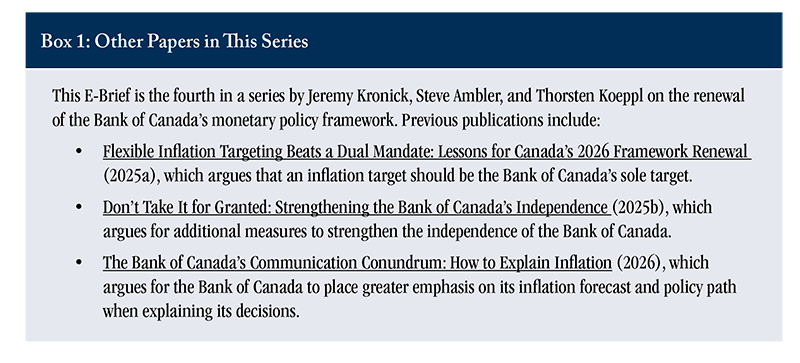
The Bank of Canada and the Government of Canada announced the renewal of their monetary policy framework agreement on November 5, 2026, which re-established the 2 percent inflation target as the Bank’s sole objective.11 Bank of Canada and Government of Canada. 2026. “Joint Statement of the Government of Canada and the Bank of Canada on the Renewal of the Monetary Policy Framework.” November 5. https://www.bankofcanada.ca/2026/11/joint-statement-of-the-government-of-canada-and-the-bank-of-canada-on-the-renewal-of-the-monetary-policy-framework-2026/. This E-Brief overlaps with the announcement of the renewal and is the last in a series of four (see Box 1). It asks whether housing should play a more prominent role in the central bank’s monetary policy decisions. Housing markets and affordability had been one of the main questions in the consultations leading up to the renewal (Bank of Canada 2026a), but did not appear in the joint announcement.22 Bank of Canada (2026b) summarizes the review process undertaken by the Bank leading up to the renewal. While we come to the firm conclusion that housing affordability should not be a formal goal for the Bank of Canada, we feel that the announcement of the renewal could have been stronger in making this explicit. Hence, we recommend that the Bank clarify in its forthcoming background documentation that it should not be responsible for resolving structural problems in the housing market that lead to affordability challenges.
The question of housing affordability arose from the Bank of Canada’s consultations with Canadians leading up to the 2026 renewal. Among other questions, the Bank asked different groups of Canadians how they thought monetary policy affected the housing market and housing affordability. The link between monetary policy and housing has long interested academics33 See, for example, Case and Shiller (1989), Iacoviello (2005), and Taylor (2007). and the public alike, given housing’s importance in households’ day-to-day lives and its knock-on effects on businesses and governments.
Statistics Canada (2026) reports that economic activity related to residential housing investment, which represents roughly 25 percent of national wealth, added $152 billion, or 4.7 percent, to Canada’s GDP in 2025. Canadian house prices have increased significantly since the early 2000s, and from 2018 to 2023, Canada had the highest average housing investment as a percentage of GDP among Organisation for Economic Co-operation and Development (OECD) countries (Lammam 2026).
According to the OECD (2025), Canadians spend about 26 percent of their total expenditures on housing. Housing also matters a lot for household finances. It accounts for about 40 percent of Canadian household assets, while mortgage debt makes up about 75 percent of total household debt, which stood at nearly 180 percent of disposable income in the first quarter of 2026.44 Statistics Canada. 2026. “National Balance Sheet Accounts.” Table 36-10-0580-01. September 11; Statistics Canada. 2026. “Household Sector Credit Market Summary Table, Seasonally Adjusted Estimates.” Table 38-10-0238-01. September 11. For the 40 percent figure, we divide the sum of dwellings and the land underlying them by total assets. For the 75 percent figure, it is mortgages as a percentage of total credit market debt.
House prices in Canada’s major cities have long outpaced those in other OECD countries, indicating a structural rather than cyclical problem (Beaudry and Kronick 2025).55 Contributing factors include, but are not limited to, specific barriers to supply like rules around zoning, suppressed house prices in the late 1990s and early 2000s, and increased immigration in the early parts of this decade. Beaudry and Kronick (2025) also refer to the notion that Canada lacks the kinds of attractive secondary cities that would otherwise keep people from boosting demand in our major cities in a way that offsets any supply-induced house price slowdowns. These structural issues limit housing supply and contribute to high house prices and rents, reducing affordability. Low interest rates following the COVID-19 pandemic fuelled house price increases further, while the sharp increase in interest rates in 2022 and 2023 raised red flags for many households that saw their mortgage costs rise. In this context, the Bank has faced criticism for contributing to housing unaffordability and calls to help alleviate the problem.
The consultation results reflected these concerns (Bank of Canada 2026a). “Participants in community conversations expressed a clear desire for action to address the housing crisis…and expected the Bank to do its part.” But priorities varied among groups. Labour groups wanted more of a focus on rent inflation. Younger generations wanted lower house prices, while older Canadians wanted higher prices, as their house was a significant part of their retirement asset portfolio.
Naturally, a coalition of groups has therefore emerged in favour of lower interest rates. Investors and developers alike argue that higher rates weaken pre-sale demand and raise construction costs, thereby restricting new supply.66 See Hossain (2024). Existing homeowners also favour lower rates because they reduce debt-servicing costs and support house prices.77 There is potentially a conflicting interest of renters and first-time home buyers that are primarily concerned with an increase in house prices that ultimately leads to higher rents and financing costs (see Rogers 2024).
This raises the possibility that municipal, provincial, and federal governments could pressure the Bank to keep interest rates low to improve affordability. As Senior Deputy Governor Carolyn Rogers (2026) observed, this creates a dilemma for the Bank of Canada: “It feels a bit like a trap. Higher prices make housing less affordable and leave many households with less room for everything else. Lower prices weigh on consumer confidence, wealth and economic growth. This is the heart of the housing affordability dilemma and why it’s so hard to fix.”
We begin by reviewing how monetary policy affects the housing market. We then look at how the Bank of Canada has taken the housing market into account in the past and ask whether housing market stability and structural supply-and-demand problems should fall within its framework.
We conclude that the Bank lacks the tools to address housing affordability and supply issues and should not pursue policies that inevitably favour one group over another. The joint announcement of the renewal agreement was a missed opportunity to clarify that the Bank should not be responsible for addressing housing market imbalances, while acknowledging housing’s unequivocal role in monetary policy decisions aimed at achieving the inflation target. It should make this clear in its forthcoming renewal background documentation.
Q: How does monetary policy affect the housing market?
A: Both the demand and supply sides of the market react to changes in interest rates.
Both demand and supply in the housing market depend heavily on debt financing. By setting the overnight rate, which then impacts other interest rates in the economy, monetary policy has a direct and often significant influence on the housing market through three main channels: current financing costs, asset valuations, and future borrowing capacity, all of which then affect the real economy and inflation.88 For a good summary, see Andaloussi, Biljanovska, and De Stefani (2024).
First, higher interest rates directly increase mortgage costs for homebuyers and homeowners, while developers face higher financing costs. As a result, both demand and supply are likely to fall when rates rise. For example, the Canada Mortgage and Housing Corporation (CMHC) estimated that rate hikes following the post-COVID inflation surge decreased housing starts in 2023 by about 10 to 15 percent.99 Iorwerth (2024). The effect of higher interest rates on housing demand is harder to assess because it depends on the general state of the economy, the composition of mortgage financing, and household indebtedness, among other factors. Recent research, however, indicates that demand reacts more strongly than supply.1010 See Surprenant (2026) as well as Strauss, Surprenant, and Tuzcuoglu (2026).
Second, higher financing costs affect housing valuations. Like with any other financial asset, current higher interest rates reduce the value of an asset – good for new homebuyers, but less so for existing homeowners –
and make new housing investments less attractive by raising the required rate of return. These effects are compounded when markets expect higher interest rates in the future or face uncertainty about future monetary policy decisions.1111 In the case of the Toronto condo market, these interactions are well summarized in Lamelza (2026).
Finally, both effects combine to tighten borrowing capacity. Homeowners will find it harder to refinance their mortgages, and the balance sheets of developers deteriorate as the value of housing as collateral falls. This will also have ramifications for the broader economy for two reasons. Households commonly use housing as collateral to finance consumption, while developers create real activity in the economy by starting new projects.
Hence, the housing market is an important transmission channel for monetary policy to influence aggregate demand and, ultimately, inflation. These channels can amplify the effects of policy rate changes on aggregate demand, increasing the effectiveness of monetary policy. High levels of household debt – as we have now – may increase the potency of monetary policy, while house prices may be more sensitive to interest rates when housing supply is restricted.
Q: Does the Bank of Canada consider the housing market in its policy decisions?
A: Yes, but the housing market is not a formal goal for the Bank.
As the last section explains, there are clear transmission mechanisms from monetary policy to the housing market, and onto the real economy and, ultimately, inflation. As a result, the Bank must weigh the impact of monetary policy on the housing market to achieve its 2 percent inflation target.
The housing market also influences monetary policy decisions directly. The shelter component of the Consumer Price Index (CPI) includes housing-related costs such as rented accommodation, utilities, and the ongoing costs of homeownership, including mortgage interest costs, among others.1212 The others include homeowners’ replacement cost, property taxes, home and mortgage insurance, maintenance and repairs, and other owned accommodation expenses. Note that the full purchase price of a home is not included, as it is treated as a capital asset. Housing therefore directly affects measured inflation and, consequently, the Bank’s monetary policy decisions.
Housing markets can also affect financial stability. For that reason, the Bank of Canada includes household indebtedness and house prices among its indicators of financial vulnerabilities, which it updates quarterly on its website. Housing also features in almost every Financial System Report the Bank issues.
Moreover, with the increase in household debt – financed through increasing house values that serve as collateral – households have become more sensitive to interest rate decisions.1313 See Kim and Lim (2020) for cross-country evidence supporting this hypothesis. This will exacerbate consumption and housing investment decisions – two significant drivers of aggregate demand.
As a result, the Bank is paying even closer attention to housing. As we mentioned, the housing market was one of the key focal points for the 2026 framework renewal. This attention is also reflected in the number of speeches and other policy communications that have mentioned housing. Our search of the Bank’s website found that, since 2006, about 45 percent (306 out of 673) of all opening statements, remarks, and speeches have explicitly referred to housing. Prominent examples include speeches by then-Bank of Canada Governor Mark Carney (2011), Deputy Governor Rhys Mendes (2025) and, more recently, by Carolyn Rogers (2026), which took place during the writing of this E-Brief.1414 Housing has also been an important subject of research by the Bank’s staff members. Without being exhaustive, see the contributions of Flood, Morin, and Kolet (2008), Christensen (2011), Paixão (2021), and MacGee and Yao (2026).
Q: Should housing market stability and affordability be explicit goals for the Bank of Canada?
A: No, the Bank should focus on its inflation target.
Given housing’s importance to monetary policy, should it become an explicit goal for the Bank of Canada? After all, the 2021 agreement between the Bank and the Government of Canada mentioned some other desirable policy goals, such as financial stability, climate change, and income distribution.
We have argued elsewhere (Kronick, Ambler, and Koeppl 2025a) that the Bank of Canada’s flexible inflation targeting regime, which stipulates that the only explicit goal of monetary policy should be achieving an inflation target, is the best monetary policy framework available. The Bank of Canada has only one main policy instrument: the overnight rate target. Other tools, such as forward guidance and quantitative easing (or tightening), are just variations on the overnight rate since they change expectations about future interest rates. As Tinbergen (1952) pointed out many years ago, successfully achieving multiple independent policy objectives requires at least an equal number of policy instruments. Otherwise, trade-offs among competing objectives are inevitable.
In addition, it is unclear what housing-related goal the Bank should pursue. As we highlighted in the introduction, different constituencies have different objectives. Some want the Bank to consider the needs of builders. Others want the focus to be on rent inflation. Seniors worry about falling house prices because housing forms part of their retirement assets, while younger Canadians hope for lower prices. Indigenous groups, meanwhile, are concerned about housing quality on reserves.
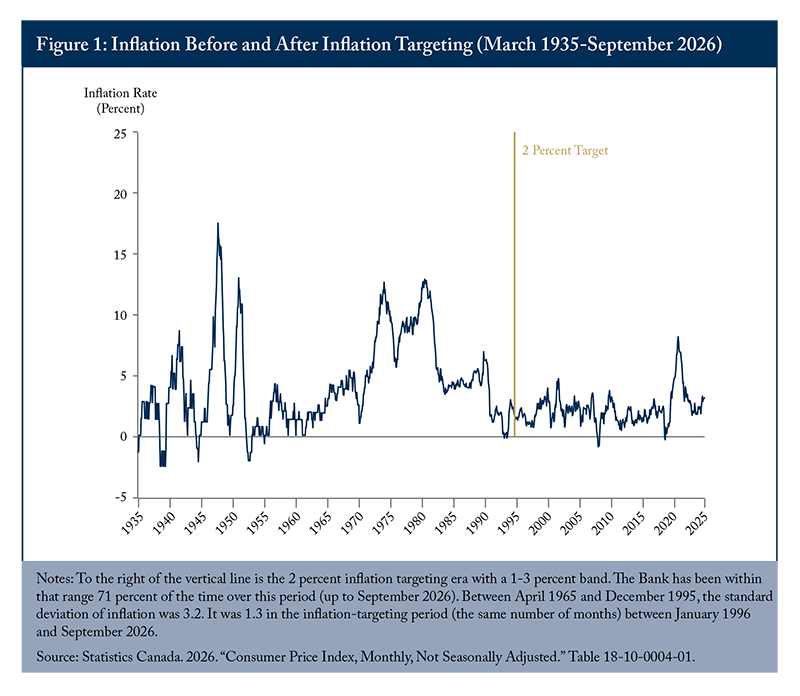
Any direct action by the Bank of Canada to address housing affordability will therefore likely favour one group over another. Although monetary policy inevitably has distributional effects, addressing them should not fall within the central bank’s formal remit. When combined with an ineffective tool to solve the problem, it is clear the Bank should stick to what it can control and has controlled best in the past: inflation (Figure 1).1515 See also Murray (2021) for why adding additional goals for a central bank is a bad idea.
Q: What are the main housing-related challenges facing the Bank of Canada when setting its policy rate?
A: Housing is a complex input into monetary policy decisions and raises financial stability considerations.
As pointed out, the Bank of Canada’s policy rate affects both housing supply and demand. Housing is an important part of aggregate demand and, thus, influences inflationary pressures. There is, however, a real complexity to the interaction of both housing demand and supply, particularly given their different response times and the lag in monetary policy transmission.
Complexity alone is not a reason to rule out a specific target for the central bank, but it exacerbates the other reasons we have already highlighted. For example, assume the Bank loosens monetary policy. By doing so, it lowers mortgage interest costs for both current homeowners and prospective owners. However, this also increases house prices, making the overall impact on demand unclear. But, as we have discussed, lower rates may also increase the supply of new homes, which would ease some of the upward pressure on house prices. Yet new construction takes time, limiting its potential to affect house prices in the short run. Moreover, rising house prices can create a wealth effect, making homeowners feel wealthier and encouraging greater consumption, which increases aggregate demand.
The transmission of monetary policy through the housing sector becomes even more complex when we consider the structure of the mortgage market. In Canada, mortgages include both variable- and fixed-rate products, typically with terms of five years or less. Policy decisions tend to have an immediate effect on variable-rate mortgages, provided lenders do not adjust the maturity to keep the periodic payment amount the same. The effect on fixed-rate mortgages, however, depends on when mortgages come up for renewal and on bond market interest rates. These differences make it difficult to assess how interest rate changes affect housing, a key driver of household expenditure.
Changes in mortgage rates also directly affect the CPI through its mortgage interest cost component. This creates a procyclical impact on the mortgage interest cost component of the CPI. As a result, the CPI tends to overstate inflation during monetary tightening cycles and understate it when the Bank lowers its policy rate.1616 Ex-MIC inflation (the inflation rate with the mortgage-interest-cost component removed) has been close to headline inflation since the final quarter of 2025. There was almost a full percentage point difference between headline inflation and ex-MIC inflation at the beginning of 2024, which fell gradually to half a percentage point by the end of 2024. See Ambler and Kronick (2025) for details. While the Bank has explored different measures to account for shelter costs, Rogers (2026) notes, “No single measure…fully captures the affordability pressures Canadians face.”1717 Several alternatives to using CPI as a formal inflation measure have been proposed for the Bank in the past. For example, see Bergevin (2012) or Poschmann and Jacobs (2015). While such measures may give better information to the Bank, they have potentially significant drawbacks, such as more volatile interest rates and more difficult communication of interest rate decisions.
House prices also impact financial stability. In Canada, as in many other countries, structural issues have led to a long-term increase in house prices relative to income.1818 See, for example, Chart 6 in Carney (2011) and Table 1 in Beaudry and Kronick (2025). This trend can be explained in large part by regulatory impediments to the construction of housing and broader economic and social trends. Dachis (2023) documents substantial and growing gaps between marginal construction costs and final house prices in major Canadian municipalities. Demographic changes, immigration, and agglomeration trends have also increased demand, especially for affordable housing.1919 See, for example, Milke and Venkatachalam (2025) for a detailed discussion about the impact of immigration.
The Bank of Canada cannot control this long-term increase in relative house prices. Different levels of government are responsible for addressing structural barriers to housing construction, including development charges, zoning rules, and public transportation (see Dachis 2023 for more). Other institutions, such as CMHC, can also directly influence the housing market through their palette of financing tools and affordable housing programs.
The Bank of Canada shares responsibility for financial stability with the Office of the Superintendent of Financial Institutions (OSFI), the Canada Deposit Insurance Corporation (CDIC), and the Department of Finance. While OSFI and CDIC handle micro-prudential regulation and deposit insurance, respectively, the Bank of Canada focuses on the financial stability of the entire system.
Rogers (2026) articulates that in recent years, “Housing had become a fault line running through the financial system.” The Bank will therefore naturally focus on developments in housing markets and assess how its policy decisions affect financial stability in this context. For example, when house prices increase sharply, coupled with the expansion of mortgage debt, the Bank would be concerned with excess leverage for households. It may then consider a more hawkish stance to lean against the increase in house prices. Conversely, when prices fall sharply, the Bank would be concerned with a sharp credit contraction and defaults, potentially prompting the Bank to consider easing monetary policy.
These considerations, however, do not justify giving the Bank an explicit financial stability target. Such a target, aimed at monitoring and controlling household debt ratios, debt-service ratios, or similar measures, would lead to precisely the kind of trade-off we discussed earlier, potentially compromising the Bank’s ability to achieve its inflation target.
Q: Should housing have been mentioned in the 2026 renewal announcement?
A: Yes. It was a missed opportunity to insulate the Bank of Canada against demands to consider housing affordability.
The Bank already has considerable expertise in modelling and predicting the impact of its monetary policy on aggregate demand via the housing market. It will no doubt continue to develop this expertise and to use it to refine its predictions of the impact of its monetary policy on headline inflation. In other words, the Bank should continue to focus on hitting the 2 percent inflation target, assessing how cyclical and structural housing issues affect its ability to do so.
One step would be to refine the inflation measures used in its models for interest rate decisions to account for the procyclical influence of mortgage interest costs (as pointed out in Ambler and Kronick 2025). Another important one is communication with the public about housing’s role in monetary policy decisions. Extending the argument in Kronick, Ambler, and Koeppl (2026), the Bank can include a focus on how housing influences the future path of interest rates needed to return inflation to target. This will require a thorough assessment of the relationship between monetary policy and housing.
But the renewal announcement also offered a unique opportunity to insulate the Bank of Canada against any demands to increase housing affordability. While this opportunity was missed, the soon-to-be-released background information could still emphasize that the Bank of Canada cannot address structural issues of affordability that affect Canadians – for example, from tariffs, environmental changes, or housing – without compromising its inflation target. At the same time, the documentation could make clear that the Bank naturally considers all these variables when setting monetary policy to hit the 2 percent inflation target. Adding this clarity and explicit language could help strengthen the Bank’s independence and reinforce its ongoing credibility in achieving its mandate, which rightly focuses solely on achieving 2 percent inflation over the medium term.
Conclusion
The housing sector is an important input into monetary policy decisions, but it is not, and should not be, a target of monetary policy. The Bank of Canada should not be responsible for resolving structural issues in the housing market. Doing so would force the Bank to abandon its neutrality and make political choices about which groups to favour, while compromising its long-run goal of inflation control.
Fiscal and regulatory policies, on the other hand, are better suited to addressing structural problems in the housing market. On the regulatory side, while the Bank plays a role, financial stability concerns are also the remit of OSFI, which has a wide range of regulatory and supervisory tools at its disposal.
On the fiscal side, federal, provincial, and municipal governments are better positioned to design policies to improve housing affordability. The federal government has established a new Crown corporation, Build Canada Homes, and expanded CMHC’s financing tools. And provinces such as Ontario have started to lower development charges, while municipalities have relaxed zoning restrictions.
The recent renewal announcement missed a unique chance to clarify these points. The forthcoming background document for the renewal should seize this opportunity.
References
Ambler, Steve, and Jeremy Kronick. 2025. “Blurred Vision: How Mortgage Interest Costs Impact Inflation.” E-Brief 368. Toronto: C.D. Howe Institute. https://cdhowe.org/publication/blurred-vision-how-mortgage-interest-costs-impact-inflation/.
Andaloussi, Mehdi Benatiya, Nina Biljanovska, and Alessia De Stefani. 2024. “Housing Markets and Monetary Policy.” Finance & Development. International Monetary Fund. December. https://www.imf.org/en/publications/fandd/issues/2024/12/housing-markets-and-monetary-policy-mehdi-andaloussi.
Bank of Canada. 2026a. “Consulting with Canadians on the Monetary Policy Framework.” https://www.bankofcanada.ca/core-functions/monetary-policy/renewing-canadas-monetary-policy-framework/consulting-with-canadians-on-the-monetary-policy-framework/.
____________. 2026b. “Renewing Canada’s Monetary Policy Framework.” https://www.bankofcanada.ca/core-functions/monetary-policy/renewing-canadas-monetary-policy-framework/.
Bergevin, Philippe. 2012. Housing Bubbles and the Consumer Price Index: A Proposal for a Better Inflation Indicator. Commentary 362. Toronto: C.D. Howe Institute. https://cdhowe.org/publication/housing-bubbles-and-consumer-price-index-proposal-better-inflation-indicator/.
Carney, Mark. 2011. “Housing in Canada.” Remarks to the Vancouver Board of Trade. Bank of Canada. June 15. https://www.bankofcanada.ca/wp-content/uploads/2011/06/sp150611.pdf.
Case, Karl E., and Robert J. Shiller. 1989. “The Efficiency of the Market for Single-Family Homes.” American Economic Review 79(1): 125–137.
Christensen, Ian. 2011. “Mortgage Debt and Procyclicity in the Housing Market.” Bank of Canada Review (Summer): 35–42.
Dachis, Benjamin. 2023. “Buyers Beware: The Cost of Barriers to Building Housing in Canadian Cities.” E-Brief 341. Toronto: C.D. Howe Institute. https://cdhowe.org/publication/buyers-beware-cost-barriers-building-housing-canadian-cities/.
Flood, Kimberly, Sylvie Morin, and Ilan Kolet. 2008. “House Prices and Consumer Spending.” Bank of Canada Review (Summer): 31–44.
Hossain, Arshi. 2024. “Is the Double Rate Cut Announced by the Bank of Canada Enough to Revive the Housing Market?” Rates.ca. October 23. https://rates.ca/resources/double-rate-cut-bank-of-canada-revive-housing-market.
Iacoviello, Matteo. 2005. “House Prices, Borrowing Constraints, and Monetary Policy in the Business Cycle.” American Economic Review 95(3): 739–764.
Iorwerth, Aled ab. 2024. “In 2023, Higher Rates Resulted in 30,000 Fewer Housing Starts.” Canada Mortgage and Housing Corporation. October 3. https://www.cmhc-schl.gc.ca/observer/2024/2023-higher-interest-rates-resulted-fewer-housing-starts.
Kim, Youngju, and Hyunjoon Lim. 2020. “Transmission of Monetary Policy in Times of High Household Debt.” Journal of Macroeconomics 63.
Kronick, Jeremy, Steve Ambler, and Thorsten Koeppl. 2025a. “Flexible Inflation Targeting Beats a Dual Mandate: Lessons for Canada’s 2026 Framework Renewal.” E-Brief 373. Toronto: C.D. Howe Institute. https://cdhowe.org/publication/flexible-inflation-targeting-beats-a-dual-mandate-lessons-for-canadas-2026-framework-renewal/.
____________. 2025b. “Don’t Take It for Granted: Strengthening the Bank of Canada’s Independence.” E-Brief 378. Toronto: C.D. Howe Institute. https://cdhowe.org/publication/dont-take-it-for-granted-strengthening-the-bank-of-canadas-independence/.
____________. 2026. “The Bank of Canada’s Communication Conundrum: How to Explain Inflation.” E-Brief 384. Toronto: C.D. Howe Institute. https://cdhowe.org/publication/the-bank-of-canadas-communication-conundrum-how-to-explain-inflation/.
Lamelza, Judy. 2026. “Toronto’s Condo Construction Slowdown.” Databid. January 7. https://databid.ca/blog/torontos-condo-construction-slowdown.
Lammam, Charles. 2026. “Canada’s ‘Real Estate Economy’ Is Costing Us – Here’s How.” The Hub. May 6. https://thehub.ca/2026/05/06/canadas-real-estate-economy-is-costing-us-heres-how/.
MacGee, James, and Yuxi Yao. 2026. “Housing and the Long-Term Effects of Trend Inflation.” Staff Working Paper 2026-1. Bank of Canada. https://www.bankofcanada.ca/wp-content/uploads/2026/02/swp2026-1.pdf.
Mendes, Rhys. 2025. “Underlying Inflation: Separating the Signal from the Noise.” Remarks to the Ivey Business School, Western University. Bank of Canada. October 2. https://www.bankofcanada.ca/wp-content/uploads/2025/10/remarks-021025.pdf.
Milke, Mark, and Ven Venkatachalam. 2025. “Too Much of a Good Thing? Immigration Trends and Canada’s Housing Shortage.” Aristotle Foundation for Public Policy. March. https://aristotlefoundation.org/study/too-much-of-a-good-thing-immigration-trends-and-canadas-housing-shortage/.
Murray, John. 2021. “Mission Creep and Monetary Policy.” E-Brief 317. Toronto: C.D. Howe Institute. https://cdhowe.org/publication/mission-creep-and-monetary-policy/.
OECD. 2025. Affordable Housing Database. Organisation for Economic Co-operation and Development.
Paixão, Nuno. 2021. “Canadian Housing Supply Elasticities.” Staff Analytical Note 2021-21. Bank of Canada. https://www.bankofcanada.ca/2021/09/staff-analytical-note-2021-21/.
Poschmann, Finn, and Aaron Jacobs. 2015. “Improving on the CPI: A Proposal for a Better Inflation Indicator.” E-Brief 213. Toronto: C.D. Howe Institute. https://cdhowe.org/publication/improving-cpi-proposal-better-inflation-indicator/.
Rogers, Carolyn. 2024. “Canada’s Mortgage Market – A Question of Balance.” Remarks to the Economic Club of Canada. Bank of Canada. November 6.
———. 2026. “Canada’s Housing Affordability Dilemma.” Remarks to the Greater Victoria Chamber of Commerce and CFA Society Victoria. Bank of Canada. October 1.
Statistics Canada. 2026. “Housing Economic Account, 2025.” The Daily. April 9. https://www150.statcan.gc.ca/n1/daily-quotidien/260409/dq260409b-eng.htm.
Strauss, Benjamin, Stéphane Surprenant, and Kerem Tuzcuoglu. 2026. “How Do Interest Rates Spur the Housing Market: Exploring Nonlinear Effects.” Staff Analytical Paper 2026-35. Bank of Canada. https://www.bankofcanada.ca/wp-content/uploads/2026/08/sap2026-35.pdf.
Surprenant, Stéphane. 2026. “Demand Roars, Supply Whispers: Monetary Policy and Housing in Canada.” Staff Analytical Paper 2026-52. Bank of Canada.
Taylor, John B. 2007. “Housing and Monetary Policy.” NBER Working Paper 13682. National Bureau of Economic Research.
Tinbergen, Jan. 1952. On the Theory of Economic Policy. Amsterdam: North-Holland.