



 The job market is tough for young adults in Canada, but unemployment rates alone do not tell the full story. Importantly, a growing share of unemployed 20- to 24-year-olds are just starting to establish a career, searching for work as new entrants or re-entrants to the labour market, rather than searching for work after losing a job.
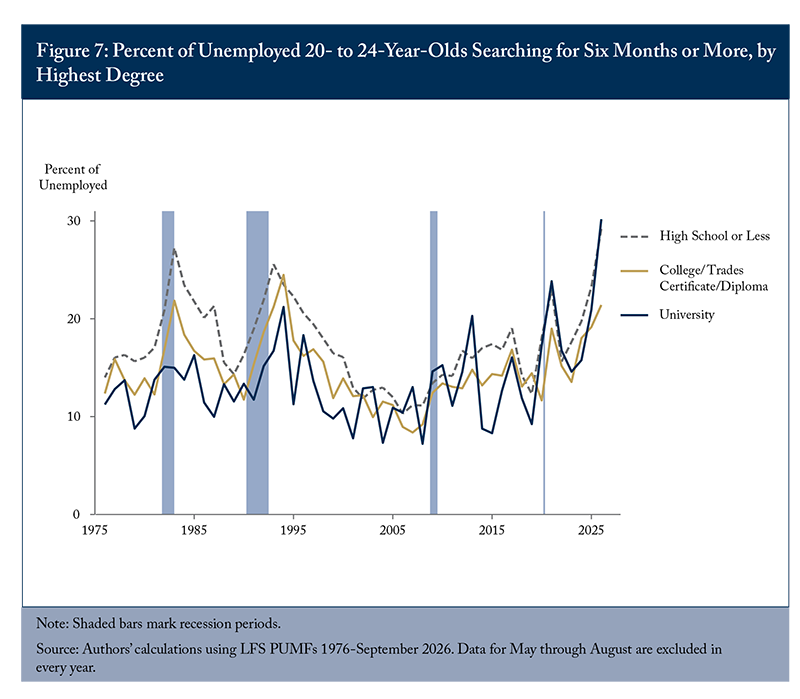
- Young adults are taking longer to find work, even with university degrees. In early 2026, 30 percent of unemployed university graduates aged 20 to 24 had been searching for six months or more, a record high. Weak hiring and fewer entry-level opportunities risk trapping young adults in a cycle where they cannot gain the experience employers demand.
- Employment policies must better support young adults entering the workforce. Governments should strengthen job-search assistance for new entrants, improve access to meaningful work experience through co-op placements, internships, and apprenticeships, and evaluate programs to ensure they deliver lasting employment benefits.
 The job market is tough for young adults in Canada, but unemployment rates alone do not tell the full story. Importantly, a growing share of unemployed 20- to 24-year-olds are just starting to establish a career, searching for work as new entrants or re-entrants to the labour market, rather than searching for work after losing a job.
The authors extend gratitude to Don Drummond, Timothy Lang, Rosalie Wyonch, Tingting Zhang, and several anonymous referees for valuable comments and suggestions. The authors retain responsibility for any errors and the views expressed.
Introduction
For young Canadians, finding a foothold in the labour market has become an increasingly pressing concern. Recent media accounts have drawn attention to the challenges young Canadians face entering the workforce.11 Wood, Andrew. 2026. “‘20 Other People Just Like You’: Why Toronto Youth Are Struggling to Find Jobs.” CBC News. March 21. https://www.cbc.ca/news/canada/toronto/toronto-youth-struggling-jobs-9.7135353. Yet the extent to which these challenges differ from those faced by previous generations remains a matter of debate.22 Ferguson, Rob. 2025. “Look Harder, Doug Ford Tells Unemployed Young People Seeking Work.” Toronto Star. September 10. https://www.thestar.com/politics/provincial/look-harder-doug-ford-tells-unemployed-young-people-seeking-work/article_08434492-e662-4f5b-bd16-348578c178ed.html. On the surface, long-term unemployment trends appear to support this skepticism. The unemployment rate for those aged 15 to 19 has remained consistently high for decades, exceeding 21 percent in the early 1980s and reaching a similar level in 2026 (Figure 1). The unemployment rate for 20- to 24-year-olds presents a different picture: after peaking near 18 percent in the early 1980s, it declined to 9.9 percent in September 2026 (seasonally adjusted; Statistics Canada 2026a). Apart from the challenges posed by COVID-19 public health restrictions in 2020 and 2021 (see Lemieux et al. 2020), these historical trends in Figure 1 might suggest a relatively resilient labour market for today’s young adults.
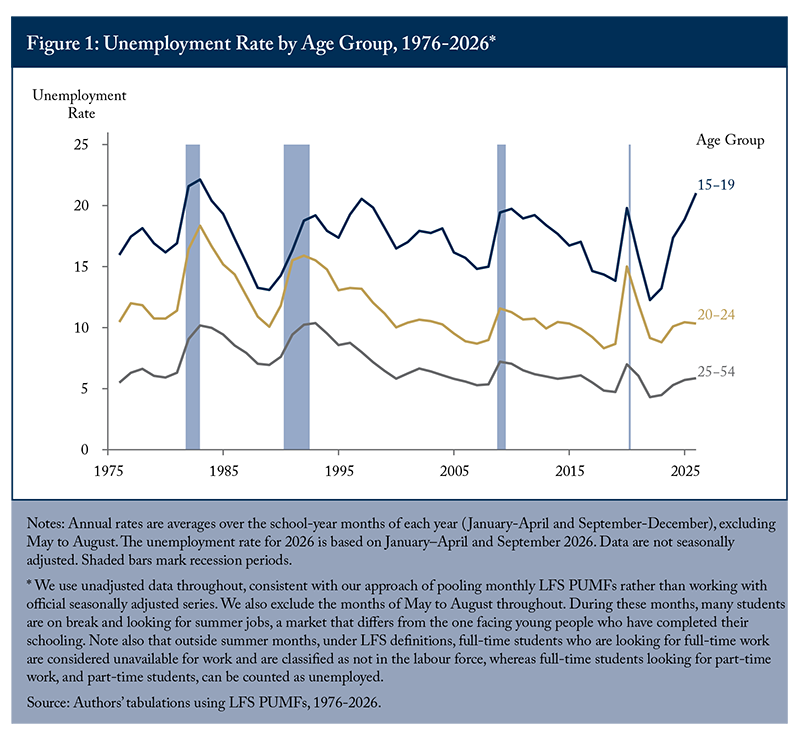
This conclusion, however, overlooks important structural changes in how young people experience the labour market. The aggregate unemployment rate masks significant shifts in both the causes and consequences of youth unemployment. Today, fewer 20- to 24-year-olds become unemployed after quitting or losing a job. Instead, a growing share are entering or re-entering the labour market and attempting to establish their careers. More concerning, the share of unemployed young people searching for work for six months or more has increased substantially over the past two decades, while the protection associated with a university education appears to have weakened. In 2026, the share of unemployed university graduates and young women searching for six months or more reached their highest level since records began in 1976. These changes suggest that historical unemployment rates alone provide an incomplete picture of the challenges facing today’s young adults. Many are trying to gain a foothold in the labour market as hiring weakens, and employers increasingly seek experienced workers.
This raises an important policy question: how can existing employment and work-experience programs better help new entrants transition into employment when opportunities to gain the experience employers demand are increasingly scarce?
The Changing Profile of Young Adults
Young people are still finding jobs. The employment rate for women aged 20 to 24 was slightly higher in 2025 than in 1980, while the rate for men fell from 75 percent to 67 percent (Table 1). Employment rates alone, however, provide an incomplete picture. Labour force participation tells a different story: the rate among young men fell sharply, from 84.8 percent in 1980 to 75.6 percent in 2025, while the rate among young women held roughly steady (73.2 to 72.9 percent). Part of the decline among young men reflects the much larger share attending school. Increased schooling is unlikely to explain the entire decline, however, as labour force participation has also declined among prime-age men over this period. Similarly, while unemployment rates for 20- to 24-year-olds in 2025 and 2026 remain well below those recorded during the recessions of the early 1980s or 1990s (Figure 1), changes in the composition of those searching for work make these historical comparisons less meaningful.
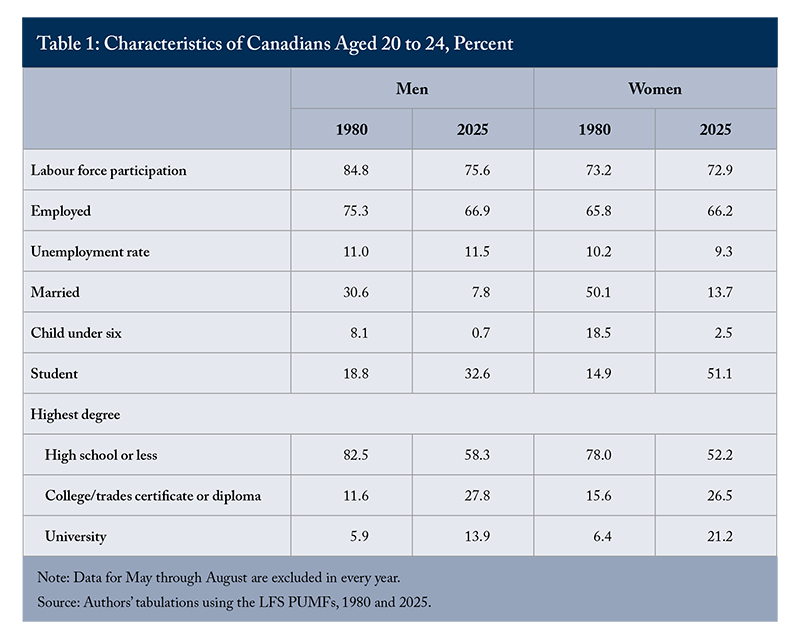
For example, in 1980, half of women aged 20 to 24 and just over 30 percent of men were married (Table 1). Eighteen percent of women aged 20 to 24 had at least one child under age six. By 2025, far fewer young adults were married or had young children (just 2.5 percent of women). Put simply, young adults today are forming families later than previous generations, meaning unemployment is less likely to affect a broader household directly. Young unemployed men in the 1980s may have struggled to meet financial obligations to their spouses and young children. Today, an unemployed young person is less likely to have dependents whose finances are directly tied to their own, though this does not necessarily make unemployment any less difficult for the individual. The burden of youth unemployment may also have shifted rather than simply diminished: as young adults live with their parents longer, more of the cost of a prolonged job search may fall on parents, and long spells of unemployment may further delay young adults’ independence and household formation.
Another important change is that more young men and women today pursue education rather than starting families and careers immediately after high school. For women in particular, decisions to delay having children are paired with greater investment in education and career development. In 1980, just 18.8 percent of men and 14.9 percent of women aged 20 to 24 were students, and relatively few held post-secondary credentials. By 2025, 33 percent of men and 51 percent of women were students, while 42 percent of men and 48 percent of women had already completed college or university (Table 1). These substantial investments, often financed through debt, carry expectations of strong financial returns. However, prolonged unemployment can have lasting “scarring” effects on earnings. Canadian estimates (Oreopoulos, von Wachter, and Heisz 2012; Messacar, Handler, and Frenette 2021) suggest that poor labour market conditions at the start of a career can depress earnings for several subsequent years, reducing the return on investments in education and skills.
Shifts in Youth Employment Across Industries
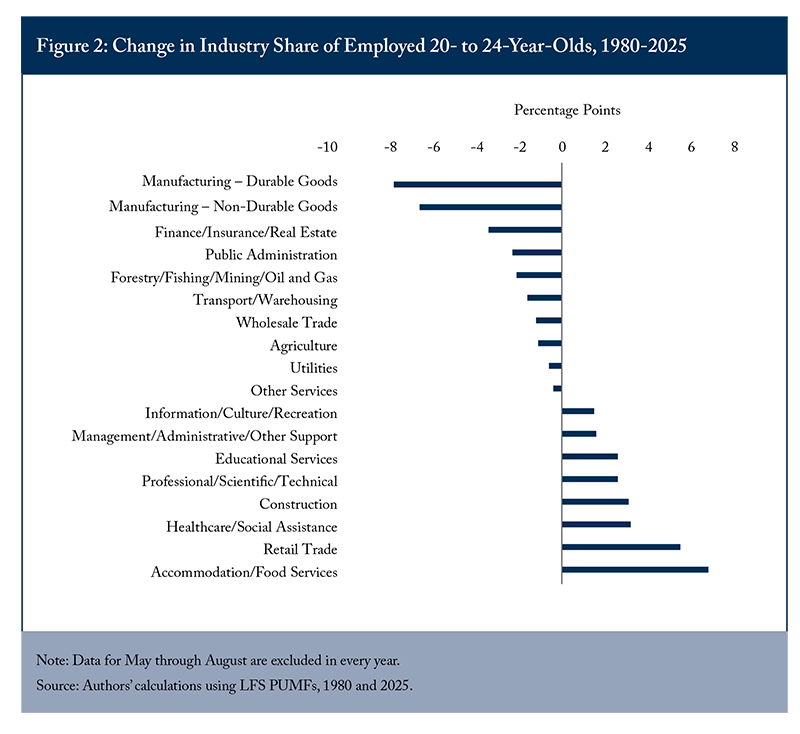
The rise in educational attainment has coincided with a shift in the industries employing young people. Manufacturing alone accounted for over 20 percent of employed 20- to 24-year-olds in 1980; by 2025, its share had fallen to about 6 percent (Figure 2). This decline was absorbed almost entirely by growth in retail trade and accommodation and food services, which together rose from roughly 21 percent to over 33 percent of youth employment over the same period. These industry changes were not primarily driven by young people’s education choices, nor were they unique to young workers: manufacturing’s share of employment also fell by about 11 percentage points among workers aged 25 to 54 and about 7 percentage points among those aged 55 and over.
Beyond the Unemployment Rate
Young adults today follow different paths into the labour market, and unemployment can have different consequences than it did for previous generations. Yet unemployment rates alone reveal little about their job-search experiences. The unemployment rate merely represents the share of the labour force that is unemployed, actively searching for work and available to start. It does not tell us anything directly about job hunting. Behind this figure are constant flows of people entering unemployment as they begin searching for work and others leaving unemployment, often for new jobs. To understand how today’s youth experience unemployment differently from previous generations, we must examine these flows into and out of unemployment.
How Young Adults Enter Unemployment
The unemployment rate is often broken down into two components: (1) the incidence of unemployment, or the rate at which people become unemployed, and (2) the duration of unemployment, or how long people search for jobs before leaving unemployment. This section first examines the incidence of unemployment and how young people enter it.
The Incidence of Unemployment
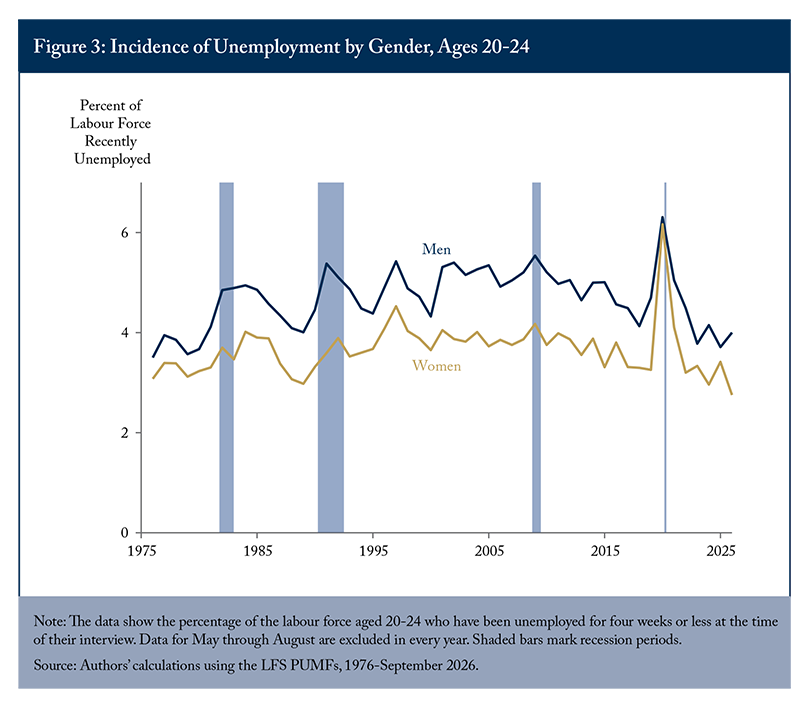
The rate at which 20- to 24-year-olds enter unemployment varies over time, but has typically been higher among men than women (Figure 3). Measured here as the percentage of the labour force reporting they have been unemployed for four weeks or less, the incidence rate tends to be higher during recessions, reflecting an increased likelihood of layoffs.33 This is a commonly used indicator of inflows into unemployment. It is measured from monthly cross-sections rather than by following individuals over time; it counts only those already in the labour force, and it can be affected by how quickly people leave unemployment. It is nonetheless useful for tracking broad trends. Broadly, incidence rose steadily through the 1980s and 1990s, before levelling off and declining after the 2008-09 recession. Despite a spike during COVID-19 shutdowns, the incidence of unemployment remained low in 2024 and 2025. In 2026, the rate increased among men but declined among women (based on non-seasonally adjusted data for January to April and September). The increase among men warrants monitoring. Overall, this measure suggests that young people’s risk of becoming unemployed remains low by historical standards.
Who Is Entering Unemployment?
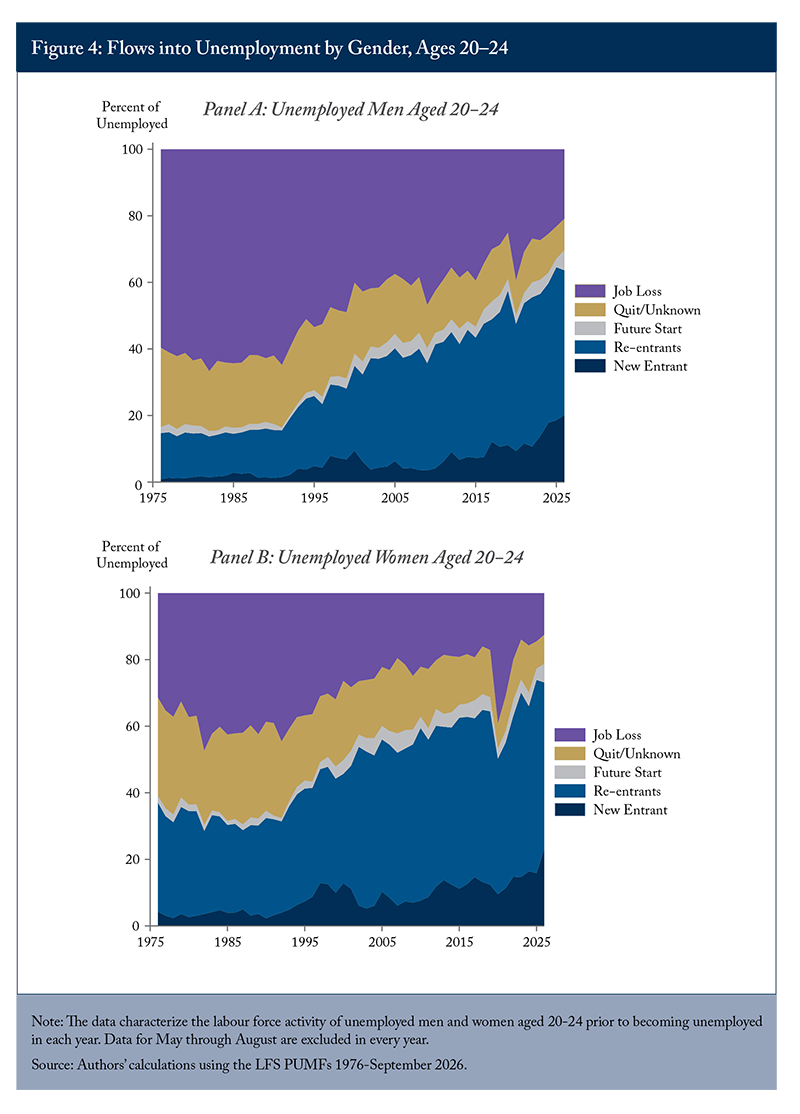
Although unemployment incidence among 20- to 24-year-olds remains low, at levels comparable to those before the early 1980s recession, the circumstances preceding unemployment have changed considerably. Until the early 1990s, most young men entering unemployment had lost a job, while young women were about equally likely to have lost or quit a job or to be re-entering the labour market (Figure 4). Since the early 1990s, a growing share of unemployed young adults have been new entrants or re-entrants, while the share who quit their jobs has declined. By 2025, 65 percent of unemployed men aged 20 to 24 and 74 percent of women were entering or re-entering the job market.
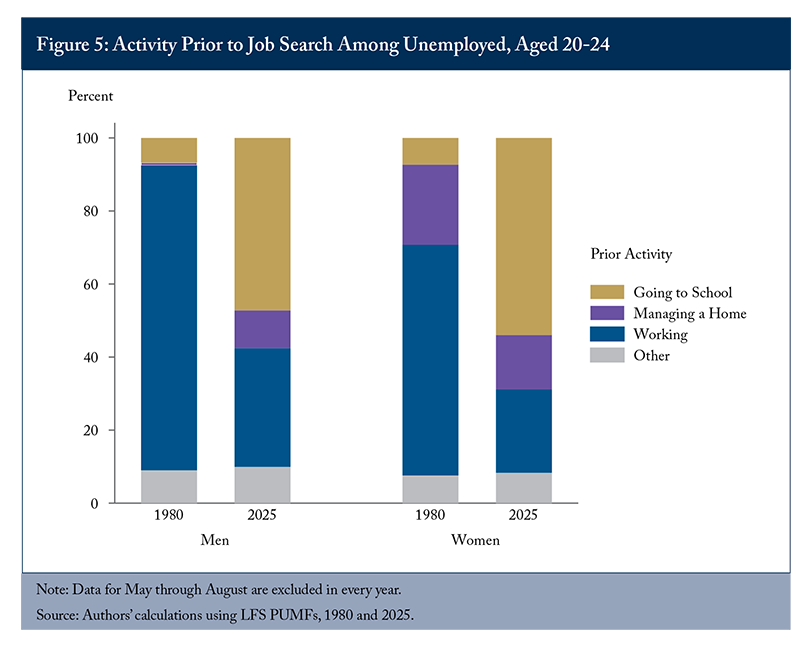
These changes highlight how differently young people enter the labour market today compared with previous generations. In 1980, only 7 percent of unemployed men and women (aged 20 to 24) reported attending school before beginning their job search (Figure 5). Most young men had previously been working, while young women had generally been working or managing a home. By 2025, the experiences of young men and women had become more similar to each other but markedly different from those of earlier generations: about half had been in school (47 percent of men and 54 percent of women), fewer had been working (32 percent of men and 23 percent of women), and more similar shares reported managing a home (10 percent of men and 15 percent of women). Given that far fewer 20- to 24-year-olds were married or had children in 2025, however, “managing a home” likely means something different today than it did in 1980.
The Challenge of Finding Work
Overall, young adults appear less likely to enter unemployment than in the past, and many unemployed young people are entering or re-entering the labour market as they begin their careers. But how successful are they in finding work?
Longer Job Searches
One way to assess the difficulty of leaving unemployment is to examine the share of unemployed individuals who have been searching for work for six months or more, commonly referred to as the long-term unemployed. Evidence suggests that the longer workers are jobless, the less likely they are to find work, as discussed by Schirle and Skuterud (2020). As expected, the portion of unemployed young men and women (aged 20 to 24) searching for six months or more rises substantially in recessions, when fewer jobs are available. However, long-term trends show that the likelihood of an extended job search for this age group fell from the mid-1990s through the mid-2000s (Figure 6). After the 2008-09 recession, long-duration unemployment among youth drifted upward unevenly, fell back sharply in 2018-19, and spiked for young men in 2021. By early 2026, it had reached levels similar to the peaks of the early 1980s recession. The recent increase likely reflects, at least in part, a broader softening of the Canadian labour market that began in 2023, when overall unemployment started to rise. Prime-age workers (aged 25 to 54) also experienced rising long-term unemployment,44 See: Statistics Canada. 2026. “Duration of Unemployment, Monthly, Seasonally Adjusted.” Table 14-10-0342-01. October 9. but the increase was steepest among young adults aged 20 to 24.
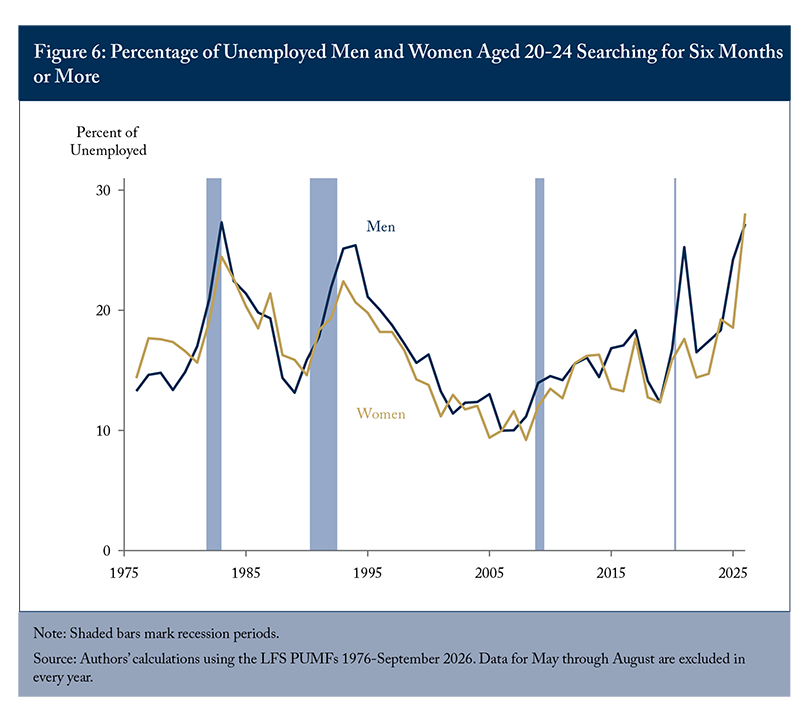
The gender gap in long-duration unemployment has also narrowed considerably since the early 2000s, although it widened at times, most notably in 2021, when the share among young men spiked (Figure 6). In early 2026, the share of unemployed young women searching for six months or more surged to 28 percent – its highest level since 1976 and comparable to the share among young men, which approached its early-1980s peak.
Does Education Still Shorten Job Searches?
The historical job-search advantage of more educated young adults may have also largely disappeared, particularly for university graduates. Through the 1980s and 1990s, young adults aged 20 to 24 with a high school education or less were generally more likely to search for work for six months or more than those who had completed college or university (Figure 7). By the early 2000s, however, this gap had closed. This convergence may reflect, in part, the rising share of the population holding post-secondary credentials over this period (Table 1). Since the early 2000s, the share searching for six months or more has risen unevenly across all three education groups, although those with a high school education or less generally fared worse through much of the 2010s.
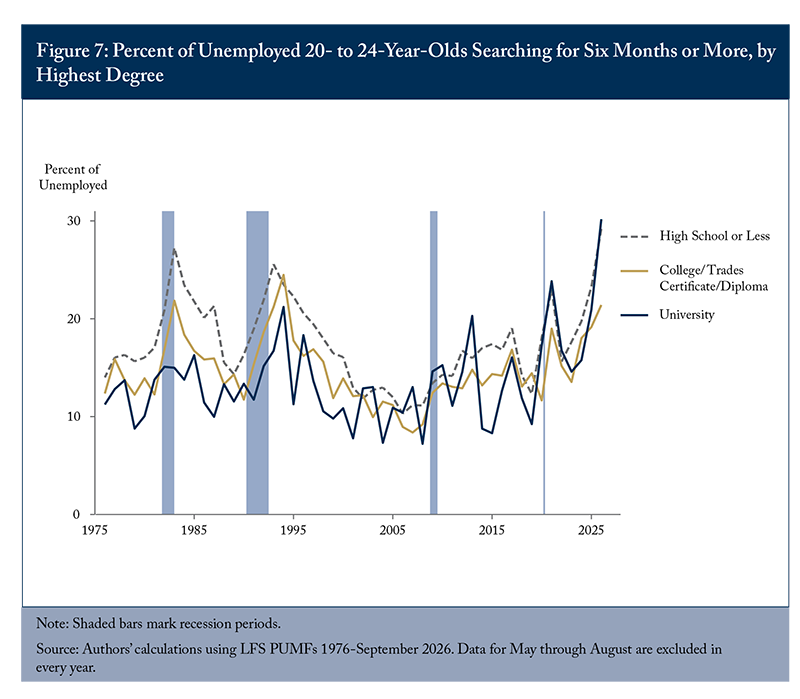
More recently, however, the increase has varied considerably across groups. In early 2026, the share of those with college or trades credentials remained below its historical peak, while the shares for university graduates and those with a high school education or less both reached new highs of 30 percent. For university graduates, this share was more than double its pre-pandemic average, marking the steepest recent increase among the three groups. One possible contributor is the rising share of young people holding university degrees, particularly among young women, whose university attainment more than tripled between 1980 and 2025, while their college or trades attainment rose by less than double (Table 1). This may have diluted the distinguishing value of a university credential in the job search relative to college or trades credentials.
Shifts in labour demand since 2023 likely also play an important role. Job vacancies fell by nearly 40 percent between early 2023 and early 2026, while those requiring less than one year of experience fell by about half, reaching roughly 20 percent below their pre-pandemic level.55 Vacancy figures are from: Statistics Canada. 2026. “Job Vacancies, Proportion of Job Vacancies and Average Offered Hourly Wage by Occupation and Selected Characteristics, Quarterly, Unadjusted for Seasonality.” Table 14-10-0443-01. September 15. Vacancies requiring no minimum education or only a high school diploma also fell well below pre-pandemic levels, consistent with the rise in long-term unemployment among those with a high school education or less. By contrast, vacancies requiring a college or trades credential or a bachelor’s degree remained about 15 percent above their pre-pandemic levels, despite declines since 2023. The divergent outcomes for college and university graduates, despite similar trends in job openings, suggest that fewer entry-level opportunities and growing competition among university graduates may matter more than a shortage of degree-level positions alone.66 Vacancy data cross-classifying education and experience requirements, and field-of-study level detail for job seekers would be needed to test this more directly against alternative explanations, such as higher reservation wages, skills mismatches, or demand shifts across sectors. Consistent with this interpretation, Royer and Tapp (2026) find that the number of 20- to 24-year-olds with a bachelor’s degree working in retail trade and accommodation and food services rose by more than half between early 2023 and mid-2026, suggesting that some recent graduates may be taking jobs that typically require less education.
Discussion
The evidence presented thus far paints a clear picture: young adults are less likely to become unemployed than in the past, but those who do are often coming straight from school and searching for longer. Looking to the past for ideas to support unemployed youth may not always help, given these stark generational differences. While unemployment duration was similarly high in the 1980s, the context was entirely different.
The generational differences for women are particularly striking. A woman in her early 20s in 1980 may have been looking for a job while also focused on motherhood and managing her home; today, she is much more likely to be finishing post-secondary education and building her career. Young men in 1980 were also more likely to become unemployed after accumulating some work experience. Today, they are more likely to be completing higher education and beginning their job searches in their 20s.
Why Are Job Searches Taking Longer?
The data cannot fully tell us why job searches are taking longer. Longer searches may partly reflect young people being more selective about the jobs they accept, potentially leading to better job matches. However, any benefits must be weighed against lost earnings and work experience, as well as the risk that employers interpret prolonged unemployment as a negative signal about applicants’ suitability (Kroft, Lange, and Notowidigdo 2013). Several indicators nonetheless point to weaker labour demand as an important contributor: youth job-finding rates have fallen to near their lowest levels in two decades, fewer young workers are quitting their jobs, and real wage growth among youth has slowed (Royer and Tapp 2026).77 On the supply side, the rapid post-pandemic increase in non-permanent residents may also have increased competition for entry-level jobs (Vincent 2026; Royer and Tapp 2026). However, available data do not allow this effect to be isolated, and Royer and Tapp (2026) find that the deterioration not explained by the business cycle has been concentrated among teenagers rather than 20- to 24-year-olds.
The labour market began to cool after the exceptionally tight conditions of 2022 and early 2023, well before the latest trade and geopolitical disruptions (Mahboubi and Zhang 2025, 2026). Part of this cooling reflects a return toward more typical conditions: by 2025, job vacancy and unemployment rates were similar to those of the mid-2010s (Mahboubi and Zhang 2026), and job postings on Indeed had fallen to roughly their pre-pandemic level (Bernard 2026). More recently, uncertainty around US tariffs, oil prices, and major trade agreements has made employers more cautious, leading them to slow hiring rather than lay off workers (Mahboubi and Zhang 2026). The result is what Bernard (2026) and Vincent (2026) describe as a “low-hire, low-fire” labour market. These conditions weigh most heavily on new entrants: some employers report holding on to experienced workers while hiring fewer people who are new to the labour market (Vincent 2026).
Beyond cyclical weakness, some observers worry that advances in artificial intelligence (AI), particularly large language models, are reducing job opportunities for youth by displacing young workers in entry-level positions. Some recent US evidence supports this concern. Brynjolfsson, Chandar, and Chen (2025) find that early-career workers aged 22 to 25 in occupations most exposed to generative AI experienced a 16 percent relative decline in employment, even as employment among more experienced workers in the same occupations held steady.
The evidence, however, is far from conclusive. Lambert and Schindler (2026), using new-hire and job-posting data from the United States, United Kingdom, Canada, and Australia, find that AI exposure is closely correlated with another post-pandemic shift: the rise of remote work. When they account for both factors, the apparent effect of AI on junior hiring weakens substantially, while the effect of remote work remains robust. In Canada specifically, exposure to remote and hybrid work significantly predicts declines in junior-level hiring, while AI exposure shows no such effect. Instead, AI exposure is associated with a modest increase in postings requiring less than three years of experience, suggesting that AI tools may complement rather than replace junior workers.
Other Canadian evidence points to similar conclusions. Hering and Rojas (2024) argue that AI is more likely to enhance workers’ skills than replace them. Mehdi and Frenette (2026) document stagnation in the number of coding professionals younger than 30 over the past few years, but also find that job vacancies in occupations more and less exposed to AI decreased at a similar rate. Similarly, Yotzov et al. (2026) find that many employers are adopting AI in their workflows, but fewer than 10 percent report any effect on employment over the past three years.
Overall, the available evidence points to a broad weakening in labour demand and changing hiring practices – including changes associated with remote and hybrid work – rather than to AI displacement as the primary explanation for deteriorating youth employment outcomes in Canada.
Regardless of the cause, young people face a disadvantage in today’s job market, largely because employers are seeking more experience. In the first quarter of 2026, 39.7 percent of job vacancies required less than one year of experience, down from an average of 46.7 percent in the first quarters of 2015 to 2019, while the share requiring one to three years rose from 32.2 to 35 percent. Statistics Canada (2026b) reports that the decline since 2022 extended across nearly every occupational group, including manufacturing, natural resources, and trades – sectors plausibly less exposed to AI adoption or remote-work substitution than knowledge-based occupations. This suggests that young people may be competing with more experienced workers, including older workers pursuing second careers, limiting their access to entry-level positions. Without opportunities to gain experience, young people risk falling into an “experience trap”: they need experience to find work but cannot gain experience without a job.
Helping Young Adults Get a Foot in the Door
While higher education may no longer shorten job searches as much as it once did, people with higher levels of education continue to have higher employment rates. Education providers and other institutions may therefore be well positioned to help youth acquire the practical experience they need to launch their careers. Wyonch and Seward (2023) show that work-integrated learning programs are associated with better labour market outcomes for new graduates. Expanding these programs could ease the school-to-work transition, particularly in a labour market where entry-level experience is increasingly required. Participation is already substantial, however: 48 percent of bachelor’s graduates in the class of 2015 participated in some form of work-integrated learning (Wyonch and Seward 2023).
Further gains may therefore depend on extending access to students in programs with fewer opportunities and improving the quality and accessibility of placements, including paid ones. The observed advantage of participants may also partly reflect differences between students who choose these programs and those who do not, as well as participants’ ability to distinguish themselves from other job seekers. That relative advantage could diminish as participation becomes more widespread, although the benefits of acquiring skills, experience, and employer contacts could remain.
Program design also matters, as benefits vary across groups. For example, co-op participation appears to offer greater gains for men than women, while work placements appear more beneficial to women (Wyonch and Seward 2023).88 In addition, Wyonch (2020) finds that co-op participation is associated with clear, statistically significant income gains at the university level, including for immigrant and visible minority graduates, whose returns to co-op participation were on par with those of non-participating Canadian-born white male peers. Women gained less than men, but female participants had incomes closer to those of non-participating men than non-participating women did. At the college level, the evidence is less consistent, with significant income benefits concentrated in specific fields such as science and engineering. This suggests that program design should be tailored to improve outcomes across different groups. Moreover, efforts to expand opportunities have yielded uneven results. A 2025 University of Waterloo study that followed more than 32,000 young Canadians found that work-integrated learning opportunities had stagnated at pre-pandemic levels despite recent investment, with paid placements declining by 9 percent over the previous year (Harris et al. 2025). These findings point to a gap between policy intentions and the opportunities available to young people.
Governments have responded to deteriorating youth labour-market conditions. At the federal level, the government announced approximately 175,000 jobs and skills-building opportunities for young people in 2026 through programs such as Canada Summer Jobs, the Student Work Placement Program, and the Youth Employment and Skills Strategy (Employment and Social Development Canada 2026). These initiatives help young people gain work experience while reducing the costs and risks employers face when hiring inexperienced workers. However, persistently weak youth labour-market outcomes suggest that providing employment programs is not enough. Young people also need reliable pathways to gain the experience increasingly required to enter the labour market.99 Recent parliamentary work points in a similar direction. A 2026 HUMA committee report recommended permanent, expanded funding for work-integrated learning programs, along with apprenticeship hiring requirements on publicly funded infrastructure projects, to help young people acquire the experience needed to enter the labour market (House of Commons 2026).
The Risk of Lasting Consequences
Helping young people find work sooner is particularly important because poor labour market conditions at the start of a career can have lasting effects on earnings and employment (Oreopoulos, von Wachter, and Heisz 2012; Messacar, Handler, and Frenette 2021). The size and persistence of these effects may differ depending on the nature of the initial shock, the speed of economic recovery, and subsequent labour market conditions. The experiences of the 2020 graduating class suggest that a quick recovery can limit scarring: three years after graduation, their employment rate was similar to that of 2015 graduates. Yet those whose employment plans were directly disrupted by the pandemic earned 10 to 16 percent less than other 2020 graduates (Statistics Canada 2024). This historical evidence raises concerns about recent cohorts, although it remains unclear whether today’s young people will experience scarring of a similar magnitude.
Policy responses should therefore recognize that prolonged unemployment can make finding work increasingly difficult. Young people who struggle to launch their careers may face greater long-term economic and social challenges.
Frenette and Handler (2026a) have estimated that 7 to 8 percent of people in their 20s are “NEETEST”: not employed, not in education or training, and not involved in caregiving roles (excluding short-term transitions). This rate has remained remarkably stable at 7 to 8 percent in every year since 2017. The evidence therefore does not suggest that the current labour-market downturn has produced a new surge in this form of prolonged disengagement. Rather, it demonstrates that a sizeable group of young people already spends extended periods outside employment, education, and other productive activities. The longer these young people remain out of work, the more difficult it may be for them to return to the job market. Many factors associated with NEETEST status also lie beyond the immediate labour market, including lower parental income, leaving high school without a diploma, living in a rural area, and being an off-reserve First Nations person (Frenette and Handler 2026b).
Policy responses should also account for the learning disruptions young people experienced during COVID-19 school closures (Mahboubi and Higazy 2022) and the possibility that limited job opportunities in sectors affected by closures delayed their entry into the workforce. Some may have delayed entering the labour market during the pandemic, missed the tight labour-market window of 2022-2023, and are now navigating a second, post-pandemic softening. Consistent with the patterns discussed above, long-term unemployment has risen most sharply among those with a university education (Figure 7), suggesting that higher educational attainment offers limited protection against these compounding delays. With today’s tough job market, they are at risk of “double-scarring,” and the long-term economic consequences of this scarring could be substantial.
Conclusion
The job market facing young Canadians today is tough, and it is difficult to predict when situations will improve. Although unemployment among young adults in their early 20s has eased over the past year, many job seekers face a labour market with weak hiring and fewer entry-level opportunities. Many also enter the workforce with little or no job experience.
This combination of weak labour demand and rising experience requirements creates a particular challenge for new entrants to the labour market. It also exposes a gap in Canada’s existing employment-support system. Currently, the largest labour-market programs available to unemployed people – including Employment Insurance and the employment services funded through it – tend to focus on people who have lost jobs and already have employment histories. Young people searching for their first substantial job often lack the work history needed to access these supports.
We do not yet fully understand why job searches are taking longer, and this argues for measures that help young people regardless of the cause. Job search support tailored to new entrants – coaching, resume and interview assistance, and career counselling designed around the needs of people undertaking a first serious job search – is one such measure. At the same time, young people need more opportunities to gain practical experience during their education and as they enter the workforce, whether through internships, summer job programs, co-op placements, apprenticeships, or other forms of work-integrated learning programs. Strengthening partnerships between employers and educational institutions can help ensure these opportunities provide meaningful experience and reflect evolving labour-market needs (Mahboubi and Zhang 2026). Programs should also account for the different circumstances and barriers young people face.
Governments have recognized the seriousness of the problem and have expanded youth employment, summer-job, and work-integrated learning opportunities. These measures cannot overcome a weak hiring environment on their own, but they can help address the experience trap that makes finding work particularly difficult for young people. As the evidence on work-integrated learning demonstrates, however, announcing or funding programs is not enough if meaningful – particularly paid – placements remain difficult to obtain. Governments should therefore regularly evaluate employment and work-integrated learning initiatives to ensure they improve long-term employment outcomes, reach young people facing the greatest barriers, and translate participation into meaningful labour-market gains (Mahboubi and Zhang 2026).
References
Bernard, Brendon. 2026. “Canadians Were Back on the Job Hunt to Start 2026, Amid a Soft but Stable Labour Market.” Indeed Hiring Lab. March 11. https://www.hiringlab.org/en-ca/2026/03/11/canadians-back-on-the-job-hunt-to-start-2026/.
Brynjolfsson, Erik, Bharat Chandar, and Ruyu Chen. 2025. “Canaries in the Coal Mine? Six Facts about the Recent Employment Effects of Artificial Intelligence.” Stanford Digital Economy Lab. November.
Employment and Social Development Canada. 2026. “Government of Canada Creating 175,000 Jobs and Skills-Building Opportunities for Youth in Canada This Year.” Government of Canada. April 13. https://www.canada.ca/en/employment-social-development/news/2026/04/government-of-canada-creating-175000-jobs-and-skills-building-opportunities-for-youth-in-canada-this-year.html.
Frenette, Marc, and Tomasz Handler. 2026a. “The NEETEST Youth: Not in Employment, Education, or Training, Excluding Short Transitions.” Economic and Social Reports. Catalogue no. 36-28-0001. Ottawa: Statistics Canada. https://www150.statcan.gc.ca/n1/pub/36-28-0001/2026003/article/00001-eng.htm.
____________. 2026b. “Experiencing NEETEST (Not in Employment, Education or Training, Excluding Short Transitions): Determinants and Long-term Educational and Labour Market Implications.” Economic and Social Reports. Catalogue no. 36-28-0001. Ottawa: Statistics Canada. August 26. https://www150.statcan.gc.ca/n1/pub/36-28-0001/2026008/article/00003-eng.htm.
Harris, Morgan, Valentina Castillo-Cifuentes, Ana Ferrer, Mariah Jolin, Hongfang Ding, Ilona Dougherty, and Amelia Clarke. 2025. “Facing Challenges, Finding Opportunity: Young People in Canada Navigating a New Employment Reality.” Insights from the Young People & Economic Inclusion Longitudinal Study – 2025. Youth & Innovation Project. University of Waterloo.
Hering, Annina, and Arcenis Rojas. 2024. “AI at Work: Why GenAI Is More Likely to Support Workers Than Replace Them.” Indeed Hiring Lab. September 25. https://www.hiringlab.org/2024/09/25/artificial-intelligence-skills-at-work.
House of Commons Standing Committee on Human Resources, Skills and Social Development and the Status of Persons with Disabilities. 2026. Youth Employment in Canada. Report 10. 45th Parliament, 1st Session. May.
Kroft, Kory, Fabian Lange, and Matthew J. Notowidigdo. 2013. “Duration Dependence and Labor Market Conditions: Evidence from a Field Experiment.” Quarterly Journal of Economics 128(3): 1123–1167.
Lambert, Peter John, and Yannick Schindler. 2026. “The Broken Ladder: AI, Remote Work, and Early-Career Hiring.” SSRN Working Paper. May 18.
Lemieux, Thomas, Kevin Milligan, Tammy Schirle, and Mikal Skuterud. 2020. “Initial Impacts of the COVID-19 Pandemic on the Canadian Labour Market.” Canadian Public Policy. COVID-19 Special Issue.
Mahboubi, Parisa, and Amira Higazy. 2022. Lives Put on Hold: The Impact of the COVID-19 Pandemic on Canada’s Youth. Commentary 624. Toronto: C.D. Howe Institute. July. https://cdhowe.org/publication/lives-put-hold-impact-covid-19-pandemic-canadas-youth/.
Mahboubi, Parisa, and Tingting Zhang. 2025. 2024 Labour Market Review: Challenges, Trends, and Policy Solutions for Canada. Commentary 678. Toronto: C.D. Howe Institute. March. https://cdhowe.org/publication/2024-labour-market-review-challenges-trends-and-policy-solutions-for-canada/.
____________. 2026. 2025 Labour Market Review: Trade Uncertainty, Structural Pressures, and Policy Priorities for Canada. Commentary 718. Toronto: C.D. Howe Institute. May. https://cdhowe.org/publication/2025-labour-market-review-trade-uncertainty-structural-pressures-and-policy-priorities-for-canada/.
Mehdi, Tahsin, and Marc Frenette. 2026. “Canadian Employment Trends in the Era of Generative Artificial Intelligence: Early Evidence.” Economic and Social Reports. Catalogue no. 36-28-0001. Ottawa: Statistics Canada.
Messacar, Derek, Tomasz Handler, and Marc Frenette. 2021. “Predicting Earnings Losses from Graduating during COVID-19.” Canadian Public Policy 47(2): 301–315.
Oreopoulos, Philip, Till von Wachter, and Andrew Heisz. 2012. “The Short- and Long-Term Career Effects of Graduating in a Recession.” American Economic Journal: Applied Economics 4(1): 1–29.
Royer, Remi, and Stephen Tapp. 2026. “The Weakest Link: Diagnosing the Deterioration of the Youth Labour Market in Canada.” CSLS Research Report 2026-03. Ottawa: Centre for the Study of Living Standards. September.
Schirle, Tammy, and Mikal Skuterud. 2020. “Long-term Joblessness: A Significant Policy Challenge on the Horizon?” Intelligence Memo. Toronto: C.D. Howe Institute. October 20. https://cdhowe.org/publication/schirle-skuterud-long-term-joblessness-significant-policy-challenge-horizon/.
Statistics Canada. 2024. “The Impacts of the COVID-19 Pandemic on the Postsecondary Graduating Class of 2020.” The Daily. March 22. https://www150.statcan.gc.ca/n1/daily-quotidien/240322/dq240322b-eng.htm.
____________. 2026a. “Labour Force Characteristics by Age Group, Seasonally Adjusted.” Table 14-10-0287-02.
____________. 2026b. “Job Vacancies, Fourth Quarter 2025.” The Daily. March 17. https://www150.statcan.gc.ca/n1/daily-quotidien/260317/dq260317a-eng.htm.
Vincent, Nicolas. 2026. “Canada’s Labour Market: Between Cycles and Structural Change.” Remarks to the Centre interuniversitaire de recherche en analyse des organisations (CIRANO). Montréal: Bank of Canada. May 26.
Wyonch, Rosalie. 2020. Work-Ready Graduates: The Role of Co-op Programs in Labour Market Success. Commentary 562. Toronto: C.D. Howe Institute. January. https://cdhowe.org/publication/work-ready-graduates-role-co-op-programs-labour-market-success/.
Wyonch, Rosalie, and Bradley Seward. 2023. From Class to Career: How Work Integrated Learning Benefits Graduates Looking for Jobs. Commentary 642. Toronto: C.D. Howe Institute. May. https://cdhowe.org/publication/class-career-how-work-integrated-learning-benefits-graduates-looking-jobs/.
Yotzov, Ivan, Jose Maria Barrero, Nicholas Bloom, Philip Bunn, Steven Davis, Devin Foster, Aaron Jalca, Brent Meyer, et al. 2026. “Firm Data on AI.” NBER Working Paper 34836. March. https://doi.org/10.3386/w34836.