



by Don Drummond, William B.P. Robson and Alexandre Laurin
- Canada’s sluggish economic growth and federal fiscal excesses have become a vicious cycle. Ottawa’s 2026 Spring Economic Update highlighted persistent spending overruns and deficits, with debt-servicing costs projected to exceed $80 billion by 2030/31. Add further commitments, notably on defence, and the federal government’s spending and borrowing will further constrain private sector investment and expansion.
- The C.D. Howe Institute’s 2026 Shadow Budget proposes a comprehensive review of federal spending, tighter expenditure controls, and greater fiscal transparency. These measures would make room for higher defence spending, return the federal budget to balance by 2030/31, and reduce the federal debt-to-GDP ratio to about 40 percent.
- The Shadow Budget also proposes a major, revenue-neutral tax reform that shifts the burden away from taxes that discourage work and investment toward less economically damaging consumption taxes. Together with spending restraint and the Productivity Mega Deduction, these reforms would encourage private investment, strengthen economic growth, and support higher living standards for Canadians.
The authors extend their gratitude to Nicholas Dahir, Yves Giroux, Kate Koplovich, John Lester, Michael Lubetsky, Peter MacKenzie, Shawn Porter, Jeffrey Trossman, Geoffrey Turner, and several anonymous referees for valuable comments and suggestions. The authors retain responsibility for any errors and the views expressed.
Introduction
The federal Spring Economic Update (SEU) was a dismal reminder that consistent fiscal planning is not a serious government priority. While its spending projections did not increase as dramatically as they did earlier in this decade, they were directionally similar. The SEU projected higher revenues than the fall 2025 budget, but increased spending wiped out those gains, leaving the deficit unchanged and far too high for an economy running close to capacity. The SEU also projected continued increases in debt and interest expenses. Conspicuously absent were the higher outlays required to deliver on the government’s pledge to raise defence spending to 5 percent of GDP. Adding these substantial defence costs to already overstretched federal finances would further worsen the fiscal burden (Busby and Dahir 2026).
Canada needs stronger economic growth to raise living standards and support the federal government’s growing demand for revenue. Yet trade tensions with the United States, other global uncertainties, high tax rates, and government spending and borrowing that crowd out private sector activity all threaten that growth. These challenges make the SEU’s economic growth and revenue projections look optimistic.
The Need for a New Fiscal Course
Canadians’ incomes are not growing nearly fast enough. Over the decade to 2023, Canada’s real gross national income per person grew at a meagre average annual rate of 0.5 percent, ranking last in the G7 and 32nd among 35 Organisation for Economic Co-operation and Development (OECD) countries (C.D. Howe Institute 2026). This near-bottom standing means weakening purchasing power and stagnating living standards, a sharp reversal from Canada’s performance over the preceding quarter-century. Rather than acknowledging the imperative for higher growth, the SEU introduced another short-term populist measure of the kind that has exacerbated Canada’s recent troubles, renaming the GST/HST credit as the Canada Groceries and Essentials Benefit (CGEB) and boosting it by 25 percent for five years.11 Renaming the credit is justifiable on the grounds that these payments are an income-support program that has nothing to do with GST paid, and the government deserves praise for moving the program into federal expenses, rather than netting it against tax revenue, as it did with the GST credit. The 25-percent boost earns the junk label – it is a straightforward boost to an income-support program that, being financed with borrowed money, cannot be sustained, even though pulling it back in 2031 as planned will prove politically difficult, and perhaps impossible. Recent other junky measures from the federal government were the GST “holiday” on selected goods from mid-December 2024 to mid-February 2025, a $250-per- person handout (Robson and Drummond 2024), and the recently extended suspension of the federal fuel excise tax.
The 2026 Shadow Budget therefore aims to shift federal finances from stifling growth to supporting it. That shift requires balancing the budget, reducing the debt burden, and addressing the tax system’s most growth-damaging features. The 2026 Shadow Budget also makes federal finances more transparent. It commits to making future spring fiscal updates informational rather than minibudgets, establishing the annual fall budget as the cornerstone of the government’s fiscal strategy, and reducing pressure for off-cycle gimmicks and unbudgeted expenses. It institutes a comprehensive review of program spending and tax expenditures to make room for higher defence outlays while phasing out the unsustainable practice of funding permanent programs through borrowing. It also eliminates several nuisance taxes and undertakes a major tax overhaul aimed at ending Canada’s economic stagnation.
The Bottom Line: Fiscal Results of the Shadow Budget
Emblematic of its effort to enhance the federal government’s fiscal accountability, this Shadow Budget presents its fiscal plan up front. Recent federal budgets and economic updates have buried the key fiscal presentation hundreds of pages deep – an important reason the federal government received a D in the C.D. Howe Institute’s latest fiscal accountability report card on Canada’s senior governments (Robson and Dahir 2025). This Shadow Budget instead puts the summary statement of transactions that reflects its proposed policy actions up front (Table 1).
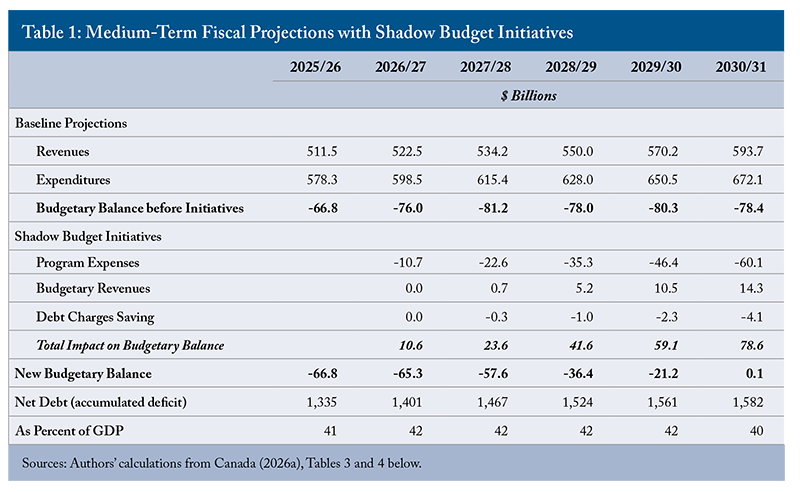
This Shadow Budget eliminates the projected budget deficit by 2030/31, halting the rise in the debt-to-GDP ratio, which holds steady at 42 percent and then diminishes to 40 percent by the end of the period. Debt charges would be more than $4 billion lower by 2030/31, with savings growing each year thereafter. Reversing the deterioration in the government’s net worth and curbing interest costs are necessary goals: continued borrowing erodes the government’s capacity to deliver services without raising taxes. Responsible fiscal policy means paying the bills for spending as they come due.
The fiscal plan puts the budget on a clear path to a small surplus by 2030/31. The debt-to-GDP ratio (accumulated deficit) stood at 31 percent before the COVID-19 pandemic – low enough to keep debt-servicing costs manageable and give the government flexibility to respond to a major health crisis. Despite significant reductions in non-defence spending, this fiscal plan reduces the debt ratio to only 40 percent through 2030/31. An appropriate longer-term goal would be to return the debt ratio closer to its pre-COVID level. Over time, small budget surpluses and economic growth would bring the ratio closer to a level consistent with fiscal stability and intergenerational fairness.
Resetting Expectations: Our Status Quo Outlook
The 2026 SEU provides the starting point for this Shadow Budget’s status quo projections in Table 1, adjusted to reflect the weaker growth outlook explained below. The SEU projected average annual deficits of about $59 billion between 2026/27 and 2030/31 and a federal debt-to-GDP ratio approaching 42 percent by the end of the projection horizon.
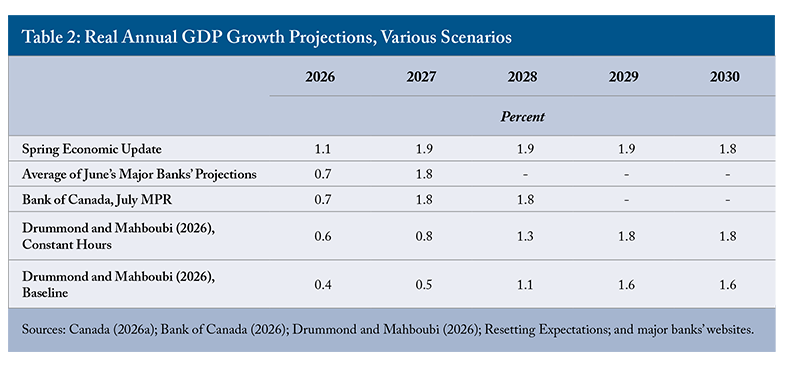
Since the SEU’s publication, stuttering growth figures and additional tariffs levied by the United States have led most forecasters to mark down significantly their forecasts for growth this year and next (Table 2).
Beyond these near-term developments, Canada’s medium-term outlook has deteriorated, posing further challenges for federal finances. The federal government’s sharp reduction in immigration targets, however desirable on its merits, means slower labour force growth and lower potential output than earlier fiscal projections assumed beyond the effects of cyclical economic weakness. At the same time, persistently weak productivity growth further reduces Canada’s economic potential. Together, these structural factors imply a materially lower path for economic growth than assumed in recent official projections, with important implications for federal and provincial finances.
Drummond and Mahboubi (2026) model long-term real GDP growth using updated demographic projections, assuming labour productivity and hours worked continue along their post-2000 trends. These supply-side constraints point to materially weaker real GDP growth than official projections suggest. Table 2 compares two scenarios with the SEU: a baseline in which hours worked per worker continue their long-term declining trend, and a slightly more optimistic scenario in which average hours worked per worker remain constant. The table also presents the June average of real GDP growth projections from Canada’s six major banks for this year and next, along with forecasts from the Bank of Canada’s July Monetary Policy Report.
The Drummond and Mahboubi (2026) projections are not forecasts in the conventional sense. Rather, they extrapolate supply-side factors using historical productivity growth and demographic projections. Actual outcomes could prove stronger. We adopt their constant-hours scenario as our status quo economic outlook, which allows for some improvement over their baseline assumption that hours worked will continue to decline. Productivity growth could pick up, or demand could outstrip supply. Other forecasters implicitly or explicitly rely on such improvements to support their more optimistic outlooks. But with global uncertainty high, the Canada-US trade relationship in doubt, and business investment depressed, counting on such gains seems unwise. Actual outcomes could just as easily fall below the Drummond and Mahboubi projections.
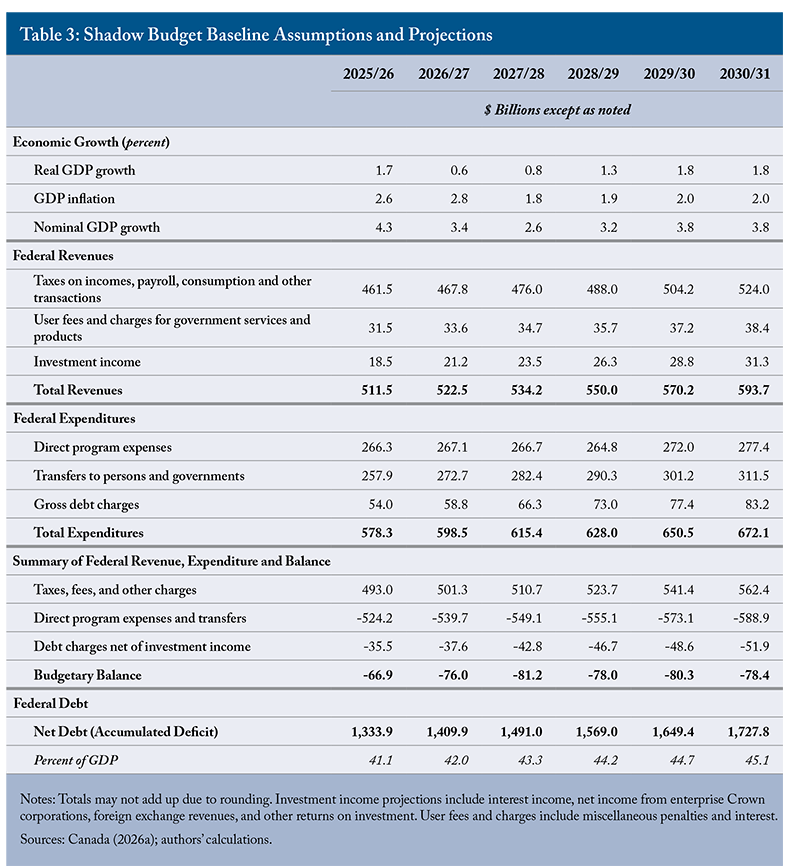
Growth in 2026 is lower than the SEU projects in all these scenarios. This weaker outlook requires us to adjust the SEU’s budgetary projections. Over the projection period, annual revenues average $7.8 billion less and expenses $3.6 billion more than the SEU projects. As a result, we project federal debt to be $57 billion higher by 2030/31 than under the SEU.
The risk of even weaker fiscal outcomes remains significant. Our baseline incorporates the revenue cost of the Productivity Mega Deduction (PMD) announced at the September 2026 Canada Investment Summit. However, it does not factor in the recent escalation in US tariffs or Canadian retaliation, which could further weaken economic activity and increase pressure for additional income support not matched by increased tariff revenues.
Importantly, our baseline includes what we infer to be the SEU’s projection for defence spending. Core defence spending currently sits at roughly 2 percent of GDP. Both the prime minister, in a speech, and the Department of Defence, in a statement to The Globe and Mail (2026), indicated that the SEU framework projects defence spending to reach around 2.5 percent of GDP by the end of the projection period. The lack of a separate line for defence spending in the SEU was a serious omission. Because the defence commitment involves major capital outlays, which typically take longer than planned, spending on an accrual basis will likely accelerate between 2031 and 2035, the second half of the North Atlantic Treaty Organization (NATO) commitment’s time horizon.22 The NATO commitment itself is tracked on a cash basis – meaning capital spending is recognized immediately – whereas the budget is presented on an accrual basis, which spreads that same spending over a longer depreciation period.
Further muddying the outlook is a series of announcements since the SEU that have yet to be incorporated into spending projections. These include national strategies related to artificial intelligence (AI) and electricity, the Food Security Strategy, the West Coast Oil Pipeline (now named Pacific Link), the Cooperative Prosperity Agreement with British Columbia, the recent federal housing commitment with Alberta, and an additional $5.4 billion for childcare over two years. Apart from the childcare commitment, it is unclear whether these initiatives involve new funding or draw on existing allocations, or what form they will take. Given this uncertainty, our baseline excludes these initiatives, other than childcare, except to the extent already captured in the SEU.
Table 3 presents our status quo budget projections, which adjust the SEU to reflect our weaker economic growth outlook. A key result is an increase in the debt-to-GDP ratio from 41 percent in 2025/26 to 45 percent in 2030/31, threatening the government’s ability to respond to future shocks. These projections serve as the baseline for the policy initiatives proposed in this Shadow Budget and the improved fiscal path they would produce.
Excessive spending underlies the poor fiscal results revealed in the SEU and its projections of more bad results to come. Even leaving aside the net actuarial losses on federal pensions and other unfunded future employee benefits, which the government has recently reported below a provisional deficit line, the SEU shows program expenses of $513 billion in 2025/26. That is up from $264 billion in 2015/16 – an annual growth rate of 7 percent. Add public debt charges and the actuarial losses, and federal spending grew from $295 billion to $578 billion over the decade – far outpacing growth in the Canadian economy, the tax base, and federal revenue.
The SEU did not project future spending growth that rapid, but even its comparatively modest 2.9 percent growth rate between 2025/26 and 2030/31 prefigured total spending of $667 billion in 2030/31. Despite the SEU’s robust revenue growth projection of 3.7 percent annually, it showed the 2030/31 bottom line was still badly in the red. While recipients appreciate federal transfer payments, available indicators of service provision, such as processing times for taxes, passports, and immigration, are unimpressive alongside such spending increases.33 See, for example, the Canada Revenue Agency’s average processing times relative to its service standards (https://www. canada.ca/en/revenue-agency/services/about-canada-revenue-agency-cra/service-standards-cra/service-standards-2023-24. html#ds2), and the passport and immigration problems that inspired the 2022 Task Force on Services to Canadians (https://www.canada.ca/en/employment-social-development/news/2022/08/members-of-the-task-force-on-services-to- canadians-ministers-ien-miller-gould-alghabra-and-fraser-provide-an-update-on-recent-work-to-improve-gover.html), which appears to have been an announcement with no follow through. What is more, as we elaborate below, the federal government has massively overshot its spending projections every year, casting doubt on the SEU’s projected spending growth, deficits, and debt.
A New Federal Fiscal Framework
Committing to Transparency and Timeliness
The SEU also highlighted federal shortcomings in fiscal transparency and accountability, particularly concerning when public trust in institutions is fragile. The government’s budget documents, public accounts, and Main Estimates should be clearer, more reliable, and timelier. The federal government once earned A-range grades in the C.D. Howe Institute’s annual fiscal accountability report card. Its grade plummeted to F in 2021 – reflecting its failure to produce a budget for the 2020/21 fiscal year, an unprecedented lapse compounded by a failure to produce a budget for the 2025/26 fiscal year44 The budget in the fall of 2025 was effectively a budget for the 2026/27 fiscal year, so there was no formal budget for the 2025/26 fiscal year, just as there was no formal budget for the 2020/21 fiscal year. – and has been in the D-to-C range since then. The 2026 Shadow Budget takes steps to give parliamentarians and Canadians timelier and better information about the government’s fiscal plans and results.
A cornerstone of this Shadow Budget’s new fiscal framework is a commitment to present each fiscal year’s budget before the end of the preceding calendar year. That timetable will give parliamentarians adequate time to review the budget before the fiscal year begins on April 1. It will also give provincial and territorial governments, and other transfer recipients, advance notice of changes that affect them.
The Shadow Budget also commits to tabling the Main Estimates alongside the budget where possible, and no later than January 31 of the following year. This would give parliamentarians sufficient time to scrutinize each item requiring approval within the broader fiscal plan. Accompanying timetables would make it a matter of public record whether the relevant committees formally considered the Estimates.
Future budgets, like this Shadow Budget, will present key figures for consolidated revenues, expenses, the surplus or deficit, and the resulting change in net debt within their first three substantive pages (excluding tables of contents and other navigational material). Recent budgets and fiscal updates, including the SEU, have buried these figures in annexes hundreds of pages into the document, where only experts know where to find them. Presenting these figures up front will make the fiscal plan easier for Canadians to find and understand.
A related and important recommendation concerns transparency around key spending parameters, particularly defence. The government should not cite differences between cash and accrual accounting or concerns about revealing information to potential bidders as reasons to withhold crucial budgetary information. The budget should report defence spending on both a cash and an accrual basis, allowing Parliament and the public to see clearly how committed funds are being allocated over time. While procurement confidentiality legitimately protects details of how and where funds will be spent, it does not justify obscuring the total amounts allocated. Disclosing overall spending commitments is a basic requirement of fiscal transparency. By contrast, specific projects and contracts need not, and cannot, be fully identified at this early stage, given how recently the government established its substantially higher spending targets. Disclosing the former does not compromise the latter.
The federal public accounts for the 2026/27 fiscal year will appear before the end of September 2027, and the public accounts for subsequent fiscal years will appear before the end of June, matching the timelines of the fastest-reporting provinces. Earlier publication will help parliamentarians and Canadians assess the government’s fiscal performance and propose action to correct any problems they find.
Budgets and public accounts, and other major federal fiscal publications such as the monthly Fiscal Monitor, will show all spending, including the amortization of pension costs, in a single consolidated expense line. They will also report debt charges before deducting investment income in pension accounts.
Ending Off-Cycle Mini-Budgets
The budget presented before the start of each fiscal year should be the foundation of a government’s fiscal plans. It is the subject of extensive consultations, gets formal scrutiny by Parliament – including votes of confidence – and is a key formal statement of the government’s fiscal plan.
Fiscal updates between budgets let the government brief members of Parliament and Canadians about the progress of its plans during the year, and any changes in circumstances that might affect the results. Lately, however, the fall fiscal updates, along with the 2026 SEU, have become budgets in all but name, with multiple initiatives on taxation and spending requiring legislation. This effective two-budgets-per-year cycle creates expectations and temptations that undermine consistent planning for the government and for Canadians alike (Robson, Busby, and Dahir 2024). Recent numbers speak plainly. Successive spring budgets and the 2026 SEU reveal a pattern of chronic fiscal drift. The 2022 Budget projected total spending of $504 billion for 2026/27. The Spring 2026 Update now projects $595 billion – $91 billion more in just four years. Each spring, projected federal spending rises substantially above the previous year’s forecast. Without hard targets, there is no credible path to lowering Canada’s debt ratio.
As part of the new federal fiscal framework, off-cycle updates would return to an informational format, reporting progress against the fiscal plan. They will contain no initiatives that change revenue in the upcoming fiscal year by more than 1 percent relative to budget projections. This change will mitigate temptations for populist gimmicks, improve the environment for consultations ahead of tax changes, and improve Parliament’s ability to understand and debate fiscal measures.55 The government of the United Kingdom has recently committed to a similar reform, motivated largely by the desirability of more stable tax policies (UK 2025).
The binding multiyear ceiling on program expenses described below will curtail spending of revenue windfalls and pre-election gimmicks. These constraints would not prevent the government from using a budgeted contingency reserve to respond to surprises, such as natural disasters or US trade hostility.66 The C.D. Howe Institute’s annual fiscal accountability report card (Robson and Dahir 2025) gives top marks to governments that include explicit contingency reserves in their budgets, as long as they do not exceed 5 percent of budgeted expenses, which provides ample room for responding to a crisis. But it would dampen the cycle of excitement and expectations that induces governments to shift priorities, ratchet spending up, and introduce late-year tax changes that create compliance and administrative burdens.
Setting a Multiyear Spending Ceiling
The past decade provides a fresh lesson about the temptations and costs of deficit spending. The new fiscal framework would reduce the tendency toward deficits and help Canadians hold the government accountable for fiscal sustainability, generational fairness, and economic stability (Lester and Laurin 2023). It would feature a legislated multiyear ceiling on non-cyclical expenses – spending that does not depend on economic conditions, such as compensation of federal employees, defence, amortization of capital, and government transfers for health, education, and childcare. The ceiling would exclude cyclical expenses such as Employment Insurance (EI) benefits and extraordinary income support during economic crises.
Several OECD countries use legislated multiyear spending ceilings or align them with fiscal targets. The Shadow Budget adopts a similar approach: a five-year binding ceiling, with exceptions for major disasters such as wars, and detailed spending plans introduced in the first year of each new government (Lester and Laurin 2025). Over time, the ceiling would strengthen fiscal discipline and make outcomes more predictable.
Reducing the Burden of Federal Taxes
The federal government’s tax take – federal revenues as a share of GDP – has increased markedly in the 2020s. It currently stands at 15.8 percent – well above the 14.2 percent average from 2008/09 to 2020/21. The SEU showed it rising further over the projection period, reaching 15.9 percent by 2030/31. Because reducing borrowing remains a priority, this Shadow Budget cannot commit to returning the ratio to its pre-2020 average. Instead, its near-term goal is to maintain revenues while reducing distortions caused by high and inconsistent tax rates.
Taxes that discourage work, saving, and reinvestment by individuals and businesses are a prime suspect in Canada’s decade-long stagnation in capital investment, productivity, and wages (Robson and Bafale 2025). Combined federal and provincial top marginal personal income tax rates are too high, while the income thresholds at which they apply are too low, especially compared with Canada’s principal competitor for talent, the United States (Mintz et al. 2026). Corporate taxes distort business and investment decisions through uneven treatment, encourage small firms to remain small, and have become internationally uncompetitive, particularly against the United States. Growing complexity and last-minute policy changes have also made tax administration and compliance harder and less predictable (Oakey 2024, 2025).
This Shadow Budget introduces an ambitious revenue-neutral tax reform – described in the next major section – to simplify the tax system and spur growth. It builds on, rather than replaces, the PMD announced at the September 2026 Canada Investment Summit.
Reviewing Federal Spending for Value
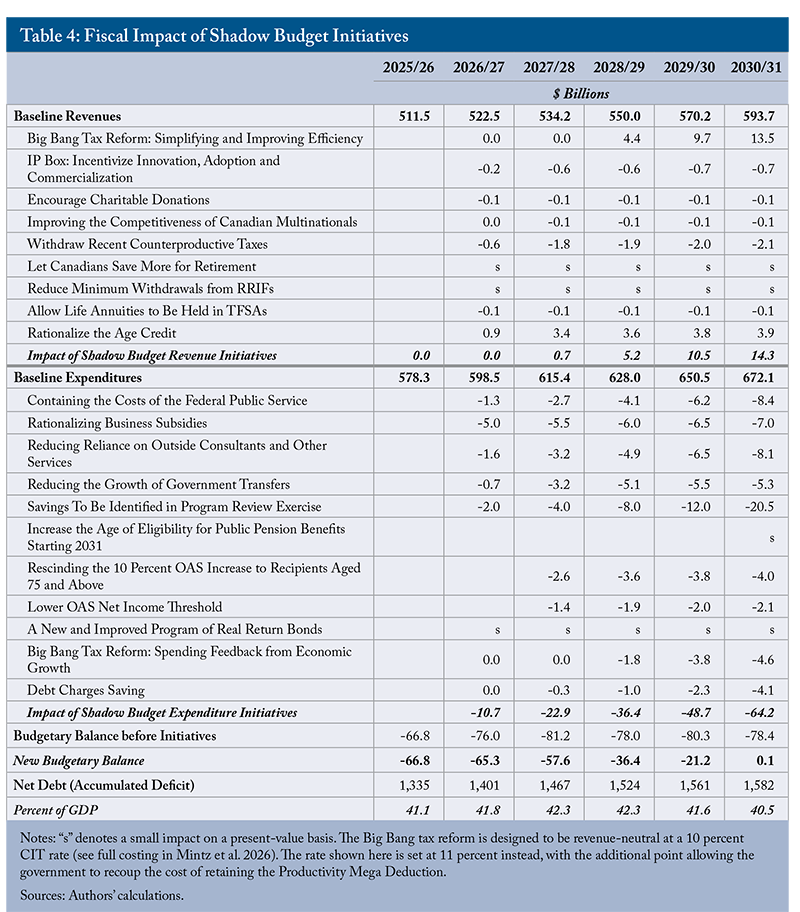
Federal government spending has outpaced Canada’s economic growth for years. This Shadow Budget proposes $42 billion in spending reductions to help return program spending to its average share of GDP from 2005/06 to 2019/20 by 2030/31. Achieving this goal while maintaining planned defence spending may require reallocating funds from non-defence programs, depending on how quickly the government reaches its core defence spending target of 3.5 percent of GDP by 2035 and how much the SEU already provides, anywhere from 2 to 2.5 percent of GDP.
The Shadow Budget contains specific measures that would reduce federal payroll costs, contracted services, and business subsidies, lowering non-defence spending by about $21.5 billion annually by 2030/31. The remaining $20.5 billion would come from a comprehensive program review to eliminate, redesign, or scale back programs that do not deliver sufficient value for taxpayers.
The federal government’s current approach to evaluating programs rarely tackles value for money directly. Reviews of business subsidies, labour-market programs, and climate change initiatives would use benefit-cost analysis where benefits and costs can be measured in dollars, including the economic cost of the taxes needed to fund them. Programs that fail to deliver value for money would be candidates for reform or elimination (Lester and Robidoux 2026).
Because the benefits of social programs are often hard to express in dollars, these reviews would use cost-effectiveness ratios to compare programs with similar objectives or target populations. Qualitative evidence, including beneficiaries’ characteristics and other available supports, would supplement these comparisons, helping policymakers weigh trade-offs between economic performance and fairness (Lester and Robidoux 2026).
Federal business subsidies rose 141 percent between 2014/15 and 2023/24, from $16.6 billion to $40.1 billion (Lester 2024). Subsequent program announcements have driven them higher yet. This Shadow Budget proposes to reduce federal business subsidies by roughly 10 percent, saving approximately $5 billion to $7 billion annually over the projection horizon. Rather than applying across-the-board cuts, it would target subsidies with the weakest economic justification, particularly those lacking evidence of correcting a genuine market failure. As the PMD offers a more economically neutral investment incentive with less political direction, the time is right to reduce selective business subsidies.
Restraining federal public service growth is central to controlling spending. Federal public service employment grew by 4 percent annually on average between 2014/15 and 2023/24. Budget 2025 expects the public service to decline from almost 368,000 in 2023/24 to roughly 330,000 by the end of 2028/29 as a result of attrition, voluntary departures, and other government actions to reduce spending. This Shadow Budget would go further by freezing departmental wage and salary budgets at 2025/26 levels for five years. Managers would retain the flexibility to reward high-performing employees while reducing lower-priority positions. This approach is conceptually similar to that proposed by Lahey (2011). The measure would save $1.3 billion in 2026/27 and $8.4 billion by the end of the projection period.
Federal spending on outside consultants and other contracted professional and special services has more than doubled since 2014/15, with most of that growth experienced post-pandemic. This Shadow Budget would gradually bring these expenditures back to their 2019/20 level, adjusted for inflation and population growth, generating annual savings of $1.6 billion in 2026/27 and $8.1 billion by the end of the projection period.
The overall limits on program spending in this Shadow Budget will ensure that reallocations within the limits finance any new expenses. It would neither expand federal dental care beyond its current targeted implementation nor broaden the scope of national Pharmacare.
The Shadow Budget also begins transitioning federal employees from defined-benefit pension plans, which place investment and actuarial risks on taxpayers, to jointly governed shared-risk plans. While this change would have no immediate fiscal impact, it would help reduce future actuarial losses, which have added substantially to federal debt over the past decade.
The program review would also examine tax expenditures, specifically those that function like subsidies or transfers but operate through the tax system, reducing reported revenues rather than appearing as spending. Because they are largely absent from budgets and public accounts, they receive less scrutiny than other expenses.77 Some tax provisions, such as deductions to avoid double taxation or avoid taxing income needed for non-discretionary expenses like life necessities – often termed “structural” measures (Canada 2026b) – modify the tax base to provide relief from tax that would be inefficient and unfair, and do not fit the definition of “tax expenditures.” Other tax credits and provisions that are intended to benefit specific categories of taxpayers or types of activity do fit the definition. Robson and Laurin (2017) calculated that showing them in spending would have raised reported federal expenses by about 6 percent. The GST/HST credit, now renamed the Canada Groceries and Essentials Benefit and shown in expenses, accounted for about one-quarter of that amount. This Shadow Budget would require certain tax expenditures to be reported more transparently and reviewed every three years to assess whether their objectives remain valid and whether they operate efficiently and fairly. Reforming or eliminating ineffective tax expenditures would create room for lower borrowing and future tax relief while improving the transparency and accountability of federal finances.
Policy Actions in the Shadow Budget
A “Big Bang” Tax Reform: Simpler, Fairer Taxes
Tax policy remains one of the government’s most impactful policy levers. Notwithstanding its size and scope, the PMD does not address deep flaws in federal taxation. Canada needs a structural overhaul of how individuals and businesses are taxed. Given this Shadow Budget’s commitment to reducing the deficit, any reform package must at minimum preserve current revenue levels in the near term. Over time, however, a more dynamic economy should generate additional revenues and further strengthen federal finances.
Canada depends on personal income tax more heavily than any other G7 economy. This imbalance discourages investment, risk-taking, and work incentives, pushes skilled workers to consider leaving Canada, and channels resources towards tax avoidance rather than genuinely productive activity. This Shadow Budget adopts most of the “big bang” reform package proposed by Mintz et al. (2026), which would overhaul all three major tax bases simultaneously, beginning in January 2028.
On personal income tax, the reform would reduce federal rates for taxpayers earning above $117,000 – a cohort responsible for roughly 55 percent of total personal income tax revenue – while reducing the number of tax brackets from five to three. The rate on the current third bracket would fall from 26 percent to 20.5 percent, matching the second bracket, while rates on the fourth and fifth brackets would fall from 29 and 33 percent, respectively, to 26 percent. Provided no province raises its top rate, the combined federal-provincial top marginal rate would fall below 50 percent in every province. A new simplified federal credit on $10,000 of income would supplement the existing basic personal amount to raise the effective tax-free threshold above $26,000 of income. Taxpayers choosing this credit would forgo most existing deductions and credits. A small set of exceptions would remain – for retirement saving, charitable giving, disability and caregiving costs, and expenses necessary to earn income – along with provisions such as the dividend tax credit and the partial capital gains inclusion rate that mitigate the double taxation of corporate profits (once at the corporate level and again at the shareholder level). Most filers, and lower earners in particular, would come out ahead by choosing this simplified route.
On the corporate side, the general federal rate would drop to 11 percent across the board, regardless of firm size or ownership, sweeping away the uneven set of preferences that currently distort how businesses make decisions. This rate cut would be paid for mainly by widening the base – scrapping the small business deduction and assorted narrow tax credits (Mintz et al. 2026). The Shadow Budget departs from Mintz et al. in one respect: it retains the PMD and offsets its revenue cost by setting the general corporate rate at 11 percent rather than the 10 percent they recommend.
Retaining the PMD is not an obvious choice. The deduction does lower the user cost of capital for eligible assets and strengthens investment incentives for such assets. But it favours assets eligible for immediate write-offs, such as machinery and equipment, over structures and selected intangibles excluded from it.88 Although the PMD lowers marginal effective tax rates on investment overall, it increases the gap between those rates on favoured versus non-favoured sectors – unhelpful to productivity and growth in GDP. We do not expand its scope, however, because immediate expensing creates its own problems. Coupled with interest deductibility on debt used to fund capital expenditures, writing off eligible investments immediately can drive marginal effective tax rates below zero, distorting investment choices. Many corporations may accumulate tax losses to carry forward, likely to spur more tax planning arrangements to transfer those losses to affiliated corporations, making revenues less predictable. We keep the PMD because firms have already made investment commitments based on it, and withdrawing it now would disrupt those plans.
A lower corporate rate for firms that do not currently benefit from the small business deduction should encourage new investment and stronger wage growth across the economy, while eliminating preferential treatment would reduce compliance and administrative costs. Removing the small business deduction would also remove an existing incentive for small firms to remain small. It would also dramatically simplify the Income Tax Act by making it possible to eliminate the need to distinguish between eligible and ineligible dividends, general-rate and low-rate income pools, and different types of refundable tax accounts.
To make up for the revenue given up on the income tax side, the plan leans on less economically damaging revenue sources instead. Raising the GST by 3 percentage points would cover the shortfall. Consumption taxes are often unpopular, but they generally cause less economic harm than income taxes. The impact of the higher GST on prices generally would be partially offset for recipients of government benefits that are indexed to the consumer price index, and the simplified credit would cushion most of the burden that would otherwise fall on lower-income Canadians (Mintz et al. 2026).
Mintz et al. (2026) estimate substantial long-run gains from these changes: higher investment lifting GDP by approximately 2.5 percent – growth that would in turn bolster tax revenues over time. We assume the reform will gradually strengthen economic growth, raising nominal GDP above the status quo by 2030, and improving the fiscal balance, mainly through higher revenues.
To encourage the creation and commercialization of intellectual property, this Shadow Budget will create an “IP Box,” lowering the corporate income tax rate on income from patents and other intellectual property generated by activity in Canada (Lester 2022). The measure would take effect in 2027.
Canada can also improve the international competitiveness of its large multinational enterprises. The global minimum tax regime (known as the Pillar Two Inclusive Framework) leaves Canadian multinationals at a potential competitive disadvantage relative to their US counterparts. Turner (2026) recommends that Canada adopt a full exemption system for foreign affiliate income, as the 2008 Advisory Panel on Canada’s System of International Taxation proposed. This would eliminate costly surplus tracking and reduce compliance burdens. The revenue loss would be small because foreign affiliate income generates little tax revenue, while Pillar Two and interest-deductibility rules limit risks of tax-base erosion. The reform would make Canada a more competitive home for multinational enterprises.
Eliminating Inefficient and Unfair Taxes
Taxes cause the least economic damage when they apply broadly and treat comparable individuals, businesses, and activities equally and fairly. Economically unjustified and inequitable tax treatment causes further harm, undermines confidence in the tax system, and encourages lobbying for special treatment.
This Shadow Budget would eliminate or phase out several recent tax measures:
- Following Budget 2025’s repeal of the luxury tax on aircraft and vessels, it would also repeal the luxury tax on vehicles.
- It would repeal the additional 1.5 percentage point income tax on banks and life insurers and reinstate the intercorporate dividend deduction for financial institutions on Canadian shares held as mark-to-market property, avoiding double or multiple taxation of the same income.
- It would repeal the tax on share buybacks.
- It would phase out the tax credit for first-time homebuyers and the First Home Savings Account. Both measures stoke demand and contribute to high prices for housing. The second violates basic tax principles by providing deductions on contributions yet allowing tax-free withdrawals.
- It would eliminate the application of alternative minimum tax to charitable donations.
To encourage charitable donations, this Shadow Budget would extend capital gains tax relief to more donations of proceeds from the sale of private company shares and real estate (Aptowitzer 2017).
Limits on tax-deferred saving in Canada put savers in defined-contribution pension plans and Registered Retirement Savings Plans (RRSPs) at a disadvantage relative to participants in defined-benefit plans (Robson 2017). This Shadow Budget would raise the limit for contributions to the former plans by three percentage points of income per year – from the current 18 percent to 30 percent of earned income – over four years. This Shadow Budget also proposes to relieve pressure on people to liquidate those savings too early. It proposes an immediate one-percentage-point reduction of minimum withdrawals from Registered Retirement Income Funds (RRIFs) mandated for each age, beginning with the 2027 taxation year.
As Tax-Free Savings Accounts (TFSAs) become increasingly important for retirement savings, Canadians should have access to investment options comparable to those available through RRSPs and other savings vehicles. This Shadow Budget would increase flexibility by allowing life annuities to be held within TFSAs (Laurin 2019).
Reviving and Improving Real Return Bonds
In 2022, the federal government stopped issuing Real Return Bonds (RRBs) – bonds indexed to inflation. It is time to reverse this decision and reintroduce RRBs with improvements. Because their principal rises with the consumer price index, RRBs protect their holders from inflation. For the government, issuing RRBs can be cost-effective, if – as is normally the case – investors accept lower yields in exchange for inflation protection. Since issuing RRBs signals the government’s commitment to its inflation target, it can reduce yields on the government’s regular bonds as well.
The government justified cancelling RRBs with reference to low demand, but the government’s management of the program undermined demand. It only issued 30-year bonds, and in small amounts, meaning institutional investors such as pension funds and insurance companies bought and held nearly all the bonds issued, making for an illiquid market. A C.D. Howe Institute survey of major institutional investors, managing over $2.4 trillion in assets, showed strong opposition to the cancellation and support for an expanded RRB program (Robson and Laurin 2024).
Globally, inflation-linked bonds are widely used. Countries such as the UK, Sweden, France, Italy, and the US have issued proportionally more inflation-linked debt, fostering liquid markets and strong demand. The fresh threat of price increases because of tariffs will make inflation protection all the more valuable to savers.
This Shadow Budget proposes a new RRB program. The government would resume issuing 30-year bonds and introduce 10-year RRBs, initially targeting $1 billion of each per quarter. It will also change its auction approach – using multiple-price auctions, as with other bonds, rather than single-price auctions – to improve liquidity in the RRB market.
Over time, a larger float of RRBs would benefit savers, strengthen financial markets, and reaffirm Canada’s commitment to low and stable inflation. A more liquid market would also raise the price and lower the yields of RRBs, helping contain federal debt-servicing costs.
Further Reducing Program Spending
In addition to savings from the program review described above, this Shadow Budget proposes specific spending cuts to eliminate the structural deficit and prepare for higher defence spending, most of which is expected between 2031 and 2035.
This Shadow Budget would phase in increases to the normal age of eligibility for Old Age Security (OAS), which would rise in monthly increments from 65 at the beginning of 2031 to 67 in 2054. The existing actuarial increase for deferring benefits would apply from the new eligibility ages, and a new actuarial reduction would be introduced for early take-up, ensuring that people who cannot work past age 65 could still collect reduced benefits from that age or earlier, while further encouraging later receipt by people willing and able to work and save for longer.
Seniors have the lowest poverty rate of any age group in Canada, making preferential tax treatment based on age increasingly difficult to justify. The Shadow Budget would reduce the base amount of the age credit from $9,028 to $4,000.
The Shadow Budget would also reverse the 10 percent increase in OAS payments to recipients aged 75 and older, saving $4 billion by 2030/31. This reflects the view that scarce tax dollars should not disproportionately benefit an age group with a lower incidence of low income than many others. In addition, it would lower the net income threshold at which OAS payments start to be reduced for higher-income seniors, effective July 2027, from $95,323 to $75,323. The new threshold would continue to rise annually with inflation, and OAS would continue to be clawed back at a rate of 15 percent. A 65-year-old eligible for full OAS would therefore lose the entire amount at around $135,000 of net income, instead of the current $155,000. Few seniors earn income above this level, and many of those who do are defined-benefit pensioners from government plans who are unlikely to depend on OAS to maintain their pre-retirement standard of living. This measure is expected to save $2.1 billion by 2030/31, net of lower tax revenues.
This Shadow Budget also proposes reducing federal transfers to provinces and territories below SEU projections. The federal government’s fiscal position deteriorated during the pandemic, while increased transfers supported provincial and territorial revenues, leaving them in relatively stronger fiscal positions. Moreover, these transfers often blur accountability by allowing subnational governments to receive credit for spending while the federal government raises the revenue. Federal funding frequently comes with conditions that conflict with provincial constitutional responsibilities, particularly in areas such as healthcare. The Equalization program has also become more complex and costly.
This Shadow Budget would reduce the escalator in the Canada Health Transfer by half for the 2027/28 and 2028/29 fiscal years. It would freeze the Canada Social Transfer at its 2026/27 level for those same two years. Both transfers would recommence escalating at their planned rates in 2029/30 and beyond. This Shadow Budget would also eliminate the floor in the federal equalization program that increases transfers beyond the levels calculated by the equalization formula (Lévesque 2024), which is expected to reduce payments by $1 billion in 2027/28 and gradually increasing amounts thereafter. It will freeze federal transfers for childcare at their 2025/26 levels, while leaving in place the temporary two-year top-up recently announced. These changes will reduce federal outlays by $5.3 billion annually by 2030/31.
Conclusion
The federal government’s 2025 Budget and this year’s SEU prefigured further deterioration in Canada’s public finances, with rising debt, interest costs and, ultimately, taxes. This Shadow Budget puts federal finances back on a sustainable path by 2030.
But reversing the fiscal excesses since 2019 will require further action. First, if the NATO spending commitment holds, defence spending must rise to 5 percent of GDP by 2035, with 3.5 of that being “core” defence spending. As discussed above, there is confusion as to whether the government’s current fiscal framework takes defence spending to 2 or 2.5 percent of GDP by 2030. The additional annual spending could be anywhere from $45 to $67 billion by 2035. That should be financed through reallocations within spending rather than elevating an already high tax burden or borrowing and returning to deficits.
The second remaining challenge is the high tax burden. Although this Shadow Budget introduces pro-growth tax reforms, it does not reduce the federal government’s overall tax take because of the revenues needed to return to budget balance. A payoff from the spending restraint in the 1995 Budget with its Program Review was decades of a lower tax burden. Post-2030, there should be a concerted effort to ensure the spending restraint proposed in this Shadow Budget also results in a lower tax burden.
This Shadow Budget sets the stage for those future moves by responding to Canada’s long-standing challenges, enhancing productivity and boosting growth, and reducing the federal spending and borrowing that is squeezing other sectors of the economy. It responds to the imperatives of fiscal discipline and economic growth and puts the federal government on a path to balance and a lower debt-to-GDP ratio. It sets new standards for transparency and timeliness in federal fiscal policy, increases defence spending, reins in growth in other program spending and tax expenditures, eliminates harmful and arbitrary taxes, and initiates reductions in personal and corporate income taxes while preserving the new PMD. Together, these measures mark a significant and timely change in direction and lay the foundation for renewed productivity growth, greater competitiveness and higher living standards, while strengthening Canada’s resilience to developments in the United States.
References
Aptowitzer, Adam. 2017. “No Need to Reinvent the Wheel: Promoting Donations of Private Company Shares and Real Estate.” E-Brief 265. Toronto: C.D. Howe Institute. September. https://cdhowe.org/publication/no-need-to-reinvent-the-wheel-promoting-donations-of-private-company-shares-and-real-estate/.
Bank of Canada. 2026. Monetary Policy Report – July 2026. Ottawa: Bank of Canada. July 15.
Busby, Colin, and Nicholas Dahir. 2026. A Steep Climb: Financing Canada’s NATO Commitment while Maintaining Fiscal Discipline. Commentary 711. Toronto: C.D. Howe Institute. https://cdhowe.org/publication/a-steep-climb-financing-canadas-nato-commitment-while-maintaining-fiscal-discipline/.
Canada. 2026a. Spring Economic Update. Ottawa: Department of Finance Canada.
______. 2026b. Report on Federal Tax Expenditures: Concepts, Estimates and Evaluations. Ottawa: Department of Finance Canada. February 26.
C.D. Howe Institute. 2026. “Canada Ranks Near Bottom of OECD and G7 for Income Growth.” Graphic Intelligence. Toronto: C.D. Howe Institute. June 22. https://cdhowe.org/publication/canada-ranks-near-bottom-of-oecd-and-g7-for-income-growth/.
Drummond, Don, and Parisa Mahboubi. 2026. “Resetting Expectations: Canada’s Economy in a Lower-Immigration Era.” E-Brief 383. Toronto: C.D. Howe Institute. May. https://cdhowe.org/publication/resetting-expectations-canadas-economy-in-a-lower-immigration-era/.
The Globe and Mail. 2026. “The Hunt for a Liberal Defence Plan.” Editorial. The Globe and Mail.
August 23.
Lahey, James. 2011. “Controlling Federal Compensation Costs: Towards a Fairer and More Sustainable System.” In How Ottawa Spends, 2011–2012, edited by Christopher Stoney and G. Bruce Doern, pp. 84–105. Montreal and Kingston, ON: McGill-Queen’s University Press.
Laurin, Alexandre. 2019. “TFSAs: Time for a Tune-Up.” E-Brief 298. Toronto: C.D. Howe Institute. December. https://cdhowe.org/publication/tfsas-time-tune/.
Lester, John. 2022. “An Intellectual Property Box for Canada – Why and How?” E-Brief 326. Toronto: C.D. Howe Institute. April. https://cdhowe.org/publication/intellectual-property-box-canada-why-and-how-0/.
_________. 2024. “Federal Business Subsidies: Explosive Growth since 2014.” The School of Public Policy Publications 17(3). University of Calgary.
Lester, John, and Alexandre Laurin. 2023. “Ottawa Needs a New Approach to Fiscal Policy.” E-Brief 338. Toronto: C.D. Howe Institute. March. https://cdhowe.org/publication/ottawa-needs-new-approach-fiscal-policy/.
Lester, John, and Alexandre Laurin. 2025. Canada’s Debt Problem: What Can Be Done? A Report on the Institute’s 2024 Debt Conference. Commentary 675. Toronto: C.D. Howe Institute. January. https://cdhowe.org/publication/canadas-debt-problem-what-can-be-done-a-report-on-the-institutes-2024-debt-conference/.
Lester, John, and Benoit Robidoux. 2026. Putting Programs to the Test: Strengthening the Federal Evaluation Function. Conference Report. Toronto: C.D. Howe Institute. August 6. https://cdhowe.org/publication/putting-programs-to-the-test-strengthening-the-federal-evaluation-function/.
Lévesque, Louis. 2024. “Not All Quiet on the Equalization Front in Canada.” Johnson Shoyama Graduate School of Public Policy. November.
Mintz, Jack, Alexandre Laurin, and Nicholas Dahir. 2026. Big Bang Tax Reform: Unleashing Growth in the Canadian Economy. Commentary 707. Toronto: C.D. Howe Institute. March. https://cdhowe.org/publication/big-bang-tax-reform-unleashing-growth-in-the-canadian-economy/.
Oakey, John. 2024. “Canadians Pay the Price of a Baroque Tax System.” The Globe and Mail. May 12. https://www.theglobeandmail.com/business/commentary/article-canadians-pay-the-price-of-a-baroque-tax-system/.
__________. 2025. “Post-Election: The Tax Policy Road Ahead.” Intelligence Memo. Toronto: C.D. Howe Institute. May 27. https://cdhowe.org/publication/post-election-the-tax-policy-road-ahead/.
Robson, William B.P. 2017. Rethinking Limits on Tax-Deferred Retirement Savings in Canada. Commentary 495. Toronto: C.D. Howe Institute. November. https://cdhowe.org/publication/rethinking-limits-tax-deferred-retirement-savings-canada/.
Robson, William B.P., and Mawakina Bafale. 2025. Canada’s Investment Crisis: Shrinking Capital Undermines Competitiveness and Wages. Commentary 699. Toronto: C.D. Howe Institute. December. https://cdhowe.org/publication/canadas-investment-crisis-shrinking-capital-undermines-competitiveness-and-wages/.
Robson, William B.P., Colin Busby, and Nicholas Dahir. 2024. “It’s Time to End the Circus of Fall Economic Statements.” Intelligence Memo. Toronto: C.D. Howe Institute. December 23. https://cdhowe.org/publication/william-robson-colin-busby-nick-dahir-its-time-to-end-the-circus-of-fall-economic-statements/.
Robson, William B.P., and Nicholas Dahir. 2025. Making the Grade: The Fiscal Accountability Report Card for Canada’s Senior Governments, 2025. Commentary 695. Toronto: C.D. Howe Institute. October. https://cdhowe.org/publication/making-the-grade-the-fiscal-accountability-report-card-for-canadas-senior-governments-2025/.
Robson, William B.P., and Don Drummond. 2024. “Junk Fiscal Policy Can Cost More than Mere Billions.” Intelligence Memo. Toronto: C.D. Howe Institute. December 5. https://cdhowe.org/publication/robson-drummond-junk-fiscal-policy-can-cost-more-mere-billions/.
Robson, William B.P., and Alexandre Laurin. 2017. Hidden Spending: The Fiscal Impact of Federal Tax Concessions. Commentary 469. Toronto: C.D. Howe Institute. February. https://cdhowe.org/publication/hidden-spending-fiscal-impact-federal-tax-concessions/.
______________. 2024. “Cancel the RRB Cancellation.” E-Brief. Toronto: C.D. Howe Institute. August. https://cdhowe.org/publication/cancel-rrb-cancellation/.
Schwanen, Daniel, Jeremy Kronick, and Farah Omran. 2019. “Growth Surge: How Private Equity Can Scale Up Firms and the Economy.” E-Brief. Toronto: C.D. Howe Institute. May. https://cdhowe.org/publication/growth-surge-how-private-equity-can-scale-firms-and-economy/.
Turner, Geoffrey S. 2026. Uneven Playing Field: The Global Minimum Tax and Canadian Competitiveness. Commentary 729. Toronto: C.D. Howe Institute. September. https://cdhowe.org/publication/uneven-playing-field-the-global-minimum-tax-and-canadian-competitiveness/.
United Kingdom, Treasury (UK). 2025. “Tax Policy Making Principles.” https://www.gov.uk/government/publications/tax-policy-making-principles/tax-policy-making-principles.